
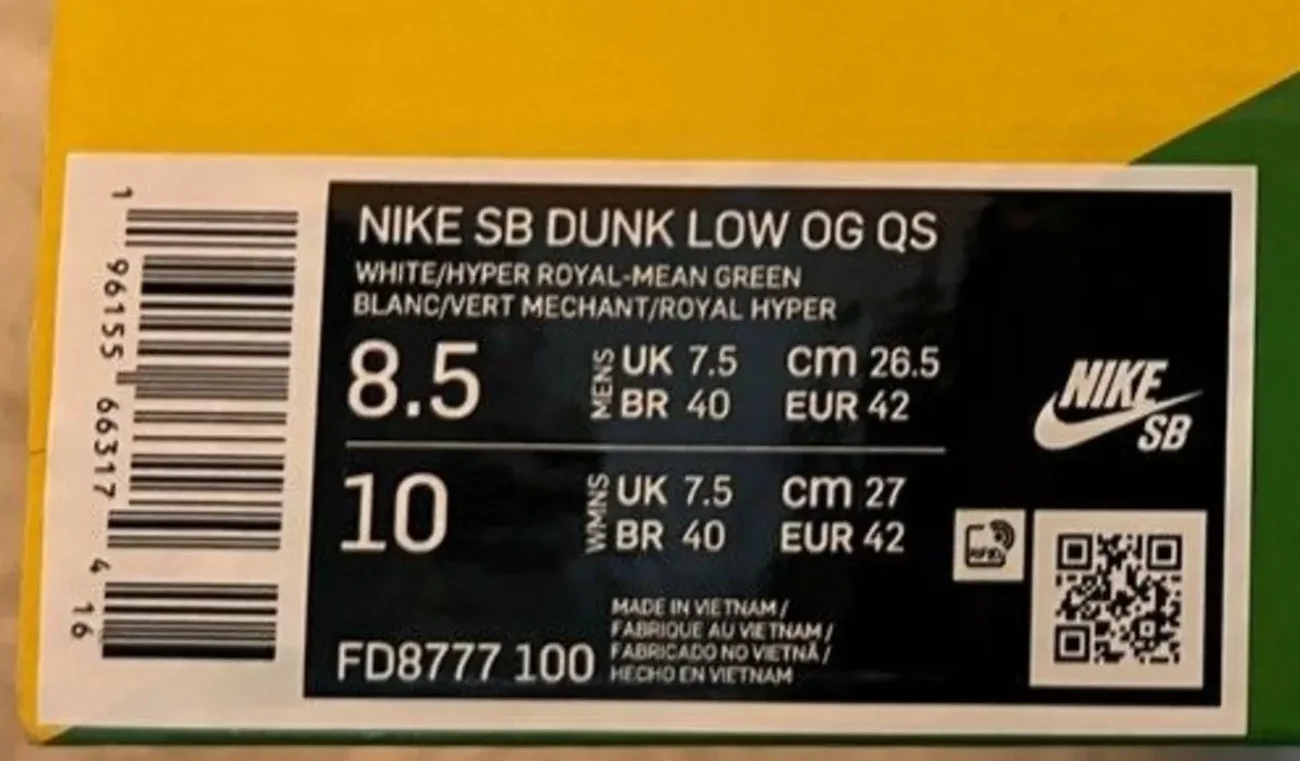
QS stands for Quick Strike, also written Quickstrike. Nike uses the designation on certain releases, but the letters do not reveal production quantities or guarantee a surprise launch, a sellout, or higher resale value.
The historical connection to selective distribution explains the QS reputation. Even so, each product has its own release details: the Parris Goebel Dunk was announced in advance, while other projects reach buyers through SNKRS or skate shops.
What does Nike QS mean?
QS stands for Quick Strike. In some records and in the historical vocabulary of sneaker culture, you will also find it written as one word: Quickstrike.
The clearest evidence comes from the brand itself. In 2023, NIKE, Inc. officially introduced the Nike Dunk Low Parris Goebel Quick Strike. In this case, there is no need to interpret an abbreviation or rely on a forum definition: Nike spelled out Quick Strike in the product name.
QS relates to a release’s naming and context. It is not a technology like Nike Air, does not identify the cushioning system, and does not determine a shoe’s materials, comfort, durability, or fit.
- QS does not mean Quick Release.
- QS does not mean Quality Standard.
- QS is not a quality rating.
- QS does not reveal how many pairs were made.
Where did the idea that Quickstrikes are rare and arrive without warning come from?
That association did not come out of nowhere. Historically, many Quickstrikes involved more selective distribution and less advance notice than standard catalog releases.
A historical Complex glossary records that Quickstrike and QS began appearing on boxes in the early 2000s. It describes what the term meant in that setting: fast releases with little publicity and restricted availability.
That history helps explain why QS carries so much weight in sneakerhead vocabulary. Before today’s constant flow of release calendars, apps, launch pages, and nearly instantaneous leaks, finding out that a particular store would receive a special pair could be a very different experience.
The mistake is turning a historical characteristic into a permanent rule. Nike’s own documented practices show that modern QS usage is more varied.
Does QS mean a surprise release?
Not necessarily. This may be the easiest myth to test.
On October 16, 2023, NIKE, Inc. published its announcement for the Nike Dunk Low Parris Goebel Quick Strike and said the shoe would be available on October 24 at Nike.com and select retailers.
In other words, Nike itself called the product a Quick Strike while publicly announcing its release date eight days ahead of time. That does not mean every QS gets eight days’ notice. It establishes something more important: a QS does not have to arrive unannounced.
Is Quick Strike the same as a shock drop?
No. The terms describe different things.
Shock drop describes an unexpected release or one made available outside the usual release schedule. QS, meanwhile, appears as part of the naming of certain Nike products and releases.
A QS may sometimes go on sale unexpectedly, but that does not make Quick Strike and shock drop interchangeable. For more release terminology, see what a drop means in sneaker culture.
Does every QS have a small production run?
QS is not an inventory counter.
The abbreviation alone does not tell you whether 500, 5,000, or 50,000 pairs were made. It also does not say how many went to each country, how many stores received the product, or how large the total production run was.
This distinction may seem minor, but it clears up a common misunderstanding: an undisclosed quantity is not the same as a small quantity.
When reliable documentation exists for a specific release’s production run, its quantity can be discussed. Without that, saying “QS quantities are controlled” as though there were a standardized numerical cap creates a level of precision the abbreviation does not provide.
Quick Strike examples across different channels
Nike Air Max 95 QS YGO “Joey”
The Yu-Gi-Oh!-inspired Air Max shows another aspect of the code. Its official Nike SNKRS page identifies the shoe as the Nike Air Max 95 QS YGO “Joey”, SKU II7404-400, and describes it as a limited edition.
The accurate conclusion is specific: this QS is officially a limited edition. That does not establish that every QS is a limited edition.
Nike Air Force 1 Low Retro QS
The Air Force 1 is useful precisely because it challenges the image of a QS as impossible to find. In Nike product documentation, the name Air Force 1 Low Retro QS appears on releases that reached the brand’s regular retail channels.
There is another important detail in the name itself: Retro QS. A sneaker can be a retro and a QS at the same time. QS therefore does not necessarily mean the first release of a colorway or a promise that a particular concept will never return.
Nike SB Dunk QS: Futura, April, and skate shops
Nike SB is an especially interesting place to examine QS usage. For the Futura Laboratories SB Dunk Low, Nike’s official system uses the technical name SB DUNK LOW OG QS FU, linked to SKU HF6061-400.
The collaboration with April Skateboards similarly appears as SB DUNK LOW PRO QS APR, SKU FD2562-400.
These examples help explain why skate shops appear so often in Nike SB’s QS stories. Certain releases do reach buyers through specialist shops, raffles, and skate-related channels. But that remains a feature of the individual release and its distribution, rather than a rule that “QS is only sold at skate shops.”
Does QS mean premium materials or better quality?
No. QS does not specify leather, suede, cushioning, fit, or durability. An SB Dunk, an Air Force 1, and an Air Max 95 still have different constructions, even when they share the designation. Compare the specifications and intended use of each version.
What is the difference between QS and General Release?
GR, or General Release, is a widely used sneaker-culture term for releases with broader distribution.
Historically, Quickstrike was associated with less widely available releases or more selective distribution channels than conventional products. That comparison is useful when treated as distribution context.
What does not work is turning it into:
- QS = a better shoe;
- GR = an inferior shoe;
- QS = always rare;
- GR = unlimited production.
These descriptions concern a product’s release and circulation, rather than its quality.
Is QS less exclusive than SP?
There is not enough evidence to treat QS and SP as two fixed steps in a universal Nike hierarchy.
SP appears elsewhere in Nike’s product naming and is usually expanded as Special Project. QS means Quick Strike. Both codes can accompany very different products, and neither is a zero-to-ten rating of “exclusivity.”
Statements such as “SP is always above QS” therefore create a more rigid classification than the documentation supports. See the separate explanation of what Nike SP means, but avoid using the two abbreviations as an automatic rarity ranking.
Are QS and Hyperstrike part of an official hierarchy?
Sneaker culture has historically used Hyperstrike to describe extremely restricted releases, often even harder to obtain than Quickstrikes.
That historical interpretation is well documented in specialist media. The important caution is not to turn it into a universal Nike corporate chart without primary documentation establishing a fixed sequence.
It is also inaccurate to automatically merge Hyperstrike, Tier 0, and Friends & Family. These concepts may have overlapped in particular release histories, but they are not necessarily three interchangeable names.
For a closer look at that designation, see what Nike HS/Hyperstrike means.
What is the difference between QS and DS?
Comparing QS and DS is a different matter because they do not even answer the same question.
QS relates to a product’s naming and release. DS, or Deadstock in sneaker vocabulary, describes the condition of an individual pair.
The same sneaker can therefore be QS and DS at the same time: QS because of its release designation, and DS because that particular pair remains in the condition described by the term.
See the separate guide to what DS means for sneakers.
Does QS automatically raise resale prices?
No. Using QS to predict appreciation is an especially risky oversimplification.
The secondary market responds to the specific product: demand, available sizes, history, collaborations, colorway, region, condition, supply, the cultural moment, and dozens of other factors can play a role.
A QS can sell above retail. It can also stay close to retail, sell below it, remain available at the official store, or go on sale.
A release’s sales history is more useful than the abbreviation when assessing price. QS does not reliably predict a profit or how long appreciation might take.
Can a QS be a retro or get a restock?
The designation appears on products named Retro QS, so it is not limited to a silhouette’s first release. It also does not promise that a product will never come back in stock. Restocks depend on the brand and retailers; check the release announcement.
How do you correctly identify a Nike QS?
Rather than look for a supposed secret formula on the box, start with the release documentation.
- Find the official product name. Check whether QS or Quick Strike appears in Nike’s identification of the shoe.
- Confirm the style code/SKU. It helps distinguish similar colorways and releases.
- Search Nike.com or SNKRS. Official pages provide stronger evidence than marketplace nicknames.
- Consult official archives or NIKE, Inc. communications. This is especially helpful for older products or names written out in full.
- For historical releases, cross-reference reliable specialist sources. Terminology and distribution have changed over time.
Do not try to identify a QS by counting the digits in its SKU. There is also no reason to assume every QS comes with a standardized special sticker on the box.
Does QS always appear on the box or tag?
Do not treat that as a universal requirement.
The abbreviation may appear in technical naming, catalogs, launch pages, product records, and tags associated with particular releases. Historically, its appearance on boxes also helped QS enter collectors’ vocabulary.
But there is no universal public checklist stating that every Quick Strike must have a special QS sticker, a unique tag, or a standardized change to the SKU format.
Does QS on the box prove the shoe is authentic?
No. Identifying a release and authenticating an individual pair are two different tasks.
A counterfeit can reproduce QS, a style code, a box, tags, stickers, and the colorway of a real product. Confirming that a code officially exists helps establish which shoe should be in front of you; it does not prove that the particular pair came from an authorized factory.
If authenticity is the question, the process needs to consider the physical product and its details. See our sneaker legit check guide.
My experience with the Nike SB Dunk Low Sean Cliver
There is a personal reason QS is more than an abstract abbreviation to me. I own a Nike SB Dunk Low Sean Cliver, and the story of how I got the pair is still one of my favorite sneaker memories.
A skate shop held an Instagram raffle to decide who would get a chance to buy it. I entered, and my name was drawn. It was the first time I had won anything that way, so the shoe became connected to that memory as well as to the product itself.
The Sean Cliver appears in official product records as the Nike SB Dunk Low Pro QS. The abbreviation identifies the release; the shop’s raffle was how I got access to that purchase.
There is an important distinction, though: the raffle is not what makes the Sean Cliver a QS. The drawing was the method used for that buying opportunity. A sneaker can be sold through a raffle without being a QS, and a QS can be sold without a raffle.
To keep decoding the language that grew alongside sneaker culture, consult the Sneakerhead Dictionary and explore more stories in History and Culture.