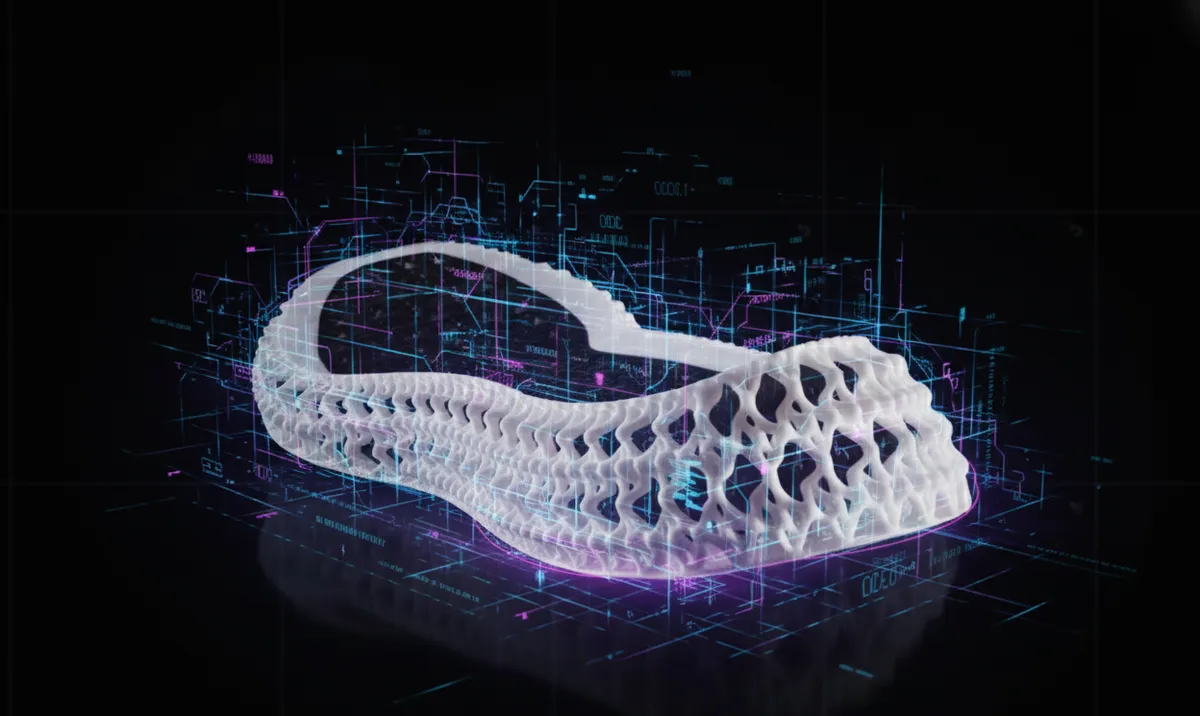
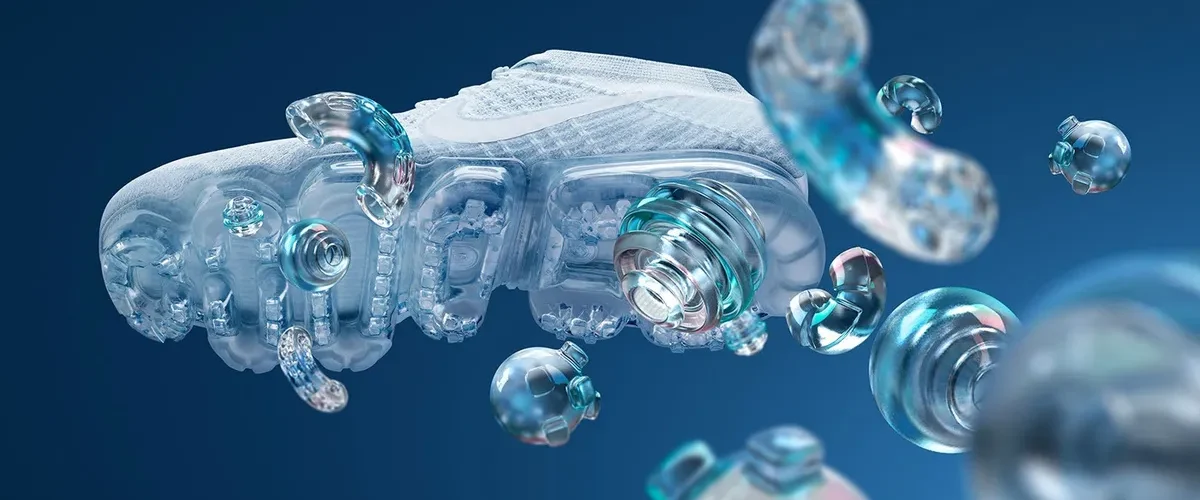
Nike Air is Nike’s cushioning platform built around sealed, flexible, pressurized units integrated into footwear. Rather than relying on midsole foam alone, certain models use an Air unit that deforms under load and recovers its shape as the load decreases. The concept made its commercial debut in the Nike Tailwind in the late 1970s and has since evolved into systems such as Max Air, Zoom Air, Tuned Air, VaporMax, and Dynamic Air.
That also means Nike Air is not one “bubble” used the same way in every shoe. Nike makes units in different sizes, shapes, pressures, positions, and geometries. In some models, Air is hidden inside the midsole; in others, it becomes a visible part of the design.
Pressure, volume, placement, and internal structure change how an Air unit responds. The underfoot feel also depends on the shoe’s foam, outsole, and fit.
What is Nike Air technology?
Nike Air is a family of cushioning systems based on flexible units filled with pressurized gas. These units may be small and encapsulated, occupy only the heel or forefoot, form high-volume structures, or extend along much of the shoe’s length.
Nike describes Air as one of its most versatile cushioning platforms and says it produces units in a wide variety of shapes, volumes, and pressures. See the company’s explanation in Nike’s Proprietary Air Drives the Future of Performance.
The word “Air” might suggest a simple bag filled with ordinary air, but the history is more complex: materials, gases, membranes, internal structures, and manufacturing processes have changed considerably since Frank Rudy’s early experiments.
How does Nike Air work?
The basic principle is mechanical. The unit remains sealed and pressurized inside the shoe. When the foot applies a load, its structure deforms. The gas and membrane resist that deformation, and the unit recovers its shape as the load decreases.
This is not “smart” adaptation involving sensors, software, or electronics. The unit simply responds physically to the forces applied to it.
A shoe’s overall behavior comes from more than Air alone. Foam, midsole geometry, outsole, plate, upper, stiffness, fit, and unit placement also affect the feel. To understand where each component sits, consult our sneaker anatomy guide.

What is inside a Nike Air unit?
Pressurized gas is contained within a flexible membrane. Depending on the generation, the construction may also incorporate internal structures, tensioned fibers, multiple chambers, tubes, or zones with different mechanical characteristics.
There is no single formula covering Air’s entire history. Technical documents associated with the technology describe thermoplastic elastomer membranes, while Nike Air Manufacturing Innovation has spent decades working with films and processes involving polyurethane and TPU.
Does Nike Air use ordinary air or another gas?
Nike Air has not always used the same gas throughout its history.
The technology originated with Frank Rudy’s idea for a semipermeable membrane capable of retaining a large-molecule gas. Nike explains this history in Never Done Imagining: The Power of Air.
Different gases have been used as the technology evolved. One milestone documented by Nike came with the Air Max 360, when nitrogen replaced SF6, a greenhouse gas previously used in certain units.
It is therefore inaccurate to say that every Nike Air unit from every era contains exactly the same substance.
Who created Nike Air technology?
Frank Rudy was an aerospace engineer. Nike identifies him as a former NASA engineer and documents his role in proposing encapsulated, pressurized gas for cushioning.

The NASA connection is real, but it needs to be explained without exaggeration. Nike’s documentation identifies Rudy as a former NASA engineer; it does not support the simplified story that a system used to protect astronauts was simply taken out of a spacecraft and put inside a sneaker.
According to Nike’s archive, Rudy presented his concept to the company and encountered considerable skepticism. Early prototypes had genuine problems, but development continued until the product reached the market.
What was the first Nike Air shoe?
Nike recognizes the Nike Tailwind as the first shoe to use Air technology. It debuted in connection with the 1978 Honolulu Marathon.
That is why you will see references to both “Tailwind 1978” and “Air Tailwind 79”: the initial release took place in late 1978, while the model’s commercial story continued into the following year.
The 1978 Tailwind and Air’s early problems
In its official Pegasus history published in 2026, Nike explains that the Tailwind introduced Air to running but also had stability issues that took years of work to address. Models such as the Columbia and Aurora attempted to solve some of those challenges.
Nike’s historical archive also records prototypes that failed during testing and problems with the silver finish on early Tailwind versions.
When did Nike Air become visible?
Nike explored the idea of showing the Air unit before the Air Max 1. The company’s archive documents visible Air prototypes dating to approximately 1980.
The major commercial breakthrough came in 1987, when visible Air moved beyond experimentation and began defining the identity of a highly influential product.
The Air Max 1 and Tinker Hatfield
The Air Max 1 launched in 1987. Its designer, Tinker Hatfield, found inspiration in the Centre Pompidou in Paris, whose architecture exposes structural and functional elements on the outside.
Hatfield applied that idea to the shoe: part of the midsole was cut away so the wearer could see the Air unit. Nike tells the story in The History of the Air Max 1.
Tinker did not invent Nike Air, however. The technology’s origins are tied to Frank Rudy. Hatfield played a crucial role in transforming Air into something that could also be seen and communicated visually.
Explore the story further in our Air Max 1 history and Tinker Hatfield profile.
What is the difference between Nike Air and Air Max?
Nike Air is the broader platform. Air Max is a family and a specific approach within that platform.
An Air Force 1 can have Nike Air completely hidden inside its sole. An Air Max 1 exposes the unit through a window. A VaporMax makes Air a major part of the structure underfoot. An Air Max Dn uses pressurized tubes operating at different pressures.
All belong to the Nike Air family, but they do not use the technology in the same way.
What is Max Air?
Max Air is an expression of Nike Air historically associated with larger-volume units and a strong visual presence.
There is no simple mathematical rule that “Max Air always contains a certain amount of air” or “a bigger bubble makes a more comfortable shoe.” Volume is only one variable. Pressure, geometry, materials, support around the unit, and the product’s intended use also matter.
What is Zoom Air?
Zoom Air is an implementation of Nike Air that uses tensioned fibers inside the pressurized unit. These fibers help maintain the unit’s profile and contribute to its mechanical response as it compresses.

The technology originally appeared as Tensile Air. According to Nike Running’s official history, the name changed to Zoom Air in 1996.
Zoom Air appears in several categories, including running and basketball. Its presence does not mean everyone will run faster or jump higher. It is one component in a larger system.
Are Zoom Air and ZoomX the same thing?
No.
Zoom Air is a pressurized Nike Air unit with tensioned fibers.
ZoomX is a foam technology.
They can work together. The Alphafly 3, for example, combines two forefoot Air Zoom units with ZoomX foam and a carbon-fiber Flyplate. This also shows why it makes little sense to attribute a shoe’s entire behavior to Air alone.
What is Tuned Air?
Tuned Air is another specific application of the Nike Air platform, historically associated with the 1998 Air Max Plus.
The concept combined Air with structural elements intended to tune the system’s feel and support. Tuned Air is not a synonym for Nike Air as a whole, and it is different from Dynamic Air.
For more on that line, see our guide to what Nike TN and Tuned Air mean.
What is VaporMax?
VaporMax debuted in 2017 and represented a major change in how Air was structured underfoot.
Nike documents that the original VaporMax used an Air unit developed to work without a traditional foam midsole between the foot and the unit, and without a conventional outsole between the unit and the ground. The unit itself took on a much greater share of the cushioning structure.
It demonstrated that Nike Air could move beyond being a hidden midsole component and become the dominant architecture of the shoe’s lower section.
That describes the original VaporMax concept; it does not mean every subsequent variation has an identical construction.
What is Dynamic Air?
Dynamic Air is a more recent development of the Nike Air platform, based on tubular chambers calibrated to different pressures.
The technology made its commercial debut in the Air Max Dn and was developed by design and engineering teams, the Nike Sport Research Lab, and Air Manufacturing Innovation.
Air Max Dn
The Air Max Dn launched in 2024 with a four-tube unit divided into two chambers.
In the configuration Nike documents for this model, the two rear tubes operate at 15 psi and the two front tubes at 5 psi. Gas can move between the tubes within the same chamber as the unit is loaded.
Those values are specific to the Dn. They do not mean 15 psi, 5 psi, or any other number is standard across Nike Air.
Technical details are available in the official Nike Air Max Dn introduction.
Air Max Dn8
Introduced in 2025, the Air Max Dn8 extended Dynamic Air across a larger area of the foot.
It uses two units and eight tubes. The rear unit combines 15 and 5 psi zones, while the forefoot unit rearranges those pressures to manage the transition along the foot.
Nike describes the Dn8 as the first full-length application of Dynamic Air. See the details in the official Air Max Dn8 announcement.
What is Nike Air Liquid Max?
In 2026, Nike added another direction to the family: the Nike Air Liquid Max, released on March 26.
Liquid Max is more than a Dn with a different upper. Its unit was developed as a full-length, two-chamber structure with a curved profile and internal sections removed to reduce unnecessary material and change how the foot loads different parts of the unit.
Nike calls this approach point-loaded Air: rather than simply increasing Air volume, designers distribute support and deformation zones at specific points beneath the foot.
Development involved pressure mapping, Nike Sport Research Lab testing, finite element analysis, and new molding and cutting processes at Air Manufacturing Innovation.
Nike published the full technical story in What Is Nike Air Liquid Max?.
Is Nike Air better than foam?
There is no universal answer, because Air and foam play different roles and often work together.
An Air unit can allow designers to control pressure, volume, placement, and geometry. Foams can offer other combinations of softness, weight, stiffness, and response.
Similarly, comparing Nike Air with adidas Boost or adidas 4D requires looking at a specific shoe, rather than the technology name alone.
Does Air always make a shoe more comfortable?
Not necessarily. Comfort is a perception that depends on the complete shoe and the wearer.
An Air unit may be designed for a firmer, more responsive, smoother, or more stable feel. The amount of visible Air does not determine softness on its own.
Pressure, geometry, unit placement, surrounding foams, shoe shape, weight, stiffness, and fit all change the experience.
Does Nike Air improve athletic performance?
Nike Air can be part of a performance-oriented product, but Air alone does not guarantee better performance.
Nike continues to use Air units in modern competition footwear. The Alphafly 3 uses two Air Zoom units in the forefoot. The same shoe also relies on ZoomX foam, a carbon-fiber Flyplate, geometry, its upper, and its outsole.
Air also appears in track, basketball, and soccer footwear. Its overall effect needs to be evaluated within the context of the particular model, sport, and athlete.
Claims such as “Nike Air makes you run faster,” “makes you jump higher,” or “reduces physical fatigue” are oversimplifications that should not be presented as guaranteed results.
Does the Air Force 1 have Nike Air?
Yes. The Air Force 1 launched in 1982 and became Nike’s first basketball shoe to use Nike Air.
The unit is encapsulated, illustrating an important point: Nike Air does not have to be visible.
The Air Force 1 began as a performance basketball shoe, but its cultural role changed. Today, it is predominantly a lifestyle model. Having Air does not automatically make a current AF1 the most suitable tool for modern competitive basketball.
Read the full story in our Nike Air Force 1 history.
Can a Nike Air unit pop?
Yes, an Air unit can fail. It is a sealed, pressurized component, not an indestructible part.
Punctures, ruptures, structural failures, severe damage, manufacturing issues, or aging can cause a loss of pressure.
That does not mean Air units routinely pop during normal use. There is no universal failure rate that would justify that claim. The likelihood depends on the model, construction, condition, and type of damage.
Does Nike Air lose pressure over time?
Air-unit membranes are designed to retain gas for long periods. Nike’s technical history records changes to gases and barrier films over the course of development.
That does not mean pressure is retained forever. Membranes, welds, and materials age, and a unit can also lose pressure after damage or failure.
With an older sneaker, assess the foam, adhesive bonds, and rubber as well; the Air unit’s appearance alone does not tell you the condition of the shoe.
How does Nike Air age?
A shoe combines materials that age in different ways.
- Foam may harden, compress, or degrade;
- certain polyurethanes may undergo hydrolysis;
- adhesives may lose integrity;
- rubber may dry out or change properties;
- uppers may crack or lose strength;
- the Air unit may remain intact or suffer pressure loss or damage.
There is no simple rule that “an old Nike Air shoe will pop” or “if the bubble still looks full, the shoe is perfect.”
Are Air and hydrolysis the same thing?
No. Hydrolysis is a degradation process that can affect certain materials, particularly some polyurethanes used in midsole components.
It does not automatically mean the gas has escaped from the Air unit. In a vintage Air Max, the unit may appear intact while the carrier or surrounding midsole begins to deteriorate.
Read the full explanation of why sneakers undergo hydrolysis and can crumble.
How did Nike Air change sneaker design?
Air’s influence went beyond cushioning.
Until the mid-1980s, the technology could be present without being visually apparent. The Air Max 1 changed that relationship by turning a functional component into a design feature.
From then on, the shapes of the units themselves began influencing silhouettes. The Air Max 97 explored a full-length Max Air unit; VaporMax made the Air structure dominate the shoe’s base; Dynamic Air turned tubes and different pressures into a visual language; Liquid Max uses internal cutouts and point-loading geometry.
One persistent myth also deserves correction: Nike’s official history identifies mountain bikes and water ripples among the Air Max 97’s references. The simplified story that Christian Tresser designed the shoe directly after a Japanese bullet train does not match the brand archive’s current account. For details, see our Air Max 97 history.
When choosing a shoe with Air, check where the unit sits, which foams accompany it, and what activity the model was designed for. The size of the visible window cannot answer those questions. Explore other constructions in the Sneaker Lab.