

When someone talks about the toe box, vamp, quarter, heel counter, strobel, midsole, or outsole, they are describing different regions, components, or systems of a shoe. The most important point is that not every sneaker has exactly the same parts: a paneled leather Air Jordan 1, a knit adidas Ultraboost, a modern running shoe, and a vulcanized skate shoe can use very different constructions.
As a quick overview, sneaker anatomy can be organized into four broad groups: the upper, which surrounds the foot; the interior and fit system; the sole unit, made up of the components beneath the foot; and structural elements and technologies, such as heel counters, shanks, plates, foams, and cushioning units.
This guide explains the terms used by designers, manufacturers, brands, reviewers, and sneaker culture without treating terminology specific to a single model as universal.
Quick map of sneaker parts
- Upper
- Toe box
- Vamp
- Tip and toe cap
- Mudguard
- Quarter
- Eyestay and eyelet
- Laces
- Tongue
- Collar
- Heel and heel components
- Lining
- Sockliner and insole
- Strobel
- Last
- Sole unit
- Midsole
- Outsole
- Shank and plates
- Stack, drop, and rocker
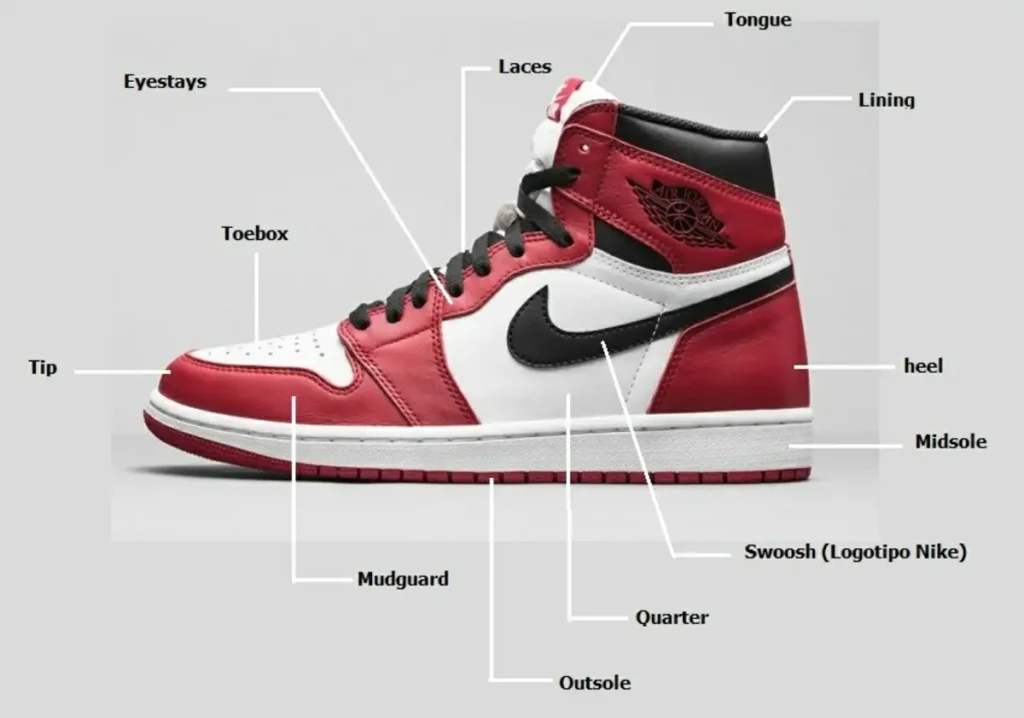
The diagram above uses an Air Jordan 1 as a visual example. It is excellent for understanding a classic upper made from multiple panels, but it should not be treated as a universal template. A knit sneaker, for example, may integrate into a single piece regions that appear as separate components on this Jordan.
Before we start: not every sneaker has the same parts
Terms such as upper, tongue, laces, collar, midsole, and outsole are widely used in footwear. Others depend much more heavily on construction. A mudguard may be a clearly identifiable panel on certain running shoes, while another sneaker may not have a separate component by that name. A quarter is easy to identify on traditional leather uppers, but it may not exist as an independent panel on a one-piece knit upper.
Even manufacturers may use slightly different terminology. That is why “sneaker anatomy” is a useful metaphor for studying footwear, not a rigid standard requiring every shoe to contain every component in exactly the same form.
Upper: what is the upper of a sneaker?
The upper is the upper assembly that surrounds the foot above the sole unit. It can be made from leather, suede, nubuck, mesh, knit, canvas, synthetic materials, films, TPU, overlays, and reinforcements.
The upper does more than one job. Depending on the product, it can contribute to fit, containment, ventilation, protection, aesthetics, and visual identity. In modern footwear, these functions may be distributed across different materials or concentrated into a single textile construction.
Toe box: where your toes sit
The toe box is primarily the front region and internal volume where the toes are accommodated. It does not have to be a separate component.
On a paneled sneaker, the area may combine the vamp, toe cap, overlays, lining, and perforations. On a running shoe made with mesh or knit, much of the toe box may consist of continuous fabric with subtle reinforcements.
It is also one of the areas where creases can appear as the upper flexes. That is different from saying every sneaker has one single “correct” flex point. To understand those marks in more detail, see our guide to creases in the toe box.
Vamp: the front section of the upper
The vamp is a traditional footwear term for the front portion of the upper that covers much of the forefoot. On a classic sneaker, it may appear as a clearly identifiable panel; on modern models, it may be mesh, knit, or an area integrated into the rest of the upper.
The toe box and vamp overlap conceptually in some descriptions, but they are not perfect synonyms: the toe box primarily describes the region and volume for the toes, while the vamp is a component or area of the upper.
Tip and toe cap: are they the same as the toe box?
No. The word tip appears in the construction terminology used by some manufacturers, including Nike’s educational shoe-anatomy material, generally referring to the frontmost region or panel and its reinforcement. But “tip” by itself is not a universal component that every sneaker must have.
Toe cap typically describes a cap or overlay at the front of the shoe. It may be made from leather, rubber, synthetic material, or another reinforcement. The toe box, by contrast, is the region that accommodates the toes.
In other words: toe box ≠ toe cap ≠ tip in every context.
Mudguard: protection and design around the lower upper
The mudguard is a protective overlay or panel used on certain shoes around the lower sections of the upper, often near the front and sides. On some running shoes and boots it is visually obvious; on other sneakers, the construction uses different names and panel divisions.
It is not accurate to automatically call every lower side strip on every sneaker a mudguard.
Quarter: side and rear panels
Quarter is a traditional term for side and rear regions or panels of the upper. On an Air Jordan 1, talking about quarter panels makes perfect sense because the construction is made from clearly defined pieces.
On a continuous knit sneaker, however, the corresponding area may exist geometrically without there being a separately cut “quarter panel.” It is a good example of how terminology depends on construction.
Eyestay vs. eyelet: what’s the difference?
The eyestay is the area or panel that supports the lacing points. The eyelet is the hole, grommet, or specific point through which the lace passes.
Not every sneaker uses metal eyelets. A lacing system may use holes punched directly into the material, fabric loops, webbing, cables, or speed-lacing systems.
Laces: more than a decorative detail
Laces adjust closure and help distribute tension across the upper.
That does not mean the laces alone “provide stability.” Fit depends on the interaction among the laces, eyestay, tongue, upper shape, collar, heel containment, and the shoe’s overall last.
Tongue: traditional, thin, or integrated
The tongue sits beneath the lacing system in traditional constructions. It can help distribute lace pressure and separate the laces from the top of the foot.
It may be thick and padded, thin, or almost fully integrated into the upper. Some sneakers use a bootie construction in which there is no classic free-floating tongue like the one seen on an Air Jordan 1.
What is a gusseted tongue?
A gusseted tongue has side connections—such as fabric wings or elastic material—linking the tongue to the rest of the upper. This can reduce tongue movement and help with fit.
On trail shoes, it can also help make it harder for small debris to enter the shoe. That does not automatically make the footwear waterproof.
Collar: the upper edge around the ankle area
The collar is the upper region that surrounds the heel and, depending on the height of the shoe, part of the area near the ankle. It may contain foam and lining, or it may be thin and minimally structured.
A tall collar or high-top construction should not automatically be interpreted as a guarantee of greater protection or injury prevention. Its real function depends on the entire shoe system and the situation in which it is used.
Heel: the rear region of a sneaker
Heel broadly refers to the rear or heel region. It is not necessarily the name of a single component.
This area may contain a heel counter, heel clip, heel tab, pull tab, lining, padding, and structures from the sole unit. Separating these terms helps avoid vague statements such as “the heel provides stability.”
Heel counter
The heel counter is a rigid or semi-rigid structure associated with the rear of the upper. It can help the shoe retain its shape and contribute to heel containment.
That does not mean a particular heel counter prevents injuries. That conclusion would require specific biomechanical evidence far beyond the mere presence of the component.
Heel clip
The heel clip is typically an external piece added to the rear of the shoe, often made from TPU or another rigid material. Depending on the model, it may contribute to structure, containment, or design.
Heel clip and heel counter are not synonyms. One may be external while the other is internal; some products may use both.
Heel tab and pull tab
A heel tab is an element or extension at the rear of the upper. A pull tab specifically describes a loop or tab designed to help pull the shoe on.
Sometimes the same piece serves both purposes, but the terms are not necessarily interchangeable.
Lining: the inner layer
Lining is the inner covering of the upper. It affects contact with the foot, friction, internal feel, and moisture management depending on the material used.
A textile lining does not guarantee high breathability by itself; overlays, foam, fabric density, and membranes also play a role.
Inside a sneaker: what sits under the foot?
Are sockliner and insole the same thing?
In everyday use, insole is often used as a synonym for a removable insert. In technical terminology, however, it can be useful to distinguish the sockliner/insock—the removable or finishing layer the foot rests on—from other structural uses of the word insole in footwear construction.
Vocabulary varies among manufacturers, regions, and shoemaking traditions, so it is best not to present this terminology as though every factory uses exactly the same words.
Strobel: the hidden stitching under the sockliner
Many modern sneakers use Strobel construction. In this approach, the bottom of the upper is closed with a textile base—often called a strobel board or strobel sock—using stitching.
When the sockliner is removed from certain shoes, this base and its stitch line may be visible. The assembled upper is then mounted over the last and connected to the sole unit according to the chosen manufacturing method.
Last: the form that defines a shoe’s volume
The last is the three-dimensional form used to develop and manufacture footwear.
It helps define characteristics such as:
- length;
- width;
- forefoot volume;
- toe-box shape;
- midfoot contour;
- heel shape;
- overall fit proportions.
The last is a design and manufacturing tool: it does not remain inside the finished sneaker.
That is why two shoes labeled with the same size can fit differently. Fit depends on more than the number printed on the tag.
Sole unit: the lower system of the shoe
Sole unit is a useful term for describing the lower system as a whole. Depending on the shoe, it may include the midsole, outsole, carrier, cushioning units, plates, shanks, and other structures.
This helps avoid a common mistake: using “sole” and “outsole” as though they were always synonyms.
Midsole: what is it?
The midsole is a central part of the system positioned between the foot/upper and the external ground-contact surface, depending on the construction used.
It often provides much of the shoe’s cushioning and geometry, but midsole does not necessarily mean a single piece of foam.
It may be built with EVA, PU, expanded TPU, PEBA-based materials, proprietary foams, lattice structures, or combinations of multiple materials.
adidas 4D is a good example of why the definition “midsole = block of foam” is incomplete: the technology uses a lattice structure produced through digital manufacturing rather than conventional “3D-printed foam.”
What is carrier foam?
Carrier foam is a foam or structure that can surround, support, or integrate another element of a cushioning system.
This is easy to see in technologies where an internal unit is not the entire midsole. A Nike Air unit, for example, can be integrated into a system with foam around it. The Air unit and the midsole are not necessarily the same component.
Outsole: the part that contacts the ground
The outsole is the external layer or group of components that comes into contact with the ground.
Rubber is extremely common, but it is not accurate to say every outsole is made entirely of rubber. Some designs use:
- solid rubber;
- blown rubber;
- high-abrasion compounds;
- gum rubber;
- segments made from different compounds;
- areas of exposed foam.
Traction also depends on more than tread pattern. Compound, hardness, texture, contact area, pattern, and the surface on which the shoe is used all interact.
Shank: structure through the midfoot
A shank is a structure used in certain shoes to modify rigidity, structural support, or midfoot control.
It may be made from TPU, plastic, composite material, and, in traditional constructions, even metal. Not every sneaker contains a separate component that can be called a shank.
It is also important not to call every midfoot structure “Torsion.” Torsion System is adidas-specific terminology; torsional support is a generic concept.
Carbon plates, TPU plates, and other plates
Modern footwear can use plates or rigid elements made from carbon fiber, nylon, TPU, and composite materials.
The function is not the same in every product. Depending on geometry and placement, a plate can contribute to:
- longitudinal stiffness;
- torsional stiffness;
- structural control;
- transition;
- integration with foams and rocker geometry;
- distribution of forces through the system.
It is not accurate to reduce every carbon plate to the claim that “it pushes you forward.” Behavior depends on the complete system.
Cushioning technologies and materials
Nike Air
Nike Air uses pressurized units integrated into the shoe system. The unit may be fully encapsulated or visible, and its placement can vary from the heel to the forefoot or cover a larger area depending on the product.
Air is a technology, not a synonym for the entire midsole. To understand its construction and evolution, see our dedicated guide to Nike Air technology.
Zoom Air
Zoom Air is an implementation within the Nike Air family that uses tensioned fibers inside a pressurized unit. When the unit is compressed and returns to its shape, those fibers form part of the system’s mechanical response.
The location and size of the unit vary widely: there are heel and forefoot applications as well as constructions such as Zoom Strobel.
adidas Boost and Light BOOST
Boost became known for using an expanded TPU-based material in midsoles. That does not mean every adidas midsole is Boost or that every TPU formulation behaves the same way.
Newer generations also use Light BOOST, showing how a brand can retain the name of a technology family while changing formulation, mass, and system behavior.
See the full explanation in how adidas Boost works. For a comparison between product families, also see Ultraboost vs. 4D.
adidas 4D
adidas 4D is a midsole platform based on a lattice structure produced with Digital Light Synthesis technology, developed in partnership with Carbon.
It is not technically precise to describe it simply as “3D-printed foam.” Learn more in our guide to adidas 4D technology.
EVA
EVA stands for ethylene-vinyl acetate. It is a family of materials widely used in footwear components, especially midsole foams.
“EVA” by itself does not describe the density, resilience, hardness, or behavior of a specific midsole. Formulation and processing make a major difference.
PU
PU, or polyurethane, is a broad family of materials. It can appear in midsoles, soles, coatings, and many other components.
It is not accurate to say that “all PU turns to dust.” Certain formulations are more susceptible to specific aging mechanisms, including hydrolysis. We cover the subject in more detail in why some sneakers crumble.
TPU
TPU stands for thermoplastic polyurethane. It is used in footwear in many different ways: clips, cages, plates, structural pieces, outsole components, and expanded materials for midsoles.
For that reason, describing TPU simply as “hard plastic” or “cheap plastic” does not reflect the range of properties available.
PEBA
PEBA is a family of thermoplastic elastomers used in some foams and components in modern footwear, especially performance running shoes.
That does not mean “PEBA is always faster.” Feel and performance depend on formulation, geometry, thickness, plate design, outsole, mass, and interaction with the wearer.
Shoe geometry: stack, drop, and rocker
Stack height
Stack height describes the height of the system between the foot and the ground at a defined measurement point. In running, heel and forefoot stack are commonly discussed.
Exact measurement methods can vary among sports regulations, brands, laboratories, and review outlets, so numbers from different sources are not always perfectly comparable.
Heel-to-toe drop
Heel-to-toe drop is the difference in height between the heel and forefoot regions.
Drop and stack are not the same thing. A shoe can have a high stack and a given drop, while another can have a lower stack with a similar difference between heel and forefoot.
There is no basis for turning a single measurement into a universal medical rule such as “high drop protects your knees” or “low drop strengthens your feet.”
Rocker
Rocker is a geometric characteristic: the curvature of the platform or sole unit that influences how the shoe transitions through a stride.
It is not a separate component that can be removed from the shoe. Its effect also depends on stiffness, stack height, foam, and plate placement.
Base width
The width of the platform beneath the foot also affects how a sneaker feels and behaves. A wider base can contribute to a more stable platform in certain designs, but there is no single universally “ideal” width.
Common terms in sneaker reviews
Medial and lateral
Medial is the side facing inward toward the body’s midline; lateral is the outside.
These terms are useful for describing asymmetrical components, wear patterns, sidewalls, plates, or specific areas of the upper.
Forefoot, midfoot, and rearfoot
Forefoot describes the front region; midfoot, the middle section; and rearfoot, the back of the foot or shoe.
Lockdown
In performance reviews, lockdown describes how well the fit system keeps the foot positioned inside the shoe.
It does not literally mean “locking” the foot in place. It also should not be evaluated by the laces alone: the last, upper, collar, tongue, and heel containment all contribute to the result.
Containment
Containment is the ability of the shoe system to limit unwanted movement of the foot relative to the upper during activity.
Panels, films, cages, sidewalls, lacing, and heel construction may contribute depending on the product.
Stability
Stability does not come from a single component. It can result from the interaction among:
- platform width;
- geometry;
- midsole stiffness and distribution;
- sidewalls;
- upper;
- heel counter;
- shank;
- plates;
- platform height;
- outsole and ground contact.
Traction
Traction is the grip interaction between the outsole and the surface. Tread pattern matters, but it does not work alone: compound, hardness, contamination, moisture, and floor or ground type also influence traction.
Cupsole, vulcanized, and cemented: different constructions
Cupsole
In a cupsole, the molded lower unit has sidewalls that “cup” part of the upper. This construction language is common in heritage basketball, skate, and lifestyle footwear.
The upper may be cemented and, in some designs, also stitched to the cupsole. Cupsole is not synonymous with vulcanized construction.
Vulcanized construction
In vulcanized construction, rubber components are cured with heat and pressure as part of the assembly process. Foxing tape around the sidewall is visually common on many canvas and skate sneakers, although each manufacturer may use its own specific processes.
It is not accurate to assume that every current model from a brand historically associated with vulcanization uses exactly the same construction.
Cemented construction
Cemented construction uses adhesives to bond sole components to the upper. It is extremely common in modern footwear and can coexist with Strobel, cupsole, and other construction choices.
Why doesn’t an Air Jordan 1 have exactly the same parts as an Ultraboost?
The Air Jordan 1 is a strong example of traditional paneled construction: leather and overlays create visually identifiable sections such as the quarter, eyestay, and toe overlays.
Certain generations of the Ultraboost may use a much more integrated knit upper, an external cage, heel structure, Strobel construction, and a Boost-based sole unit. The functions are still there—accommodating the toes, securing the midfoot, containing the heel, and forming the lower platform—but they do not have to be divided into the same panels.
That is why studying sneaker anatomy by function and construction is more useful than memorizing the labels of a single model.
Swoosh and other branding elements
The Swoosh is Nike’s logo and can be applied as a panel, embroidery, print, film, or another visual element. It is important to design identity, but it is not a universal anatomical part of a sneaker.
The same principle applies to adidas’ 3-Stripes, Jordan Brand’s Jumpman, and other proprietary elements. Branding can overlap with a structural component, but a brand name and an anatomical name are not the same category.
Which parts actually influence comfort?
There is no single “comfort component.” The overall sensation results from the interaction among the last, fit, sockliner, upper, lining, collar, tongue, midsole, geometry, flexibility, and pressure distribution.
A soft midsole does not automatically fix an upper that is too tight. A thick sockliner does not necessarily solve a last that is incompatible with the shape of the foot. And more foam does not mean universal comfort.
What part of a shoe provides stability?
The technically accurate answer is: no single component does it alone.
Perceived stability can result from a wide base, sidewalls, firmer foam, geometry, heel containment, the upper, a shank, plates, the outsole, and platform height working together.
This also avoids turning footwear characteristics into medical promises. A structural component should not automatically be described as an injury-prevention feature.
Which parts wear out first?
It depends on the material, activity, and how the shoe is used. The outsole can abrade; the toe and vamp can crease or wear; the lining can experience friction; paint can peel; foams can lose properties; and adhesives can age.
The mechanism matters, too. A sneaker that is crumbling is not necessarily experiencing the same type of degradation as a pair with sole separation. For that distinction, see our guide to hydrolysis and sneaker degradation. For color changes, see also why some sneakers turn yellow.
Frequently asked questions about sneaker parts
What are the main parts of a sneaker?
As a general overview, a sneaker has an upper, internal fit and finishing components, and a sole unit. Within those groups, there may be a toe box, vamp, tongue, collar, lining, heel counter, sockliner, strobel, midsole, outsole, shank, and other components. The exact list depends on the construction.
Are the toe box and toe cap the same thing?
No. The toe box is primarily the region and volume that accommodates the toes. The toe cap is a front cap or reinforcement that may or may not exist as a separate component.
What is the vamp?
The vamp is the front section of the upper that covers much of the forefoot. It may be a separate panel, mesh, knit, or an area integrated into a continuous construction.
Are eyestay and eyelet the same thing?
No. The eyestay is the area or panel that supports the lacing points. An eyelet is the hole, grommet, or specific point the lace passes through.
Are a heel counter and heel clip the same thing?
No. A heel counter is usually a rigid or semi-rigid structure associated with the rear of the upper. A heel clip is typically an additional external piece. A shoe may have one, both, or no clearly separate component with either name.
Is a midsole always foam?
No. Foams are very common, but modern platforms can use different structures or combinations of materials. adidas 4D is an example of a lattice midsole rather than a conventional block of foam.
Is an outsole always rubber?
No. Rubber is very common because of properties such as abrasion resistance and traction, but some outsoles combine different materials and may leave areas of foam exposed.
What is Strobel construction?
It is a widely used sneaker construction in which the bottom of the upper is closed by a stitched base. That assembly is then mounted over the last and integrated with the sole system.
What is a shoe last?
A last is the three-dimensional form used during development and manufacturing to define the shape and volume of a shoe. It influences fit, the toe box, and the heel, but it does not remain inside the finished product.
Are drop and stack the same thing?
No. Stack height describes the height between the foot and the ground at a particular region using a defined measurement method. Heel-to-toe drop is the difference between the heel and forefoot heights.
What part absorbs impact?
The midsole and its cushioning systems usually play a central role, but the sockliner, outsole, units such as Air, and the shoe’s geometry can also contribute to feel and mechanical response.
Do all sneakers have the same parts?
No. Category, construction, materials, and manufacturer can significantly change sneaker anatomy. A paneled leather basketball shoe, a mesh runner, a knit upper, and a vulcanized skate shoe can perform similar functions using very different components.
Conclusion: a sneaker works as a system
The best way to understand sneaker anatomy is not to memorize a fixed list of parts. It is to understand how the last, upper, fit, internal structure, midsole, outsole, geometry, materials, and technologies work together.
The Air Jordan 1 is an excellent example of a classic paneled sneaker; the Ultraboost shows how knit, a cage, and a modern midsole reorganize that anatomy; Nike Air demonstrates how an internal unit can integrate with the sole unit; and adidas 4D shows that not every midsole has to be conventional foam.
To keep exploring the engineering behind sneakers, visit the Sneaker Lab, our guide to Nike Air technology, our explanation of adidas Boost, and the complete guide to adidas 4D technology.