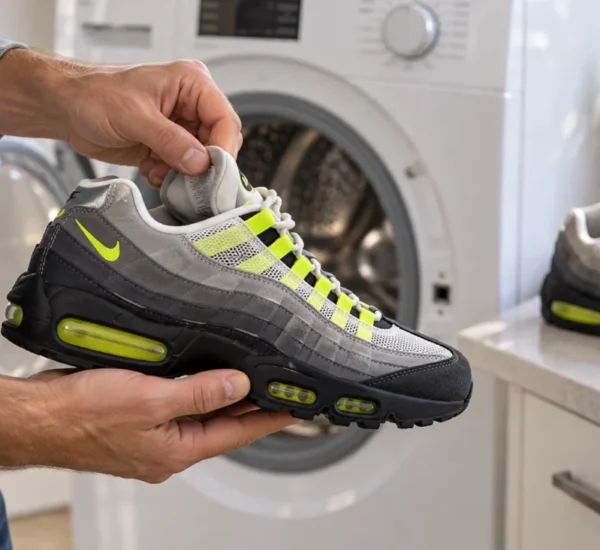
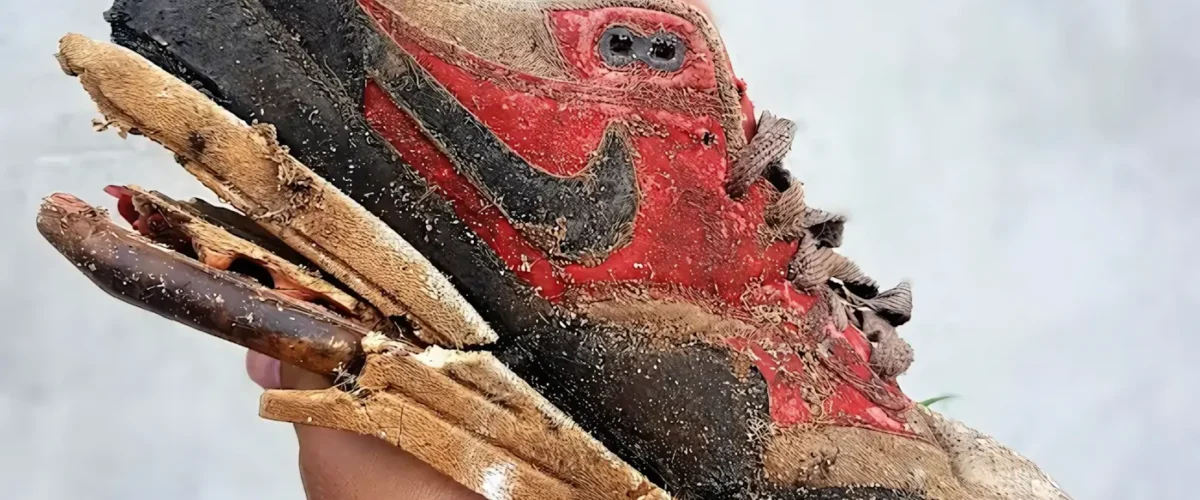
You open a box after years in storage, and the sneaker looks almost new. Then you put it on, and the midsole starts cracking or turning to powder. “Hydrolysis” is usually the first explanation offered, but there is an important correction: not every crumbling sneaker has undergone hydrolysis.
Crumbling is a symptom. Hydrolysis is a specific chemical mechanism that can degrade certain materials, especially some polyurethane formulations. Other pairs can fail through oxidation, fatigue, permanent foam compression, adhesive degradation, abrasion, flaking, cracking, or a combination of these processes.
That explains why two sneakers of the same age can deteriorate very differently, and why “it’s old, so it hydrolyzed” is not a sufficient diagnosis.
Quick answer: why can stored sneakers turn to powder?
Some sneaker components age even without wear. In certain polyester-based polyurethane foams, environmental moisture participates in hydrolysis reactions that break susceptible bonds in the material. Over time, this can reduce the foam’s molecular weight, strength, and cohesion.
The material may still look intact while sitting undisturbed. When the shoe finally experiences loading, bending, and compression, its already-weakened structure may crack or collapse quickly.
PU is not the only material in a sneaker, and not every failure is hydrolytic. Before considering prevention or restoration, identify which component is failing.
What is hydrolysis?
Hydrolysis is a chemical reaction in which water participates in breaking susceptible chemical bonds.
In certain polyester-based polyurethane formulations used in footwear components, the ester groups in the polyester segments are especially relevant. Water can participate in cleaving these bonds, forming smaller fragments and progressively reducing the polymer’s integrity.
A study of polyester polyurethane soles preserved in a museum identified products associated with hydrolysis and interactions with metal components. It provides evidence about that aged material, rather than a universal failure timeline for every sneaker.
The explanation is therefore more specific than “water attacks all polyurethane.” The reaction depends on the particular material’s chemistry.
How does degradation show up in the material?
Loss of cohesion may appear as cracks, crumbling, or reduced resistance to bending. Some formulations also become soft or sticky. These signs help guide an inspection, but they do not identify the chemical reaction on their own.
Does all polyurethane undergo hydrolysis in the same way?
No. That is one of the biggest oversimplifications in discussions of old sneakers.
Hydrolysis resistance depends on formulation, polyol, structure, density, additives, stabilizers, processing, temperature, humidity, and time.
Polyester-based polyurethane
Polyester-based polyurethane contains polyester segments with ester groups susceptible to hydrolysis. This chemistry has considerable historical significance in footwear components known for cracking, crumbling, and losing integrity after long periods.
That does not mean every polyester PU foam fails on the same schedule. Formulations and conditions of use can dramatically change its service life.
Polyether-based polyurethane
Polyether-based polyurethane generally has much greater hydrolysis resistance. Manufacturers such as BASF offer polyether TPU families specifically developed for high resistance to hydrolysis.
That does not make all polyether PU indestructible: oxidation, heat, abrasion, fatigue, and other mechanisms remain possible.
Why do heat and humidity accelerate the process?
Water is needed for the hydrolysis reaction, and temperature affects the speed of many chemical reactions. The combination of susceptible material + moisture + high temperature + time is therefore particularly unfavorable.
SATRA even has a specific method for assessing hydrolysis in footwear materials: SATRA TM344. Materials are kept in a hot, humid environment for set periods and then subjected to mechanical testing.
That does not establish a universal time to failure for sneakers. The test is accelerated precisely to compare materials and their resistance under controlled conditions.
Do unworn sneakers age, too?
Yes. Leaving a sneaker unworn does not stop chemical reactions that can occur during storage.
It is important to separate two ideas:
- wear from use: abrasion, compression, and fatigue caused by movement;
- aging: chemical and physical changes that can continue even while a pair sits unused.
Unworn does not mean unaged. A sneaker with no visible wear can still contain degraded materials.
Likewise, DS, or Deadstock, describes wear condition, rather than a polymer’s chemical age.
Why do some pairs break on their first wear after years in storage?
Because degradation can happen quietly while a sneaker is stored.
While the pair sits unused, its midsole does not repeatedly bear body weight or undergo major deformation. Once it is worn, compression and bending load a material that may already have lost a significant portion of its strength.
That is when the familiar scenes occur: seemingly pristine sneakers splitting, cracking, or disintegrating after only a few steps.
Wearing the shoe did not necessarily cause all that degradation at once. It may simply have exposed weakness accumulated over years.
Is hydrolysis the only reason a sneaker crumbles?
No. Diagnosing every degraded sneaker as hydrolysis can lead to both an incorrect chemical explanation and an unsuitable restoration.
Adhesive failure and sole separation
If the outsole, midsole, and upper separate but the materials remain cohesive, the problem may lie in the adhesive bond.
Adhesives age, too. Heat, humidity, flexing, contamination, surface preparation, and time can weaken a bond.
In that situation, professional regluing may be technically feasible.
Oxidation
Oxidation is another chemical mechanism. It involves reactions with oxygen and reactive species and can change the properties of polymers, rubber, foams, coatings, and pigments.
Oxidation is not hydrolysis.
Compression set and fatigue
A foam may lose some height or ability to rebound after repeated compression cycles. That can leave a midsole feeling “dead” or permanently deformed without hydrolysis being the main mechanism.
Flaking
Flaking is the shedding or peeling of a surface layer, paint, finish, or coating. The main midsole structure may remain intact.
Cracking
Cracking means the formation of cracks. It is a symptom or failure mode, rather than an identification of the chemical mechanism.
Abrasion
Abrasion is physical material loss through contact and friction. An outsole worn down by thousands of contacts with the ground is not necessarily undergoing hydrolysis.
Is yellowing a sign of hydrolysis?
Not necessarily. Discoloration may involve oxidation, UV, migration of components, dirt, finish reactions, and several other mechanisms.
A sneaker can turn yellow without losing structural integrity, and a midsole can be structurally degraded without pronounced yellowing.
See our guide to why sneakers turn yellow.
Does EVA undergo hydrolysis?
EVA, an ethylene-vinyl acetate copolymer, should not automatically be assigned the same classic degradation mechanism seen in certain polyester polyurethane soles.
That does not mean EVA lasts forever. EVA foam can age through a combination of use, compression, fatigue, heat, oxidation, environmental exposure, and changes in its structure.
When an EVA midsole loses cushioning, hardens, deforms, or cracks, it is therefore inaccurate to automatically conclude that it is “the same hydrolysis as old PU, just slower.”
Do TPU and eTPU undergo hydrolysis?
TPU stands for thermoplastic polyurethane, but the family includes different chemistries.
Polyether-based TPUs can have excellent hydrolysis resistance; polyester-based TPUs behave differently and may contain polyester bonds susceptible to hydrolysis.
BASF distinguishes polyether and polyester Elastollan series. Their chemical basis changes hydrolysis resistance, so “TPU” alone is not enough to predict aging.
Does adidas Boost undergo hydrolysis?
The responsible answer is: Boost should not be treated as equivalent to older molded polyester PU midsoles, but absolute immunity should not be promised without knowing the specific formulation.
adidas describes classic Boost as TPU particles expanded to form eTPU. BASF identifies the Infinergy material associated with Boost as expanded thermoplastic polyurethane.
TPU is a chemical family, however. The detailed composition of every Boost generation and formulation is not publicly documented well enough to turn the word “polyurethane” into a hydrolysis diagnosis.
A Boost failure needs to be assessed by identifying the component that deteriorated. The technology’s name alone cannot identify the mechanism responsible for the damage.
See our technical guide to adidas Boost technology.
Does Nike Air undergo hydrolysis?
Nike Air is not a foam. It is a technology based on pressurized units.
In an Air Max sneaker, the Air unit works alongside other structural components. A PU midsole or support structure around the unit may degrade without that meaning “the Air turned to powder.”
Photos of old Air Max pairs sometimes show much of the surrounding material disintegrated while the Air bag remains visually recognizable. That does not guarantee the unit is still functional, either.
To understand the distinction, see how Nike Air technology works.
Why can old Air Max pairs fall apart?
Certain older releases used polyurethane midsoles or components susceptible to aging. If a component loses cohesion, it can break apart around the Air unit.
Do not turn that into a blanket rule for the “Air Max 1,” “Air Max 95,” or “Air Max 97,” though.
A release made decades ago may have a different formulation, suppliers, and construction from a recent retro of the same silhouette.
What about the Air Jordan 3, 4, 5, and 6?
The same principle applies to Jordan.
Certain older releases of these silhouettes used PU components and can show age-related degradation. That does not mean every Jordan 3, 4, 5, or 6 is destined for hydrolysis.
The silhouette’s debut year is not the pair’s production year. A Jordan 4 made in 2026 has not undergone decades of chemical aging simply because the design debuted in 1989.
Which sneakers need extra attention?
It is more useful to think in terms of material, age, and release than to create a fixed list of models.
- Vintage sneakers with polyester polyurethane midsoles or soles;
- certain older Air Max releases with susceptible PU components;
- certain older Jordan retros;
- older performance footwear with PU components;
- pairs stored for many years in hot, humid environments;
- pairs manufactured long before their purchase date.
None of these categories is an automatic diagnosis of failure.
Do DS and unworn mean the materials are preserved?
No.
DS, NIB, unworn, and similar terms primarily describe wear condition and how a pair is presented for sale. They do not freeze the shoe’s chemistry at the moment it left the factory.
Never worn does not mean chemically new.
A vintage sneaker may never have touched the ground and still contain aged foam, glue, rubber, coatings, or other components.
See what vintage sneakers are and the differences between OG, retro, and vintage.
Age starts at manufacture, not purchase
A product purchased as “new” may already have spent years in stock, transportation, distribution, or storage.
Its production date can therefore be more useful than its purchase date when assessing material age.
There is no magic number, whether five, eight, or ten years, after which every sneaker necessarily undergoes hydrolysis.
How should you check an old sneaker before wearing it?
With an older pair, especially a vintage one, begin with a visual inspection and gentle handling.
- Look for cracks and fine fissures;
- check for powder or small fragments near the midsole;
- look for sticky or softened areas;
- check for sole separation;
- look for deformation and permanently compressed zones;
- check for flaking paint or coatings;
- note significant texture changes;
- look for dried-out or cracked rubber;
- check whether the material seems extremely crumbly.
An unusual smell is not a reliable chemical test.
Avoid forcefully squeezing a rare midsole or performing an aggressive “flex test” just to see whether it breaks. The test itself can turn a preservable item into a damaged one.
Remember: a perfect visual inspection does not prove the internal structure retains its original strength.
How can you store old sneakers more safely?
No method can freeze chemical aging, but proper storage can reduce factors that accelerate many degradation mechanisms.
- Choose a cool, stable environment;
- avoid persistently high humidity;
- avoid heat;
- avoid direct sunlight;
- minimize large temperature and humidity swings;
- do not store a shoe wet or still damp after cleaning;
- inspect important pairs periodically;
- for large collections, a hygrometer can help you understand the environment;
- in very damp settings, humidity control may help.
There is no universal relative-humidity percentage for “every sneaker.” A shoe is a composite object: leather, textiles, foam, rubber, adhesives, and coatings may react differently to their environment. Aim for stable, moderate conditions rather than “zero humidity.”
Does silica gel actually prevent hydrolysis?

Silica gel is not a shield against hydrolysis.
It is a desiccant. Its porous structure adsorbs water molecules onto its surface, helping control humidity in a microenvironment when the correct quantity is used appropriately.
There are three important limitations:
- its capacity is finite;
- the material can become saturated;
- silica gel does not reverse hydrolysis that has already occurred in a polymer.
Professional conservators also use silica gel to regulate humidity inside containers, but it needs maintenance and reconditioning or replacement according to the product and storage system.
Do not open or ingest packets. If the product has a chemical indicator or regeneration instructions, follow the manufacturer’s guidance rather than improvising a heating method.
Does keeping shoes in a box cause hydrolysis?
The box does not cause hydrolysis on its own.
The issue is the microclimate. A box in a cool, controlled environment is very different from a closed box containing a damp sneaker inside a hot closet.
There is also no universal rule that every box should always be open or always be airtight.
Do plastic bags or shrink wrap help?
I do not recommend indiscriminately sealing old sneakers in plastic.
If moisture is already present in the shoe or the enclosed air, sealing can trap that microenvironment. Sealed containers can work in conservation when internal humidity is deliberately controlled, but that is different from simply wrapping a sneaker in plastic.
Does wearing sneakers prevent hydrolysis?
Wearing a shoe once a month does not guarantee protection against hydrolysis. Movement does not remove the material’s chemical susceptibility to aging.
Chemical aging still depends on material, humidity, temperature, and time.
Regular wear can reveal problems earlier and keep a shoe from being forgotten for years, but it also adds flexing, abrasion, and compression.
There is no magic wearing schedule that acts as a chemical treatment.
Does washing sneakers accelerate hydrolysis?
One wash should not automatically be described as “the cause of hydrolysis.”
However, too much water, unsuitable products, machine washing, heat, and incorrect drying can affect adhesives, finishes, shape, and various shoe materials.
Follow material-appropriate care guidance and let the sneaker dry completely before storing it. Do not use intense hair-dryer heat or strong sunlight as a universal drying method.
See our guide to sneaker-cleaning products and methods.
Can hydrolysis be repaired?
A chemical reaction that has already occurred in a polymer cannot be reversed with glue, paint, cream, silicone, or spray.
What can be repaired depends on which component failed.
Regluing
If the main problem is failure of the adhesive bond and the underlying materials remain structurally sound, professional regluing may restore the connection between components.
If the PU midsole itself has lost cohesion and become crumbly, new glue will bond to a substrate that is still falling apart.
Cosmetic repair and recoloring
Paint can improve appearance. A coating can be replaced in some cases. Neither restores molecular weight or mechanical strength to hydrolyzed foam.
Sole swap
A sole swap replaces the sole assembly or a degraded component with a compatible one, usually taken from a donor shoe.
That may allow a well-preserved upper to be restored, but it requires compatible size, shape, geometry, and construction. It is not simply a matter of gluing any sole to any upper.
The conceptual distinction matters, too: a sole swap replaces degraded material; it does not reverse hydrolysis.
On collectible pairs, replacing components also changes the item’s physical originality.
When is an old sneaker unsafe to wear?
If the midsole is crumbling, deeply cracked, losing pieces, or making the shoe unstable, it may fail during wear.
Do not keep wearing a structurally compromised sneaker, even for walking: a sudden sole failure can cause a fall. Set the pair aside for professional assessment before considering repair or further wear.
That does not mean every vintage sneaker is beyond use. Each pair needs an individual condition assessment.
For more on footwear materials, construction, and technology, visit the Sneaker Lab. To see exactly where the midsole, outsole, upper, and other components sit, consult our sneaker anatomy guide.