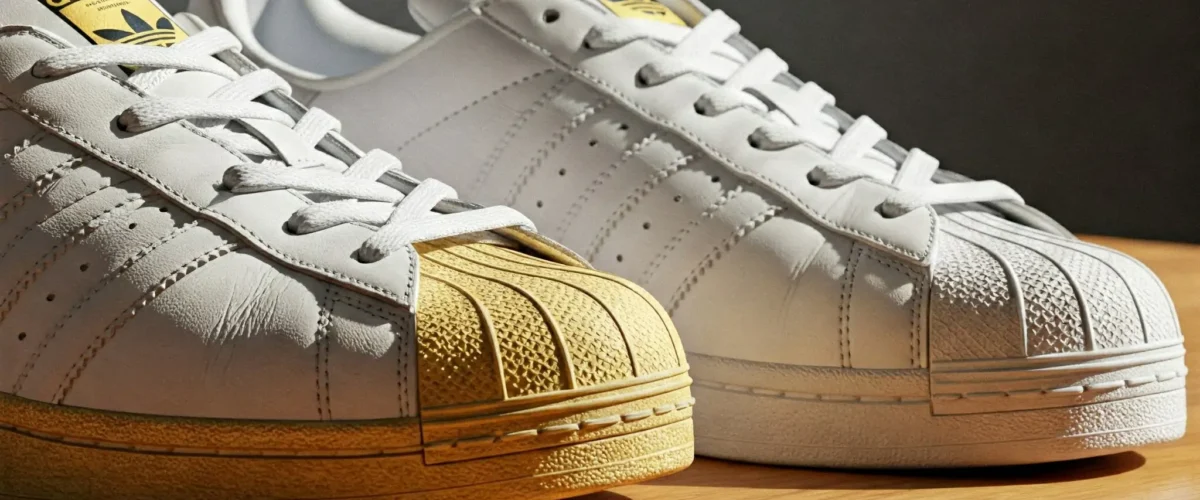
A white sneaker can start turning cream, beige, or yellow even when you take good care of it. Sometimes what looks like aging is simply built-up dirt; in other cases, the rubber, plastic, coating, or adhesive has genuinely changed color.
Before trying to reverse yellowing, identify the affected area and clean it gently using a method suited to the material. If the discoloration remains after drying, stronger products may damage the shoe without restoring its original white color.
Rubber outsoles, foam midsoles, TPU, leather, mesh, knit, suede, and translucent components age in different ways. A product that merely removes dirt from a sole can permanently stain a delicate upper.
Quick answer: why do white sneakers turn yellow?
A yellow appearance can result from a combination of factors, including:
- built-up dirt, oils, and residue;
- cleaning-product residue left in the material;
- prolonged exposure to light and ultraviolet radiation;
- reactions involving oxygen and components of the polymer;
- high temperatures;
- humidity levels unsuitable for certain materials;
- aging of rubber, plastics, foams, coatings, pigments, and adhesives.
Calling every yellowed shoe simply “oxidized” is an oversimplification. The first step is to identify which part changed color and what it is made of.
Yellowing or dirt? Make that distinction first
Not everything that looks yellow is a permanent chemical change.
If the surface looks dingy mainly in contact areas, creases, edges, or places that collect dust, accumulated dirt may be the cause. In that situation, material-appropriate cleaning can restore much of the original appearance.
If rubber, plastic, or a translucent component shows a fairly uniform color change even after cleaning, a change within the material or its finish is more likely.
Both problems can also occur together: a sole may be dirty and show genuine aging beneath the dirt.
What does UV light do to rubber and plastics?
Ultraviolet radiation can accelerate the degradation of polymers and pigments. Canadian Conservation Institute guidance treats light, heat, and the material’s own characteristics as conservation factors. Discoloration may accompany mechanical changes, but color alone does not reveal a component’s strength.
Leaving a collectible pair in direct sunlight every day is therefore a poor preservation strategy.
This also explains the contradiction in many DIY tutorials: the same UV radiation used to try to change a yellowed sole’s appearance is a known aging agent for many polymers.
Is oxidation the only cause?
No. Reactions involving oxygen matter for many materials, but they do not explain every case.
Plastics and elastomers can undergo several forms of degradation, including photo-oxidation, thermal oxidation, and, in certain materials, hydrolysis. Polymer formulation, additives, pigments, and storage conditions affect the result.
That is why two apparently similar sneakers can age very differently even when stored in the same environment.
Why can sneakers turn yellow inside the box?
Storing a shoe reduces its exposure to light and dirt, but it does not freeze the aging process.
Oxygen, temperature fluctuations, and humidity are still present inside the box. The shoe itself also combines different materials, including foam, rubber, adhesives, textiles, leather, coatings, and plastic parts, which age at different rates.
The original box can help protect against light, dust, and impacts, but it does not guarantee indefinite preservation.
Do plastic boxes make sneakers turn yellow?
It is inaccurate to say every closed plastic box necessarily accelerates yellowing.
The outcome depends on the box material, temperature, humidity, the pair’s cleanliness, and conditions inside. Closed storage systems can even be useful when the environment is properly controlled.
The problem is storing shoes wet, dirty, or still damp after cleaning and creating a warm, unsuitable microenvironment.
Does silica gel help preserve sneakers?
Silica gel is a desiccant: it adsorbs water vapor and can help control humidity inside a suitable container. It is not an anti-yellowing product and does not prevent every aging reaction.
Putting a few old packets in a box is no reason to assume conditions will remain controlled forever. Silica gel adsorbs moisture until it reaches capacity and needs replacement or regeneration according to the type used.
For an everyday collection, the simplest strategy remains avoiding extremes: choose a clean place away from direct sunlight, excessive heat, and persistent moisture.
How can you keep white sneakers from yellowing quickly?
- Avoid direct sunlight during storage: light and UV can accelerate degradation in many polymers and pigments.
- Avoid excessive heat: do not routinely leave collectible pairs in a car trunk, near heaters, or in very hot locations.
- Store shoes completely dry: never put a damp pair back into a closed box.
- Remove dirt before storage: mud, dust, sweat, and residue can make preservation more difficult.
- Use material-compatible products: more aggressive chemicals increase the risk of fading, stains, or surface changes.
- Do not expect shoes to last forever: rubber, foam, adhesives, and coatings continue aging even on rarely worn pairs.
How do you clean each material without making it worse?
Rubber and durable outsole areas
Always start with the gentlest option: remove surface dust and use an appropriate cloth or brush with a small amount of mild cleaning solution.
If the area remains yellow after it is completely clean and dry, the material itself may have changed. Increasing abrasiveness or chemical concentration at that point can turn a cosmetic issue into permanent damage.
Mesh and knit
These fabrics need a soft brush and light pressure. Harsh chemicals and bleach can change the color, finish, and fibers.
Remove the cleaning product thoroughly, since soap or detergent residue can also leave marks after drying.
Leather
Do not treat leather like rubber. Use minimal moisture and a product appropriate to its specific finish. Natural leather, coated leather, and synthetic materials can react differently to the same solution.
Suede and nubuck
These materials are particularly sensitive to water, unsuitable brushing, and general-purpose cleaners. Choose tools and cleaners specifically intended for suede or nubuck.
For more help choosing the right product for each surface, see our guide to sneaker-cleaning products.
How can you remove yellowing from sneakers?

First, determine whether the material has actually yellowed or is simply dirty.
Clean it using a conventional method suited to the material and let the shoe dry completely. Only then reassess it.
When a rubber or plastic component remains yellow after cleaning, restoration products can change its appearance in some cases. The result depends on the component’s composition and should not be confused with a complete reversal of chemical aging.
Does hydrogen peroxide actually whiten yellow soles?
Hydrogen-peroxide treatments are familiar in sneaker restoration and can lighten certain surfaces. That does not make peroxide suitable for every shoe or every part of a shoe.
High concentrations can cause discoloration and react undesirably with pigments, textiles, leather, finishes, adhesives, or polymers. Additional UV exposure is not harmless to materials, either.
For that reason, this guide does not recommend applying 40-volume peroxide and leaving a shoe in the sun for hours as a universal solution.
For valuable, old, or mixed-material pairs, consulting an experienced restorer is the more cautious choice. If a restoration-product manufacturer provides specific compatibility and application instructions, follow them exactly.
Why don’t we recommend a homemade UV chamber?
An improvised box with a UV lamp does not automatically make the process safe for a sneaker.
Wavelength, intensity, temperature, distance from the source, exposure time, and material composition all change the outcome. UV is also a known degradation agent for many polymers.
A surface that looks lighter after treatment may have undergone other changes that are not immediately visible.
Can bleach and strong cleaners discolor sneakers?
Aggressive products can stain, fade, or degrade shoe components. The effect depends on the material and the product used.
“Stronger is better” is a poor rule for sneaker cleaning. Always start with the gentlest method compatible with the surface.
Does yellowing mean a shoe is ruined?
Not necessarily.
A color change may be predominantly cosmetic. However, the same environment causing discoloration can also contribute to other aging processes.
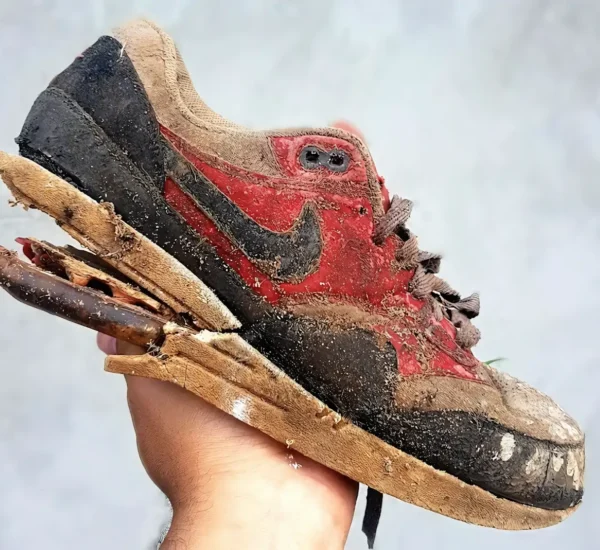
Watch for signs such as:
- crumbling foam;
- deep cracks;
- a separating outsole or midsole;
- material that has become excessively hard or brittle;
- deformation;
- peeling coatings.
Those signs matter more for assessing structural deterioration than color alone.
The yellowed look can also be intentional
Interestingly, the appearance collectors try to avoid in an old pair has also become a design feature in modern releases.
For the 2022 Air Jordan 1 “Lost & Found,” Jordan Brand intentionally recreated elements associated with a 1985 AJ1 aged over decades, including a yellowed-looking midsole.
The Air Jordan 3 “White Cement Reimagined” followed a similar idea, with aged finishes on components such as the midsole, eyelets, and heel piece.
It is important to distinguish a factory-applied finish from a shoe’s actual aging.
For more on footwear materials, cleaning, preservation, and technology, visit the Sneaker Lab.