Creases are the folds that appear as an upper flexes during wear, especially around the toe box. On many sneakers, this is completely normal: walking requires the shoe to bend with your foot.
You can sometimes make creases less visible and restore some shape, but there is no guaranteed “factory reset.” A deep crease may return when you wear the shoe again, and aggressive attempts to remove it can cause a worse problem than the crease itself.
The most important rule is simple: the method depends on the material. Natural leather, coated leather, synthetics, suede, nubuck, mesh, knit, canvas, and patent leather do not react the same way to heat, water, and pressure.
What are sneaker creases?
A crease is a fold produced when the upper bends. As you take a step, your foot needs to flex at the forefoot, and the upper follows that movement.
The severity and pattern of the marks depend on factors such as:
- upper material and thickness;
- surface coating or finish;
- upper design and panel layout;
- toe box structure and reinforcements;
- interior volume;
- the silhouette’s flex point;
- foot shape;
- fit;
- gait;
- frequency of wear;
- the age and condition of the materials.
Why does the toe box bend?
Because the shoe needs to accommodate the foot’s normal movement. A sneaker that is completely rigid at its flex point would not necessarily be better.
It makes little sense to treat every crease as a sign of poor quality. Even excellent leather can develop natural flex marks.
Fit affects the geometry of the fold, but does not eliminate it. Excess length or volume can make a sneaker bend at a different point; an overly tight shoe creates other stresses. Creasing remains possible even with the correct size.
Do creases mean the shoe is damaged?
No. A normal crease is not automatically structural damage.
It is important to distinguish:
- crease: a fold in the material;
- cracking: a fissure or break in the material or coating;
- delamination: separation between layers;
- loss of shape: deformation or a loss of the original form, which can happen even in storage;
- collapse: a more extensive breakdown of the toe box structure.
If a fold already has a crack, broken paint, or a separating coating, aggressive “smoothing” can worsen the failure.
Can you completely remove creases?
Sometimes a light crease can become much less noticeable. In other cases, the change is already part of the material’s structure and can only be partially improved.
Even if the surface becomes smoother, the shoe will flex again when you walk. Reducing creases does not mean permanently restoring factory condition.
Before trying anything, identify the upper material
Do not choose a technique based only on the model name. The Air Force 1, Jordan 1, and Dunk, for example, have been made in countless versions with different materials and finishes.
Natural leather
Natural leather can crease with wear. Gradually restoring shape with internal support is a more conservative approach than immediately applying heat.
Compatible conditioners may help maintain certain leathers, but they are not crease erasers. Before using any product, confirm compatibility and spot-test where appropriate.
Coated and synthetic leather
A material may look like leather while having a surface layer of PU, PVC, or another coating. It may also be a coated synthetic substrate.
Excessive heat can change shine, texture, adhesion between layers, or shape. Do not assume a technique used on natural leather is automatically safe.
Suede and nubuck
The velvety surface of suede and nubuck can be marked by pressure, water, and heat. Start with gentle internal support, keep the material dry, and use an appropriate brush to restore the nap when necessary.
I do not recommend a household iron or soaking in hot water to try to erase a crease in suede or nubuck.
Mesh and knit
Mesh and knit should not automatically receive a treatment developed for leather. Some visible deformation may come from the fibers themselves, overlays, or reinforcements beneath the fabric.
Shape support and storage without compression are more cautious options. Avoid concentrated heat, since synthetic fibers, bonded areas, and overlays may deform.
Canvas
Canvas can wrinkle, too. Proper stuffing may help restore its shape, but excess water and heat can affect dye, shrinkage, adhesives, or nearby components.
Patent leather
Patent leather needs special care because its glossy finish can mark, crack, stick, or change appearance under unsuitable heat and pressure. For valuable pairs, avoiding experiments with a household iron is the more cautious choice.
The gentlest method: gradually restoring shape
Before reaching for heat, try supporting the toe box and allowing the material to rest in its proper shape.
Shoe trees
A shoe tree fills some of the interior space and helps a sneaker retain its shape during storage or maintenance.
Choose a shape that fits without aggressively forcing the toe box. Not every traditional shoe tree is designed for a sneaker’s geometry.
A shoe tree is different from a shoe stretcher. A stretcher is intended to change width, length, or specific fit points and can apply much more force.
Soft stuffing
Another option is gently filling the front with unprinted white paper, suitable packing paper, or clean, dry fabric.
The aim is to support the shape, rather than make the toe box rigid and stretched under tension.
Do not overstuff. Too much pressure can alter the shape, strain seams, push overlays out of place, or deform the toe cap.
Avoid wet paper. Newspaper is not my first choice, especially with a light-colored lining, because its ink can transfer.
Do crease protectors work?
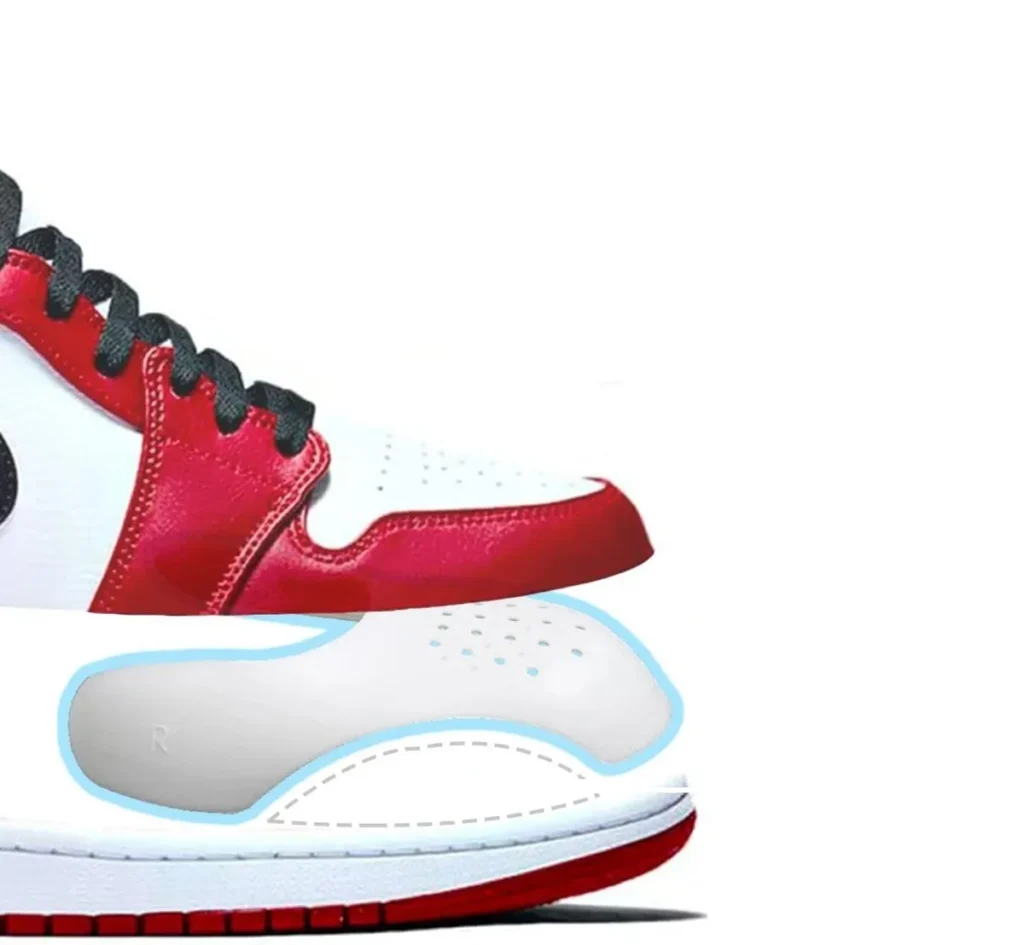
Crease protectors are inserts placed in the front of a shoe to limit some toe box flexing.
Their role is mainly preventive. They may reduce certain folds, but they do not stop all movement or chemically repair material that is already creased.
Manufacturers such as Crep Protect and RESHOEVN8R currently sell these accessories specifically for support and crease reduction.
What are the risks of crease protectors?
The main issue is simple: they take up space inside the shoe.
Adding a rigid or semirigid insert to an already-snug toe box can put pressure on the toes and cause discomfort.
If the protector bothers you, squeezes your foot, or changes the fit too much, remove it. Preserving the toe box’s appearance should not take priority over comfortable footwear.
Do not buy shoes smaller or larger specifically to “solve creasing,” either. Choose the size that fits your foot properly.
Does ironing remove sneaker creases?
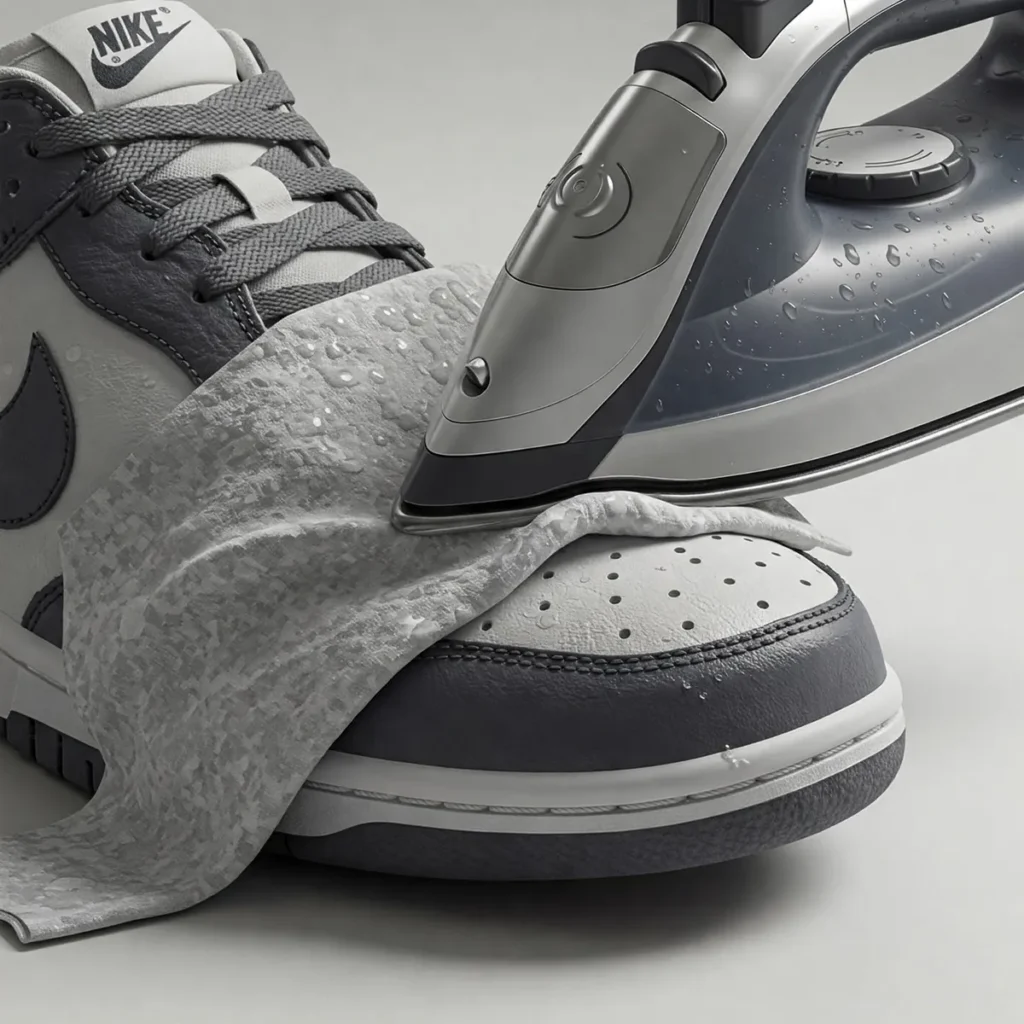
The method exists and can reduce creases in certain leathers, but it should be treated as a higher-risk technique, rather than a universal recipe.
Nike describes ironing as the riskiest method among the techniques in its guide. A published tutorial does not make the process suitable for every material.
The problem with instructions such as “iron on low or medium for 10–15 seconds” is that low and medium are not universal technical temperatures. Irons vary, as do materials, coatings, paints, adhesives, and thicknesses.
A towel creates a barrier between the iron’s plate and the sneaker, but does not automatically make the procedure safe.
If you are still considering heat treatment on a product whose documentation allows it, first:
- identify the material correctly;
- check the manufacturer’s guidance;
- avoid direct contact with the iron;
- do not use it on cracked or delaminating coatings;
- stop immediately if the shine, texture, or color changes, or if you notice an unusual smell;
- do not turn repeated attempts into prolonged heating cycles.
For a rare, expensive, vintage, or unidentified-material sneaker, I recommend avoiding a household iron if you lack experience.
When should you NOT use an iron?
- When you do not know the material;
- on patent leather;
- on suede or nubuck as a general DIY treatment;
- on mesh or knit;
- on heat-sensitive synthetics;
- over weakened prints, paint, or coatings;
- when cracking is already present;
- when there are signs of delamination;
- on vintage pairs with aged materials that have not been assessed first.
Does steam work?
Steam is often presented as a “gentler” alternative, but it still combines heat and moisture.
For certain leathers, professionals may use controlled moisture and heat as part of reshaping. That does not make household steam safe for every toe box.
Suede, coatings, synthetics, adhesives, paints, and vintage materials may react poorly. Do not use steam as an automatic substitute for ironing.
Why don’t we recommend dipping the toe box in hot water?
Immersing the front of a sneaker in hot water is not a recommended DIY crease treatment.
A sneaker is a composite system. Even if the surface looks durable, water can reach the lining, reinforcements, foams, structural insole, seams, and adhesive interfaces.
Hot water also adds unnecessary heat and may affect:
- finishes;
- leather;
- synthetic coatings;
- glue;
- paint;
- suede and nubuck;
- textiles;
- laminated components.
Moisture trapped inside a sneaker can also encourage odor, mold, and other problems.
Do sprays remove creases?
Do not treat a cleaning, waterproofing, or conditioning spray as a “crease remover” unless the manufacturer specifies that purpose.
Crep Protect Spray, for example, is currently sold as hydrophobic protection against liquids and stains. That is a different function from reshaping a toe box.
RESHOEVN8R offers cleaning, protection, and conditioning products, shoe trees, and crease protectors; that does not make every spray from the brand a crease remover, either.
Does leather conditioner help?
An appropriate conditioner may help keep certain leather surfaces supple and even-looking, but it does not automatically erase a crease.
Use only a product compatible with the finish, and spot-test when the manufacturer recommends it. Some conditioners can change color or shine.
Do not apply smooth-leather conditioner indiscriminately to suede, nubuck, knit, mesh, patent leather, or synthetic materials.
How to reduce Air Force 1 creases
The Air Force 1 is one of the silhouettes most associated with creasing because its toe box flexes during walking. That is normal wear behavior, rather than an automatic defect.
Do not assume every Air Force 1 uses exactly the same leather, either. Releases combine leather, synthetics, and textiles in different ways.
The most conservative approach is to:
- wear the correct size;
- after wear, let the toe box recover its shape with moderate support;
- use a compatible shoe tree or clean stuffing without excessive pressure;
- consider a crease protector only if it does not compromise comfort;
- clean according to the material;
- avoid aggressive heat.
For the silhouette’s background, see our Nike Air Force 1 history.
How to reduce Jordan 1 creases
The Jordan 1 also normally creases around its flex point. Depth varies with fit, foot shape, wear, and especially the material used on that version.
Do not apply a technique just because it worked on another Jordan 1. One colorway may use leather, while another combines synthetics, suede, patent leather, or other materials.
Start with gradual internal support. If a coating is cracking, do not try to “smooth out” the crack with heat.
How to reduce Nike Dunk creases
The same principle applies to the Dunk: the silhouette alone does not identify the material.
Dunks have been released in leather, suede, textiles, synthetics, and special constructions. First identify that release’s upper, then choose the gentlest compatible approach.
How can you reduce new creases without compromising fit?
- Choose your size for comfort and proper fit;
- do not size down to “lock” the toe box;
- do not size up just to try to change the flex point;
- store the sneaker without weight crushing the front;
- use an appropriate shoe tree or stuffing when it makes sense;
- use a crease protector only if there is enough room;
- clean and care for each material with compatible products;
- avoid extreme heat and improvised solutions.
Rotating pairs can reduce how often a particular sneaker flexes, but normal wear should not be treated as a mistake. Shoes are made to be worn, and they bend.
Do not alter your natural gait with a “crease walk” or “penguin walk” just to preserve a toe box. Comfort and natural movement come before a crease-free appearance.
Viral methods that can damage sneakers
Some techniques spread through videos because they produce quick visual changes. That does not give them an acceptable safety margin for every material.
- Iron directly on the upper: do not do it;
- heat gun: extremely concentrated heat is unnecessary for home sneaker care;
- boiling water or hot-water immersion: not recommended;
- intense steam: combines heat and moisture and is not universally safe;
- very hot, concentrated hair-dryer airflow: may affect materials and adhesives;
- microwave: never put a sneaker in a microwave;
- oven: never use an oven as a restoration tool;
- dryer: heat and impacts may deform the shoe;
- hair straightener: not an appropriate tool for an upper;
- strong sunlight to “soften” it: adds uncontrolled heat and UV exposure;
- acetone: may remove paint, coatings, and finishes;
- alcohol as a “softener”: not a crease treatment and may alter certain finishes;
- petroleum jelly or general-purpose oils: may darken, stain, or change the appearance.
What about vintage sneakers?
For an older sneaker, assessing its condition should take priority over improving a fold.
The pair may have dried-out leather, a fragile coating, aged adhesive, brittle paint, or a degraded midsole. Applying heat and pressure to those materials poses a greater risk.
If you see crumbling, structural cracking, or midsole problems, start with our guide to hydrolysis and sneaker degradation.
To understand the difference between an old pair and an old silhouette, see what “vintage sneaker” means.
Can a DS (deadstock) pair have a misshapen toe box?
Yes. An unworn pair may have deformation from packaging, pressure during storage, shipping, or manufacturing marks.
That is not necessarily a crease caused by wear.
Loss of shape and wear-related creasing are different. The former can happen even if the sneaker has never been worn; the latter is tied to flexing during use.
Do creases reduce resale value?
They can affect the aesthetic assessment of a used sneaker, especially when deep or accompanied by cracking, but there is no universal discount percentage.
Size, model, overall condition, box, accessories, market conditions, and demand also affect price.
Creases are not an authenticity test, either. An authentic sneaker can crease, and so can a counterfeit.
When should you seek professional restoration?
Consider a professional when:
- the sneaker is rare or has significant sentimental value;
- it is vintage;
- you cannot identify the material;
- it has patent leather, delicate suede, or special coatings;
- the paint is already fragile;
- a crease has developed into cracking;
- there are signs of delamination;
- the work would require heat, moisture, or disassembly.
Even an experienced restorer should not promise to make every worn upper exactly like factory-new material.
For more on sneaker care, materials, and construction, visit the Sneaker Lab. To understand how the front area connects with the rest of the upper, see our sneaker anatomy guide.