A vintage sneaker is generally a pair actually produced in an earlier era. The physical object has aged; it isn’t simply a new shoe with an old design, factory-yellowed colors, or nostalgic packaging. That’s the most important idea behind the term in sneaker culture.
“Vintage” has no universal minimum age accepted by every brand, store, and community. Usage varies, but one simple question resolves much of the confusion: when was this particular pair manufactured? From there, it’s much easier to distinguish vintage from retro, OG, used, and deadstock.
What does vintage mean in sneakers?
In sneakers, vintage primarily describes when the physical pair was produced. A shoe manufactured decades ago can be vintage even if it was an ordinary, mass-market model without a famous collaboration.
A sneaker therefore doesn’t have to be rare, expensive, culturally revolutionary, or from a silhouette’s first release to be vintage. Those qualities can increase collectors’ interest, but they aren’t the basic definition.
It’s also important to separate age from authenticity. A pair can be old and authentic, old and restored, or even a counterfeit made in the past. Vintage isn’t an automatic seal of authenticity.
The age of the design and the age of the pair are different
A design’s age tells you when the silhouette originated. A pair’s age tells you when the actual shoes in your hands were produced. The distinction may seem small, but it clears up plenty of confusing listings.
- The design’s age: tells the history of the model or silhouette.
- The pair’s age: tells the history of that physical product, including its label, materials, box, and manufacturing date.
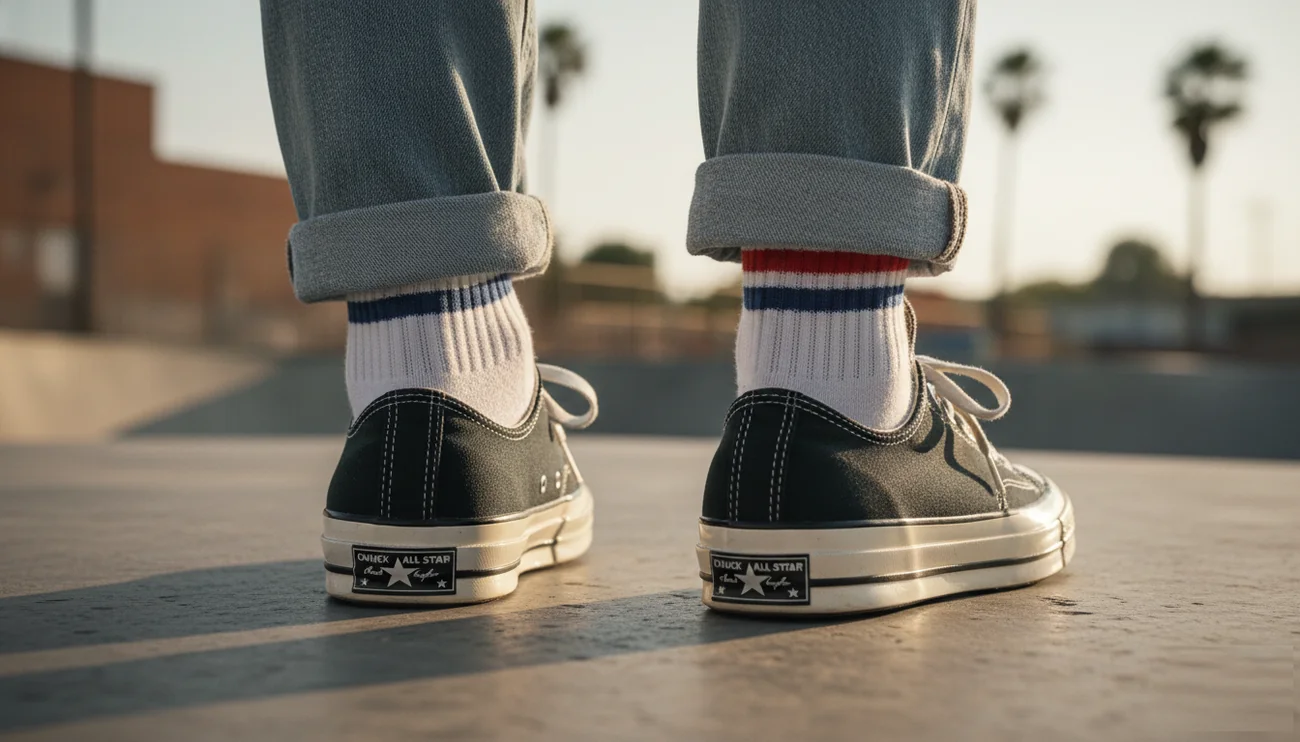
The Converse Chuck Taylor All Star makes this easier to picture. Converse’s official timeline dates the All Star to the late 1910s, Chuck Taylor’s arrival at the company to 1922, and the addition of his signature to 1934. Even so, a Chuck Taylor manufactured today isn’t vintage simply because its silhouette has more than a century of history.
A Chuck Taylor actually produced decades ago, on the other hand, can be described as vintage. In short, an old design doesn’t retroactively age a new pair.
Vintage styling doesn’t make a new shoe vintage
Brands can release new products with aged-looking midsoles, washed canvas, deliberately faded colors, distressed finishes, or packaging inspired by another decade. The result may have a vintage aesthetic, but it remains a physically new product.
The Chuck 70 illustrates that distinction. Converse presents today’s Chuck 70 as an interpretation of Chuck Taylor heritage, with historically inspired details and contemporary construction. It may look like it comes from another era; that doesn’t make it a pair actually produced in that era.
Is there a minimum age for a vintage sneaker?
There is no single minimum age across sneaker culture. Individual marketplaces have their own criteria: Etsy, for example, requires an item to be at least 20 years old to be listed as vintage. That threshold is a platform rule, not a universal certification for older shoes.
When evaluating a listing, prioritize the production year or decade over the label alone. In 2026, pairs physically produced in the 1980s and 1990s are clear examples of period pieces; a pair from the 2000s requires identifying the specific year and edition offered.
What’s the difference between vintage and retro?
Vintage describes a physically old pair. Retro usually describes a new edition, reintroduction, or rerelease of an existing silhouette. Brands may use related terms such as reissue, rerelease, archive, or heritage.
A newly manufactured Air Jordan 3 Retro is retro, but it isn’t a vintage physical object. An Air Jordan 3, whether an original or a retro, produced decades ago may now be considered vintage. That’s the nuance people often miss: a retro ages, too, and can become vintage.
Retro doesn’t necessarily mean “exact copy” or “improved version,” either. Materials, shape, molds, colors, branding, and construction can vary between editions. Read the full explanation of retro sneakers or explore our comparison of retro, vintage, and OG.
What’s the difference between vintage and OG?
Vintage and OG can describe the same pair, but they aren’t synonyms. In sneakers, OG points to something original or its origins, and its meaning changes with context: an original release, a period colorway, or the commercial name of a current edition. The abbreviation’s linguistic origin is Original Gangster.
Imagine a silhouette first released in 1985 and rereleased in 1994. A 1985 pair can be the OG release and, today, also vintage. A 1994 pair can be vintage because of its physical age without being the original 1985 release.
An older OG release can therefore fit both descriptions, while many vintage sneakers aren’t OG. See the full context in what OG means in sneakers.
Is vintage the same as used or deadstock?
No. Used and deadstock describe condition or wear history; vintage describes the physical product’s era.
- A recently produced used sneaker is used; wear alone doesn’t make it vintage.
- A vintage sneaker may have been worn heavily, lightly, or never.
- An unworn vintage pair may be listed as vintage deadstock or DS vintage, depending on the market’s vocabulary.
A pair stored for 20 or 30 years may never have touched the street and still have dried-out glue, deteriorated foam, hardened rubber, yellowing, or fragile synthetic materials. Never worn doesn’t mean never aged.
How can you identify a sneaker’s era?
No magic detail works for every brand and decade. Label systems, codes, and manufacturing countries have changed over time. Identification becomes more reliable when several pieces of evidence tell the same story.
- Model, colorway, and release: confirm the edition being assessed, not just the silhouette’s name.
- Style code or SKU: where available, compare the code with catalogs, brand archives, and documented references for that release.
- Inside label: examine its format, dates, size range, and country of manufacture against the conventions of that specific era.
- Box and accessories: the box label, paper, laces, hangtags, and inserts can help, but they may have been switched.
- Construction and materials: stitching, logos, molds, the outsole, insole, and finishing should be compared with the correct release.
- Provenance: receipts, older photos, ownership history, and documentation can increase confidence in rare pairs.
A manufacturing country, label, or SKU alone doesn’t prove age or authenticity. Counterfeits can copy codes, and components may have been replaced. For important pieces, compare period archives and seek an assessment from someone genuinely familiar with that generation.
Can vintage sneakers still be worn?
Some older pairs can still be worn; others should be preserved as collection pieces. The decision depends on the model, materials, age, and structural condition. A photograph isn’t enough to verify a midsole’s internal integrity.
Inspect carefully before wearing, and don’t forcefully bend an already fragile component. If you see crumbling, deep cracks, loose parts, or an obvious loss of structure, don’t wear the pair until it has been properly assessed.
Midsole
Look for cracks, deformation, crumbling areas, and changes in consistency. Some polyurethane foams are especially vulnerable to hydrolysis; they can lose integrity despite little or no wear. EVA ages differently and can compress, harden, or lose responsiveness without necessarily disintegrating like certain polyurethanes.
Adhesives and bonds
Look for gaps between the upper, midsole, and outsole, along with residue or earlier repairs. Adhesives can lose performance over time. A simple separation may be repairable, but “just glue it” isn’t a diagnosis: the underlying material still needs to be structurally sound.
Outsole rubber
Check for excessive hardness, cracks, lost grip, and separation. Rubber can oxidize and change behavior depending on its formulation, exposure, and storage. An outsole that looks intact in a photo may still be too slick or rigid for safe walking.
Upper, lining, and insole
Leather can dry out or crack; synthetic coatings can peel; and fabrics, internal foams, printed details, and stitching can weaken. Mold, persistent odor, or color transfer deserve attention and shouldn’t be romanticized as “patina.”
Why can older sneakers deteriorate without being worn?
Materials continue reacting to moisture, oxygen, light, heat, and ingredients within their own formulations. The Canadian Conservation Institute’s guidance explains that plastics and rubbers don’t all respond the same way: some are more affected by oxidation, others by light, additive loss, or hydrolysis.
Hydrolysis is chemical degradation caused by a reaction with water or moisture and is especially relevant to certain materials, including some polyurethane foams. It isn’t a universal name for every old shoe breaking down. Glue separation, hardened rubber, dry leather, and peeling synthetic coatings can involve other processes.
Consider age, composition, storage, and wear history together. None replaces an inspection of the pair’s current condition. To explore the mechanism, see hydrolysis and sneaker deterioration.
Preventive conservation and restoration
Conservation includes different forms of care and treatment. In the American Institute for Conservation’s terminology, preventive conservation reduces deterioration risks; restoration is treatment intended to bring an object closer to a known or presumed state, sometimes using nonoriginal materials. The practices aren’t necessarily opposites.
For sneakers, restoration can include regluing, repainting, a sole swap, replacement insoles or laces, and reconstruction of components. A repair doesn’t mean counterfeit, but it should be disclosed because it can affect originality, wearability, and collector interest.
How should you clean and store vintage sneakers?
Minimal intervention is usually the best starting point: identify the material and its condition first, then choose the least aggressive method. Products safe on a modern sneaker can stain, strip finishes, damage adhesives, or dry out older components.
- Gently remove loose dust without abrasion.
- Test any product on a small, inconspicuous area before applying it more broadly.
- Avoid soaking the pair, and stop cleaning if you see color transfer, stickiness, or material coming loose.
- Keep the sneaker away from intense heat, prolonged sunlight, excessive moisture, and chemicals.
- Support its shape without pressing against brittle materials.
- For rare, fragile, or historically important pairs, consult a professional experienced with older footwear.
How can you buy vintage sneakers more safely?
Buying vintage calls for more questions than buying a recent release. Before negotiating, establish exactly what’s offered and whether your goal is to collect, restore, or wear the pair.
- Identify the release: model, colorway, size, approximate year, style code, and original market.
- Request detailed photos: the label, box, stitching, midsole, outsole, insole, and glued joins.
- Ask about work done: sole swaps, repainting, regluing, and replacement parts should be disclosed. Ask when the work was done and who did it.
- Assess the structure: don’t stop at how the upper looks.
- Consider provenance: documentation and history can help, especially for rare releases.
- Compare equivalent transactions: the same release, size, and condition. An active listing isn’t proof of a sale.
- Check return rules: photos don’t always reveal odor, stiffness, or fragility.
To estimate price without automatically treating age as value, use a price check based on comparable completed sales. Vintage estimates are often less precise because few pairs are truly equivalent.
Are vintage sneakers always rare or expensive?
No. Age isn’t price. A 30-year-old sneaker may have little demand, be incomplete, or be unsafe to wear. A newer pair may cost much more because of demand, scarcity, or cultural context.
A vintage pair’s value depends on the model, release, size, condition, original components, rarity, documentation, restoration work, and number of interested buyers. Even an original box or missing accessory can matter, but none guarantees appreciation.
Why do some people collect vintage sneakers?
For some collectors, the appeal is a direct connection to an era: materials and construction that have changed, colorways that never returned, sports history, fashion, memories, or simply the pleasure of research. A period pair can reveal details a reissue didn’t reproduce, without automatically making the older shoe “better.”
Vintage isn’t the opposite of hype, either. An old sneaker can be overlooked or fiercely sought after, and someone can enjoy historical pieces, recent retros, and collabs all at once. Sneaker collecting is broad precisely because there is more than one way into it. That freedom is part of the appeal: a collection can bring different eras and personal interests together.
My experience with a vintage Converse Chuck Taylor
One of my most memorable sneaker experiences was buying a vintage Converse Chuck Taylor. It wasn’t flashy or hyped, and it certainly wasn’t a limited collab. Its appeal was its history as an object.
Holding the pair, I noticed construction that differed from current versions. On that particular example, the canvas felt more substantial, the sole showed clear signs of age, and several details revealed another production era.
Wearing it felt like carrying a piece of history on my feet. That’s an observation about that specific pair, not a rule about every old Chuck Taylor: materials and construction vary by decade, factory, market, and version.
Is vintage or retro a better buy?
There is no universal winner. The choice depends on what you want from the shoe.
- For collecting: vintage can offer period production, historical originality, and the pleasure of research.
- For frequent wear: a recent retro is physically younger and may be more practical, although comfort and construction still need to be assessed model by model.
- For preservation: condition and originality may matter more than being able to wear it.
- For investing: neither vintage nor retro guarantees returns; price and liquidity can fall.
Sources
- Converse: official brand and Chuck Taylor All Star history.
- Converse: Chuck 70 and its contemporary interpretation of the silhouette’s heritage.
- Canadian Conservation Institute: caring for plastics and rubbers.
- American Institute for Conservation: conservation, preventive care, and restoration.
- Etsy: age requirements for vintage items on the platform.
For more descriptions used in listings, see the Sneakerhead Dictionary.
For the wider context, explore Sneaker History and Culture: From Rubber Soles to a Global Movement.