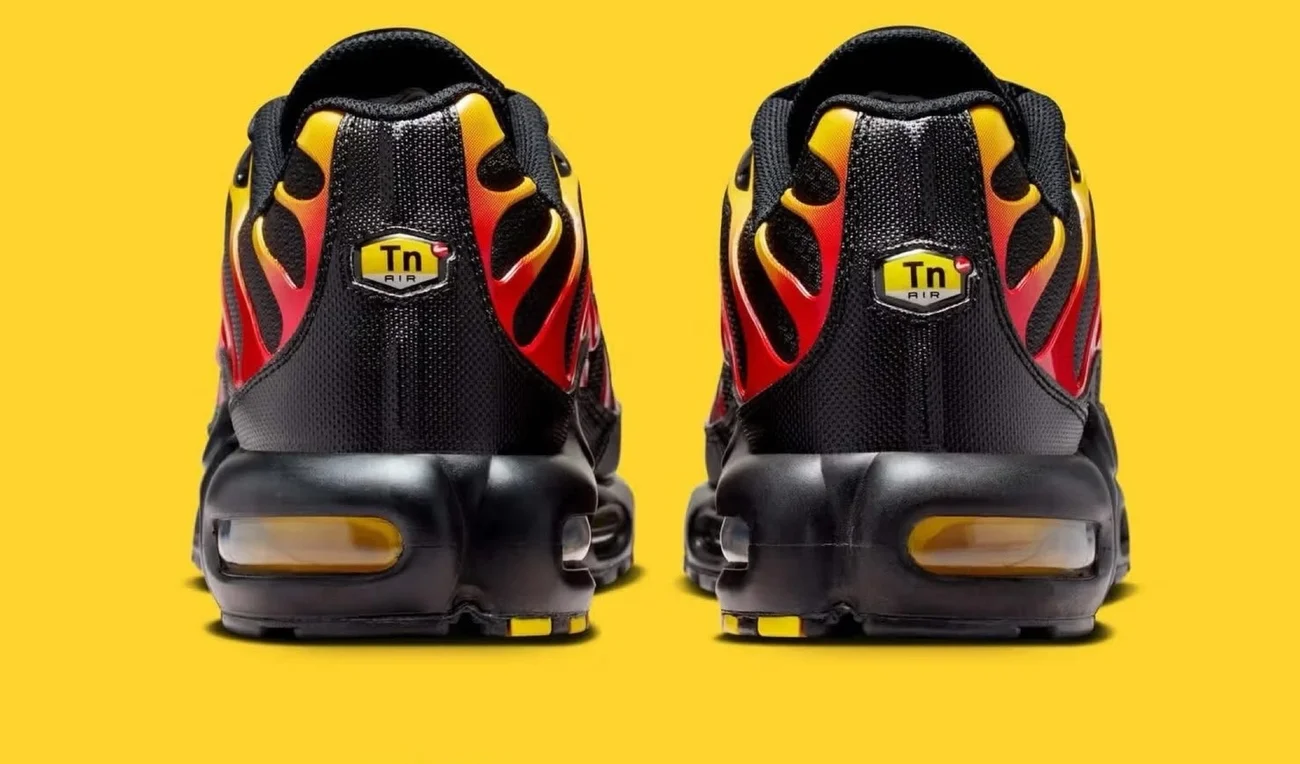
Two letters on the heel helped give the Air Max Plus a second name: TN. They stand for Tuned Air, the cushioning technology that debuted with the model in 1998. But the story did not stay inside the midsole. The Air Max Plus became so recognizable that, in many places, “TN” came to name the shoe itself.
Designer Sean McDowell brought references to a Florida sunset, palm trees, and a whale’s tail into the project. People in different countries later gave the model their own nicknames and meanings.
What does Nike TN mean?
TN is short for Tuned Air. “Tuned” means adjusted or calibrated and describes the cushioning system’s mechanical configuration.
The term refers to a configuration within the Nike Air family designed to calibrate support and stability in specific areas. The small Tn Air badge seen on the Air Max Plus turned that technical identification into one of the model’s most recognizable logos.
Is TN the technology or another name for the Air Max Plus?
Both uses exist, but they do not mean exactly the same thing:
- Tuned Air is the technology.
- Nike Air Max Plus is the name of the silhouette released in 1998.
- Nike TN, or simply TN, is the popular name by which the classic Air Max Plus became known in several markets.
When someone says, “I bought a pair of TNs,” they are almost always talking about Air Max Plus shoes. Technically, though, Tuned Air is not the silhouette. It is the system that helped define it and also appeared in other Nike products.
Nike itself adopted this vocabulary. The product is still officially named Air Max Plus, but regional pages and communications use TN to reflect how people recognize the shoe. It became more than casual slang: it is part of the model’s commercial and cultural identity.
What is Tuned Air technology?
Tuned Air combines Nike Air cushioning with calibrated mechanical components to adjust support and stability in specific areas of the sole. The current Air Max Plus description emphasizes visible cushioning, a supportive midfoot arch, and Nike Air units originally designed for performance running.
That does not mean an electronic control system decides where to send more air. The system is passive and mechanical: there are no sensors, software, or real-time adaptation. “Tuned” describes how the platform was configured during design, rather than hidden intelligence inside the midsole.
How does Tuned Air actually work?
The original system combines Air units with mechanical elements of calibrated stiffness to alter the response at particular points in the sole. The tuning is built into the design, without actively controlling the gas as you move through a stride.
Technical and historical sources describe these elements as mechanical structures or hemispheres. Their number, position, and materials can vary by product and generation, so a description of one release should not become a rule for every shoe carrying the Tn Air badge.
There is also no simple hierarchy in which Tuned Air is “better” than Nike Air or Max Air. Nike Air is the broad cushioning family; Max Air emphasizes larger-volume, visible Air units in different configurations; Tuned Air is a particular solution within that evolution. Each product is designed for its own purpose.
Where did the Air Max Plus come from?
The Nike Air Max Plus launched in 1998 as a running shoe and introduced Tuned Air. Sean McDowell, then new to Nike, designed it. Foot Locker participated in development and initial distribution; that relationship is part of the project’s origins, not just its retail history.
McDowell told the project’s story in material originally published by Nike and preserved in a historical Air Max Plus interview. This is where the design stops looking merely “futuristic” and starts revealing the beach, wind, and ocean.
Sean McDowell and a sky changing color
McDowell had watched a Florida sunset: the blue sky darkening, palm trees moving, and the landscape beside the ocean. Those images returned when he began drawing the shoe. The upper’s famous gradient came from the changing sky, rather than a randomly applied effect.
Palm trees, waves, and TPU “fingers”
The lines wrapping around the upper, the wavy reinforcements that seem to form a cage, were inspired by palm trees swaying in the wind. The design also echoes the movement of waves. Along with creating a visual signature, these TPU elements give the upper structure. To locate the upper, midsole, outsole, and arch within the construction, our sneaker anatomy guide helps explain each part.
The whale’s tail beneath the midfoot
The midfoot support arch was designed after a whale’s tail rising out of the water. It is easy to miss when the shoe is on foot, but a defining detail when viewed from below or above. Sean McDowell looked to a sunset, palm trees, waves, and a whale; the resulting design went on to span decades of streetwear.
Why did the Air Max Plus become known as the TN?
The Air Max Plus introduced Tuned Air in a highly visible way. The Tn Air badge acted as a signature, while the design made a point of showing something new underfoot. The connection became so strong that the technology’s code became shorthand for the silhouette.
It is similar to a nickname becoming more powerful than the full name. In certain conversations and markets, “Air Max Plus” almost takes a supporting role. Still, the distinction prevents mistakes: not everything that borrows the Plus look uses Tuned Air, and Tuned Air was not confined to one model.
From running to the street: how the TN became a cultural phenomenon
The Air Max Plus began in the running category, but its aggressive look, gradient, and visible Air unit found audiences far beyond sports. Its transition to lifestyle did not happen identically in every country. This is one of the richest chapters of TN history: each place added its own accent, nickname, and memories to the same design.
France and “Requin”
In France, the Air Max Plus became established as the Requin, meaning “shark.” The nickname relates to the cage’s sharp appearance, the aggressive stance, and the aquatic impression of colorways such as Hyper Blue. More important than choosing one visual origin is recognizing what happened: French street culture renamed the product and made that local name part of its history.
The model became prominent in rap, sportswear, and urban life in cities such as Paris and Marseille. That does not justify reducing everyone who wears it to one class or subculture. “Requin” matters precisely because it records a community making the shoe its own, rather than a stereotype.
United Kingdom
In the UK, the Plus entered an already strong relationship between Air Max, streetwear, music, and urban identity. London repeatedly appears in international accounts of the model’s story. No single explanation can represent the entire country; the verifiable point is the TN’s lasting presence in British retail, on the street, and in sneaker vocabulary.
Australia
In Australia, TN became a particularly strong identifier for the Air Max Plus. Sneaker Freaker’s documented Australian history of the model shows a long-lasting presence in retail and street style, well beyond a brief hype cycle.
Some reporting associates the shoe with particular groups, but reducing decades of wear to crime or a social caricature would be inaccurate. The Australian relationship includes fashion, youth, music, collecting, everyday wear, and releases created for that market. The shoe is the same; its cultural meaning changes with the place.
Is the TN the same shoe in every country?
The base silhouette may be the same, but popular names, distribution, colorways, and cultural context vary. In France, “Requin” carries its own memories. In Australia, TN is central to the local vocabulary. In the UK, Air Max Plus and TN coexist in retail and on the street.
Regional editions and size-range differences can also exist. That does not mean every TN bought in a particular country is technically different. Check the specific release, style code, and corresponding official page.
The Air Max Plus family and its legacy
The original’s success led to sequels, retros, variations, and hybrids. Their names need to be used carefully:
- Air Max Plus 2 and Air Max Plus III: continued the Plus lineage and are historical examples of products associated with Tuned Air. They are not merely new colorways of the original.
- Air Max Plus Ultra: a lighter reinterpretation of the silhouette. “TN Ultra” may appear in conversation, but it is not the most accurate way to record the official name.
- Air Max Plus Drift: a modern reinterpretation of the design. Automatically calling it “TN Drift” mixes a nickname with product naming.
- Air VaporMax Plus: combines the Air Max Plus upper and visual language with VaporMax cushioning. Looking like a TN does not make it Tuned Air.
In 2026, Nike also sells the Air Max Plus VII in select markets. The continuing name shows the family remains active, but each generation should be understood through its own specifications.
Are TN and Dn the same technology?
No. TN means Tuned Air; Dn means Dynamic Air. The Air Max Dn belongs to a later technological generation with a different Air-unit architecture. The letters look similar and both belong to the Air Max family, but the systems are not interchangeable.
Is Nike TN still sold in 2026?
Yes. The Air Max Plus remains in Nike’s official catalog, receives new colorways, and appears alongside variations such as Premium, OG, and kids’ versions, depending on the country. That is more concrete evidence of its longevity than simply saying it is “still in style.”
Are Nike TNs comfortable?
Nike presents the current Air Max Plus as a shoe with visible cushioning and a supportive midfoot arch. That describes its intended experience, rather than guaranteeing the same sensation for everyone. Some people may find it firm, structured, or heavy; others may enjoy that feel.
Comfort depends on size, foot width and volume, socks, time spent wearing the shoe, intended use, and personal preference. “It has Tuned Air” therefore does not automatically mean “it will be comfortable all day.”
Is the Air Max Plus good for running today?
The Air Max Plus was developed as a performance running shoe in 1998. Today, however, it is sold mainly as a lifestyle sneaker. For running now, it makes more sense to start with a contemporary model developed specifically for the activity, terrain, distance, and runner’s needs.
That does not erase the TN’s athletic origins. It simply recognizes that nearly three decades of development separate a 1998 running platform from today’s shoes.
How does Air Max Plus sizing run?
On the adult DM0032-042 page, Nike states that the Air Max Plus runs small and recommends going up half a size. That guidance is useful for the current product, but should not be applied blindly to every historical edition, kids’ version, or variation in the family.
Wide or higher-volume feet may experience the structured upper differently. Consult the exact release page’s recommendation, measure your feet, and compare them with Nike’s official size chart for the product category. The printed size alone does not resolve width, volume, or fit preferences.
Is a Nike TN worth buying today?
It can make sense for someone who likes the striking look, Air Max Plus history, and a lifestyle sneaker with a noticeably structured feel. Before buying, consider price, weight, fit, colorway, and intended use.
For modern running, compare models designed for that activity. For casual wear, try the structured upper and decide whether the Plus’s weight and design work for your routine.
TN and Air Max Plus have become almost synonymous in everyday usage, but the technical distinction remains useful when comparing versions and hybrids. Explore more terms in the Sneakerhead Dictionary.