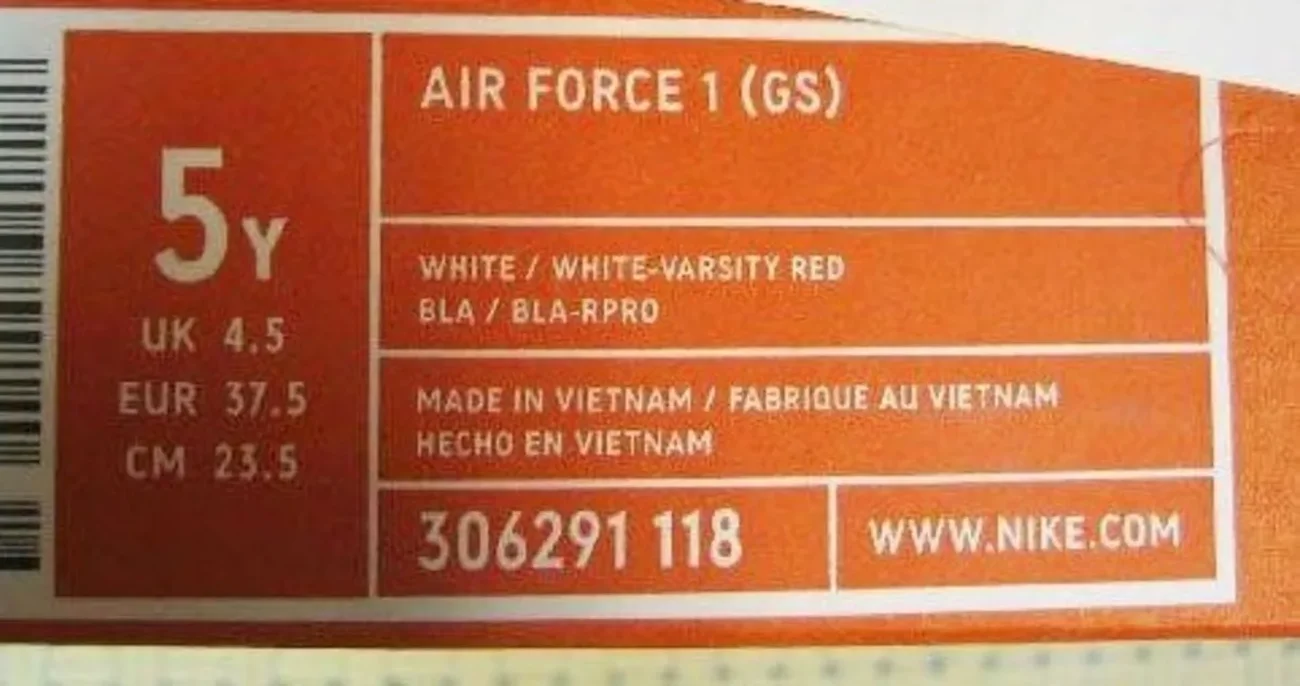
GS means Grade School and identifies a youth sneaker size range. On Nike’s current U.S. site, that category is presented to shoppers as Big Kids. GS does not mean “fake,” “lower quality,” “girls only,” or “a smaller adult shoe.” It tells you first and foremost which sizing category the product belongs to. The most important practical detail for U.S. shoppers is that Nike’s current Big Kids footwear chart runs from 1Y through 7Y. The “Y” means Youth. At the top of that range, 7Y corresponds numerically to US Men’s 7 and US Women’s 8.5 on Nike’s chart. That numerical conversion does not guarantee that a GS version and an adult version of the same sneaker are built identically. Fit, shape, materials, cushioning, tooling, and style codes can differ by release. Size equivalence and product equivalence are two separate questions.
What Does GS Mean at Nike?
In sneaker terminology, GS stands for Grade School. The abbreviation is commonly used for youth-sized versions of Nike and Jordan sneakers, including models that are also sold in adult sizing. Nike’s current consumer-facing language in the United States usually says Big Kids’ Shoes rather than putting GS in every product title. Sneaker stores, resale platforms, collectors, and older release terminology still use GS frequently. So when a listing says “Air Jordan 4 GS,” the useful translation is: this is the youth or Big Kids version of that release. It does not tell you whether the pair is authentic, rare, premium, or technically identical to the adult version. For more abbreviations used on sneaker boxes and listings, see the Sneakerhead Dictionary.
Is GS for Children or Youth?
GS belongs to the youth range. Calling it “kids’ sizing” is broadly correct, but it can be too vague because Nike separates footwear into categories such as Baby/Toddler, Little Kids, and Big Kids. On Nike’s current U.S. site, Big Kids is the category that overlaps most strongly with what sneaker culture calls GS. That distinction matters because a 7Y shoe sits in a very different size range from a toddler product even though both are technically sold under kids’ footwear. GS is therefore best understood as a youth sizing category, not a statement about who is allowed to wear the shoe.
What Does the “Y” Mean in Nike Sizes?
The Y means Youth. That is why Nike youth sizes appear as 4Y, 5Y, 5.5Y, 6Y, 6.5Y, and 7Y.
- GS describes the Grade School/Big Kids product category.
- Y appears in the specific Youth size notation, such as 5Y, 6Y, or 7Y.
The two terms are related, but they are not interchangeable. GS is the category label; Y is the sizing suffix.
What Sizes Are Nike GS?
Nike’s current U.S. kids’ footwear chart defines Big Kids as 1Y through 7Y. That is the official size-chart range, even though an individual sneaker may be offered only in part of that range. For example, many Jordan and Nike Big Kids product pages begin at 3.5Y and run through 7Y. That is a product assortment decision, not proof that the Big Kids category itself begins at 3.5Y. This is why statements such as “GS always means 3.5Y–7Y” can be misleading. Always separate the full Nike size chart from the sizes actually stocked for one release.
- 3.5Y: US Men’s 3.5, US Women’s 5, EU 35.5, CM/JP 22.5.
- 4Y: US Men’s 4, US Women’s 5.5, EU 36, CM/JP 23.
- 5Y: US Men’s 5, US Women’s 6.5, EU 37.5, CM/JP 23.5.
- 6Y: US Men’s 6, US Women’s 7.5, EU 38.5, CM/JP 24.
- 6.5Y: US Men’s 6.5, US Women’s 8, EU 39, CM/JP 24.5.
- 7Y: US Men’s 7, US Women’s 8.5, EU 40, CM/JP 25.
Can Adults Wear GS Sneakers?
Yes. Adults can wear GS sneakers if the available size matches their foot and the specific shoe fits comfortably. GS is a youth sizing category, not an age restriction. Plenty of adults—especially people whose feet fall within the 3.5Y–7Y range commonly stocked for sneaker releases—can physically fit Big Kids products. The important question is not “Am I too old for GS?” It is: Does this specific GS version fit my foot and meet my needs?
GS Sizing for Women
Nike’s current U.S. chart gives direct numerical conversions between US Kids and US Women’s sizing. For example, 5Y corresponds to Women’s 6.5, 6Y to Women’s 7.5, and 7Y to Women’s 8.5. That makes many Big Kids releases accessible to adult women. The conversion is especially useful when a colorway is released only in GS or when the youth version is priced differently from the adult version. Still, a converted size is only the starting point. Width, toe-box volume, arch shape, and overall last can feel different from an adult women’s version.
GS Sizing for Men
On Nike’s current chart, the numerical relationship between Big Kids and US Men’s sizing is direct through this range: for example, 6Y corresponds to Men’s 6, and 7Y corresponds to Men’s 7. Men whose feet fit within that range can consider GS products, but the same warning applies: a 7Y product and an adult Men’s 7 product can share a nominal size while still differing in construction or fit.
What Adult Size Is 7Y?
According to Nike’s current U.S. kids’ footwear chart, 7Y corresponds to US Men’s 7 and US Women’s 8.5. The same row shows EU 40 and CM/JP 25. Nike lists the recommended foot length for 7Y at approximately 9 11/16 inches. Nike also warns that the CM value printed on shoe boxes and labels is not the same thing as the foot-length measurement shown in its fit guidance. That distinction matters because shoppers sometimes compare only the “CM” line printed on a label and assume it is a direct measurement of their foot.
Size Conversion Is Not the Same as Fit
A conversion chart answers which number corresponds to another sizing scale. Fit describes how the shoe actually sits on your foot: width, internal volume, toe room, heel lockdown, arch feel, and overall shape. Two shoes can both be labeled 7Y and fit differently. The same can happen between a 7Y GS version and an adult Men’s 7 version of what appears to be the same silhouette.
If a model is known to run small, large, narrow, or wide, use the guidance for that exact product rather than assuming the numerical conversion solves everything. Our guide to what TTS means in sneakers explains that fit terminology in more detail.
Are GS and Adult Sneakers Exactly the Same?
Not necessarily. Some GS releases closely resemble their adult counterparts, while others use different proportions, tooling, cushioning, materials, branding details, or construction.
The visual difference may be subtle. A sneaker can look almost identical in product photos while using a different style code and a youth-specific build.
For that reason, do not assume “same colorway + equivalent size = same product.” Compare the GS and adult product pages release by release.
Are GS Materials Lower Quality?
GS does not mean lower-quality materials. Grade School is a size category, not a quality grade.
A brand may choose different leather, synthetic materials, mesh, padding, or finishing for the youth version of one release. On another release, the specifications may be very close to the adult version.
A difference in materials also does not automatically mean the GS product is “cheap” or badly made. Product design, price target, intended user, and manufacturing choices all influence the construction.
Does the Technology Change Between GS and Adult Versions?
It can, but not by definition. GS tells you the sizing category; it does not tell you exactly what cushioning, Air unit, foam, plate, or support system is inside the shoe.
This matters most in performance footwear. A youth basketball or running shoe may use a different implementation from the adult version because the intended user, body mass, dimensions, and price point are different.
For lifestyle sneakers, some Big Kids products still include genuine Nike Air cushioning. The correct approach is to read the product specifications instead of assuming that every GS model has “less Air” or simplified technology.
Can the Shape of a GS Sneaker Be Different?
Yes. The last, proportions, panel dimensions, padding, and internal volume can differ between youth and adult versions.
It is still too broad to say “GS is always narrower.” Some people experience GS models as narrower or lower-volume, but the result depends on the silhouette and the wearer’s foot.
If possible, try the exact version on—or buy from a retailer with a clear return policy—rather than relying on a universal GS fit rule.
Why Are Some Colorways Released Only in GS?
Nike and Jordan Brand sometimes create colorways specifically for Big Kids. That allows the youth range to have its own product identity instead of functioning only as a scaled-down copy of adult releases.
A GS-exclusive colorway can therefore be desirable to adult collectors who happen to fit the size range. The target category does not determine whether an adult can appreciate or wear the design.
The resale market can also give a youth-exclusive colorway a completely different demand pattern from the adult line.
Are GS Sneakers Always Cheaper?
No. Many youth versions have a lower retail price than comparable adult versions, but the exact difference varies by model and release.
Current Nike U.S. listings provide easy examples: a Big Kids Air Jordan 1 Retro High OG can carry a lower retail price than adult versions of the same franchise. But that does not create a permanent percentage discount.
On the secondary market, size, condition, colorway, demand, and scarcity can erase or even reverse the retail-price difference.
How Can You Identify a GS Version?
Use several signals together rather than looking for one universal stamp:
- Product name: Nike may say Big Kids’ Shoes, while sneaker marketplaces may use GS or Grade School.
- Y sizing: sizes such as 5Y, 6Y, and 7Y identify the Youth scale.
- Box label: size, product description, and style code can help identify the version, although label formats vary.
- Style code: the GS version may use a different code from the adult version even when the colorway looks similar.
No single one of these elements proves authenticity. Counterfeit products can reproduce box labels, size notation, and style codes.
GS vs. PS vs. TD: What Is the Difference?
Sneaker culture and resale listings often use several abbreviations to separate youth-size categories:
- GS — Grade School: commonly associated with Nike’s current Big Kids category.
- PS — Preschool: commonly used for the smaller-child range that Nike currently presents to consumers as Little Kids.
- TD — Toddler: commonly used for toddler-size releases; Nike’s current site uses Baby/Toddler as the consumer category.
Nike’s current U.S. product pages may therefore say Big Kids, Little Kids, or Baby/Toddler even when sneaker marketplaces and collectors use GS, PS, and TD shorthand.
These labels are size and product categories. They do not tell you whether a sneaker is authentic, limited, or more valuable.
How to Measure Your Foot Before Buying GS
Nike’s official measuring guidance is more reliable than starting with “I usually wear a size 7.”
- Place a sheet of paper on the floor against a wall and stand with your heel against the wall.
- Mark the end of your longest toe.
- Measure both feet and use the longer measurement.
- Compare the result with Nike’s current kids’ footwear chart.
- If you fall between sizes, follow Nike’s current fit guidance and the recommendations for the exact model.
Do not confuse Nike’s recommended foot-length measurement with the CM/JP size printed on product labels. Nike explicitly notes that those two values are different.
How to Compare a GS Sneaker With the Adult Version
Before choosing between youth and adult versions, compare them release by release:
- Confirm the full product name and style code for both versions.
- Open the official GS and adult product pages when both are available.
- Compare the upper, lining, midsole, outsole, and cushioning system.
- Check proportions, branding, and visible construction details.
- Read the fit guidance for the exact product.
- Compare retail pricing rather than only resale listings.
- Consider the intended use: lifestyle wear and athletic performance can require different priorities.
If you plan to use the shoe for basketball, running, or another performance activity, pay extra attention to the cushioning and structural specifications. A visual match is not enough.
For casual wear, fit and comfort may matter more to you than small construction differences.
Is GS Worth Buying if You Are an Adult?
It can be. GS may make sense if the size fits, the specific construction works for your intended use, and the price is attractive.
A GS-exclusive colorway can also be the main reason to buy. There is no rule that an adult collector must avoid a product because Nike markets it in the Big Kids category.
The main mistake is assuming that numerical size equivalence guarantees identical fit and construction. Compare first, then decide.
Nike GS FAQ
What Does GS Mean on a Sneaker Box?
GS means Grade School and identifies a youth-size version. Nike’s current U.S. consumer terminology generally calls this category Big Kids. A box or marketplace listing may still use GS, and the sizes typically use the Y suffix.
Is GS a Kids’ Size?
Yes. GS is a youth category, broadly corresponding to Nike’s Big Kids range. Adults whose feet fit the range can still wear it.
Is GS for Boys or Girls?
GS describes size, not gender. Nike sells Big Kids products across boys’, girls’, and general kids’ sections, and anyone can wear a pair that fits properly.
What Does 7Y Mean at Nike?
7Y is Youth size 7. Nike’s current U.S. chart maps it numerically to Men’s 7, Women’s 8.5, EU 40, and CM/JP 25.
Is GS Smaller Than “Regular” Sizing?
GS uses a youth size scale, so “regular” is too vague to be useful. Convert the number using Nike’s chart, then confirm the actual fit of the specific model.
Are 7Y and Men’s 7 the Same Product?
Not necessarily. Nike’s chart gives them numerical size equivalence, but a GS 7Y and an adult Men’s 7 can use different style codes, lasts, materials, tooling, or cushioning.
Are GS Sneakers Lower Quality?
No. GS is not a quality grade. Materials and construction depend on the exact product and release.
Does Every GS Sneaker Have Less Air or Simplified Technology?
No. Technology has to be checked product by product. Some Big Kids models use Nike Air cushioning, while other youth products may use a different setup from their adult counterpart.
Are GS Sneakers Always Cheaper?
No. Youth retail pricing is often lower on comparable releases, but not universally. Secondary-market pricing follows its own supply and demand.
Does GS Prove a Sneaker Is Authentic?
No. GS, Y sizing, a box label, and a correct-looking style code can all be copied. Authentication is a separate process; see our Legit Check guide.
GS Is Simple Once You Separate Size From Product
GS means Grade School: a youth sizing category that Nike currently presents to U.S. shoppers as Big Kids. Y identifies the Youth size scale, and Nike’s current chart runs from 1Y through 7Y.
Adults can wear GS when the size and fit work. A 7Y corresponds numerically to Men’s 7 and Women’s 8.5, but that does not prove the GS and adult shoes are constructed identically.
The best rule is straightforward: convert the size, then evaluate the product. Check the exact release, style code, fit, materials, cushioning, and intended use rather than assuming that GS alone tells you everything.