NSW stands for Nike Sportswear. Nike uses the name for an assortment of sport-inspired footwear, apparel, and accessories designed for everyday life. Air Force 1, Air Max, and Dunk are among the families represented in this area.
Sportswear is neither a technology nor a quality rating. Many of its models retain innovations developed for sports, but athletic origins do not make every current version suitable for training or competition.
What is Nike Sportswear?
Nike Sportswear is a broad area of Nike’s offerings closely connected to lifestyle and everyday wear. But calling it “Nike’s casual side” and leaving it there misses a substantial part of the story.
The Nike Sportswear page brings together footwear, apparel, and accessories for men, women, and kids. Its links include Air Force 1, Air Max, Dunk, Shox, Vomero, Pegasus, Total 90, and Retro Running, alongside categories such as T-shirts, sweatshirts, jackets, and pants.
That selection can change by collection, season, and market. It is best understood as a snapshot of how Nike currently organizes and presents Sportswear, rather than a permanent organizational chart capable of classifying every SKU the company has produced since the 1970s.
Is Nike Sportswear the same as lifestyle?
Lifestyle is a useful approximation, but not a perfect substitute for Nike Sportswear.
In sneaker retail, lifestyle generally describes products positioned primarily for everyday wear, fashion, and personal style, rather than as the latest sports equipment for competition or specialized training.
Sportswear is closely connected to that world. In some markets, Nike uses a revealing idea to present parts of this range: products that began with performance and evolved for everyday life.
That is very different from saying Sportswear is “the opposite of performance.” Many of its most recognizable silhouettes exist because Nike was once trying to solve real problems for athletes.
It is also worth separating sportswear from streetwear. The two overlap considerably, especially in sneaker culture, but they are not synonyms. Nike Sportswear is broader than simply “Nike’s streetwear.”
Can an NSW product have performance technology?
Yes. NSW does not mean “no technology.”
A sneaker now worn as a lifestyle shoe may contain Nike Air, Max Air, foams, constructions, or other elements that originated in sports research. The technology does not automatically disappear when the context of use changes.
Air itself is the simplest example. Nike Air technology began with athletic performance and cushioning, but today also appears in countless sneakers worn mainly away from courts and tracks.
There is an important nuance, though: retaining a historical technology does not mean remaining the best current sports equipment for the original purpose. A retro sneaker may keep an Air unit without being the model a runner would choose to compete against a modern shoe developed specifically for running.
Technological origins, current construction, and market positioning are different questions.
From courts and tracks to the street: the story behind Sportswear
The most fascinating part of Nike Sportswear is not the abbreviation. It is the journey the products have taken.
For decades, Nike developed shoes for basketball, running, soccer, tennis, and other sports. Some aged as athletic equipment. Others did something much less common: they found a second life.
They moved beyond sports, passed through communities, gained new colors, were adopted by music, skateboarding, or fashion, and became part of everyday wardrobes.
Air Force 1: from basketball to everyday wear
Nike’s official Air Force 1 archive records the model’s 1982 release. Bruce Kilgore designed it as a basketball shoe, and it was the first in the sport to incorporate Nike Air.
One of Nike’s biggest lifestyle icons, in other words, began as an effort to improve what happened on a basketball court.
Nike’s own timeline shows when the shoe moved beyond that role. After its reintroduction in Baltimore in the mid-1980s, the Air Force 1 gained traction on the streets and developed an identity that no longer depended solely on basketball.
Today, Nike presents the Air Force 1 among its Sportswear families. Its history helps explain how a basketball shoe became an everyday staple.
The full story is worth exploring in our history of the Nike Air Force 1. Understanding the AF1 only as a “white casual sneaker” erases precisely what made the silhouette so important.
Air Max: from running to lifestyle
With Air Max, the story moves from the court to the track. The Department of Nike Archives records the Air Max 1’s arrival in 1987, after Tinker Hatfield worked with Nike engineers to turn visible Nike Air into a market-ready innovation.
The model was born in a context of running and innovation. Nike describes that historical evolution as something that began with cushioning and became an icon on the street as well.
Decades later, Air Max is one of the most prominent families in Nike Sportswear. That does not rewrite 1987. It makes 1987 even more relevant.
The shoe worn with a casual outfit today still carries a visible piece of its athletic history in its midsole window.
Dunk: basketball, skateboarding, and the street
The Dunk may be an even better illustration of why rigid classifications fail.
According to Nike’s official Dunk history, it originated in connection with the 1985–86 college basketball season through the College Colors Program. School colors helped give the shoe a visual identity that quickly began drawing attention off the court, too.
In the 1990s, skaters adopted low-priced Dunks and discovered that the construction also worked well on a skateboard. New chapters involving art, music, fashion, and Nike’s own expansion into skateboarding followed.
That is why simply saying “Dunk is NSW” tells you very little. Today, lifestyle Dunks appear within Sportswear, while Nike SB Dunk products are connected to skateboarding.
For a closer look at that transformation, see our history of the Nike Dunk.
Retro Running: when running aesthetics find a new life
The Retro Running category within today’s Sportswear almost explains the connection between athletic archives and lifestyle footwear on its own.
Designs associated with running in earlier eras return because their proportions, panels, mesh, overlays, and soles have gained aesthetic appeal, even when more modern running equipment exists.
The Nike P-6000 is a good example. Nike describes it as a blend inspired by past Pegasus models, especially the Pegasus 25 and Pegasus 2006, bringing a 2000s running aesthetic to a contemporary product.
That is very different from saying “the P-6000 is a modern running shoe.” Athletic inspiration and current positioning can coexist without being the same thing.
Total 90: from soccer to a new setting
The Total 90 also appears within Sportswear. The casual reinterpretation brings back visual elements of the soccer-cleat family, such as asymmetrical lacing, but changes the intended setting: Nike presents it for the street.
It is another reminder that Nike’s athletic archive does not stand still. A design language created for a field, track, or court can return years later with a different role.
Does NSW include apparel or just sneakers?
It includes much more than sneakers.
Nike Sportswear also appears on T-shirts, sweatshirts, pants, jackets, shorts, accessories, and collections such as Nike Tech. The current Sportswear page clearly separates footwear and apparel, and Nike Brazil has also used NSW directly in apparel product names.
Finding NSW on a T-shirt or jacket is therefore nothing unusual. The abbreviation has never been exclusive to sneakers.
What is the difference between Nike NSW and Nike SB?
Nike Sportswear and Nike SB are not synonyms.
Nike SB is directly connected to skateboarding. Its current official catalog includes shoes constructed and presented as skateboarding products, along with its own apparel and accessories.
The distinction becomes especially interesting when one silhouette crosses both worlds. The Dunk has lifestyle versions and Nike SB Dunk versions. In 2026, Nike also introduced the Nike SB Air Force 1, with skate-specific changes to fit, midsole height, traction, and impact protection.
Even a classic strongly associated with Sportswear, then, can receive a version genuinely designed for another purpose.
For more on that world, see what Nike SB means.
What is the difference between Nike Sportswear and ACG?
ACG stands for All Conditions Gear and has its own history within Nike.
In February 2026, Nike officially reintroduced ACG with a dedicated focus on outdoor performance, including trail running, hiking, and exploration.
That shows why NSW and ACG should not be compared as two equivalent boxes labeled “casual versus adventure.” ACG has its own history, and its positioning has also changed over the decades.
That evolution is covered in more detail in what Nike ACG (All Conditions Gear) is.
Is Jordan part of NSW?
It is inaccurate to simply say Jordan is an NSW subdivision.
Sportswear landing pages in some markets may show Jordan products alongside other lifestyle styles. That is merchandising: a way of organizing what consumers see in that shopping experience.
Store organization is not the same as a corporate organizational chart. NIKE, Inc. itself presents Nike, Jordan, and Converse as brands in its portfolio.
Seeing Air Jordan on a Sportswear page therefore does not make Jordan Brand synonymous with NSW.
Does NSW appear on the tag or SKU?
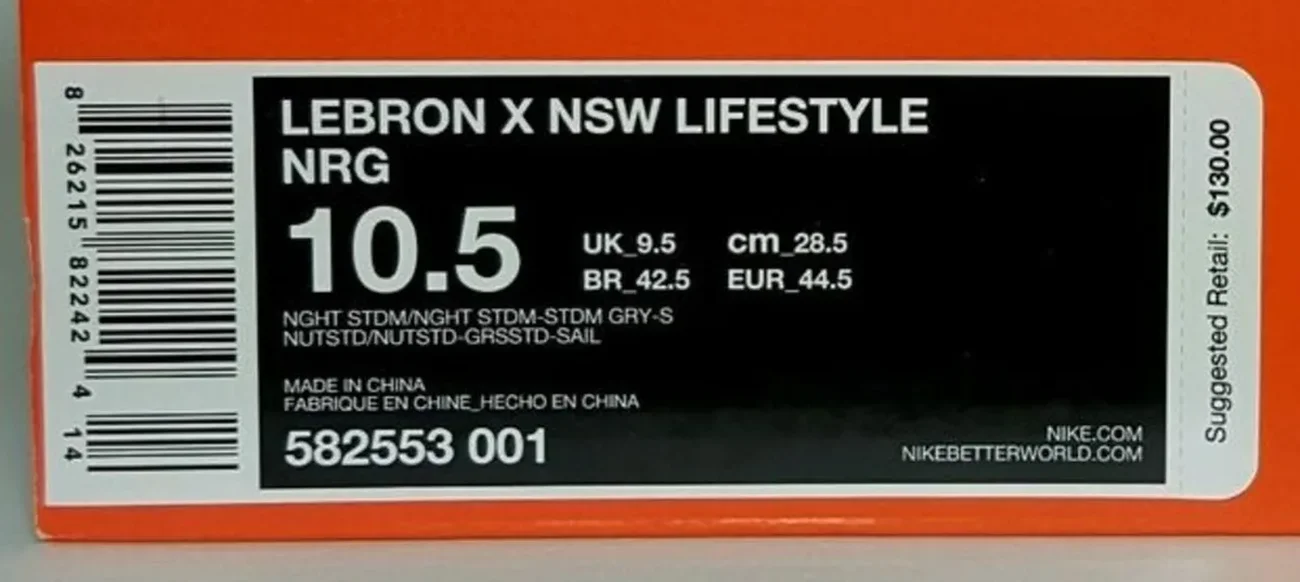
NSW may appear in product names, descriptions, retail systems, or other forms of commercial identification. Nike Brazil has published apparel with “Nike NSW” directly in the product title.
That should not be turned into a rule that “every Sportswear product has NSW printed on its internal tag.” There is no reason to assume a universal standard across all eras, markets, and product categories.
The same caution applies to the SKU or style code. The code identifies a specific product configuration. There is no documented universal sequence that lets you look at a SKU and immediately conclude: this is NSW.
How can you tell whether a product belongs to Nike Sportswear?
The safest approach is to check the specific product, rather than memorize a magic code.
- Check the official name and description. Nike may use Sportswear or NSW directly in its presentation.
- Look at how the product is organized on Nike’s official site. Its current category helps explain its commercial positioning.
- Consult official documentation when the classification matters. Product families change contexts and receive different versions.
- Use the SKU as a product identifier, rather than a universal NSW decoder.
Together, the name, description, and code distinguish versions within a family without requiring you to infer the category from appearance alone.
Does NSW mean the product is authentic?
No. NSW does not tell you whether a specific item is authentic. It simply means Nike Sportswear.
Authentic Nike Sportswear products obviously exist. The problem is treating the abbreviation as proof of authenticity. A counterfeit can reproduce names, tags, logos, codes, and other information found on genuine products.
Authenticity requires examining the product and its provenance. To understand that process, see what a Legit Check (LC) is.
Is Nike NSW premium, rare, or more expensive?
Not by definition.
NSW does not mean Premium, special edition, limited release, or rare product. Sportswear can include products at different price points, regular collections, special versions, and collaborations, but those characteristics need to be evaluated individually.
The same goes for quality and comfort. The abbreviation alone does not promise a particular material, level of finishing, softness, or durability.
NSW provides context. It is not a quality grade.
To keep decoding the names, abbreviations, and concepts found on boxes, in releases, and in collector conversations, continue with the Sneakerhead Dictionary. To explore the stories that turned sports products into cultural icons, visit Sneaker History and Culture.