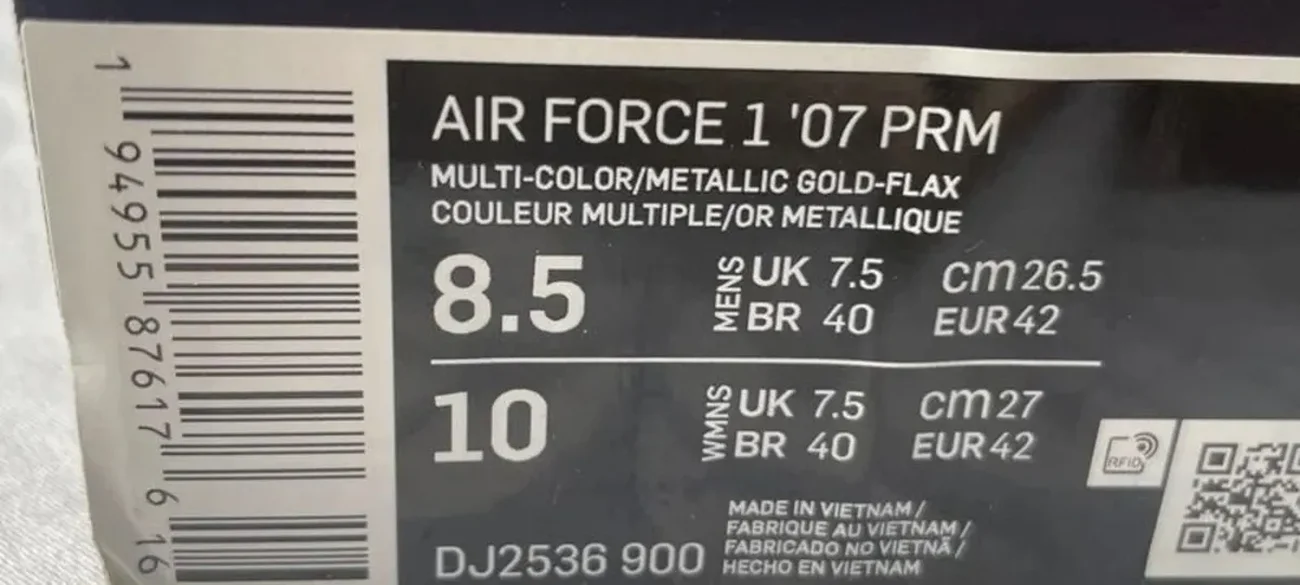
PRM is short for Premium in Nike product naming. The connection appears, for example, on Nike’s Brazilian Air Force 1 ’07 PRM page, whose description calls the same edition the Air Force 1 ’07 Premium.
The word identifies a version of a product, rather than a quality certification. To understand what changes, compare that version’s specifications: PRM can appear on a casual sneaker or a performance court shoe.
What does Nike PRM mean?
PRM is associated with Premium in Nike product names.
There is no single technical specification for all PRM products. The abbreviation does not, by itself, define leather grade, outsole durability, or a finishing standard.
The usage is well established, though, and official Nike pages help demonstrate the connection. One Brazilian example is the Nike Air Force 1 ’07 PRM: PRM appears in the page’s name, while the description calls the product “Nike Air Force 1 ’07 Premium.”
The relationship between PRM and Premium is documented for the product. Claims of greater comfort or durability require a separate evaluation.
For other abbreviations found in names, on boxes, and in sneakerhead conversations, continue afterward with the Sneakerhead Dictionary.
Is PRM a Nike quality certification?
No. PRM is a product designation, not a quality certification.
A quality certification would require a defined testing or inspection standard. Nike’s product pages do not establish a uniform technical standard for every PRM.
It is more accurate to treat PRM as a suffix or designation for a particular product version. In some cases, that version really does feature noticeably different materials or details. In others, the distinction may lie in the colorway, theme, or a particular combination of features.
What changes on a Nike PRM?
The most accurate answer is: it depends on the release.
Differences may involve materials, textures, colors, or details connected to an edition’s theme. There is no mandatory list of changes for every PRM.
Materials can change
Some PRMs feature a distinctive mix of materials. A particularly clear example is the Nike Tennis Classic CS PRM.
For the White/Black/White colorway, style code JA8560-100, Nike describes the upper as pony hair over genuine leather. The product also uses a foam midsole, rubber outsole, and stitched cupsole construction.
This is a good example of PRM associated with a particular material treatment.
But there is a huge difference between saying “this Tennis Classic CS PRM uses these materials” and “every PRM uses leather and pony hair.” The first statement comes from the official specifications. The second would be invented.
Textures and finishes can also distinguish a version
Depending on the product, the difference may involve texture, a visual treatment, surface finishing, metal details, overlays, lining, or other elements.
These should always be described as they appear on that release. If Nike says “premium leather,” we can report that Nike describes that material as premium leather. That is not the same as an independent analysis showing it is objectively better than every leather used on other versions.
The same applies to suede. Suede does not automatically become “better” because it is on a PRM, and a shoe does not become a PRM simply because it has suede.
Colorways and details can matter
Some PRM versions feature color combinations, graphics, or elements created for a particular story. This is especially apparent in Nike’s current tennis shoes, where some PRMs connect to themes and tournaments while retaining their sporting purpose.
Not every difference, then, can be reduced to “they used more expensive leather.” The entire version needs to be considered.
Does every Nike PRM use premium leather?
No.
It is an easy generalization to make because many historical PRMs became known for leather, suede, or other visually distinctive material treatments.
But the range of products shows why it cannot become a rule.
The Nike Vapor 12 PRM, for example, is a performance hard-court tennis shoe. Nike describes an engineered mesh upper, a firm midfoot structure, specialized rubber in the traction pattern, and Air Zoom cushioning.
The construction makes sense for what the shoe needs to do during a match. Automatically replacing technical materials with natural leather just to make something seem “more premium” could even be counterproductive in certain sports products.
Natural material is not a universal synonym for better material. Whether a material suits its intended use is a much more useful question.
Is Nike PRM more comfortable or more durable?
Neither is guaranteed.
Comfort depends on factors such as the last, midsole, cushioning, flexibility, upper stiffness, ventilation, weight, and even the wearer’s anatomy.
Durability depends on construction, materials, frequency of wear, surface, climate, care, and intended use.
A different material can improve one quality while making another worse. A more structured upper may feel different from lightweight mesh; suede and leather require different care from technical fabrics. The PRM suffix cannot resolve that equation on its own.
If terms such as upper, midsole, and outsole are still confusing, our sneaker anatomy guide explains each part of the shoe before you compare constructions.
Does PRM mean limited, rare, or exclusive?
No.
PRM does not automatically tell you:
- How many units were produced;
- How many stores received the product;
- How long it will remain available;
- Whether there will be a restock;
- Which countries will sell it;
- Whether it will attract strong secondary-market demand.
A particular PRM release may become rare over time. Another may remain available, go on sale, or never attract much collector interest.
Rarity belongs to that release’s history, rather than to the three letters.
Is every Nike PRM a collaboration?
No. PRM does not mean collab, either.
A collaboration may carry a particular designation, but PRM alone does not establish that another designer, artist, brand, or store participated in the project.
Likewise, PRM is not synonymous with hype, exclusivity, or investment.
Is Nike PRM more expensive?
There is no universal pricing rule.
One PRM version may launch with a different MSRP from another version. Another may have a similar price. After launch, discounts and promotions can change the comparison further.
Price comparisons should use equivalent versions, sizes, markets, and dates. Retail prices and any discounts are commercial decisions, rather than values built into the abbreviation.
Are PRM and the word “Premium” exactly the same thing?
The two naming conventions should not automatically be merged.
Nike also has products in which Premium is written out as part of the model’s own name.
Two important examples are the Nike Pegasus Premium and Nike Vomero Premium.
The Nike Pegasus Premium is a modern running shoe combining ZoomX, a sculpted Air Zoom unit, and ReactX. The Nike Vomero Premium is also a running product, using ZoomX and two Air Zoom units.
In these cases, “Premium” forms part of the model’s commercial identity. We should not simply rename them “Pegasus PRM” and “Vomero PRM,” or assume they follow exactly the same system as PRM used as a suffix on another version.
Similar words do not justify creating a classification Nike has not published.
What is the difference between PRM and SE?
PRM and SE appear as different designations on Nike products, but should not be arranged on a ladder where one is automatically “superior” to the other.
A sound comparison looks at each release: its official name, the materials Nike specifies, construction, intended use, colorway, and what actually distinguishes that version.
There is therefore no reliable basis for summarizing the relationship as “PRM has better quality, while SE only changes the design.” These are different product designations, not report-card grades for sneakers.
What about PRM versus QS or SP?
The same caution applies to QS, SP, and other abbreviations found on Nike products over the years.
There is no reason to create a universal hierarchy such as SE < PRM < QS < SP and conclude that moving up the sequence necessarily brings higher quality, better materials, fewer pairs produced, or greater value.
These designations need to be researched within the historical and commercial contexts in which they were used. Combining them into one scale is easy to memorize, which is precisely why it can be misleading.
How do you correctly identify a Nike PRM?
The best evidence is the release’s official name.
- Look for the full product name. Real examples include “Nike Tennis Classic CS PRM” and “Nike Vapor 12 PRM.”
- Confirm it on an official page or in reliable documentation. This avoids classifying a shoe simply because it looks refined.
- Use the style code to identify the exact release. It helps distinguish specific colorways and versions.
- Read the product specifications. They tell you the actual materials, technologies, recommended playing surface, and other details.
Trying to identify PRM just by looking at a shoe is unreliable.
A sneaker with leather, suede, an unusual texture, or a luxurious appearance may have no PRM in its name at all. Materials do not prove a designation.
Does PRM appear on the tag?
PRM may appear with a product’s name in listings, commercial systems, and the identification of certain releases. How that name appears on boxes and tags may vary by period and product.
What we should not claim is that every Nike PRM must have “PRM” in a particular position on its internal tag.
For identification, the combination of official name, style code, and release documentation is far more reliable than an invented universal tag rule.
Does PRM prove a Nike shoe is authentic?
No.
A counterfeit can copy the product name, PRM, style code, packaging, tag, and other visual elements of a real item.
Finding “PRM” on a box or listing therefore does not authenticate the pair. Authenticity requires a separate investigation.
If that is the question, our Legit Check (LC) guide explains what it means to examine whether a sneaker is authentic.
Is a Nike PRM worth buying?
It certainly can be, if that particular version makes sense for you.
Rather than buying because three letters supposedly mean “the best Nike,” ask:
- What materials does this release actually use?
- Do you like this colorway?
- Does the model suit your intended use?
- Do its fit and construction work for your feet?
- Does the current price make sense compared with the alternatives?
For someone interested in the Tennis Classic CS PRM, for example, the combination of pony hair and leather may be exactly the appeal. For someone shopping for a court shoe, the questions about a Vapor 12 PRM are entirely different: stability, traction, fit, and responsiveness become much more important.
PRM does not choose the best product for you. It helps identify a version worth investigating.
To keep understanding the small designations that appear after sneaker names, consult the Sneakerhead Dictionary. To explore how models, technologies, and sports products have moved through different eras of sneaker culture, visit History and Culture.