
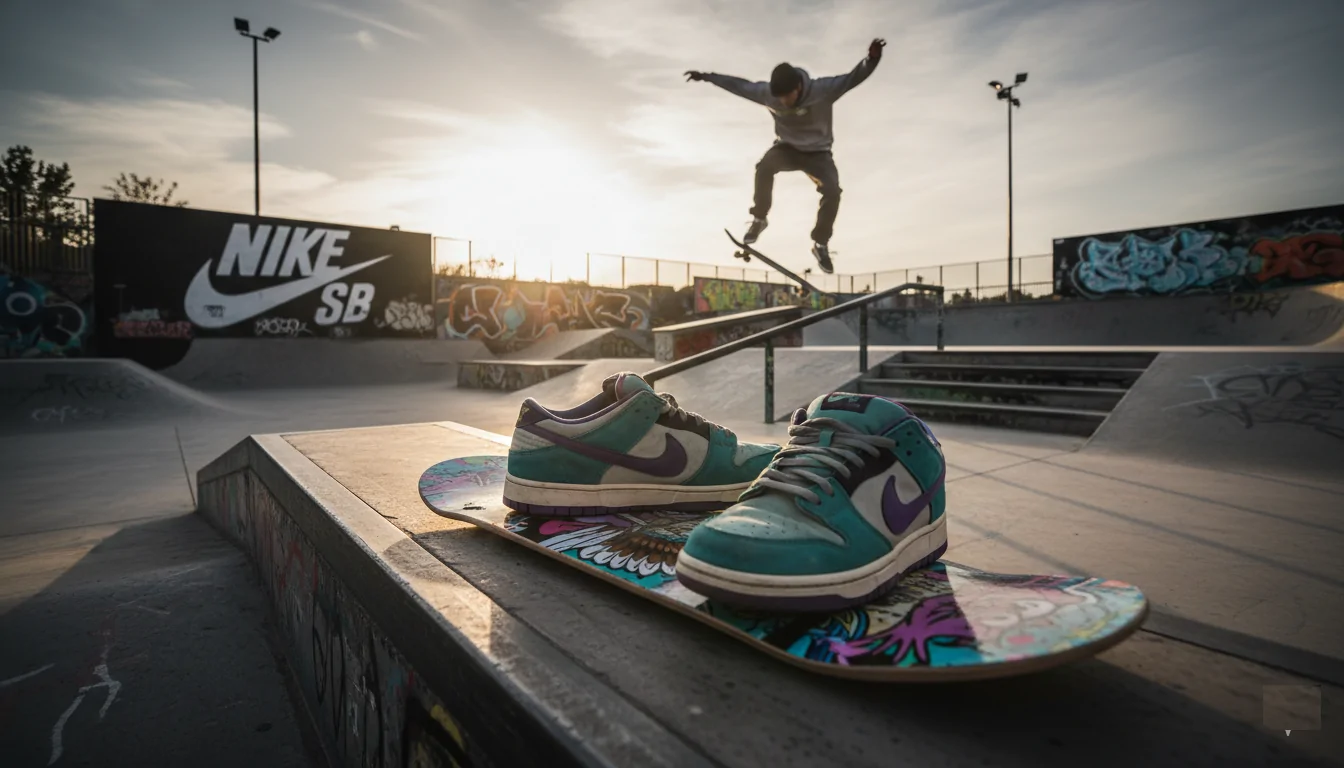
Nike SB stands for Nike Skateboarding. It is Nike’s skateboarding division, formally established in 2002 after several attempts to gain a foothold in the market during the 1990s. The project found a clearer direction under Sandy Bodecker, with the Nike SB Dunk as one of its cornerstones. But Nike SB has never meant just the Dunk.
The story is more complicated than a major brand simply deciding to make a skate shoe. The Nike Dunk started as a basketball shoe, was adopted by skaters before an SB version existed, and only later received skate-specific modifications. Meanwhile, distribution through skate shops, riders, videos, teams, and collaborations helped shape the division’s identity.
When did Nike SB launch?
Nike SB launched in 2002. What came before it matters, though: Nike itself acknowledges earlier attempts to enter skateboarding during the 1990s without earning the credibility it wanted in a culture deeply connected to independent brands, skate shops, and skater-owned companies.
Rather than tell this story as if Nike understood skateboarding from the start, it is more accurate to say the company had to rethink its approach. Sandy Bodecker became a central figure in that change.
Who was Sandy Bodecker, and why did he matter to Nike SB?
Sandy Bodecker was a veteran Nike executive who took the lead on a new push into skateboarding. According to Nike’s own archives, he began developing a skate-specific Dunk in 2001. The following year, the SB Dunk arrived alongside this new chapter of Nike Skateboarding.
His role was not to “invent the Dunk,” a silhouette that had existed since the 1980s, but to help transform Nike’s skateboarding strategy. Product development, athletes, and community relationships became more closely connected.
Nike later honored Bodecker with the SB Dunk Low “Sandy,” a reinterpretation of the Dunk created for a charity auction in 2003.
Did skaters wear Dunks before Nike SB existed?
The Nike Dunk began as a college basketball shoe, not a skate shoe. After its prominence in basketball faded and it went through periods of lower visibility in Nike’s catalog, skaters found pairs and appreciated features such as durable leather, a relatively straightforward profile, and a grippy outsole.
Skaters adopted it before Nike formally launched the SB version. That is why it is inaccurate to say the Dunk has always been a skate shoe.
Are the Nike Dunk and Nike SB Dunk the same thing?
No. They share a silhouette and much of their visual language, but their histories and construction differ.
- Nike Dunk: originated in college basketball and later became a lifestyle shoe as well.
- Nike SB Dunk: the adaptation developed specifically for Nike’s skateboarding division and launched in 2002.
This also means a regular Dunk Low should not automatically be called an “SB.” The same applies to lifestyle colorways that merely resemble particular releases from the skate line.
What changed on the 2002 SB Dunk?
According to Nike’s historical archive, the SB version released in 2002 introduced functional changes for skateboarding, including a Zoom Air unit, a padded tongue, additional cushioning, and grip adjustments.
Zoom Air is part of the Nike Air family, but its presence in the SB Dunk does not mean every Nike SB shoe uses exactly the same cushioning system. Those solutions vary across models, generations, and signature lines.
It is also inaccurate to describe the SB Dunk as simply “a Dunk with a fat tongue.” The padded tongue became a visual hallmark of many versions, but the differences also involve construction, the insole and cushioning, and skate-specific adjustments.
Who were Nike SB’s first skaters?
The original Colors By series in 2002 featured four skaters, each associated with a colorway of their own:
- Richard Mulder;
- Danny Supa;
- Reese Forbes;
- Gino Iannucci.
They were more than faces in advertisements. The early strategy connected riders, product choices, and specialist shops, an important difference between this new effort and Nike’s previous attempts to enter skateboarding.
Why were skate shops so important?
In the early years, controlled distribution through independent skate shops helped connect Nike SB with skateboarding’s existing community. These shops were more than retail outlets: in many cities, they were hubs of the local scene, bringing together teams, videos, events, products, and people.
This helps explain why Nike SB’s story cannot be reduced to shoe technology. How the product reached its audience was part of the strategy, too. That background also helps explain the Orange Label program and the ISO abbreviation.
What do Orange Box, Silver Box, Pink Box, and other Nike SB eras mean?
Collectors began using shoebox colors as a practical way to identify periods in Nike SB history. Terms such as Orange Box, Silver Box, Pink Box, and Black Box appear frequently in the market and in specialist coverage.
Orange Box refers to the first phase in 2002. Other packaging and eras followed, including Silver, Pink, and Black. The timeline gets more complicated in later periods, and not every box marks a specific technical change to the shoes.
A term like “Pink Box Dunk,” then, works better as a reference to a release era than as the name of a technology.
How did collaborations help define Nike SB?
Collaborations turned the SB Dunk into a platform for stories connected to skate shops, artists, music, independent brands, and local culture. The historical significance of these partnerships does not depend on their resale prices.
Supreme and the early collaboration years
Supreme was among the collaborators that defined Nike SB’s early years. These projects helped establish a model in which a skate shop or culturally influential brand could reinterpret the Dunk without turning it into generic promotional merchandise.
Staple Pigeon
The SB Dunk Low created with Jeff Staple in 2005 used the pigeon as a symbol of New York City. Its release at Reed Space became one of the most memorable episodes of the early SB Dunk era and received widespread press coverage.
Diamond Supply Co. “Tiffany”
The famous 2005 Dunk is a collaboration between Diamond Supply Co. and Nike SB. “Tiffany” became a nickname for its color scheme.
It was not a collaboration with Tiffany & Co. The distinction matters because Nike would officially work with Tiffany & Co. on a different project many years later.
Concepts Lobster
Concepts developed its own series of lobster-inspired SB Dunks. The 2008 Red Lobster started a line that later expanded into other colors and interpretations.
Parra
Dutch artist Piet Parra brought his graphic style to Nike SB through projects connecting his skateboarding background with his artistic work. His first Nike SB collection, featuring the Dunk Low and Blazer Low, arrived in 2019.
Ben & Jerry’s “Chunky Dunky”
In 2020, Nike SB and Ben & Jerry’s brought the ice cream brand’s aesthetic to the SB Dunk Low “Chunky Dunky.” It is a good example of how the Dunk had become a cultural platform extending well beyond skateboarding’s purely functional needs.
Travis Scott
Projects associated with Travis Scott also helped put the SB Dunk back at the center of mainstream attention in the early 2020s. That was part of a much larger story, though: Nike SB already had nearly two decades of skateboarding, collaborations, and a culture of its own behind it.
Does Nike SB only mean the SB Dunk?
No. The Dunk has a major presence in collecting, but Nike SB has a long history of other models.
Names that have become important over the years include:
- Stefan Janoski: a signature line that became one of Nike SB’s most recognizable;
- Blazer SB: a skate adaptation of a Nike silhouette that predates the division by decades;
- Paul Rodriguez: one of the leading signature lines in SB history;
- Nyjah Huston: signature models from a later generation;
- Ishod Wair: skate projects with a distinct identity;
- Leo Baker: an important presence in the contemporary Nike SB team.
Is Nike SB about skate performance or sneaker culture?
Both can coexist, depending on the model and the context.
The division develops skateboarding products and sponsors professional athletes. At the same time, certain SB Dunks have moved beyond that use to become important pieces of streetwear, collecting, and sneaker culture.
That does not mean resale prices determine how good a shoe is for skating. A release highly prized by collectors can be culturally important without being the best practical choice for a particular skater. Likewise, a model with little hype may be much better suited to everyday skating.
Over time, Nike SB expanded its catalog and developed signature lines, videos, teams, and collaborations that brought skateboarding, art, music, and sneaker culture together. For more terms from this world, the Sneakerhead Dictionary covers related concepts without reducing the culture to the resale market.