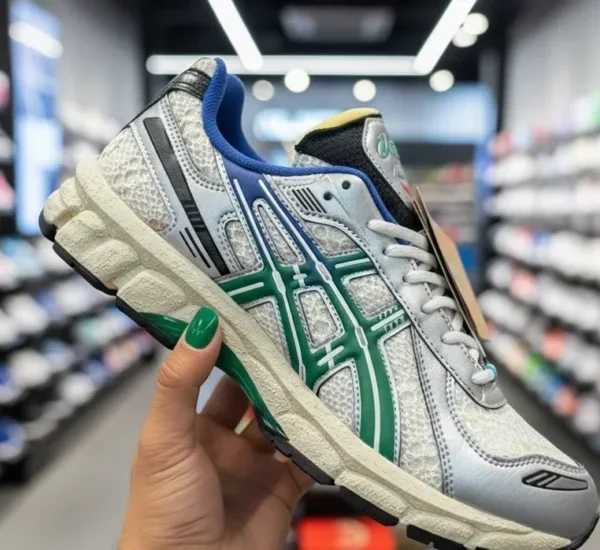
Retro, vintage, and OG aren’t synonyms, and they aren’t three mutually exclusive categories, either. Retro usually describes a later production of an existing model; vintage primarily concerns the physical age and manufacturing era of a particular pair; and OG depends on context, potentially referring to an original release, a historical colorway, or even part of a modern edition’s name.
The same sneaker can be both retro and vintage. An older original release can be both OG and vintage. A newly manufactured Air Jordan 1 Retro High OG, meanwhile, is a current production despite having OG in its name.
The most useful principle is this: the age of a design isn’t the same as the physical age of an object.
The key distinction: design age, object age, and origins
Much of the confusion disappears when we separate three questions:
- Was this pair produced after an earlier edition of the same design? That helps explain retro.
- When was this physical object actually manufactured? That helps explain vintage.
- How does this name, release, or colorway relate to the model’s historical origins? That helps interpret OG.
A design created decades ago can be manufactured today. In that case, the design has a long history, but the object that recently left the factory hasn’t acquired those decades of age along with it.
Today’s Chuck 70 illustrates the difference: Converse presents it as a reinterpretation of its archive, with details inspired by the past. That reference doesn’t make every newly manufactured Chuck 70 a pair produced in the 1970s.
What is a retro sneaker?
In sneaker vocabulary, a retro is usually a later edition that brings back a previously released model or design.
Jordan Brand made the term especially familiar by using “Retro” for many Air Jordan rereleases, but other brands aren’t required to use the same naming convention. Depending on the company and product, you may also see reissue, rerelease, archive, heritage, re-edition, or simply a product name that revives a historical model.
Jordan Brand describes its Retro collections as drawing on the past while looking ahead, including new interpretations of materials and color blocking.
That demonstrates an important point: retro doesn’t mean a 1:1 reproduction of the original.
For a deeper explanation of the term, see what a retro sneaker is.
Can a retro become vintage?
Yes. An older retro can fit both descriptions.
Retro describes that edition’s relationship to an earlier release. That relationship doesn’t disappear with time.
If a retro was produced decades ago, the physical object has aged, too. Today, it can therefore be described as both:
- retro, because it was a later production of an earlier model;
- vintage, because that physical pair belongs to a past era.
Is a retro an identical copy of the original?
Not necessarily.
Between an original release and a later edition, differences can include:
- shape;
- molds;
- materials;
- foams and rubber;
- upper height;
- branding;
- the tongue;
- stitching;
- colors;
- manufacturing processes.
Some editions aim to closely match the original; others reinterpret details. A change doesn’t automatically mean an improvement, either. Comfort, materials, and construction need to be assessed on the specific release.
Statements such as “every retro is more comfortable,” “every retro has better materials,” or “every retro is cheaper” therefore aren’t reliable rules.
What is a vintage sneaker?
Vintage primarily describes the physical age and era of a particular pair.
It doesn’t need to belong to a silhouette’s first release.
An Air Jordan Retro produced decades ago can therefore be vintage today. Likewise, an ordinary sneaker from an earlier era can be vintage without ever having been rare, expensive, or historically revolutionary.
To explore this category further, see what a vintage sneaker is.
Is there a minimum age for a vintage sneaker?
There is no universally regulated age threshold in sneaker culture.
Etsy requires at least 20 years for items sold as vintage. That’s a platform-specific criterion and an example of a commercial convention, rather than a rule governing every collector’s vocabulary.
It shouldn’t become a mathematical boundary for sneakers. Communities, stores, archives, and collectors may use the word somewhat differently.
In 2026, pairs genuinely manufactured in the 1980s and 1990s are very clear examples of period objects. Early-2000s sneakers also appear in vintage contexts as time passes.
Does vintage require wear or visible aging?
No. Age and condition are different things.
A vintage sneaker can be:
- used;
- lightly used;
- never worn;
- deadstock;
- restored;
- with or without visible signs of aging.
Yellowing, dirt, cracking, and wear therefore aren’t requirements for calling something vintage.
If the condition is described as DS, that doesn’t tell you the product’s age, either. See our separate explanation of DS in sneakers.
Does an unworn sneaker keep aging?
Yes. Not wearing a shoe doesn’t freeze its materials in time.
Adhesives, foams, rubber, leather, fabrics, synthetics, and polymers age in different ways depending on their composition and storage conditions.
The Canadian Conservation Institute explains that certain polymers, including some polyurethanes, degrade through reactions with water. That materials guidance helps explain why a lack of wear doesn’t guarantee structural preservation.
This doesn’t mean every vintage sneaker will suffer hydrolysis. The phenomenon depends on the materials and specific construction. To understand the issue separately, see how hydrolysis can degrade certain sneakers.
What does OG mean in sneakers?
OG is context-dependent. Reducing it simply to “Original Release” creates problems.
Linguistically, Merriam-Webster records OG as deriving from “Original Gangster” and documents its broader use for someone or something original or originating.
Sneaker culture adapted that range of meanings, and OG can appear in different situations.
OG release
When OG is used to mean original release, it refers to the initial production of that model or edition.
For the Air Jordan 1, for example, Nike’s official archive identifies its original release as 1985 and names Peter Moore as its designer.
OG colorway
An OG colorway is a color combination from a silhouette’s original release period or lineup.
That doesn’t mean each model has just one OG colorway. A silhouette can have several color combinations from its original era.
A modern retro can also bring back one of those historical colorways without physically becoming an original-release pair.
See the distinction in detail in what OG colorway means.
OG in modern product names
OG also appears in the commercial names of current products. One of the clearest examples is the Air Jordan 1 Retro High OG.
That name alone shows that retro and OG aren’t absolute opposites.
For more uses of the abbreviation, see what OG means in sneakers.
Air Jordan 1: how retro, vintage, and OG overlap
The Air Jordan 1 is especially useful because the terminology appears across several generations of the same model.
An Air Jordan 1 produced in 1985
A pair genuinely belonging to the 1985 release can be described today as:
- an OG release, because it belongs to the original production;
- vintage, because the physical object was manufactured decades ago;
- DS or used, depending on its condition.
A 1994 Air Jordan 1 Retro
The Air Jordan 1 returned as a retro in 1994. That pair:
- is retro because it was produced after the 1985 release;
- can also be described as vintage in 2026 because of its own physical age;
- doesn’t retroactively become the 1985 OG release.
The 1994 reissue appears in Sotheby’s cataloged examples. It lets us separate three facts: the design dates to 1985, the edition is a 1994 retro, and the pair’s age dates to its own manufacture.
A modern Air Jordan 1 Retro High OG edition
Nike has cataloged, for example, the Air Jordan 1 Retro High OG “Love Letter”, code DZ5485-201, in Shadow Brown, Light British Tan, and Team Red. It is a contemporary use of the naming convention.
That pair is therefore:
- a retro;
- a modern product with “High OG” in its name;
- not the physical pair produced in 1985;
- not necessarily an OG colorway.
For the silhouette’s development, see the history of the Air Jordan 1.
Does Retro High OG prove the pair is authentic?
No, not as an authentication claim.
“Air Jordan 1 Retro High OG” is a product name. It doesn’t replace checking the provenance of the actual pair you’re buying.
A counterfeiter can also put “OG” in a description or on a fake box or label.
Authenticity is a separate question. If you have doubts about a physical pair, gather evidence specific to that release. See what a legit check is.
Do retro, vintage, and OG tell you the condition?
Not by themselves.
An OG release can be used. A vintage pair can be deadstock. A retro can be completely deteriorated. Each term describes a different dimension.
That also explains why “never worn” doesn’t mean “never aged.” A sneaker can sit in a box for decades without taking a step and still undergo chemical and physical changes in its materials.
Do retro, vintage, and OG determine rarity or price?
No.
These terms don’t promise limited production, high prices, or appreciation.
A vintage sneaker may have been mass-produced. An OG release can have varying availability. A retro can be highly sought after or remain easy to find.
It’s also important to separate historical value from financial value. An object can be interesting for studying an era without commanding a high market price.
None of the three terms automatically makes a sneaker an investment or guarantees future appreciation.
My experience with a vintage Converse Chuck Taylor
One of my most memorable experiences was buying a vintage Converse Chuck Taylor. The appeal was the opportunity to examine a pair actually produced in another era.
On that particular pair, the smell of the material, the canvas texture, and the construction details really stood out. Placing it alongside current models I knew, I could notice differences in construction and how the materials felt.
That experience doesn’t mean every old Chuck Taylor has exactly the same canvas or smell, or is automatically “better built” than every current Converse. It describes the pair I had in my hands.
There was another side to it, too: care. Because it was an older object, I needed to pay much closer attention to the materials’ actual condition before treating it like a newly manufactured sneaker.
My experience with an Air Jordan 1 High OG Bred retro
My experience with the Air Jordan 1 High OG Bred retro was completely different.
With that pair, I felt I had a design deeply connected to Air Jordan 1 history in a later production, with a much more contemporary feel underfoot than the vintage Converse I had worn.
That’s an experience with one specific retro, not a rule that every retro is automatically more comfortable, safer for everyday wear, or technically superior to the original.
Different releases can change materials, shape, and construction. To compare comfort or quality, you need to identify exactly which two editions you’re putting side by side.
Which makes more sense to wear?
There is no universal winner among retro, vintage, and OG.
If your priority is regular wear, assess the specific pair’s:
- physical age;
- foam and midsole type;
- adhesive condition;
- rubber;
- upper;
- signs of drying, cracking, or separation;
- storage history;
- suitability for your intended use.
A recent retro often avoids some of the material uncertainties of a decades-old pair, but that doesn’t automatically make every retro “the best choice.”
Which makes more sense to collect?
That also depends on your goal.
If you want the physical object from the original release, you need to look for that exact OG release.
If you’re interested in objects from a particular era, you may prioritize vintage pairs, including older retros.
If you want the aesthetic and historical connection without necessarily dealing with physically old shoes, you might prefer a recent reissue.
Those choices reflect the collection’s purpose, not a universal hierarchy in which OG is always “better,” vintage always “more important,” and retro always “inferior.”
How should you assess an older pair before buying?
Before buying an OG release, vintage pair, or older retro, separate identity, condition, and authenticity:
- Identify the exact model and edition.
- Confirm the year or release the seller claims to offer.
- Check the style code and historical references when available.
- Ask for current photos of the actual pair.
- Assess the upper, midsole, outsole, adhesives, and structural components.
- Check whether the box and accessories genuinely belong to that edition, when that matters to you.
- Look for age-related changes consistent with that release’s materials.
- Assess provenance and authenticity separately.
- Consider the return policy before a remote purchase.
Especially with older pairs, descriptions such as “OG,” “vintage,” and “DS” don’t replace examining the actual object.
My view on authenticity
One personal point remains important to me: always prioritize authenticity. A simple, genuine pair is much more worthwhile than a fake version of a rare model.
That’s my preference as someone interested in each release’s real history. It isn’t a rule about who can participate in sneaker culture, and it doesn’t mean a genuine product is automatically rare, expensive, or financially valuable.
Remember, too, that “retro,” “vintage,” or “OG” in a listing doesn’t prove authenticity. When in doubt, treat authentication as a separate investigation.
For more listing and collecting terms, see the Sneakerhead Dictionary.
For the wider context, explore Sneaker History and Culture: From Rubber Soles to a Global Movement.