
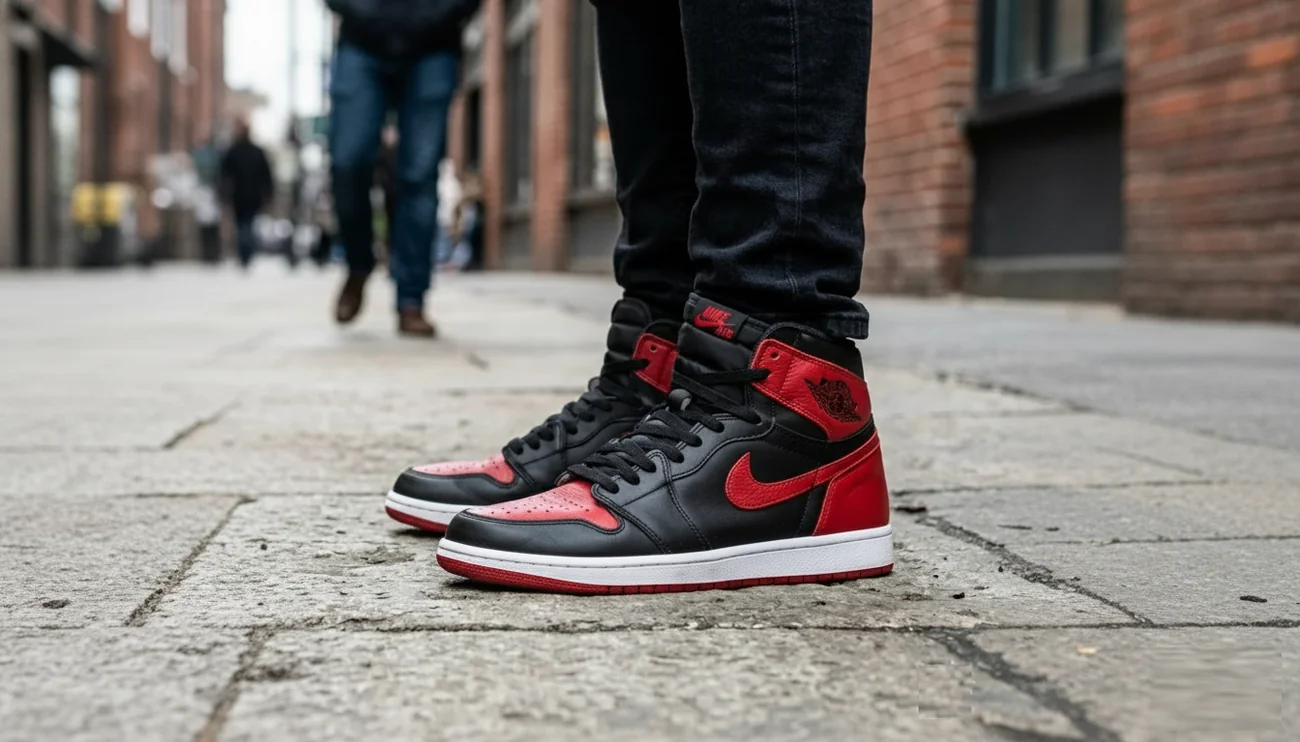
An OG colorway is a color combination that belongs to the original release period of a sneaker, a version, or a product line. The idea seems simple, but there is an important distinction: OG colorway does not necessarily mean a sneaker’s one and only first color scheme.
Some silhouettes debuted in more than one color combination during their original run. That means a single model can have several OG colorways. A historic colorway can also return decades later in a retro edition without making that modern pair an actual example of the original release.
This distinction clears up several common sources of confusion in the sneaker market: OG colorway is not synonymous with OG release, does not prove authenticity, does not mean limited edition, and does not guarantee a high resale price.
What Does OG Colorway Mean?
OG colorway means original colorway. In practice, the term identifies a color scheme associated with the historically recognized original release period of a particular model or version.
A “colorway” is a combination of colors and how they are arranged on a product. Two sneakers with the same silhouette can have very similar materials and construction but different colorways because the colors of the upper, Swoosh, midsole, outsole, laces, or other elements change.
“OG” connects that combination to the model’s historical origins. For the broader meaning of the abbreviation, see our guide to what OG means in sneakers.
Is an OG Colorway Always the First Color Released?
Defining an OG colorway as one single first color combination is not a reliable rule.
A silhouette may enter the market in several colorways during its original release period. In that case, more than one combination can belong to the group historically recognized as OG.
That is why the question is not just “What was the first color?” You also need to ask:
- Which model and version are we discussing?
- When was its original release period?
- Which colorways actually released during that period?
- Does the brand recognize that combination as part of the model’s original history?
The Air Jordan 1 Shows Why There Can Be More Than One OG Colorway
The Air Jordan 1 is one of the clearest examples. Nike’s official archive lists the original release in 1985, identifies Peter Moore as its designer, and presents Black/Red as a historic example from its origins.
That does not mean Black/Red was the Air Jordan 1’s only original colorway. Its 1985 history includes several color combinations, and a number of them can be described as OG colorways when the historical context is correctly identified.
So phrases such as “Chicago OG colorway” or “Black/Red OG colorway” describe the connection between that color scheme and the silhouette’s original era. They do not mean every pair in those colors was manufactured in 1985.
Are OG Colorway and OG Release the Same Thing?
No. This is one of the most important distinctions.
OG Release
This is the actual original release of a particular model or version. An Air Jordan 1 produced during the original 1985 release belongs to that historical period.
OG Colorway
This is the color combination associated with that original period. It can be reproduced later.
An Air Jordan 1 manufactured decades later can therefore bring back an OG colorway from 1985 without becoming an original 1985 pair.
The release is the historical product; the colorway is its historical color scheme.
Can a Retro Sneaker Have an OG Colorway?
Yes. This is extremely common.
A brand can bring back an older silhouette in a color combination from its original era. That makes it a modern retro edition of an OG colorway.
That does not mean the reproduction is identical to the historical product in every detail. Different generations can vary in:
- materials;
- color shades;
- shape and proportions;
- panel thickness;
- branding;
- manufacturing processes;
- internal components;
- packaging.
That is why “the return of an OG colorway” should not automatically be read as “an exact one-to-one reproduction of the old sneaker.” For more on this distinction, see what retro means in sneakers.
Does Retro High OG Mean the Colorway Is OG, Too?
Not necessarily.
In the Air Jordan 1 Retro High OG line, “Retro High OG” is part of Jordan Brand’s product naming and lineage. A modern shoe can carry that designation while introducing a color combination that never existed in 1985.
In other words:
- Retro High OG does not automatically mean OG colorway;
- OG colorway does not necessarily mean the physical pair is old;
- a new colorway can appear on a shoe built and named as a Retro High OG.
To identify where the colors originated, check the model, year, style code, and history of that combination.
Does OG Colorway Mean a Sneaker Is Genuine or Authentic?
No. Here, “original” refers to history; it is not a certificate of authenticity.
A counterfeit can copy a historically OG color combination. Likewise, a listing can use “OG colorway” correctly or incorrectly.
Determining whether an actual pair is genuine requires a separate authentication process. See our legit check guide.
The OG name, style code, box, and colorway do not individually prove authenticity.
Is Every OG Colorway Rare?
No.
OG describes a color combination’s historical connection to the model’s origins. It does not tell you how many pairs were produced.
An OG colorway can be reissued several times and receive wide distribution. Meanwhile, an entirely modern colorway can have an extremely small production run.
Origins, rarity, and production numbers are different attributes.
Are OG Colorways Always Worth More?
There is no such rule.
A historical connection can increase interest in certain releases, but market value depends on the specific product. Size, condition, supply, demand, region, year, quantity, and market timing all affect price.
A highly sought-after modern colorway can sell for more on the secondary market than a retro in an OG colorway. Another OG colorway might sit on store shelves for a long time.
The “OG colorway” label alone is therefore no basis for predicting appreciation or recommending a sneaker as an investment.
Does OG Colorway Mean Vintage?
No. Vintage concerns the age and historical context of the physical pair, while OG colorway describes the historical origins of its colors.
A retro produced in 2026 can reproduce an OG colorway and still be a sneaker made in 2026. For more on that difference, see what makes a sneaker vintage.
Is OG Exclusive to Nike and Jordan?
No. Other brands also use OG in their product communications. You still need to check what the term means for each specific release.
adidas also uses OG when discussing its products. Its Ultraboost guide, for example, identifies the original 2015 generation as the Ultraboost 1.0 (OG). This shows that OG is not exclusive to Nike; establishing that a particular colorway is original still requires documentation of that combination.
Nike and Jordan offer useful historical examples, but they do not own the concept.
How Can You Tell Whether a Colorway Is Really OG?
There is no universal seal of approval. The most reliable approach is to trace the release’s history.
- Identify the exact silhouette: a similar name is not enough.
- Confirm the generation or version: long-running product families can change substantially over time.
- Establish the original release period: the brand’s own archives are the best reference when available.
- Check which colors existed during that period: a silhouette can have several OG colorways.
- Separate colorway from release: a modern retro can reuse historic colors.
- Check the pair’s SKU and year: these help identify the edition you are examining.
Official archives, historical catalogs, period advertising, and reliable documentation are more useful than simply repeating a resale listing’s description.
Why Do OG Colorways Matter in Sneaker Culture?
They help tell a silhouette’s visual history.
The first color combinations may be associated with an athlete, a team, a campaign, a design era, or simply the way the public first encountered that shoe. When they return years later, new generations can experience a historical reference without having to find an actual vintage pair.
That significance does not have to dictate anyone’s taste. Some people seek out reproductions of historic colors; others prefer collaborations, fresh interpretations, or combinations that did not exist when the shoe first released. Related definitions are collected in the Sneakerhead Dictionary’s OG, retro, and vintage section.