
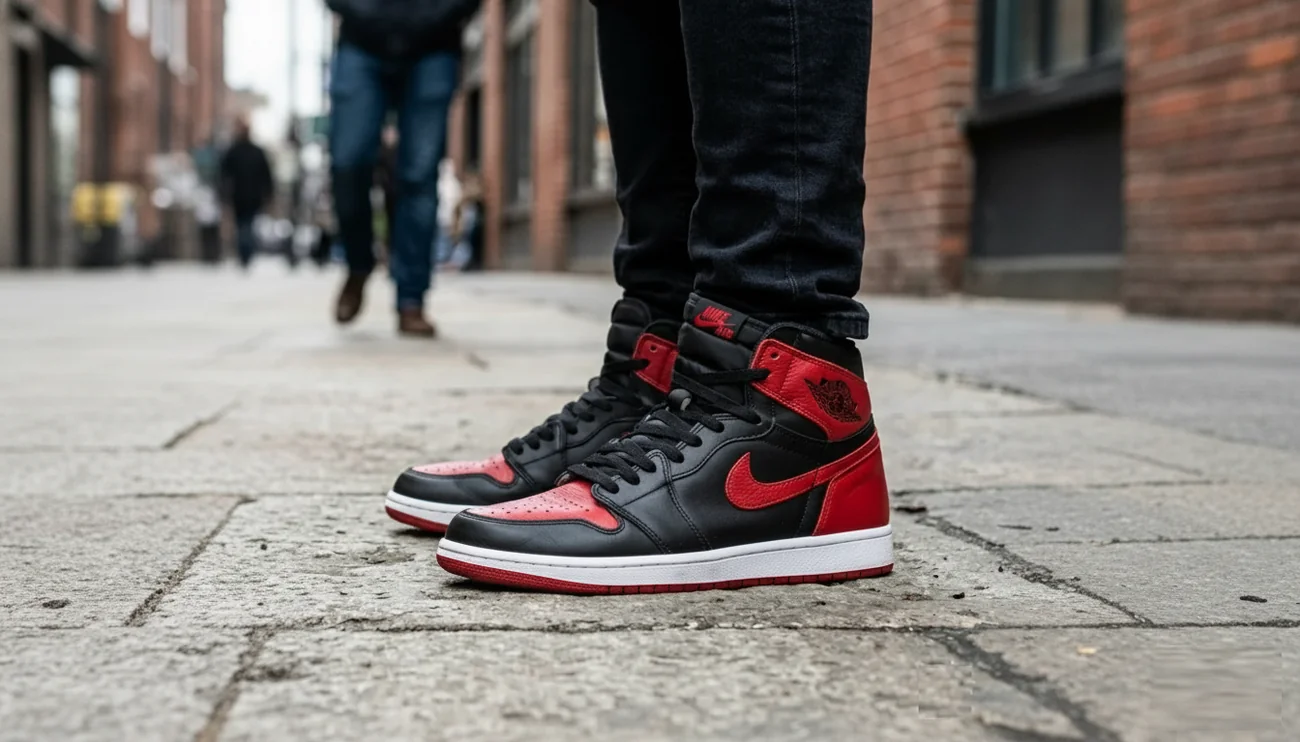
OG is a context-dependent term tied to original versions and historical origins in sneaker culture. Depending on where it appears, it can refer to a model’s original release, a colorway from its original era, a historical reference, or simply part of the official name of a modern version.
Jordan Brand uses Air Jordan 1 Retro High OG in the names of contemporary releases. That does not mean the pair was manufactured in 1985 or that its color combination existed that year.
To understand exactly what OG means, look at the context: Which model, release, year, and colorway are we talking about, and who is using the term?
What Does OG Mean in Sneakers?
In contemporary sneaker language, OG usually points to something original or to its origins. But what is being called original can change from one sentence to the next.
OG can refer to:
- an original release, meaning the initial release;
- a physical pair manufactured during that period;
- an OG colorway;
- a historical configuration of a particular silhouette;
- a reference to the model’s original lineage;
- or the official product name of a modern edition, such as Air Jordan 1 Retro High OG or adidas Samba OG.
OG is therefore not a universal technical certification. The first question should be: “Original in what sense?”
Where Does the Term OG Come From?
Merriam-Webster traces the term to Original Gangster. Its etymology note cites an account from former Crips members about the abbreviation’s use in the early 1970s and identifies Ice-T’s 1991 album O.G. Original Gangster as a likely influence on its spread to other contexts. That does not establish a specific date when sneakerheads adopted it.
This does not mean you need to interpret “OG sneaker” literally as “Original Gangster sneaker” every time you see the abbreviation in a catalog. The term’s etymology and its specialized meaning within sneaker culture are different matters.
Nike did not create OG. Neither did Jordan Brand. Sneaker culture adopted an expression already circulating in popular culture and began using it to discuss origins and history.
What Is an OG Release?
OG release, or original release, is a way of referring to the original release of a particular model or version.
Here, the connection is to an object produced in that era, not merely a color combination returning decades later.
Imagine a silhouette introduced in 1985 and reissued in 2026. A pair actually made for the 1985 release and a pair manufactured in 2026 are not the same historical object, even if they share a design, name, or colors.
What Is an OG Colorway?
An OG colorway is a specific use of the concept: a color combination associated with a silhouette’s or line’s original era.
A silhouette can have several OG colorways. “OG” does not necessarily mean “the first and only color combination.”
And an OG colorway can return.
When a brand makes a retro of a historical color combination today, the colorway can be OG while the physical pair was still manufactured in modern times.
This topic deserves its own explanation, so we also have a dedicated guide to what an OG colorway is.
Air Jordan 1: The Original Release and Later Editions
The Air Jordan 1 helps put these ideas into context because Nike maintains official historical documentation of the model.
In its official Air Jordan 1 archive, Nike lists:
- Original Release: 1985;
- Designer: Peter Moore;
- Artifact of Origin: Department of Nike Archives;
- Color: Black/Red for the historical pair featured;
- Style Code: 4281 in the archive entry.
An Air Jordan 1 physically manufactured in 1985 therefore belongs to the model’s original-release era.
An Air Jordan 1 made decades later comes from a later production run, even when it brings back colors, branding, or visual elements from that history.
For a closer look at the silhouette’s evolution, read our history of the Air Jordan 1.
Is Black/Red the Air Jordan 1’s Only OG Colorway?
No.
Nike highlights Black/Red in its historical archive, and sneaker culture often calls that combination “Bred.” But Nike’s own material records that the original Air Jordan 1 came in multiple colorways.
That also explains why phrases such as “the Jordan 1’s OG colorway” can be imprecise. Often, the more accurate wording is “one of its OG colorways.”
What Does Air Jordan 1 Retro High OG Mean?
Air Jordan 1 Retro High OG is a modern product name officially used by Jordan Brand.
It does not mean the physical pair was manufactured in 1985.
It also does not automatically mean the product’s colorway was among the original 1985 colorways.
For example, Nike lists the Air Jordan 1 Retro High OG “Love Letter,” style code DZ5485-201, in Shadow Brown, Light British Tan, and Team Red. That edition shows that the name is also used for contemporary color combinations.
Is a Retro High OG the Same as the Original 1985 Air Jordan 1?
Not as a historical object.
A modern pair can bring back many elements associated with the historical Air Jordan 1. That does not make it literally the same manufactured product as the 1985 release.
Pairs made decades apart can differ in:
- shape;
- molds;
- materials;
- foams;
- rubber compounds;
- stitching;
- branding;
- finish;
- padding;
- packaging;
- manufacturing processes.
Some retros may aim for greater historical accuracy in certain elements. Others make more noticeable changes.
Having OG in the name is not a certification of a technically exact, one-to-one reproduction.
Do OG and Retro Mean the Same Thing?
No.
Retro usually describes a later edition, reintroduction, or rerelease connected to an earlier product.
OG depends more on context: it can point to the original release, a historical colorway, the silhouette’s origins, or part of the name of a current version.
Both terms can appear together, as in Air Jordan 1 Retro High OG, but that does not make them synonyms.
There is also no universal rule that “every modern OG is a retro.”
For the other half of this comparison, read what retro means in sneakers.
Do OG and Vintage Mean the Same Thing?
No, they do not.
Vintage primarily relates to an object’s physical age. OG relates to historical origins or the context of a product name.
An Air Jordan 1 actually made in 1985 can have both characteristics today: it belongs to the original-release era and is a vintage object.
An Air Jordan 1 Retro High OG made today does not become vintage just because its name includes OG.
And a retro manufactured many decades ago may eventually be considered vintage because of its own age, even though it was never part of the original release.
Our guides to vintage sneakers and retro vs. vintage explore that distinction in more detail.
Is OG Exclusive to Nike and Jordan Brand?
No. The expression belongs to a broader cultural vocabulary and also appears in other brands’ official product names.
adidas uses OG in products such as the Samba OG, offered in classic combinations and new colors. Commercial use of the abbreviation is not exclusive to Nike or Jordan Brand.
Another example is the LA Trainer OG, a contemporary edition that draws on the adidas archive. The full name and description of that edition help explain the historical reference.
Does OG Mean a Sneaker Is Authentic?
No.
This confusion comes from using “original” informally to mean “not counterfeit.” But that is not the role of OG in sneaker naming.
A listing can say “OG,” “OG colorway,” or “Retro High OG” and still be offering a counterfeit product.
The question about OG is:
“How does this release, name, or colorway relate to its historical origins?”
The authentication question is:
“Is this physical pair actually a genuine, authorized product from the brand?”
If the second question is what you need answered, see our guide to legit checks.
Does a Style Code Prove That a Sneaker Is OG or Authentic?
A style code helps identify the release the product is supposed to represent. It can help connect a name, colorway, release period, and supporting documentation; check shoe size separately.
But a code does not authenticate the physical pair on its own.
Counterfeits can copy codes, labels, and boxes. That is why identifying a release and authenticating an object are separate steps.
Does OG Tell You Anything About a Sneaker’s Condition?
Not necessarily.
A pair from the original release could now be:
- new or unworn;
- heavily worn;
- restored;
- missing its box;
- incomplete;
- oxidized;
- damaged;
- very well preserved.
OG does not mean deadstock, and it does not tell you how many times the sneakers have been worn.
Origins and condition are separate attributes.
Is Every OG Rare or Limited?
No.
OG does not tell you how many pairs were produced.
A historical colorway can receive several retros over the years. A modern product with OG in its name can be widely distributed. And a silhouette can be culturally important without being scarce.
OG therefore does not automatically mean:
- limited edition;
- exclusive;
- sold out;
- grail;
- small production run.
Are OG Sneakers Always More Expensive?
There is no such rule.
Price depends on factors such as the model, release, year, colorway, size, condition, box, accessories, provenance, authenticity, availability, supply, demand, region, and current market conditions.
A physical pair from a rare historical release can be expensive. A modern product with OG in its name can be available at retail. An OG colorway can be rereleased many times.
The abbreviation alone does not determine the price or guarantee appreciation or an easy resale. To compare pairs, first identify the release, size, and condition; then look at recent comparable sales.
How Should You Interpret OG in a Listing or Product Name?
Rather than trying to “identify an OG” by looking at a stitch, start with the documentation and context.
- See whether OG is part of the official name. Does the brand actually call that product OG, or did the seller add it?
- Find out what is being called original. The release, colorway, configuration, or lineage?
- Confirm the year of that specific pair. The silhouette’s debut year is not automatically the year the pair was made.
- Confirm the specific release. Research its full name and SKU or style code.
- Check whether it is a retro release. A retro comes after the historical release it references.
- If the claim is “OG colorway,” verify the history of that color combination.
- Do not assume a technically exact, one-to-one reproduction. Check the materials and details in the documentation for that release.
- Do not use OG to infer age. A current product can have OG in its name.
- Do not use OG to infer condition. An original-release pair can be worn, restored, or incomplete.
- Do not use OG as authentication. Get a separate legit check when needed.
To keep making sense of these terms without turning sneaker slang into invented rules, explore the Sneakerhead Dictionary.
For the wider context, explore Sneaker History and Culture: From Rubber Soles to a Global Movement.