
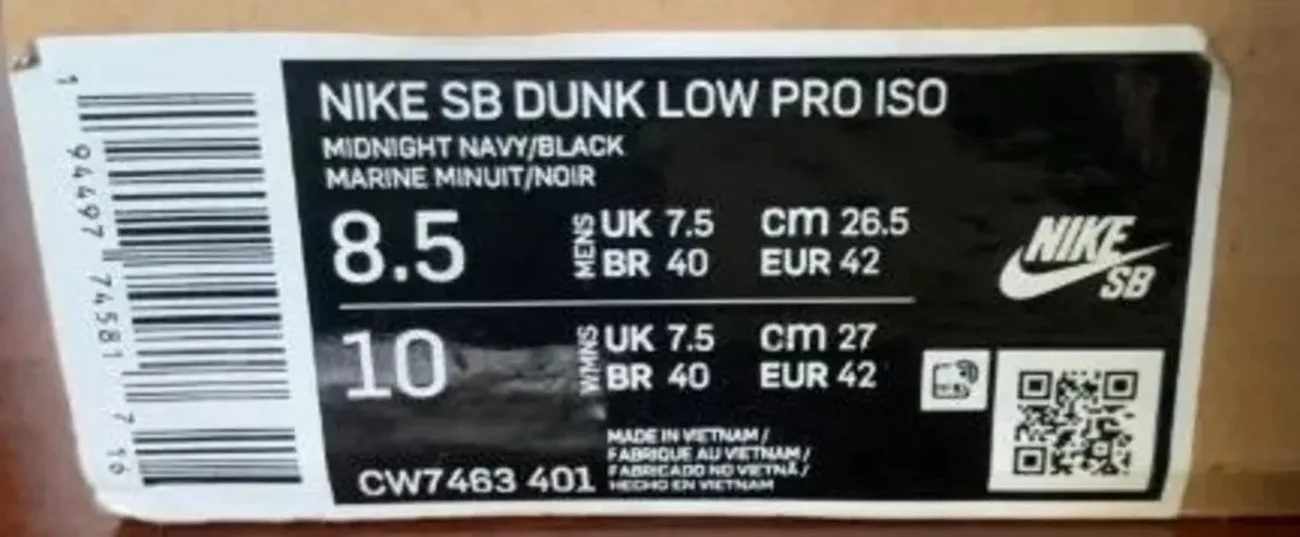
ISO appears in the names and references of some Nike SB products and is widely understood as “In Store Only.” The literal expansion is useful, but the more important idea is that ISO is tied to Nike SB’s Orange Label ecosystem and to participating skate shops.
In Nike SB, ISO describes a specialized distribution context rather than cushioning, shape, materials, condition, rarity, or authenticity. The letters point toward the role of local skate shops in the product’s release—not a promise that the shoe is scarce, premium-priced, or impossible to buy online.
What Does ISO Mean in Nike SB?
ISO is widely understood as “In Store Only” in Nike SB terminology. In practical terms, the designation is associated with Orange Label products distributed through participating skate shops.
ISO does not describe a technology or a specific type of Dunk. It is a product and distribution designation used inside Nike Skateboarding, often shortened to Nike SB.
The phrase “In Store Only” can sound as if every ISO release must be purchased only by physically walking into a shop. That is too rigid. The defining idea is skate-shop distribution, while the exact sales method can vary by country, release, retailer, and time.
Are ISO and Orange Label the Same Thing?
They are closely connected, but they describe different layers. Orange Label is Nike SB’s skate-shop-focused program and product ecosystem. ISO is a designation used on certain products associated with that ecosystem.
Nike SB describes Orange Label as skate-shop-exclusive product created as a “thank you” to the shops that continue to support and inspire skateboarding. The official Orange Label page includes classics such as the Dunk, Blazer, and Bruin.
That is why sneaker conversations often use ISO and Orange Label almost as shortcuts for the same context. Still, it is more accurate to say that ISO is a product designation connected to the broader Orange Label skate-shop program.
Why Does Nike SB Orange Label Exist?
The most useful explanation starts with skate shops, not rarity. Independent skate shops have historically done more than sell shoes and decks: they sponsor skaters, organize events, support local scenes, share information, and give skate communities a physical home.
Nike SB presents Orange Label as a way to recognize and support those shops by routing selected products through the specialty skate channel.
A global brand can make the product, but skate culture is also built locally. Shops, teams, parks, videos, events, and relationships between skaters help turn a shoe into part of a living community.
The Role of Skate Shops in Nike SB Culture
An independent skate shop is not simply a smaller sneaker retailer. In many U.S. skate scenes, it can function as a meeting point, sponsor local riders, host premieres or contests, recommend setups, and connect generations of skaters.
That relationship helps explain Nike SB itself. The division did not grow only by putting a Swoosh on skate shoes; it had to earn credibility inside a community with its own brands, stores, media, and history.
Orange Label is one way Nike SB structures its relationship with qualified specialty shops. That does not mean every store receives every pair or that every Orange Label release uses the same launch method.
Does “In Store Only” Mean an ISO Shoe Can Never Be Sold Online?
It should not be interpreted as a universal ban on online sales. Nike SB’s current Orange Label language focuses on products being available through skate shops, and Nike’s shop directory identifies participating Orange Label retailers.
A participating shop may have e-commerce, use raffles, offer local pickup, sell by phone, or apply release-specific rules. In recent years, some Orange Label pairs have been sold by skate shops both in-store and online.
- country or region;
- the specific release;
- the launch date and release phase;
- the retailer’s sales rules;
- inventory and the sales method chosen by the shop.
It is also unsafe to claim that an Orange Label product can never appear on a regional Nike or SNKRS page. Nike has published Orange Label-related SB Dunk product pages in some markets. Channel behavior can vary by country and release.
What Is an Orange Label Shop?
An Orange Label Shop is a skate shop identified by Nike SB as participating in the Orange Label ecosystem. Nike SB maintains an official skate-shop directory where participating stores can be identified.
Not every retailer that sells skate products is automatically an Orange Label Shop. Participation depends on the retailer’s relationship with Nike SB and the distribution structure in that market.
Even an identified Orange Label retailer will not necessarily receive every release, every size, or every restock. For a specific pair, check the shop’s current release information rather than assuming availability.
How Can You Identify a Nike SB ISO Release?
There is no single visual detail that identifies every ISO product from every era. The safest method is to combine official naming, Orange Label references, style code information, product imagery, and the retailer’s release communication.
Official Product Name
Look for the complete name in Nike SB materials and at participating skate shops. Names such as Nike SB Dunk Low Pro ISO make the designation explicit.
Orange Label Reference
Official Nike SB copy or retailer communication may connect the product to Orange Label. That is stronger evidence than guessing from one color accent.
Visual Details
Some releases use Safety Orange accents as part of Orange Label identity, including tongue branding, insoles, or other small details. Placement and amount vary, so orange details should be treated as clues rather than a universal test.
Style Code or SKU
The style code helps identify the exact release. Compare it with official Nike or trusted skate-shop documentation instead of searching only by color or nickname.
Does ISO Always Appear on the Nike Size Tag?
No universal rule says every Nike SB ISO product must show “ISO” on the internal size label. That label generally prioritizes production and identification information such as style code, size, country of manufacture, and manufacturing details.
Depending on the release, ISO may appear in the official product name, retailer listing, box label, launch communication, or other product references.
The absence of “ISO” from the internal size tag does not by itself prove that a sneaker is fake or unrelated to Orange Label. First identify the exact release and style code.
Orange Label Is Not Exclusive to the Dunk
The SB Dunk is the best-known Orange Label silhouette, but Orange Label is not a shoe model. Nike SB’s official Orange Label page also references classics such as the Blazer and Bruin, and the program has included apparel and other skate-focused products.
That is another reason ISO should not be defined as “a type of Dunk.” The shoe remains a Dunk, Blazer, Bruin, or another product; ISO describes its relationship to the Orange Label distribution context.
Nike SB Dunk Low Pro ISO: Real Examples
One documented example is the Nike SB Dunk Low Pro “University Blue,” style FJ1674-401. Nike’s regional SNKRS product copy describes subtle Safety Orange details as a reference to Orange Label DNA and calls the program exclusive styles created for local skate shops.
Another official example is the Nike SB Dunk Low Pro “White,” style FJ1674-100. Nike uses the same Orange Label explanation and connects the product directly with supporting local skate shops.
These examples do not create a universal visual formula. Safety Orange is documented on these releases, but counterfeit products can copy color accents, labels, and style codes. Authentication requires more than spotting orange.
Does ISO Mean Limited, Rare, or Exclusive?
Not automatically. ISO indicates a specialized distribution context. It does not reveal the total production quantity, number of pairs per store, restock quantity, or long-term availability.
Restricted distribution and rarity are not the same thing. A product can be sold through fewer channels yet still have meaningful inventory, while a non-ISO release can be far harder to find.
- ISO does not guarantee a small production run;
- ISO does not guarantee high demand;
- ISO does not guarantee an immediate sellout;
- ISO does not automatically make a release a collaboration;
- ISO does not automatically turn a release into a grail.
Does ISO Increase Resale Value?
There is no universal rule. ISO status by itself does not determine retail price, secondary-market premium, or future appreciation.
The resale price of a specific pair can be influenced by model, colorway, size, condition, demand, supply, region, timing, collaborations, restocks, and how many buyers actually want that release.
Does ISO Mean Better Materials or Higher Quality?
Nike SB uses promotional language around Orange Label that emphasizes favorite styles and strong materials. That should not be converted into the blanket claim that every ISO product is objectively better made than every non-ISO Nike SB.
Some releases may use specific leather, suede, color treatments, or finishing choices. Evaluate materials and construction product by product rather than treating ISO as a universal quality grade.
Does ISO Prove a Nike SB Is Authentic?
No. ISO describes product naming and distribution, not authenticity. A counterfeit can reproduce the letters, orange details, style code, box label, and other visible cues.
The reverse is also true: not every authentic Nike SB is ISO, and the absence of Orange Label features does not make a pair fake. For authentication, use release-specific evidence and see our Legit Check guide.
Are ISO, QS, PRM, and SE the Same Thing?
No. These abbreviations appear in different Nike naming contexts and should not be treated as a ranking where one is automatically rarer, better, or more valuable than another.
ISO
In the Nike SB context discussed here, ISO is tied to Orange Label and distribution through participating skate shops.
QS
QS is traditionally expanded as Quickstrike, but its commercial use and distribution have varied over time. It should not automatically be translated into one fixed production quantity. See what Nike QS means.
PRM
PRM is commonly associated with Premium in Nike naming, but it is not a universal technical certification that can be compared consistently across every Nike line and era. See what Nike PRM means.
SE
SE is commonly used for Special Edition naming, but the letters alone do not define production quantity, sales channel, or value. See what Nike SE means.
The practical rule is simple: abbreviations help identify context, but the official product page and the exact release tell the fuller story.
Where Can You Find Nike SB ISO and Orange Label Releases?
- Start with the official Nike SB skate-shop directory.
- Check whether the shop is identified as an Orange Label retailer.
- Follow the shop’s website and social channels for release-specific rules.
- Confirm the full product name and style code.
- For sold-out releases, use reputable resale channels and keep condition, authenticity, and buyer protection as separate checks.
When buying outside primary retail, do not let “ISO” replace normal due diligence. A product can be a genuine Orange Label release and still be misrepresented by an individual seller.
Is a Nike SB ISO Worth Buying?
It can be if you genuinely like the model, colorway, materials, or skate performance of that specific release. Orange Label also has cultural meaning because it directs attention back toward local skate shops.
What does not make sense is paying a premium only because ISO sounds like a secret code for exclusivity. Compare the actual shoe, price, fit, construction, and your reason for buying it.
Nike ISO FAQ
What Does ISO Mean in Nike?
In Nike SB, ISO is widely understood as “In Store Only” and is associated with Orange Label products distributed through participating skate shops.
What Is Nike SB Orange Label?
Orange Label is Nike SB’s skate-shop-focused product program. Nike describes it as a way of supporting and thanking the shops that continue to inspire local skate communities.
Can ISO Only Be Sold In Person?
Not as a universal rule across every country and release. The core feature is skate-shop distribution. Participating retailers may use in-store sales, online sales, raffles, pickup, or other release-specific methods.
Can an ISO Product Appear on SNKRS?
It should not be claimed that this never happens. Nike has published regional SNKRS pages for Orange Label-related products, and channel strategy can vary by market and launch.
Does Every Skate Shop Sell Orange Label?
No. Nike SB identifies participating shops, and even an Orange Label Shop will not necessarily receive every release, size, or restock.
Is Every Nike SB Product ISO?
No. Nike SB products are distributed through different channels. Only certain releases belong to the ISO and Orange Label context.
Does ISO Always Appear on the Internal Size Tag?
No. There is no universal internal marking rule. ISO may appear in the official name, launch documentation, box information, retailer listing, or other product references.
Does ISO Mean the Sneaker Is Rare or Limited?
No. Specialized distribution does not reveal total production quantity and does not guarantee scarcity.
Is ISO Better Quality?
Not as a universal rule. Certain releases may use specific materials or finishing, but the comparison has to be made product by product.
Does ISO Increase Resale Value?
Not necessarily. Secondary-market price depends on the model, colorway, size, condition, supply, demand, region, and timing.
Does ISO Prove the Nike SB Is Authentic?
No. Counterfeits can copy ISO naming and Orange Label details. Authentication is a separate process.
ISO Tells a Bigger Story Than the Acronym
Understanding ISO in Nike SB means recognizing that the most useful information is not a promise of rarity. It is the relationship between Nike SB, selected products, specialty skate retail, and the local shops that help sustain skate culture.
“In Store Only” remains the most widely used expansion of the acronym, but “available through skate shops” better describes how Orange Label operates across different regions and release methods.
In the end, the small ISO designation is a reminder that skateboarding products do not reach culture through the factory alone. They move through shops, skaters, local scenes, and communities—and Orange Label keeps that distribution channel visible.