PE stands for Player Exclusive: a version associated with a particular athlete, team, or program. Nike uses the term officially, and Jordan Brand also has a long history of shoes made for players.
A PE may change the colors, graphics, and personal references; functional modifications depend on the individual case. Some versions also reach the public. That makes it important to distinguish a pair supplied to an athlete from a retail production run inspired by it.
What does Nike PE mean?
PE stands for Player Exclusive, meaning a version exclusive to a player or athlete.
This is not just a definition created by collectors. NIKE, Inc. officially uses the phrase “player-exclusive (PE) footwear” when discussing its athlete partnerships.
In 2024, for example, the company reported having 20 player-exclusive footwear partnerships and named athletes including Jewell Loyd, Yang Liwei, and Jonquel Jones.
PE therefore identifies a product context connected to athletes or players. It is not a technology, a type of cushioning, or a universal seal of rarity.
For other sneaker designations, the Sneakerhead Dictionary offers related explanations.
Is Player Exclusive the same as Player Edition?
The answer requires more care than simply saying, “Yes, they are exactly the same thing.”
In official communications, Nike uses Player Exclusive and the abbreviation PE in basketball-footwear contexts.
The company also uses Player Edition. In December 2024, for example, it introduced the Nike G.T. Hustle 3 Paige Bueckers Player Edition.
Both expressions appear in Nike’s vocabulary and can serve very similar purposes depending on the product. What is not safe is declaring that “PE officially means Player Exclusive or Player Edition in exactly the same way for every product and era.”
When explaining the abbreviation PE, Player Exclusive is the expansion directly documented by NIKE, Inc.
What is a PE shoe in practice?
A PE is best understood as a version of a model associated with an athlete, group, or team in a particular context.
Depending on the project, that version may include:
- A specific colorway;
- The athlete’s number;
- Initials or logos;
- Team or school colors;
- Personal messages;
- References to family or places connected to the athlete;
- Specific materials;
- In some documented cases, functional modifications.
The important word is “may.”
PE is not a universal specification sheet. Not every product must have an embroidered number, team colors, or different cushioning.
Is every PE custom-built for the athlete?
It is not safe to say that it is.
Professional athletes may receive shoes tailored to particular needs involving fit, insoles, support, or other modifications. But those possibilities do not make every PE an entirely bespoke construction.
For some PEs, the main publicly documented difference is visual.
Paige Bueckers’ G.T. Hustle 3 is a good example. Nike details baby blue and lavender colors, references to UConn and Minnesota, embroidery related to her “buckets” nickname, and a message from her father.
Those details connect the product to the athlete’s story. The cited description does not identify an exclusive recalibration of the foam or Air Zoom for her.
Are a PE and a signature shoe the same thing?
No. This is one of the most important distinctions in the subject.
A signature shoe is a model or franchise developed around and associated with an athlete’s identity.
LeBron James has the LeBron line. Kevin Durant has KD. Sabrina Ionescu has Sabrina. A’ja Wilson has A’One. These are examples of signature families in Nike basketball.
A PE, meanwhile, can be a specific version of one of those models for someone else.
NIKE, Inc., for example, announced a Jonquel Jones KD17 PE. The KD17 remains Kevin Durant’s signature shoe; Jonquel’s version is a Player Exclusive built on that platform.
An athlete’s colorway does not automatically become a new signature shoe just because it appears during a big night on the court.
PE and custom are different concepts, too
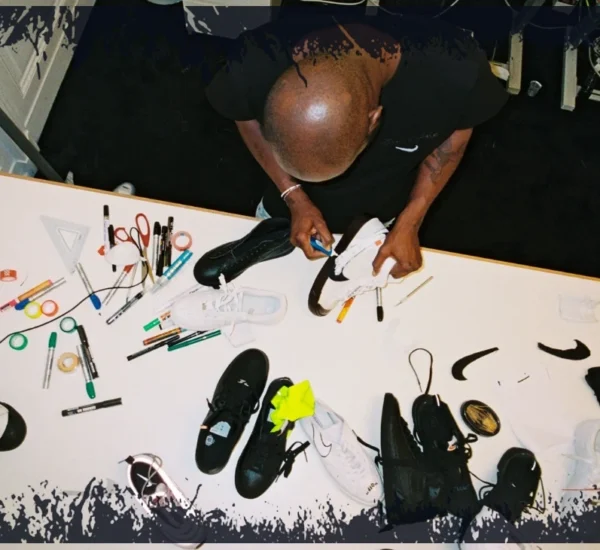
A sneaker painted, cut apart, or rebuilt by an artist after production does not become a Player Exclusive simply because it was personalized for someone.
Custom describes a product modification or customization.
PE describes a version originating within the brand’s official relationship, or an authorized program, with an athlete or team.
A PE may include factory-customized elements. Even so, the categories are not interchangeable.
Michael Jordan shows that PE history goes back decades
Player Exclusives existed long before social media, app-based drops, and tunnel-fit photos dominated sneaker conversations.
Nike itself preserves two excellent examples from Michael Jordan’s career.
Nike Air Ship PE: before the Air Jordan 1
In its official archive of shoes Michael Jordan wore in The Last Dance, Nike records that during his rookie season, MJ wore a Nike Air Ship PE with “Nike Air” on the heel.
The page provides context for the White/Red and Black/Red versions.
That record concerns the period before the Air Jordan 1 became the defining symbol of the partnership.
The archive documents this Air Ship PE, but does not identify it as the first Player Exclusive in all of Nike history.
Air Jordan XIII Low PE in 1998
The same official page documents Michael Jordan wearing an Air Jordan XIII Low PE during the 1998 playoffs and Finals.
That shows the idea’s continuity: even after MJ had his own signature line, specific versions still existed within that family.
Signature and PE can coexist.
Team PE and college PE: not every exclusive belongs to one person
Footwear supplied specifically to players also has a place at the team and college level.
In a story published in 2026, the Department of Nike Archives recalls how Georgetown received player-only Nike Terminators with HOYAS across the heel.
The example shows that player-specific versions for programs and teams extend well beyond one famous athlete. It does not mean every Nike college shoe carries the official designation Team PE.
In the sneaker market, terms such as team PE and college PE identify colorways and versions intended for particular programs or teams. The exact designation still needs to be confirmed product by product.
How many pairs of a PE are produced?
There is no standard number.
That is why claims such as “every PE has 2, 5, or 12 pairs” should not be used without specific documentation.
A particular release may have a known quantity supported by Nike, the athlete, archives, or solid documentation. If the number has not been published, there is no reason to fill the gap with an estimate.
Player Exclusive describes a product and its context. It is not a unit of measurement.
Can a PE be sold to the public?
Yes. This is probably the most important correction for anyone who learned that “a real PE never reaches stores.”
Several different situations are possible:
- A pair produced and supplied directly to an athlete may never receive a commercial release;
- A colorway originally created as a PE may later inspire a release;
- A previously exclusive version may officially reach retail;
- Nike itself may call a publicly available product a Player Edition.
These situations should not be conflated.
House of Hoops: Player Exclusives at retail in 2007
In November 2007, Nike and Foot Locker opened House of Hoops in Harlem.
In the official opening announcement, NIKE, Inc. said the store would carry player exclusive footwear and mentioned personalized styles associated with Kobe Bryant, Jason Kidd, and then-rookie Kevin Durant.
More importantly, the company said those styles would be available to consumers through that channel.
In other words, Nike itself demonstrated as early as 2007 that “Player Exclusive” and “never sold to the public” were not absolute equivalents.
Paige Bueckers: a Player Edition released at retail
In December 2024, Nike introduced the G.T. Hustle 3 Paige Bueckers Player Edition, created during her college career at UConn.
The shoe featured personal details, her favorite colors, and references to her two homes, Minnesota and UConn. It was officially made available through SNKRS and select stores.
It is a clear example of why Player Edition should not automatically be read as “a product you cannot buy.”
Kobe: a previously unreleased PE reaches the public in 2026
The Air Force 1 Low Protro “Obsidian and White” offers another example of an athlete’s version reaching consumers.
Nike released the Air Force 1 Low Protro “Obsidian and White”, style IM1980-400, and officially describes its origins as a previously unreleased Player Exclusive for Kobe Bryant.
The public version also received a Protro update, including drop-in ReactX and Nike Air.
The design’s story therefore began as a Kobe PE before it became an official consumer release.
That does not mean a retail pair is literally the same physical object issued to Kobe. A design’s origins and an individual pair’s provenance are different questions.
An athlete-issued PE and a retail release are not the same thing
This distinction is essential for collectors.
Consider three different things:
- A PE supplied to an athlete: an actual pair produced or issued for that person or team to use.
- A colorway originally created as a PE: a design developed in that context that later receives another production run.
- A retail release: a version officially produced for consumers, potentially based on the earlier PE.
All three may look extremely similar while having different histories and provenance.
That is why simply finding “PE” in a marketplace listing title does not settle the question.
Is a PE rarer than a QS, SP, or SE?
There is no universal scale that allows a blanket “yes.”
PE describes a connection with a player or athlete.
QS, SP, and SE are other designations used in different contexts. Putting them in an exclusivity pyramid mixes dimensions that are not directly comparable.
An athlete-issued PE can be extremely hard to find. A particular release with another designation can also have very limited distribution.
There is no universal formula of:
SE < QS < SP < PE.
If those other abbreviations appear on a product you are researching, consult their separate histories, including Nike QS, Nike SP, and Nike SE.
Is a PE necessarily more expensive?
There is no universal Player Exclusive price.
A pair actually issued to an athlete and supported by strong provenance may attract collectors. But its price depends on much more:
- The athlete;
- The model;
- The pair’s history;
- Whether it is game-worn or game-issued;
- Provenance;
- Size;
- Condition;
- Demand;
- Whether a retail release exists.
An officially sold Player Edition may simply carry a retail price set by Nike.
PE therefore does not mean “a fortune” and should not be treated as an investment.
What do game-worn and game-issued mean for a PE?
These terms may appear when PEs enter the collectible market.
Game-worn indicates that the pair is being represented as actually worn in a game.
Game-issued normally describes an item produced or supplied for an athlete’s use, but that does not automatically mean it was worn in a game.
In both cases, provenance matters greatly. Photos, documentation of origin, ownership history, and other records can help build the case.
Even so, no generic certificate should replace a careful examination.
How do you identify the PE you are looking at?
Before trying to authenticate a physical pair, determine exactly which release it claims to be.
- Model: what is the base silhouette?
- Athlete or team: who is the version associated with?
- Colorway: is that color scheme documented?
- Year: when did the athlete actually wear or receive the product?
- Style code: when available, does it match the documented release?
- Official sources: do Nike, Jordan, SNKRS, archives, and historical photos confirm its existence?
This step identifies what the product is supposed to be.
It still does not prove that the physical pair is authentic.
Does PE always appear on the internal tag?
There is no basis for claiming that it does.
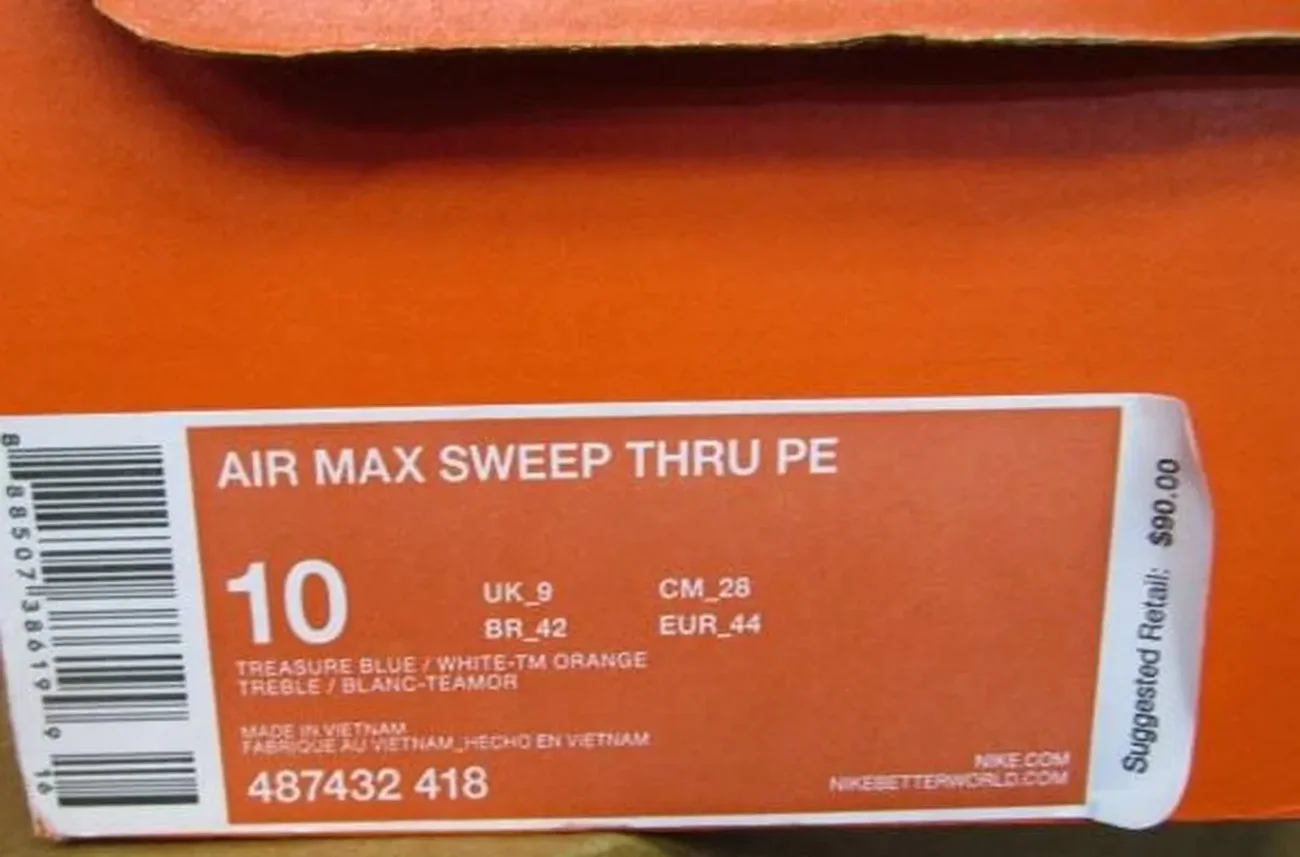
PE may appear in the name used by Nike or Jordan, in an archive, press release, catalog, media coverage, retail record, or, depending on the product, on a particular tag or box label.
But there is no universal size-tag field where “PE” must appear on every Player Exclusive.
Does PE on the box or in the name prove authenticity?
No.
A counterfeit can reproduce:
- The PE abbreviation;
- The athlete’s number;
- The team colorway;
- The style code;
- The box label;
- Logos;
- Visual details.
Even a correct SKU can be copied.
For athlete-issued or game-worn PEs, investigating provenance is especially important: where the pair came from, its chain of ownership, whether there are records of the athlete with that version, and which documents support the story.
For more on the difference between identification and authentication, see what a Legit Check is.
Is a PE worth buying?
The answer depends much more on the product than on the two letters.
If it is a retail release derived from a PE, assess it as you would any other sneaker:
- Model;
- Fit;
- Performance or intended use;
- Design;
- Price.
If it is a purported athlete-issued or game-worn PE, the evaluation changes: release identity, documentation, and provenance become much more important.
What does not make sense is buying solely because you expect its value to rise.
PE tells a story about an athlete and a product. It does not promise a financial return.
To keep decoding designations without turning abbreviations into myths, consult the Sneakerhead Dictionary. For more stories where basketball, design, and sneaker culture intersect, explore Sneaker History and Culture.