
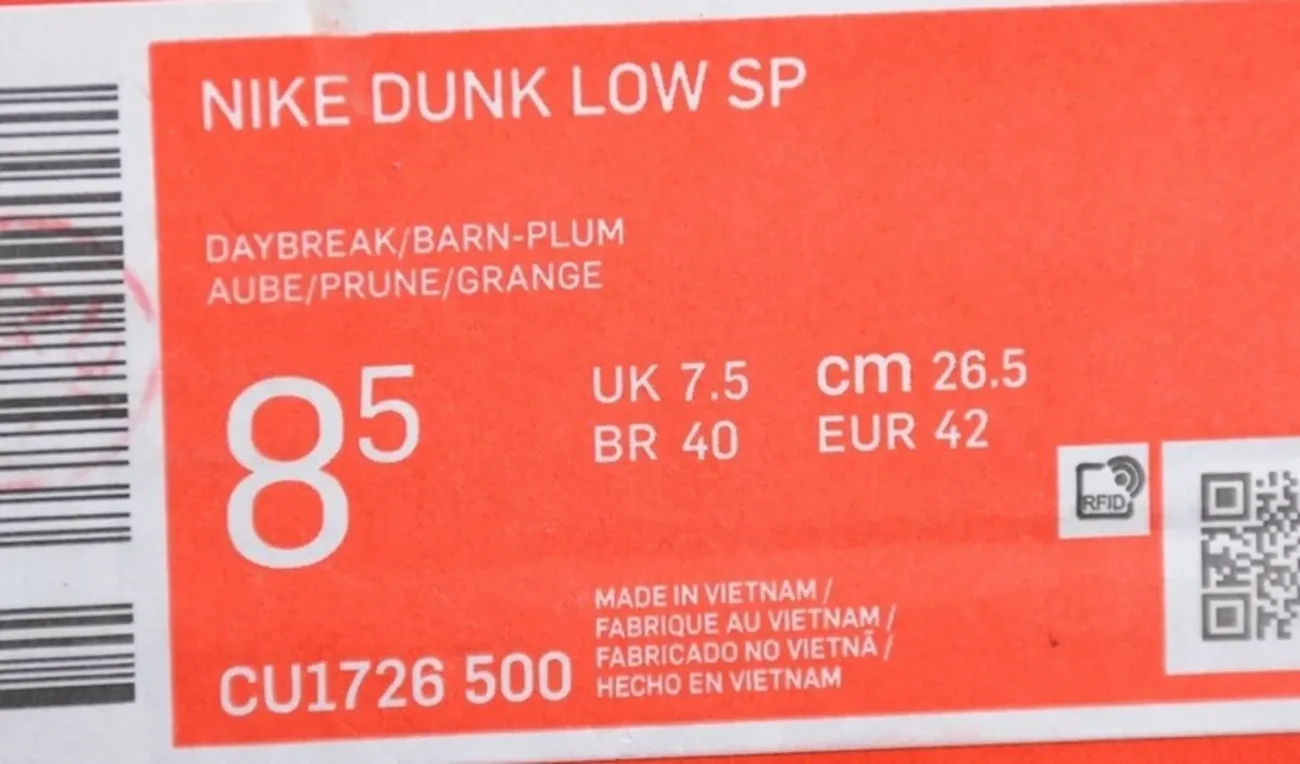
SP is associated with Special Project in sneaker media and terminology. Nike officially uses SP in product names, but that association should not be turned into a corporate rule with mandatory product features.
A Nike SP can be a collaboration, an archive-inspired reissue, or a performance product. To establish its materials, intended use, and distribution, look up the exact version. SP alone does not prove rarity or superior quality.
What does Nike SP mean?
SP is widely understood and documented as Special Project. This expansion has appeared in specialist sneaker media for years. Sneaker Freaker, for example, has described identifiable Nike releases as “SP (Special Project)” in its product coverage.
Nike’s pages confirm its use of SP; specialist publications document the expansion Special Project. These are different forms of evidence, and neither establishes a fixed production quantity or a specification shared by every SP.
One editorial example appears in this Sneaker Freaker comparison of the Patta x Nike Air Max 1, which identifies a recent release as SP and explicitly spells out “Special Project.”
Does SP mean limited edition?
Not necessarily. A Nike SP can be part of a release with limited availability, but SP alone does not disclose production numbers or establish a universal distribution rule.
The T90 SP, for example, has a direct-to-consumer Nike product page. Its presence at official retail does not reveal its production run, but it does rule out treating SP as a synonym for exclusively private access.
Do Nike SP shoes use better materials?
There is no such guarantee. It helps to separate what the designation means from the features of an individual product.
The Nike Air Max Dn8 SP, for example, has had versions that Nike itself describes as having premium leather uppers. That is a feature of that Dn8 SP. It does not mean every product labeled SP automatically uses premium leather.
Other SP shoes use mesh, textiles, suede, synthetics, foam, and completely different constructions. To find out whether an SP is truly “premium,” read that shoe’s specifications rather than trying to infer them from the last part of its name.
Is SP always a collaboration?
No. Some Nike collaborations use SP in their names, but many SP products have no named outside collaborator.
That is why collab and SP should not be treated as synonyms. A collaboration can be an SP. An SP does not have to be a collaboration.
Nike’s catalog offers straightforward examples: the Nike T90 SP, Nike Pegasus Premium SP, Nike Air Baltoro SP, and Nike Air Zoom Spiridon SP officially use SP. Those letters alone do not establish a partnership with a designer, boutique, or artist.
T90, Pegasus, and Air Max: examples of SP products
Nike T90 SP: from the soccer field to the street
The Nike T90 SP is a good example of why SP should not automatically be read as “performance product.” Nike describes this version as a reinterpretation of the Total 90 that takes its soccer-cleat inspiration from the field to the street.
The shoe retains key T90 design elements, including asymmetrical lacing, but now appears as a sneaker for off-field wear. Here, soccer history and lifestyle footwear meet.
Nike Pegasus Premium SP: SP can also mean a performance shoe
If there were still any impression that SP was reserved for retros or lifestyle projects, the Nike Pegasus Premium SP settles it.
Nike classifies the Pegasus Premium as designed for road running and describes a midsole combining ZoomX, a full-length sculpted Air Zoom unit, and ReactX foam. For version IH4369-001, the Australian product page lists a weight of about 325 g, or 11.5 oz, in a men’s UK 9 and a 10 mm heel-to-toe drop.
The point here is not to turn those specifications into a definition of SP. They belong to that specific Pegasus Premium SP. The example shows that the SP designation can appear on a shoe developed for running.
Nike Air Max Dn8 SP: product-specific materials are still product-specific
For the Air Max Dn8 SP, Nike presents versions with leather construction and the Dn8’s characteristic Dynamic Air system. It is a completely different product from the Pegasus in its intended use, cushioning platform, and construction.
Both carry SP. That is exactly why using SP as a shortcut to predict materials, comfort, or technology does not work.
Nike Air Zoom Spiridon SP and Daybreak SP: revisiting the archives
SP also appears on reinterpretations of historical silhouettes. The Air Zoom Spiridon SP revisits a line originally introduced in 1997, which Nike now positions as a heritage running silhouette ready for the street. The Daybreak SP, meanwhile, returns to the look of 1970s running shoes.
This helps explain why the abbreviation appears on such different sneakers: SP does not define a single product category.
Is SP rarer than QS?
There is no basis for answering “yes” as a universal rule.
SP and QS are different designations. One specific release may be harder to find than another, but there is no universal public Nike chart establishing that every SP has a smaller production run, more restricted distribution, or greater exclusivity than every QS.
It is therefore inaccurate to create the formula “QS < SP.” To explore the other abbreviation without turning the comparison into a ranking, see our guide to what Nike QS means.
Are SP and PRM the same thing?
No. SP does not mean Premium. They are different designations.
You may find an SP with materials Nike describes as premium, but that remains a feature of that particular product. To understand the other designation separately, see our guide to what Nike PRM means.
Does SP raise the retail price or resale value?
There is no guarantee that it does.
Retail pricing is set for the specific product, while the secondary market responds to factors such as model, colorway, size, demand, availability, condition, and region. SP may be part of the story of a highly sought-after release, but the abbreviation alone does not create appreciation.
Check price and availability when you are ready to buy. A discount, a sellout, or a restock does not redefine the abbreviation.
Sneakers are products and part of a culture. They can be collectible, rare, or desirable, but none of those qualities automatically turns a product designation into an investment recommendation.
Does SP always appear on the tag or box?
It is not safe to say that it does. Where and how the designation appears can vary by product, period, market, and packaging.
What can be consistently confirmed is that Nike uses SP in the official names of multiple products. Depending on the release, it may also appear on box labels, in catalogs, in retail systems, or in related product documentation.
That is different from claiming every Nike SP must have “SP” printed on the size tag inside the tongue. Do not use the presence or absence of those two letters in one location as a universal test.
How do you correctly identify a Nike SP?
Instead of looking for a “magic” SP characteristic, establish the release’s identity by combining several pieces of information:
- Full official name: check how Nike or SNKRS names the product.
- Style code: compare the code for the exact version and colorway you are researching.
- Colorway: confirm the release’s official colors.
- Date and context: distinguish the original release, a retro, a reissue, and a new colorway.
- Source: prioritize Nike, SNKRS, and reliable editorial archives when the original page is no longer available.
This process is better at establishing which release you are looking at. Identifying a release still is not the same as physically authenticating an individual pair.
Does SP prove a Nike shoe is authentic?
No. A counterfeit can copy the SP name, style code, box, tags, and visual details.
Likewise, different packaging or materials that look “premium” do not prove authenticity on their own. An authentication process needs to identify the correct release and evaluate multiple details together.
If that is your question, the more relevant resource is our sneaker legit check guide.
So is a Nike SP better than a regular Nike?
You cannot answer that from the abbreviation.
If you are comparing two shoes, look at what actually affects the experience:
- Materials;
- Cushioning;
- Fit and shape;
- Weight;
- Intended use;
- Outsole;
- Finishing;
- Price;
- Availability.
Sometimes the SP version will be your favorite. Other times, the regular version will make more sense. The suffix helps identify the product; it does not choose the best shoe for you.
Can SE and SP appear together?
Yes. Nike identifies version CI1694-001 as the Zoom Vomero 5 SE SP. The coexistence of SE and SP shows why they should not be treated as mutually exclusive steps on a rarity scale. The product page describes synthetic leather, mesh, Cushlon foam, and Zoom Air. Those specifications belong to the version, not to the SP abbreviation.
To keep exploring the stories, codes, and expressions that became collectors’ vocabulary, visit the Sneakerhead Dictionary or discover more stories in Sneaker History and Culture.