
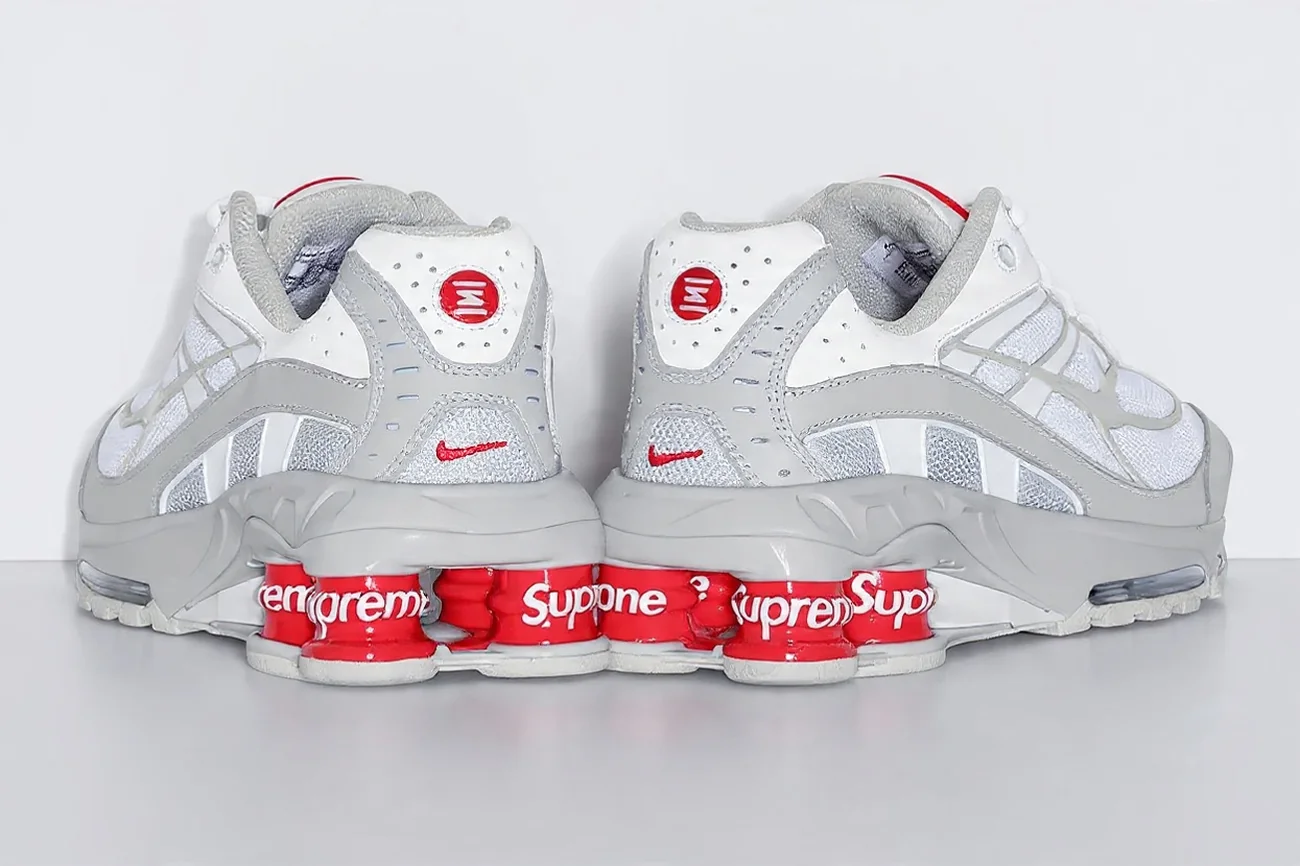
Collab is an informal shortening of collaboration. In sneaker culture, a collab happens when a footwear brand officially works with another partner to create a product, collection, reinterpretation of an existing silhouette, or an entirely new design.
That partner can be another brand, designer, artist, musician, athlete, retailer, boutique, institution, or cultural organization. The level of involvement can vary: some collaborations mainly change colors and materials, while others substantially reconstruct a shoe or lead to a new silhouette.
A sneaker collab does not have to be rare, limited, expensive, or difficult to buy. It also does not have to increase in value on the secondary market, feature two oversized logos, or come in special packaging. Those things can happen, but none of them is required for a project to qualify as a collaboration.
What Does “Collab” Mean in Sneakers?
Collab means collaboration. The essential element is an official partnership between the brand responsible for the product and another recognized participant in the project.
That partnership can take many forms. The collaborator may help direct the creative concept, select materials, develop a story, modify an existing silhouette, or work with the brand on an entire collection. The exact level of participation should be checked in official communication because brands do not always disclose every part of the design process.
In names such as Nike x Off-White or adidas x Wales Bonner, the “x” communicates a partnership between the parties. Its absence does not mean a project is not collaborative. Brands may use “by,” “with,” “for,” joint naming, or simply the collaborator’s name.
An official announcement is more reliable than the typography used in a product name. For more terminology used across collecting, releases, and resale, see the 90Sneakers Sneakerhead Dictionary.
Who Can Be Part of a Sneaker Collaboration?
A collaboration does not have to happen only between two fashion brands. Possible partners include:
- Another brand: a partnership can connect sportswear, streetwear, luxury, skateboarding, music, or outdoor culture.
- Designer or fashion designer: the collaborator may reinterpret materials, proportions, construction, and visual language.
- Artist or musician: involvement can range from concept and product design to storytelling and campaign work.
- Athlete: the partner may contribute aesthetics, personal history, or performance feedback.
- Store or boutique: a retailer can help shape colorways, materials, storytelling, and sometimes distribution.
- Institution or cultural organization: museums, franchises, and cultural projects can also become official collaborators.
Do not assume a celebrity personally designed every part of a shoe. Creative participation, direction, co-creation, campaign involvement, endorsement, and sponsorship can describe very different levels of involvement.
What Can Actually Change in a Collaborative Sneaker?
A collab can change one or several layers of a product:
- color combinations;
- upper materials;
- graphics and prints;
- logos and labels;
- tongues, laces, and insoles;
- shape and proportions;
- panels and stitching;
- midsole or outsole details;
- packaging and accessories;
- campaign and storytelling;
- the complete construction of the silhouette.
At one end of the spectrum, the collaboration may focus mainly on a colorway and co-branding. At the other, the partner may visually deconstruct a familiar shoe, change its construction, or work with the manufacturer on an entirely new model.
None of that automatically makes the final product better than a regular release. Materials, comfort, finish, durability, and performance still need to be evaluated on the actual shoe.
Are Collabs, Special Editions, Colorways, and Customs the Same Thing?
No. These terms can overlap in the same product story, but they describe different things.
Collab
A collab describes an official partnership. A brand works with another partner to create or reinterpret a product. The release may be limited or widely distributed.
Special Edition
A special edition can be created internally by the brand to celebrate an anniversary, event, city, championship, or theme. Without an officially involved external partner, it does not automatically become a collaboration.
Colorway
A colorway is the combination of colors and finishes used on a model. A brand can release many colorways without any collaboration. A collab can include one or several colorways and may also change other parts of the shoe.
Custom
A custom is a personalization or modification made to an existing sneaker, usually outside the official manufacturing process. An artist painting or rebuilding a Nike sneaker does not automatically make the result an official Nike collaboration.
A “Nike customized by an artist” and a “Nike x artist” are different classifications. In the second case, the partnership must be authorized and recognized by the brand.
PE or Player Exclusive
PE means Player Exclusive: a version developed for a specific athlete, team, or sports context, often without a general retail release. A PE is not automatically a collaboration, although some projects can involve creative input from the athlete.
Signature Shoe
A signature shoe is a silhouette or product line built around an athlete or personality. It usually belongs to an ongoing brand relationship and does not have to be classified editorially in the same way as a one-off collaboration.
The categories can overlap. adidas and Bad Bunny, for example, began their official creative partnership in 2021 by reworking existing adidas models. In 2026, the relationship expanded into the BadBo 1.0, which adidas describes as Bad Bunny’s first signature shoe.
Endorsement or Sponsorship
In an endorsement relationship, a person represents, wears, or promotes the brand. That does not prove participation in product creation. An artist photographed in a sneaker or a sponsored athlete wearing a model does not automatically turn that shoe into a collab.
Is Every Sneaker Collab Limited or Exclusive?
No. “Collab” tells you who participated in the project; “limited edition” mainly tells you how a product was distributed or how much inventory was offered. They are separate characteristics.
- A collaboration can be limited.
- A collaboration can have broad distribution.
- A limited edition can be created entirely by the brand with no external collaborator.
- A regular release can exist without any collaboration.
- A partnership can continue across many seasons and produce dozens of products.
In some projects, part of a collection is widely distributed while certain versions are restricted to a region, event, or partner. The release structure does not change the fact that the project was collaborative.
Low supply also does not automatically create resale value. Scarcity matters only when enough demand exists for the available inventory.
Are Collabs Always More Expensive or Better?
No. A collaboration can have a higher retail price because of materials, production, positioning, or commercial strategy, but that is not a requirement. Some collaborative products remain close to the pricing of regular versions.
The collaborator’s name does not guarantee:
- better materials;
- better finishing;
- more comfort;
- greater durability;
- structural innovation;
- rarity;
- future appreciation.
Quality should be evaluated on the actual product, not only on the co-branding. A regular colorway can make more sense for a buyer than a more expensive collaboration built on the same silhouette.
Why Do Brands and Creators Make Sneaker Collaborations?
Generating attention can be one goal, but it is not the only one. Collaborations can also:
- exchange creative references;
- reinterpret historical archives;
- reach different communities;
- experiment with materials or construction;
- connect sport, fashion, music, art, and other cultural contexts;
- introduce an older silhouette to a new audience;
- tell stories connected to the collaborator;
- develop products for a specific use or audience;
- build a long-term relationship between the partners.
Creative and commercial interests can coexist. A collaboration can carry cultural meaning while also functioning as part of the companies’ sales and positioning strategies.
Examples That Show Different Types of Sneaker Collaborations
Nike x Virgil Abloh / Off-White: Reconstructing Familiar Silhouettes
In 2017, Nike announced The Ten, a collaborative project by Virgil Abloh, founder of Off-White, built around ten silhouettes from Nike, Jordan, and Converse.
The models were divided into two themes. “REVEALING” used a cut-apart, exposed, reconstructed visual language that made normally hidden parts of footwear construction visible. “GHOSTING” explored translucent materials and layered components.
The project shows how a collaboration can go much further than changing colors. Abloh worked with exposed stitching, open foam tongues, quotation-mark graphics, displaced panels, and construction details that deliberately called attention to how the shoes were made.
The Ten became highly influential in conversations around deconstruction and exposed design within sneaker culture. That is more precise than claiming one project single-handedly redefined all modern sneaker aesthetics.
For more context, read our Nike x Off-White guide. You can also see how collaboration changed one specific silhouette in our guide to Air Jordan 1 collaborations.
adidas x Wales Bonner: A Fashion Partnership Across Multiple Seasons
The partnership between adidas Originals and Grace Wales Bonner demonstrates that a collab does not need to be a one-off release. Across multiple seasons, the project has reinterpreted elements from the adidas sports archive through materials, finishing, apparel, and footwear.
The collaboration was still active in 2026. adidas Originals by Wales Bonner Spring/Summer 2026 included lifestyle and performance products, showing how a long-running partnership can evolve across categories instead of depending on one limited drop.
adidas x Bad Bunny: From Reworked Classics to a Signature Shoe
adidas officially announced its creative partnership with Bad Bunny in 2021, beginning with collaborative projects built around existing adidas models and the artist’s visual language.
The partnership continued through additional silhouettes and collections. In 2026, adidas introduced the BadBo 1.0 as Bad Bunny’s first signature shoe, describing it as a new chapter in a creative relationship that had already developed over several years.
This example teaches two useful distinctions: a musician can participate in product collaboration, and a continuing collaboration can eventually lead to a signature silhouette. Even so, an artist appearing in a campaign does not automatically make that person a product collaborator.
New Balance x Aimé Leon Dore: A Continuing Partnership Across Categories
New Balance and Aimé Leon Dore maintain a collaboration that has moved across archive silhouettes, lifestyle products, and performance footwear instead of existing as one isolated colorway.
That range remained visible in 2026, when New Balance released Aimé Leon Dore collaborative versions of performance-running models including the FuelCell Rebel v5 and SC Elite v5. The partnership shows that a sneaker collab can extend beyond casual lifestyle releases.
Supreme x Nike SB: Skate Culture, Retail, and Collaboration
Supreme x Nike SB collaborations help explain the role that retailers and culture-driven brands can play in sneaker projects. Nike’s own SB history places collaborations with skate brands, artists, musicians, and other partners at the center of the Dunk SB’s growth during the early 2000s and beyond.
Partnerships of this type combine a manufacturer’s product-development capabilities with a collaborator’s knowledge of a specific community. Depending on the project, that influence can appear in materials, colors, concept, campaign, or distribution.
What Is Co-Branding in Sneakers?
Co-branding is the visible presence of both partners’ identities on the product, packaging, or marketing. It can appear through logos, labels, insoles, graphics, shared naming, or other brand marks.
Many collaborations use co-branding, but it is not mandatory and does not have to be visually loud. Some collaborations make both identities obvious; others keep the collaborator’s contribution much more subtle.
Co-branding also does not prove that a physical product is authentic. Counterfeits can copy logos and packaging, while unauthorized products can apply trademarks without permission.
How Can You Confirm That a Sneaker Collaboration Is Official?
Dual branding, special packaging, unusual materials, and low availability can suggest a collaboration, but none of those details is sufficient proof by itself.
- Look for an announcement on the manufacturer’s official website or newsroom.
- Check the official product page.
- Review official communication from the collaborator.
- Confirm the product name, release date, silhouette, and style code when available.
- Use authorized retailers as secondary confirmation.
Social-media photos, community nicknames, and reseller listings can contain errors or incomplete information.
Customs, samples, prototypes, and digital mockups can also be incorrectly presented as official collaborations. When possible, match the physical product to official information from the brand and collaborator.
Are Collab, Hype, and Resale the Same Thing?
No. They describe different things:
- Collab: the official partnership behind the product.
- Hype: the amount of attention, anticipation, or desire surrounding a release.
- Resale: a later sale on the secondary market.
A collaboration can generate enormous hype, modest interest, or almost no mainstream attention. A non-collaborative sneaker can also be extremely difficult to buy.
After release, either type of product can enter the secondary market. A collab can trade above retail, near retail, or below retail depending on supply, demand, size, region, timing, restocks, and condition. See our guide to sneaker resale for the broader market context.
Resale price also does not automatically measure design quality or cultural importance. A creatively significant project may have broad distribution, while a scarce product can become expensive without making an equally important design contribution.
Why Do Some Sneaker Collabs Get So Much Attention?
Some collaborations become highly visible because several factors line up at the same time:
- the collaborator matters to a specific community;
- the design intervention is easy to recognize;
- the underlying silhouette is well chosen;
- the concept is clear and understandable;
- the project connects with music, sport, art, or fashion;
- the partners already have cultural history or credibility;
- distribution aligns with the level of demand;
- the campaign communicates the project effectively.
None of these factors guarantees success. A famous partnership can receive criticism, sit at retail, or lose attention quickly. A project that initially seems quiet can gain importance years later.
How Do Collaborations Influence Sneaker Culture?
The most interesting impact of sneaker collaborations is not limited to resale price. They can change how an existing silhouette is perceived, revive overlooked archive models, connect communities, and bring outside creative references into footwear design.
The Ten demonstrated the potential of visibly reconstructing familiar models. Wales Bonner has brought a continuing fashion direction to the adidas archive. Bad Bunny’s partnership evolved from reinterpretations of existing shoes into a signature silhouette. Nike SB collaborations have repeatedly connected product, skate culture, retail, and community.
For some collectors, a collaboration can represent identification with the partner, a memory from a specific era, or an interest in a particular design approach. That is different from saying every collab automatically gives the wearer status or becomes historically important.
Collecting itself can involve memory, identity, design, belonging, nostalgia, and cultural research. Those themes are part of the broader stories explored in Sneaker History & Culture.
How Are Sneaker Collaborations Released?
Distribution can happen through the manufacturer’s website or app, the collaborator’s own channels, selected retailers, physical stores, raffles, or event-specific releases. Some products launch globally, while others are restricted to certain markets, events, or sales channels.
Some collaborations release through a drop, meaning a scheduled product release at a specific date or time. Drop describes the release method or moment; collab describes the nature of the partnership. They are not synonyms.
After retail release, pairs can also appear on the secondary market. If you are comparing large resale platforms, see our StockX vs. GOAT comparison.
How to Buy a Sneaker Collab More Safely
- Confirm that the project was officially announced.
- Verify the full product name, colorway, and style code.
- Compare the pair with official product imagery instead of relying on one visual detail.
- Check seller reputation, buyer protection, and return policy.
- Treat prices far outside the normal market range as a reason to investigate further.
- Do not use special packaging or dual branding as standalone proof of authenticity.
- For used pairs, inspect condition, accessories, repairs, and alterations.
- Calculate shipping, sales tax, marketplace fees, and any other checkout costs before moving to resale.
No single visual trick can authenticate every collaborative sneaker because materials, packaging, and counterfeit techniques vary. For broader buying guidance, start with the 90Sneakers Buying Guide and use a release-specific authentication process when the pair requires closer inspection.
Is a Sneaker Collab Worth Buying?
It can be when the product makes sense for you regardless of whether the resale price later rises. Before buying, consider:
- Do you genuinely like the design, or are you mainly afraid of missing the release?
- Does the collaborator or story actually matter to you?
- Will you wear the sneaker or add it to a collection?
- Do the materials, comfort, and finishing make sense at the price?
- Is there a similar regular release that costs less?
- Is the secondary-market price far above retail?
- Do the retailer or marketplace return and buyer-protection policies work for you?
Exclusivity is not a universal benefit, and a high price does not prove higher quality. Buying only because you expect appreciation involves risk: demand changes, restocks can increase supply, and secondary-market prices can fall.
Sneaker Collab FAQ
What Does Collab Mean in Sneakers?
Collab means an official collaboration between a footwear brand and another partner to develop a product, collection, or reinterpretation of a silhouette.
What Does the “x” Between Two Brands Mean?
The “x” usually communicates a partnership, as in Nike x Off-White. Naming conventions vary, however, and some official collaborations use different wording.
Does a Collab Have to Be Between Two Brands?
No. The partner can be a designer, artist, musician, athlete, fashion label, retailer, boutique, institution, or cultural organization.
Is Every Collab Limited?
No. A collaboration can have limited production or broad distribution. Limited editions can also exist without an outside collaborator.
Is Every Collab Rare?
No. Rarity depends on available supply relative to demand and market. A long-running partnership can produce widely distributed products.
Are Collabs Always More Expensive?
No. Pricing depends on materials, production, positioning, and distribution. Some collaborations cost more than comparable regular models, while others remain close in price or later receive discounts.
Does Every Collab Go Up in Value?
No. A collaboration can resell above, near, or below retail. Supply, demand, size, restocks, condition, and timing all influence secondary-market pricing.
What Is the Difference Between a Collab and a Special Edition?
A collab requires an official partnership. A special edition can be created internally by the brand for an event, anniversary, theme, city, or campaign without an outside collaborator.
What Is the Difference Between a Collab and a Colorway?
A colorway is a product’s combination of colors and finishes. A collab is the partnership behind a product. A colorway can be collaborative or created entirely by the manufacturer.
What Is the Difference Between a Collab and a Custom?
A collab is officially authorized and developed with the brand. A custom is usually a later modification of an existing product and does not necessarily represent any official partnership.
Is an Athlete Shoe Always a Collab?
No. It may be a Player Exclusive, a signature shoe, a campaign product, or simply a model worn by a sponsored athlete. The classification depends on the actual product relationship and official communication.
How Can I Tell if a Collaboration Is Official?
Look for the announcement and product information on the manufacturer’s and collaborator’s official channels. Dual branding, special packaging, or low availability are not enough by themselves.
Are Collab and Hype the Same Thing?
No. Collab describes the partnership; hype describes attention and demand around a product. A collaboration can have little hype, while a regular release can be extremely sought after.
Are Collab and Resale the Same Thing?
No. Resale is the secondary-market sale of a product. A collaborative sneaker may be resold, but it may also remain available at normal retail.
Sources and Further Reading
The examples in this article were checked against official Nike, adidas, and New Balance materials, including Nike’s documentation of Virgil Abloh and The Ten, adidas communications about its continuing Wales Bonner and Bad Bunny partnerships, and current New Balance product pages for Aimé Leon Dore collaborative footwear.
For more terms, people, and movements that shape sneaker culture, explore the Sneakerhead Dictionary and Sneaker History & Culture.