
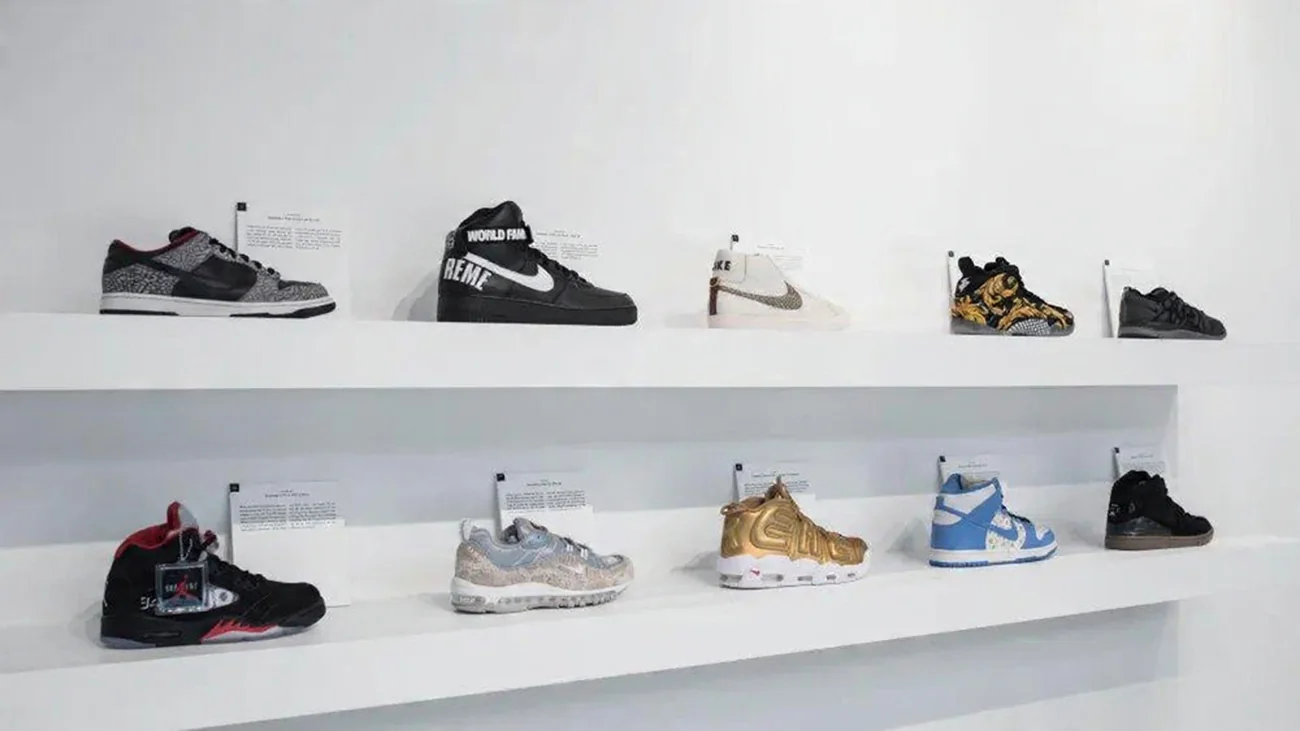
Sneaker resale is the sale of a shoe on the secondary market after its first retail sale. The pair can be new or used, recent or old, and sold above, near, or below its original price.
The best-known form of resale is buying a sought-after release at retail and trying to sell it for more. That’s only one segment of the market. Collectors selling part of a collection, consignment stores, marketplaces, vintage pairs, and used sneakers are all part of resale, too.
Resale, then, doesn’t mean guaranteed profit. A limited shoe can lose demand, receive a restock, or trade below retail. Condition, size, fees, and how easily you can find a buyer also affect the result.
What does resell mean in sneakers?
In Brazil’s sneaker community, resell is informally used for both the act of reselling and the resale market. In English, resale is the more natural noun for the secondary market, while a reseller is the person or business selling again.
- Resell: the verb meaning to sell again; also used informally in Brazilian sneaker discussions for the market itself.
- Resale: the subsequent sale or the resale market.
- Reseller: a person or company that resells products.
These words appear alongside terms such as drop, raffle, deadstock, Ask, and Offer. Find more in the Sneakerhead Dictionary.
The primary and secondary markets
The simplest way to understand resale is to separate two stages in a product’s circulation:
- Primary market: the first sale by the brand, an official store, or an authorized retailer.
- Secondary market: a subsequent sale after that initial retail transaction.
In collectors’ vocabulary, buying from the brand or an authorized retailer is part of the primary market. Reselling that same physical pair afterward belongs to the secondary market. “Resale” here follows sneaker-community usage; in other commercial contexts, an authorized retailer may also be called a reseller.
The product doesn’t need to have been bought with resale in mind. Someone can buy a shoe to wear, change their mind, and sell it. They might also sell part of a collection or an older pair no longer available at retail.
Retail vs. resale: what’s the difference?
Retail refers to the price or sale through the brand or an authorized primary-market retailer; that price can change after release. Resale is the subsequent sale on the secondary market.
The difference isn’t “cheap retail” versus “expensive resale.” A sneaker can resell:
- above retail, when buyers are willing to pay more;
- near retail;
- below retail, when demand is low, supply is excessive, or the seller wants a quick sale.
The brand’s suggested price doesn’t establish a permanent floor for the secondary market. Even a sale above retail can produce a loss after fees and shipping. Resale is also broader than scalping, a term for buying scarce products with the intention of quickly reselling them at a higher price.
How does the sneaker secondary market work?
There is no single format. Transactions can happen on marketplaces, through consignment, in physical stores, or directly between people. Each model divides responsibility differently for listings, storage, payment, shipping, returns, and verification.
Marketplaces
A marketplace organizes sellers’ listings and buyers’ orders under its own rules. Some platforms handle payment and shipping; others also offer physical verification; and certain transaction types let a previously approved seller ship the product directly.
A marketplace doesn’t necessarily involve direct contact between buyer and seller. With an intermediary, identities can remain separate, and the product may pass through a verification facility before reaching the buyer.
Consignment
With consignment, the owner delivers or ships the product to a company that sells it on their behalf. Once it sells, the consignor receives the agreed amount after applicable fees or commission.
Depending on the agreement, the company may store, list, display, and ship the product. Timing, item withdrawal, price adjustments, and costs vary between services.
Direct person-to-person sales
In a direct sale, buyer and seller negotiate without a specialist platform handling the entire transaction. That can reduce some fees, but it leaves the participants with more responsibility for verification, payment, shipping, and resolving disputes.
Without buyer protection or expert assessment, the risk of fraud, counterfeits, or inaccurate descriptions can increase.
How does StockX work in 2026?
StockX’s documentation distinguishes its Verified Marketplace, Listings Marketplace, and Live Marketplace. Each has its own condition, verification, and access rules; they aren’t all available in the same countries.
Verified Marketplace
The Verified Marketplace is for new, unworn items that meet StockX’s condition standards. According to the company, the product is verified by the platform or shipped directly by a StockX Verified Seller.
In this marketplace, a buyer can use:
- Buy Now: buy immediately at the lowest available Ask.
- Offer: submit the price the buyer is willing to pay.
For sellers, the main options are:
- Ask: set the desired price and wait for a matching offer.
- Sell Now: immediately accept the highest active matching Offer.
The interface borrows language from financial markets, with offers, asking prices, and sales history. Sneakers aren’t stocks, however, and StockX shouldn’t be described as equivalent to a regulated securities exchange.
Listings Marketplace
The Listings Marketplace is available to selected buyers and sellers in the United States. It features individual listings in New, New – Other, and Used condition, with seller-provided photos and descriptions.
StockX verification may be available for selected items in this marketplace. Rules, features, and availability can vary by region. Don’t automatically apply all Verified Marketplace rules to the Listings Marketplace.
Live Marketplace
The Live Marketplace supports live buying and selling. According to StockX support, orders in this marketplace aren’t eligible for StockX verification. Check availability for the buyer’s account and region.
For a platform walkthrough, see how to buy on StockX. Always confirm the current rules for the marketplace available in your region.
How do GOAT, Flight Club, and Stadium Goods fit into resale?
GOAT
GOAT lets approved sellers submit products for sale. Its documentation covers new, used, and new-with-defects items, with condition and photo requirements that vary by listing and seller profile.
That illustrates how the secondary market extends beyond new pairs. GOAT has its own rules for verification, shipping, commissions, and handling discrepancies. For more detail, see how GOAT verifies products and handles order problems.
Flight Club
Flight Club uses consignment and shipment for verification. Its product policy says it accepts authentic, new, unworn sneakers. Those requirements shouldn’t be confused with every condition that can be traded across the GOAT/alias network.
Flight Club’s seller activity moved to alias in 2025. The platform brings together sales across the Flight Club and GOAT network; it does more than simply connect buyers directly with sellers.
Learn more about its history and operation in our Flight Club guide.
Stadium Goods
Stadium Goods resells sneakers and streetwear, including through consignment. On its authenticity page, it says it keeps inventory in its warehouses and physically inspects products and packaging before shipment.
Check the company’s current agreement and support information for accepted conditions, costs, and selling procedures. Our Stadium Goods article provides background on the store.
What is deadstock?
In contemporary sneaker-community usage, deadstock or DS generally means a new, unworn pair. Exact criteria can vary between stores, communities, and platforms, however.
An original box, accessories, tags, absence of damage, and packaging condition can be part of a particular platform’s requirements. There is no universal community rule that every pair called deadstock must have a perfect box and absolutely every accessory.
Deadstock primarily describes condition, not rarity. A DS sneaker can be common, widely available, and priced below retail. Meanwhile, a used shoe can be rare and command a high price.
Are used sneakers part of resale, too?
Yes. Used, vintage, discontinued, and privately collected pairs are part of the secondary market. Value can be affected by:
- outsole and midsole wear;
- stains, tears, repairs, or alterations;
- upper condition;
- the presence of a box and accessories;
- size;
- rarity and demand;
- age and deterioration risk;
- authenticity and provenance.
These factors don’t form a fixed formula. A very rare pair may remain desirable with signs of wear, while another in excellent condition may attract few buyers.
Why do some sneakers gain value while others fall in price?
Price comes from the meeting of sellers willing to sell and buyers willing to pay. No single characteristic guarantees appreciation.
Supply and demand
Limited supply relative to strong demand can push prices up. If there are many sellers and few interested buyers, prices can fall. An officially announced quantity doesn’t always match the quantity actually available across all regions.
Restocks and reissues
A restock replenishes inventory. By increasing supply, it can temporarily reduce or stabilize resale prices, although the result depends on the volume added and existing demand.
A future reissue can also change demand for earlier versions. In other cases, historical or manufacturing differences help an older edition retain its value. There is no automatic response.
Size and region
Different sizes of the same release can have different supply and demand. A reference price for one size doesn’t necessarily represent every pair.
Region, currency, shipping, import costs, and local availability also create differences. A shoe common in one country may be hard to find in another.
Collaborations and cultural relevance
A collaboration can attract buyers by bringing together recognized brands, artists, designers, or stories. Projects such as Nike x Off-White show how design, storytelling, and availability can work together.
A collab doesn’t guarantee appreciation, though. Some releases rise, others stay near retail, and others fall below it.
The model’s history
Silhouettes with a legacy, such as the Air Jordan 1, can maintain interest for sporting and cultural reasons. That doesn’t mean every colorway or edition will perform the same way commercially.
Condition and the passage of time
Preservation can affect price, but storing a sneaker doesn’t guarantee appreciation. Materials age even without wear: adhesives can fail, foams can deteriorate, components can yellow, and moisture or improper storage can cause damage.
Public taste changes, too. A product in high demand today can lose relevance, while a forgotten model may attract renewed attention after a reissue or cultural shift.
Drops, raffles, and bots: how do they relate to resale?
Drop
A drop makes a product available, often at a set date and time in sneakers and streetwear. Not every drop is limited or destined to sell out quickly.
See our full explanation of what drop means.
Raffle
In sneaker retail, a raffle usually grants selected entrants the right to buy a product. It doesn’t necessarily mean receiving free shoes. Timing, payment, and pickup depend on the store’s rules.
Bots
Automated tools have been used to attempt purchases during competitive releases. Retailers use antibot systems and may cancel orders or accounts when they detect rule violations.
Getting a pair at release doesn’t guarantee a financial advantage. The product may not attract the expected demand, and later costs can wipe out any margin.
The selling price isn’t the same as profit
An asking price or recorded sale doesn’t automatically reveal what the seller earned. The calculation can include:
- the price paid at retail or in a previous purchase;
- shipping paid when buying the pair;
- platform commissions and fees;
- payment processing;
- shipping to the buyer or verification facility;
- packaging and storage;
- currency conversion;
- applicable taxes or obligations;
- price reductions for condition discrepancies;
- losses from cancellations or products with no buyer.
Fees vary by platform, country, marketplace, and seller level. Percentages in older articles may not reflect current costs. Check the fee estimate and rules before listing.
Is sneaker resale an investment?
People buy sneakers hoping their value will rise, but that doesn’t make them a predictable investment or equivalent to stocks, fixed-income products, or regulated funds.
Sneakers are physical goods with their own risks:
- Variable liquidity: there may be no buyer at the price you want.
- Falling demand: trends and preferences change.
- Restocks: new supply can change the price.
- Deterioration: materials can age even inside the box.
- Costs: fees and shipping reduce the result.
- Size differences: one size may behave differently from another.
- Fraud: payment, authenticity, and descriptions can lead to disputes.
- Valuation difficulties: listings aren’t necessarily completed sales.
You can make money, break even, or lose money. Buying a pair simply because it appears limited doesn’t replace an assessment of costs and demand, and no price history guarantees future results.
How can you buy resale sneakers more safely?
- Read the condition and verification rules for the marketplace you’re using.
- Check photos, the description, SKU, size, accessories, and box condition.
- Do a price check based on completed sales, not just sellers’ asking prices.
- Be wary of offers far outside the market range without a verifiable explanation.
- Use payment methods with appropriate buyer protection.
- Check return, cancellation, and dispute policies before paying.
- Calculate shipping, platform fees, and applicable sales tax; for cross-border purchases, also consider currency conversion and any import charges.
- For direct sales, check the other person’s reputation and document the transaction.
StockX, GOAT, Flight Club, and Stadium Goods describe their own inspection or verification processes, though availability differs by service and marketplace. These reduce certain risks but should never be described as a universal guarantee that mistakes cannot happen. Read the procedure for reporting problems, too.
Is resale part of sneaker culture?
Yes. Resale helps collectors find older models, sold-out sizes, discontinued editions, and pairs that never officially reached a particular region. It also lets people sell items that no longer fit their collections.
Buying releases solely to resell them at higher prices also draws criticism from consumers who can’t access them at retail. That debate exists alongside the secondary market’s other functions, such as circulating used pairs and finding older editions.
Not everyone who sells a sneaker is a professional reseller. There are occasional sellers, collectors refreshing their collections, and companies operating resale businesses. Those descriptions help explain behavior, but they aren’t an official market classification.
Sources and next steps
Check the rules through official channels: StockX Verified Marketplace, StockX Listings Marketplace, selling on GOAT, Flight Club sellers, and Stadium Goods consignment.
For more on the language and context of this market, visit the Sneakerhead Dictionary and our sneaker history and culture articles.