In sneaker culture, a drop usually means the release of a sneaker, apparel item, collaboration, or another product. If someone says “the drop is Friday,” they mean the product will become available that day.
But there is an important catch: a drop does not necessarily mean a limited release, a raffle, a sold-out product, or a sneaker that will increase in value. And in the phrase “cop or drop,” the same word has a different meaning: passing on something or choosing not to buy it.
Understanding these distinctions clears up much of the confusion around terms such as drop, shock drop, raffle, draw, restock, release date, W, and L on launch pages and in conversations among sneakerheads.
Do Drop and Release Mean the Same Thing?
The two terms often overlap.
Release can refer to a launch or to a particular edition of a product. Drop, in fashion, streetwear, and sneaker language, usually emphasizes the moment a product becomes available.
In practice, “release date” and “drop date” often point to the date when shoppers can try to buy the product.
That distinction should not become a rigid technical rule, though. Brands, stores, and communities may use the terms slightly differently.
Is Every Drop Limited?
No. Drop describes a release, not how many units were produced.
Some drops are extremely restricted, while others receive wide distribution. A product can reach many stores, remain available for weeks, or return to stock later.
To find out whether a release is truly limited, check the information for that specific product. Claims such as “limited,” “exclusive,” “F&F,” regional distribution, or official production numbers need their own supporting evidence.
Is a Drop the Same as a Raffle?
No. A drop is the release; a raffle is a way to allocate the opportunity to purchase.
For a highly sought-after release, a store may open entries before the release date. It then selects eligible entrants who can purchase the product under its rules.
So any of the following is possible:
- a drop sold directly without a raffle;
- a drop allocated through a raffle;
- a release with more than one way to gain access;
- a product that remains available through regular purchases after launch.
Also check whether entering authorizes an automatic purchase and charge if you are selected. That is how Nike describes the US SNKRS Draw; other countries and stores may have different rules.
What Is a Shock Drop?
A shock drop is a surprise release or one made available with little advance notice.
The phrase is particularly associated with platforms and brands that release sought-after products without a conventional, extended advance announcement.
The distinction is simple:
- drop: a release;
- shock drop: a surprise release or one with little advance notice.
So every shock drop is a type of drop, but not every drop is a surprise.
What Is the Difference Between a Drop and a Restock?
A drop is a release or a planned product availability event. A restock replenishes inventory of something that was already available before.
For example:
- a Dunk releases in March: that is the drop;
- the product sells out;
- a store gets more pairs in May: that is a restock.
For a closer look at the second situation, see what restock means in sneakers.
What Does Drop Mean on Nike SNKRS?
Nike also uses the word for releases. Certain products may appear on SNKRS, in the Nike App, on the brand’s website, or across a combination of those channels.
That does not mean a drop is a format exclusive to SNKRS, or that every release follows the same process.
Depending on the product and region, options may include:
- a regular purchase;
- a draw;
- select access;
- a surprise release;
- distribution through retailers.
Always check the rules for the actual release rather than assuming the purchase method just because someone called it a drop.
Why Does Drop Mean Something Else in “Cop or Drop”?
This is one of the most common ambiguities in sneaker vocabulary.
In the sentence:
“The drop is Friday.”
drop means release.
But in the question:
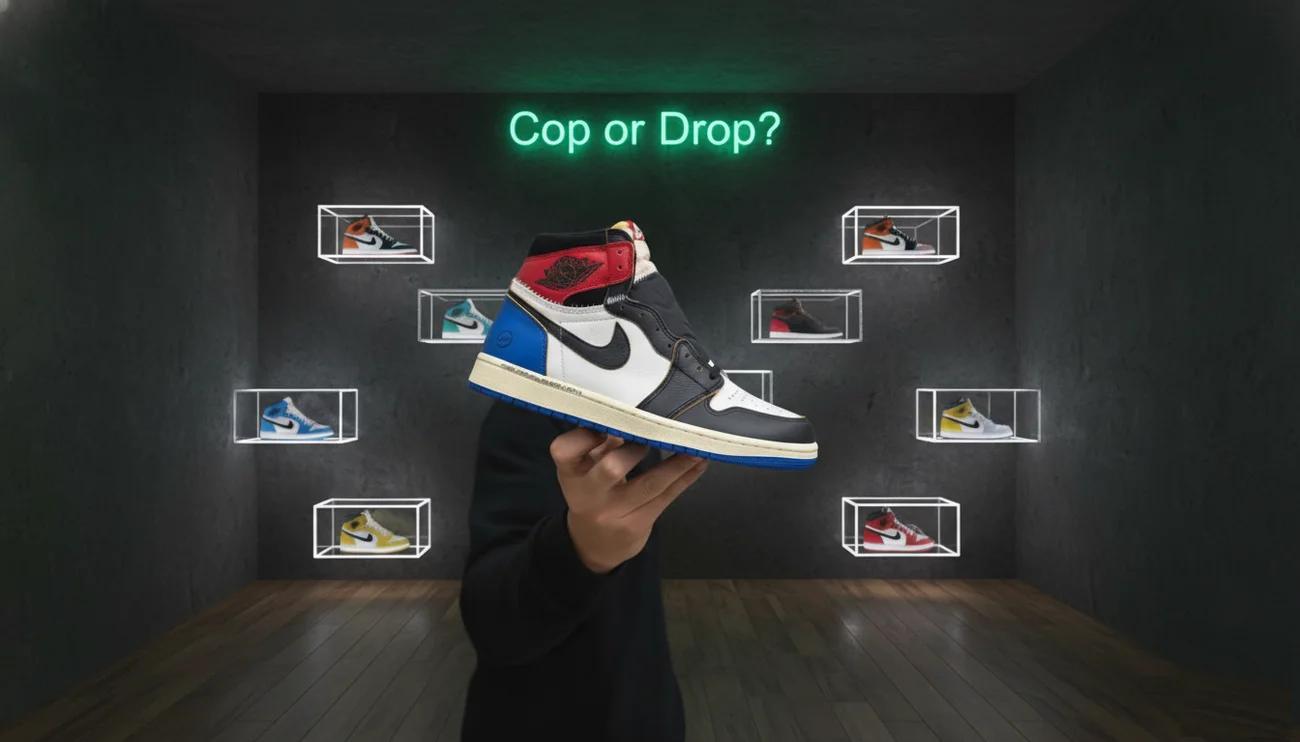
“Cop or drop?”
drop means pass on it or do not buy it.
So this sentence makes perfect sense:
“That Jordan is a cop for me. I’m going to try for it at Saturday’s drop.”
The first term expresses an intention to buy; the second refers to the release. For the full expression, see what cop or drop means.
Does Drop Mean Someone Took an L?
No.
If someone answers “drop” in a cop-or-drop poll, they probably decided to pass on that product. That is different from trying to buy it and missing out.
In sneaker language:
- Cop: an intention to buy or the act of acquiring something, depending on context;
- Drop, in “cop or drop”: passing on it;
- W: a successful attempt;
- L: an unsuccessful attempt.
You can decide a sneaker is a cop, enter the release, and end up taking an L. You can also call it a drop and never try to buy it.
For those terms, see what W and L mean in sneakers.
Does Every Drop Sell Out?
No. Drop and sold out are separate concepts.
A product can sell out in seconds, remain available for months, or go on sale later. Having a release date does not, by itself, tell you what demand will be.
Does a Limited Drop Always Go Up in Resale Value?
No.
Scarcity can affect availability, but it does not guarantee enough demand to support a high price.
The secondary market depends on several factors:
- model and SKU;
- size;
- supply;
- demand;
- region;
- restocks;
- market conditions at the time.
That is why “it will be a limited drop” does not mean “it will go up in value.” A sneaker should not automatically be treated as an investment just because its initial availability is low.
How Does a Sneaker Drop Work in Practice?
There is no single format, but the process usually includes some of these steps:
- Announcement: the brand or retailer introduces the product.
- Release date: a release or drop date is announced, when applicable.
- Sales channel: a website, app, physical store, raffle, or another method is identified.
- Purchase or selection opens: shoppers try to get the product according to the rules.
- Outcome: the product may remain available, sell out, or return later.
The process varies considerably. A very limited collaboration can work completely differently from a widely distributed Dunk Low.
How Can You Prepare for a Drop?
For a release you actually intend to buy, the most useful approach is to verify the details:
- official date and time;
- the region where the product will be sold;
- participating retailers;
- release method;
- official price;
- raffle or draw rules, if applicable;
- available sizes;
- the seller’s cancellation or return policy.
A social media countdown can be exciting, but your main source should be the brand or retailer handling the release.
For other purchasing and distribution terms, see the Sneakerhead Dictionary’s releases, drops, and buying section.
For the wider context, explore Sneaker History and Culture: From Rubber Soles to a Global Movement.