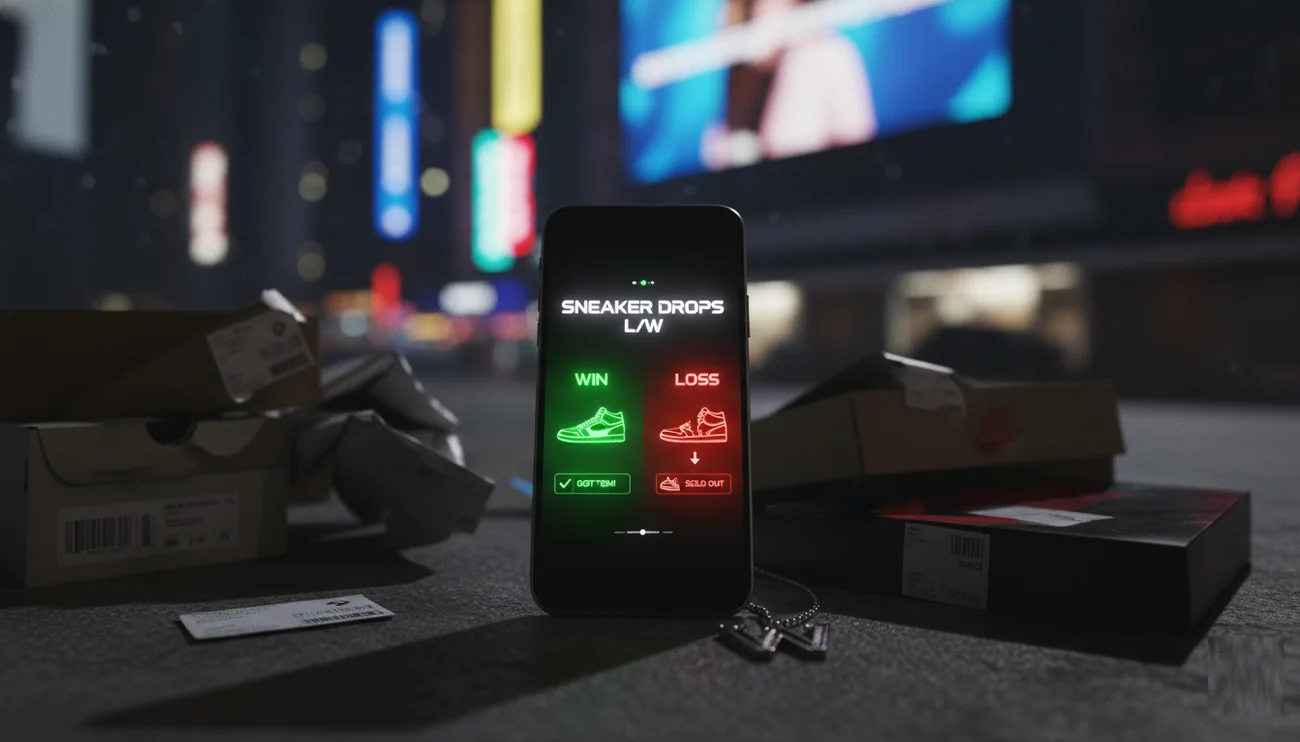
In sneaker releases, W means win and L means loss. A W means that particular attempt to get the pair succeeded; an L means it didn’t.
The stage of the purchase varies: W can mean a selection, reservation, completed checkout, or confirmed order. L can mean not being selected, your size selling out, or a failure before confirmation. The store’s message tells you what actually happened.
What do W and L mean in sneakers?
It’s important to talk about the result of an attempt, rather than simply “bought” or “didn’t buy.” If a skate shop draws names for the right to pay for and pick up a pair, being selected can already count as a W. On another site, W might only apply once checkout is complete and the order is confirmed.
The same goes for an L. You can take an L in one raffle even if the shoe is still available at another store, in another region, or in another size. The letter describes the outcome of that attempt; it doesn’t tell you about availability across every channel.
Did W and L originate in sneaker culture?
W and L also abbreviate wins and losses in sports and are used informally online. In the sneaker community, got a W and took an L refer to the outcome of a purchase attempt or selection process.
There is no specific origin date established here for their sneaker usage. The meanings come from win and loss; how they apply to a release depends on the conversation.
What does a W look like in practice?
A W is a positive result, but the actual outcome depends on the release mechanism.
A W in a raffle
A raffle selects among people interested in acquiring a product. Some stores draw for the right to buy; others preauthorize payment and charge those selected; still others require in-store pickup and payment by a deadline.
That’s why “I won the raffle” usually doesn’t mean “I won free shoes.” It means the entry was selected within that purchase system. Free entry and a free product are very different things.
The rules matter more than the slang. Before entering, check whether selection results in an automatic charge, a later opportunity to buy, a reservation, or in-store pickup. If you enter at several retailers, budget for more than one selection; check cancellation and return rules rather than assuming you can undo an extra win.
A W in a SNKRS Draw
According to Nike’s U.S. SNKRS Draw guidance, participants choose a size during a limited entry window and keep their payment details current for preauthorization. You are charged if selected, and results arrive after the drawing closes. Other retailers and regions may use a different process.
The Draw rules limit entries to one per person per launch product. W/L is an informal way to communicate selection or nonselection; check Nike’s official message for any remaining steps.
Policies can vary by country and can change. Check the rules displayed for the release and region you’re entering rather than assuming every store follows SNKRS.
A W on an FCFS release
FCFS stands for First Come, First Served: customers are served or sold the product in order, while stock lasts. There isn’t necessarily a later selection process. If you complete the purchase before stock runs out, you can say you got a W.
With this format, timing, queues, and availability can directly affect the result. In a draw with an entry window and selection after it closes, entering in the first second doesn’t automatically improve your chances. A strategy only makes sense when it fits the mechanism.
What about an L? When an attempt doesn’t work out
Take an L or took an L means missing the result you wanted. In sneakers, that can happen in several ways:
- your entry wasn’t selected in the raffle or draw;
- your size sold out;
- stock ran out before checkout was complete;
- the payment or order wasn’t confirmed;
- the release window ended without a purchase;
- you couldn’t secure the reservation or pickup through that channel.
In a selection system, an L doesn’t necessarily mean you made a mistake. You can fill everything out correctly, enter on time, and still not be selected. Following the steps makes an entry valid; it doesn’t guarantee selection.
Remember, too: L describes the outcome, not the shoe’s quality or the taste of the person trying to buy it. A pair can remain available elsewhere while you still took an L in that particular raffle.
Raffle, draw, FCFS, and drop: why aren’t they the same?
A drop is a product release or the moment it becomes available. It can use a regular sale, FCFS, a raffle, a draw, reservations, or another mechanism. Learn more in what drop means in sneakers.
Raffle is the broad term used for a selection process linked to the opportunity to acquire a pair. Draw also means a drawing or selection and appears in names of specific systems, such as SNKRS Draw. In everyday conversation, raffle and draw often overlap, but each operation’s rules determine what actually happens.
FCFS isn’t a raffle. It is a sale based on order of arrival or completion, limited by available stock. A release can produce Ws and Ls in any of these formats; what changes is the path to that result.
W/L vs. cop or drop: what’s the difference?
Cop or drop expresses an intention or opinion: do you plan to buy the release or pass? W/L records the outcome of an attempt.
For example:
- before the release: “Cop.”;
- after the raffle, if selected: “W.”;
- after the raffle, if not selected: “L.”
There is another online use, too. Saying “that colorway is a W” means the speaker thinks the color combination is a success. Saying “I got a W on SNKRS” usually means a successful release attempt.
My experience with Ws and Ls
In my own experience following releases, some Ws stand out precisely because they didn’t all happen the same way. There have also been far more Ls than a collection photo usually reveals. That mix is part of the real story for anyone who takes part in competitive drops.
The W on the Nike SB Dunk Low x StrangeLove
I got the Nike SB Dunk Low x StrangeLove at its original release. The name and context are documented in the official Nike SB archive, which records the StrangeLove Skateboards collaboration, the Bright Melon/Gym Red/Soft Pink colorway, and its February 2020 release.
Sean Cliver: selected for the right to buy
The Nike SB Dunk Low x Sean Cliver was different: I entered a skate shop’s Instagram raffle and was selected for the right to buy. It’s a perfect example of why W doesn’t universally mean “payment already completed.”
Nike SB officially records the model as the Cliver Dunk Low and “Sean Cliver x Nike SB Holiday Dunk,” distributed through skate shops and SNKRS in December 2020. The W I’m describing was the shop’s selection; the purchase was the next step.
Air Jordan 1 Skyline: a W doesn’t require a rare collab
Another W was the Air Jordan 1 Retro High OG known as “Skyline.” Nike Brazil’s official page identifies the model by SKU DX0054-805 and describes its gradient denim as inspired by the transition from dawn to dusk.
W can also describe a successful purchase of a shoe you want without a collaboration or limited production run. The expression describes the attempt’s outcome, not a rarity category.
The Ls along the way
I also took Ls on practically every attempt I made involving Nike x Off-White projects, various Yeezys, and the Nike SB Dunk Low x Ben & Jerry’s “Chunky Dunky.” Nike officially documents the Chunky Dunky as Ben & Jerry’s debut SB Dunk collaboration, originally released in 2020.
Why are some releases so difficult?
There is no universal success rate. Many brands and stores don’t disclose total quantities, entries by size, or regional allocations. Without that information, any exact “chance of a W” would be more guesswork than calculation.
Several factors can increase competition:
- limited supply relative to the number of eligible participants;
- demand concentrated in particular sizes;
- regional distribution or allocation to only a few stores;
- the popularity of the model, colorway, or collaboration;
- the selling channel’s rules and technical capacity;
- unauthorized automation, where it occurs.
Bots are part of the longstanding debate about fairness in online releases, but they don’t explain every L. In a legitimate draw, you may simply not be selected. In FCFS, stock may run out. At a local store, there may have been very few units in your size. The mechanism matters.
“Global competition” isn’t an automatic explanation, either. Many drops are national, regional, local, or restricted to eligible customers. The actual pool of participants depends on that release’s rules.
Can you legitimately improve your chances of a W?
No trick guarantees selection. What you can do is avoid missing an opportunity because of incomplete account details, an expired deadline, or an overlooked rule:
- follow official release calendars and brand or store channels;
- create your account before the release and check your address, size, and payment information;
- enable notifications when available;
- read the rules to understand selection, charges, and pickup;
- submit your entry within the stated window;
- enter raffles at different authorized retailers when each set of rules allows it;
- for FCFS, be ready for the scheduled time and checkout process.
Entering different legitimate raffles isn’t the same as creating multiple entries in a single drawing. Don’t use fake accounts, duplicate identities, or extra devices to get around the rules. Besides offering no guaranteed benefit, that can invalidate your entry.
In a drawing where selection happens after entries close, entering in the first second doesn’t imply priority. Check the size and payment conditions before submitting, because selection may trigger a charge under the rules.
What should you do after an L?
First, take a breath. An L doesn’t oblige you to pay any price on the secondary market. Sometimes “not this time” is simply the end of that attempt, and that’s okay.
If you still want the pair, you can:
- check for a release at other authorized retailers;
- watch for a possible restock without treating it as a promise;
- look into trusted stores for authentic sneakers;
- consider the resale market only if the price, authenticity, and your budget make sense;
- do a price check using recent sales and comparable sources;
- pass on the release and save your budget for another sneaker.
A restock can happen, but it isn’t guaranteed. Resale prices can also rise, fall, or remain close to retail. W/L records what happened in that attempt; it doesn’t predict the market.
Sources and references
- Nike Help: How Can I Join a SNKRS Draw?
- Nike Help: SNKRS Draw Rules and Terms and Conditions
- Nike Help: How Do I Get Nike’s Newest Sneaker Releases?
- Asphaltgold: how raffles work and W/L usage
- Nike SB Vault: StrangeLove
- Nike SB Vault: Cliver
- Nike SNKRS: SB Dunk Low x Ben & Jerry’s “Chunky Dunky”
- Nike Brazil: Air Jordan 1 Retro High OG, SKU DX0054-805
- Sneaker History: community uses of “Catching a W” and “Taking an L”
Find more expressions in the Sneakerhead Dictionary and learn how they circulate in the sneakerhead community.
For the wider context, explore Sneaker History and Culture: From Rubber Soles to a Global Movement.