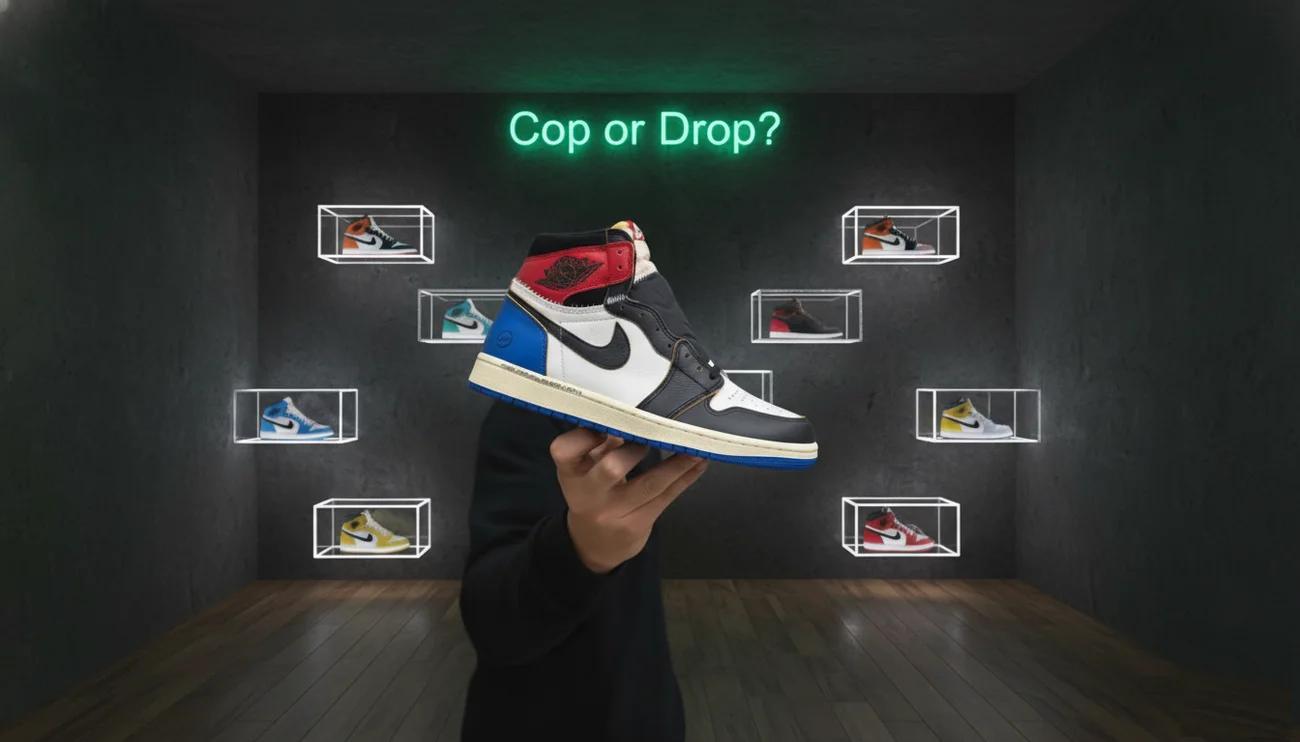
Cop or drop means “buy it or pass.” It is a simple question in sneaker culture and streetwear that asks for someone’s opinion on a product: would you buy this pair or pass on it?
Suppose a new Dunk colorway appears and someone asks, “Cop or drop?” Answering “cop” means something like “I’d pick it up” or “I’d buy it.” Answering “drop” means you would pass on the release.
Context determines whether “cop” expresses an intention or a completed purchase. It also distinguishes “drop” as a decision to pass from “drop” as a release. W and L refer to a different stage: the outcome of the attempt.
What Does Cop Mean in Sneakers?
In sneaker vocabulary, cop means to acquire, buy, pick up, or get a particular item.
Merriam-Webster lists the informal verb cop with meanings including “get hold of” and “purchase.”
The meaning therefore shifts slightly with the sentence:
- “Cop.” → “I’d buy it.” / “I’d pick it up.”
- “I’m going to try to cop.” → “I’m going to try to buy it or get it.”
- “I copped them.” → “I got or bought that pair.”
In Brazilian sneaker conversations, “copar” appears as an informal Portuguese adaptation of the English verb. It is community usage, not required vocabulary.
Did Sneaker Culture Invent the Word Cop?
No. The verb is much older than sneaker culture, hip-hop, SNKRS, or the modern idea of a sneaker drop.
Merriam-Webster dates the verb to 1846 in senses related to getting or taking, and includes buying among its current uses. The sneaker community did not invent the word.
Does Cop Necessarily Mean Buying a Limited Sneaker?
No.
You can use cop for a sought-after release, a general release, a sneaker on sale, a T-shirt, or another streetwear item.
The word describes acquiring the product. It does not tell you whether the item is rare, expensive, limited, or hyped.
Drop Can Mean “Pass” or “Release”
Within cop or drop, drop means deciding not to buy. “That Dunk is a drop for me” means “I’m passing on that Dunk,” a usage recorded in Sneaktorious’ glossary.
In “the drop is Saturday,” the word means release. A sentence can use the related terms without contradiction: “It’s a cop for me; I’m going to try for it at Saturday’s drop.”
Cop, Copped, Instacop, and Pass in Conversation
Cop
Depending on context, it indicates that someone would buy, wants to acquire, or intends to try to get the product.
Copped
The past-tense form. In sneaker culture, it usually indicates that someone got or bought the item.
Instacop
Instacop conveys a strongly positive reaction: something a person would buy immediately or without much hesitation. Glossaries such as Sneaker History and Sneakerjagers record this meaning.
That does not mean a purchase has automatically happened. “Instacop” can simply be an enthusiastic way of saying “I want that pair.”
Cop or Pass
Cop or pass is a natural variation on the same idea: buy it or pass. There is no requirement to use only “cop or drop.”
Are Cop or Drop and W/L the Same Thing?
No. This is an important distinction.
Cop or drop usually describes a preference, intention, or decision.
W/L describes the result of an attempt: W for win when you get the item and L for loss when you do not.
The sequence might look like this:
- you see the sneaker and decide: cop;
- you enter the release or raffle;
- you get to buy it: W;
- or you miss out: L.
Our guide to what W and L mean in sneakers explores that language of results.
How Did Cop or Drop Become a Content Format?
In a poll, a sneaker photo appears alongside the question “Cop or drop?” This community usage is documented, for example, in Sneakerjagers’ glossary.
But there is an important nuance: a cop-or-drop poll measures only the stated preferences of the people who responded.
It does not necessarily measure actual purchases, objective product quality, or total market demand.
Do More Cop Votes Mean a Sneaker Will Rise in Value?
No. That relationship is too simplistic to serve as a market forecast.
A poll can be an informal gauge of interest within that specific audience. Nothing more.
Someone can vote cop without ever trying to buy. Another person might like the shoe but think it costs too much. Someone else might buy only if it goes on sale.
Even real demand does not determine future prices by itself. Available supply, sizes, region, restocks, product condition, and market timing also matter.
So:
- more cop votes do not guarantee appreciation;
- more drop votes do not guarantee a price decline;
- cop or drop should not be used as an investment signal.
How Do You Decide Whether a Sneaker Is a Cop or a Drop for You?
There is no universal checklist. Everyone weighs factors differently, and a sneaker does not have to be culturally significant or hard to get to make sense in your rotation.
Do You Actually Like the Design?
Start with the basics. If the colorway, shape, or concept does not appeal to you, internet attention does not oblige you to call it a cop.
Does the Model Suit How You Plan to Use It?
A sneaker for all-day walking can call for different priorities than a pair chosen mainly for its looks. Assess the specific model, not just the name of a technology.
Does the Fit Work for You?
Size, width, internal volume, and the model’s official fit guidance can matter much more to a satisfying purchase than hype.
Does the Price Fit Your Budget?
A sneaker can look great and still make no sense at that price. “Drop because of the price” remains a perfectly valid answer.
Are You Choosing the Pair or Reacting to the Release?
Hype can be part of the fun, but it does not need to be your only criterion. A slept-on sneaker can be an excellent cop for someone, while a sought-after release can still be a drop.
Buying to wear, to collect, or simply because you like a pair is a completely normal motivation. Resale does not have to be part of the decision.
Examples of Cop or Drop in Conversation
The following examples are made up solely to show how the terms change with context:
- “That Dunk is a cop for me.” → I would buy it.
- “I like it, but at that price, it’s a drop.” → I like it, but I am passing.
- “I’m going to try to cop at release.” → I am going to try to buy it.
- “I managed to cop my size.” → I was able to buy it.
- “I wanted to cop, but I took an L.” → I wanted to buy it, tried, and missed out.
- “The drop is Saturday.” → The release is Saturday.
- “Instacop.” → I would buy it without much hesitation.
For more release terminology, see releases, drops, and buying in the Sneakerhead Dictionary.
For the wider context, explore Sneaker History and Culture: From Rubber Soles to a Global Movement.