
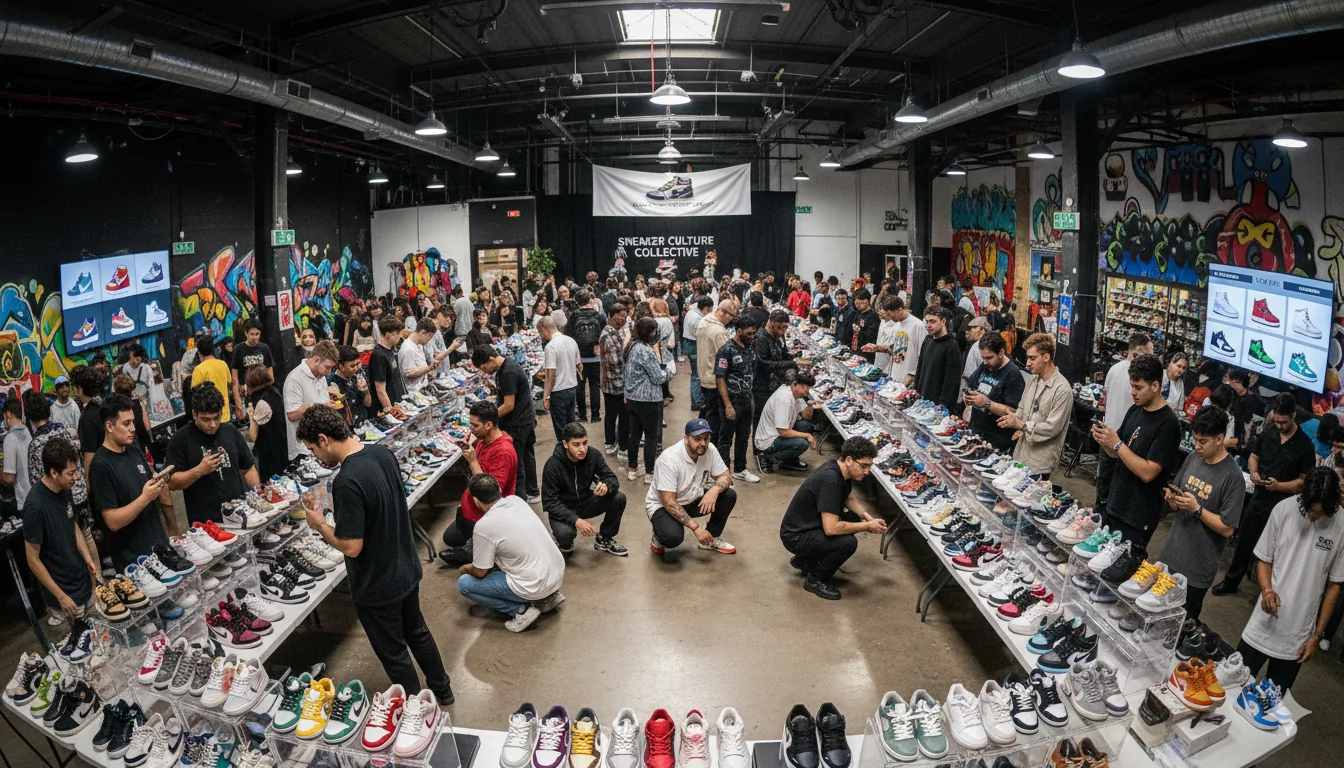
The sneakerhead community brings together people who share an interest in sneakers, their history, design, releases, everyday wear, collecting, and culture. It is not a single organization or a club with universal rules. In practice, countless communities and local scenes are connected by a shared interest.
That network can exist in a dedicated forum, a group of friends, on social media, in a store, at an event, in a release-day line, or in a conversation about that old Air Max someone finally managed to identify.
And you do not need a wall full of shoeboxes to participate. The sneaker community includes everyone from experienced collectors to people interested in history, design, performance, skateboarding, vintage sneakers, restoration, photography, or simply wearing good shoes.
Who Is Part of the Sneakerhead Community?
There is no single type of member.
Depending on the community, you might find:
- collectors;
- people who wear sneakers without collecting them;
- fans of particular brands or silhouettes;
- vintage collectors;
- skateboarders;
- runners interested in performance;
- designers and customizers;
- restorers;
- photographers and content creators;
- stores and sellers;
- buyers and other participants in the secondary market;
- researchers and people interested in footwear history.
These groups overlap, but they are not identical. Someone can love Air Jordans without caring about resale. Another person might collect 1990s running shoes and completely ignore the month’s most hyped releases.
A community exists because people share an interest, not because everyone has the same taste.
Do You Need a Large Collection to Join?
No. There is no minimum number of sneakers required to join a sneaker community.
A huge collection may be part of someone’s hobby, but it is not an admission pass.
Knowledge does not have to be an entrance exam, either. Beginners can ask questions, discover models, and learn from people who have followed the scene longer.
Does the Sneakerhead Community Have an Official Starting Point?
There is no single verified date marking the birth of the global sneakerhead community.
Sneaker culture developed through several histories that intersected over time. Sports, basketball, running, skateboarding, hip-hop, street style, collecting, and design helped turn athletic shoes into objects whose meanings extend beyond their original function.
The exhibition Out of the Box: The Rise of Sneaker Culture, shown at the Oakland Museum of California in 2016–2017, brought together footwear dating back to the 19th century, manufacturers’ archives, and collections from figures associated with hip-hop. That history helps explain why sneaker culture has multiple roots that predate digital drops.
Statements such as “the sneaker community started in hip-hop” or “basketball created it” therefore oversimplify a history shaped by multiple scenes.
Did Forums Help Build the Online Sneaker Community?
Yes. Long before today’s social media platforms dominated the conversation, specialized forums were already connecting people interested in sneakers.
One of the most important examples is NikeTalk. The community began in December 1999 and remained active for decades, becoming a substantial archive of discussions about sneakers, sports, and culture.
For NikeTalk’s 25th anniversary in December 2024, cofounder Nelson C reflected on its beginnings in 1999 and the development of an international community around sneakers, sports, and culture.
That account documents the history of a specific forum. It does not establish the origins of the entire sneaker community or measure its size.
Does the Sneakerhead Community Exist Only Online?
No. In-person connections matter just as much as digital ones.
Communities meet at stores, fairs, conventions, local meetups, brand events, and other gatherings organized around sneakers and streetwear.
Sneaker Con is a documented milestone. According to the event’s official history, its founders started the project in 2008, and the first event took place in New York in March 2009, drawing more than 3,000 people.
The format brought community and commerce into the same space: people could meet, check out collections, and buy, sell, and trade sneakers.
Sneaker Con also announced a São Paulo event for November 25–26, 2023, at Expo Center Norte. It is an example of these gatherings’ international reach alongside established local scenes.
Did the Community Create Sneaker Slang?
Communities play an important role in the spread, adoption, and evolution of language, but it is risky to claim that “the community created” each individual expression.
Terms such as drop, LPU, W, L, heat, grail, DS, and VNDS can take on specific meanings as they circulate through forums, stores, marketplaces, and conversations among collectors.
Some expressions have traceable origins; others developed so broadly that no individual inventor is known.
For explanations of these terms, see the Sneakerhead Dictionary.
What Can You Learn in a Sneaker Community?
A good community can bring a wealth of collective experience into a single conversation.
Depending on the group, discussions can help you learn about:
- a silhouette’s history;
- differences between generations;
- how a particular shoe shape fits;
- release dates and launch methods;
- colorway details;
- preservation and restoration techniques;
- historical references;
- people’s experiences with stores;
- differences between editions of the same sneaker.
But collective knowledge does not automatically make every post factual. A comment can be wrong, someone’s memory can mix up dates, and a release rumor may never be confirmed.
When information matters, especially about a release, product, or authenticity, it is worth separating community experience from verifiable documentation.
Can a Sneaker Community Authenticate a Pair?
Communities can help flag concerns, compare photos, and find references, but the number of comments does not turn an opinion into a certificate of authenticity.
An experienced member may spot important inconsistencies. Even so, authentication requires examining the correct release, construction, labels, codes, materials, provenance, and other details relevant to the model.
For more on that process, see our guide to sneaker legit checks.
Is the Sneakerhead Community the Same as the Resale Market?
No.
Buying, selling, and trading have long been part of some corners of the community, and events such as Sneaker Con have incorporated those activities into in-person gatherings.
But reducing the sneaker community to the secondary market leaves out much of the culture.
Someone can follow sneakers for their history, design, sports connections, fashion, restoration, or collectibility and never resell a single pair.
Likewise, buying and selling does not automatically make someone a representative of the entire community.
For that specific commercial activity, see what sneaker reselling means.
Does the Sneakerhead Community Decide Which Sneakers Become Popular?
It can influence attention and demand, but it does not control the market on its own.
Community discussions can spotlight a forgotten model, increase interest in a particular colorway, or quickly spread information about a release.
Commercial success also depends on distribution, price, availability, campaigns, athletes, artists, fashion trends, and shoppers who do not actively participate in sneaker communities.
That is why a few dozen enthusiastic posts do not constitute market research, just as negative comments in one group do not prove a product failed globally.
What Problems Come Up in Sneaker Communities?
Community does not mean an absence of conflict.
Depending on the space, discussions may involve:
- gatekeeping;
- resellers;
- prices;
- bots at releases;
- authenticity;
- replicas and counterfeits;
- incorrect information;
- toxic behavior;
- disputes over what makes someone a “real sneakerhead.”
There is no single solution to these issues, and they do not show up the same way in every group. Some communities focus on collecting; others on performance, vintage sneakers, skateboarding, fashion, or simply conversation.
Is There a “Right” Way to Participate?
There is no universal rule, but a few practices make any community better:
- separate opinion from fact;
- cite sources when information needs to be verified;
- do not ridicule beginners;
- respect different tastes;
- do not present a rumor as a confirmed release;
- be transparent when buying, selling, and trading;
- understand the specific rules of each group or event.
For the broader context behind these scenes and stories, explore Sneaker History and Culture.