
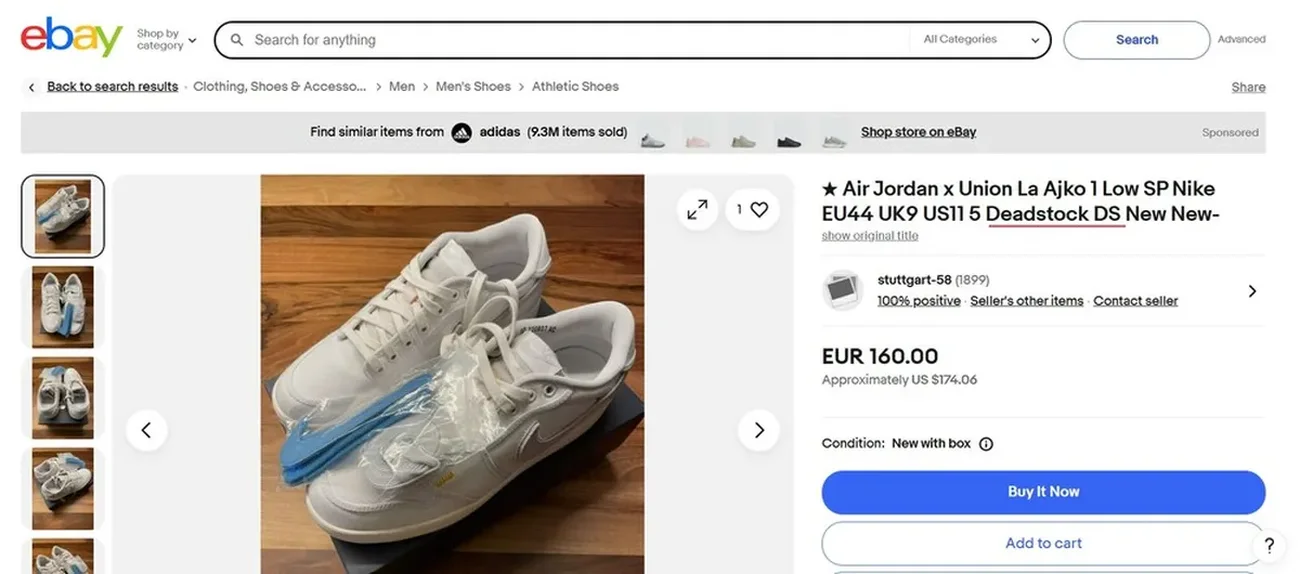
DS means Deadstock. In modern sneaker culture, the abbreviation mainly describes a pair that is new and unworn. But the details of what each seller, collector community, or marketplace accepts as “deadstock”—the box, accessories, try-ons, relacing, or small storage marks—do not follow one universal standard.
That nuance matters because DS mainly answers one question: has the sneaker been worn? By itself, the abbreviation does not guarantee that the pair is flawless, authentic, rare, complete, structurally sound, or more valuable.
An Air Jordan that has sat in its box since the 1990s may still be unworn. That does not mean it has defeated time. A closed box does not freeze adhesives, foams, rubber, or other materials—collectors might wish it did, but chemistry does not negotiate.
What Does DS Mean in Sneakers?
DS is short for Deadstock. Today, when the term appears in a sneaker listing, collector conversation, or resale negotiation, it usually communicates that the pair is new and has not been worn.
You will find stricter definitions that require complete packaging, tags, untouched factory lacing, or no try-on at all, while other sellers use DS primarily as another way to say “unworn.” That disagreement exists because Deadstock is cultural and commercial vocabulary, not a condition grade controlled by one authority across the entire sneaker industry.
When the details actually matter, “DS” should therefore be the beginning of the description—not the end of it.
Deadstock Did Not Always Mean “Never Worn”
The history of the word is one of the most interesting parts of the term.
The Complex feature “The Russ Report: What Does ‘Deadstock’ Really Mean?” documents an older retail meaning of “dead stock”: inventory that remained unsold and sat on store shelves, in stockrooms, or in basements.
It was literally stock that had become commercially “dead.”
As sneaker collecting, eBay, consignment stores, and online resale grew, the expression changed function. “Dead stock” became “deadstock” and increasingly shifted toward describing product condition, including recent releases that had never been old unsold inventory at all.
Today, sneakerheads usually use DS to mean a new, unworn pair even though the term began somewhere else historically.
From Unsold Inventory to Sneaker Slang
That transformation reflects part of sneaker culture’s own evolution. A retail-inventory phrase moved through stores, classifieds, forums, eBay listings, consignment shops, and collector-to-collector deals until it became one of the secondary market’s most recognizable abbreviations.
So it is not historically accurate to say that Deadstock has always meant “a sneaker that was never worn.” That is mainly the modern sneaker-culture meaning.
The Air Force 1 and Old “Dead Stock” Pairs
The Air Force 1 offers a useful example of the older commercial sense of the expression.
An academic study of the cultural and commercial evolution of sneakers discusses how, after Nike initially discontinued the Air Force 1, consumers continued searching for old unsold pairs sitting on sale racks and in East Coast store inventory. Those pairs fit the older idea of dead stock: old merchandise that had remained unsold but was still new.
In that context, the expression sits very close to its original retail meaning: older inventory that was still new and had never been sold.
That does not mean the Air Force 1 created the term. The example simply shows how “dead stock” made sense in retail before DS became an everyday sneaker-condition label.
Is There an Official Universal Definition of Deadstock?
No.
There are community definitions, seller practices, and marketplace-specific rules, but there is no global authority deciding exactly how long a sneaker can be tried on, how the laces must sit, or which accessories are mandatory for every collector and marketplace.
That lack of a universal standard explains many arguments about try-ons, boxes, tags, and relacing.
Rather than trying to win a definition war, the most useful approach for both buyer and seller is simple: describe exactly what happened to the pair.
How Does StockX Use the Term Deadstock?
StockX has its own operational condition rules.
Under StockX’s current Verified Marketplace condition requirements, sneakers must be brand new and include the required shoebox. StockX has historically described this standard as a condition commonly known in sneaker culture as “deadstock.”
That does not make StockX the owner of the definition. It means that to sell inside that particular marketplace, the product has to satisfy StockX’s own standards.
That distinction is even more important in 2026 because StockX now operates different marketplace formats. The Listings Marketplace, for example, uses explicit condition levels such as New, New – Other, and Used.
Specific marketplace, specific rules.
What About eBay? Not Every Marketplace Uses DS
eBay makes the difference in marketplace language especially clear.
Its current shoe-condition categories include New with box, New without box, New with defects, and Pre-owned, with additional pre-owned condition levels depending on the listing flow.
“New without box,” for example, can describe a shoe that is brand new, unused, and unworn but no longer has its original packaging.
That is why you should not assume DS maps perfectly onto the same checklist everywhere. Read the actual listing condition and the marketplace’s current rules.
What Do Buyers Usually Expect From DS Sneakers?
The most widely shared core expectation is new and unworn.
Beyond that, many buyers look for:
- no clear signs of outdoor wear on the outsole;
- an interior without wear caused by actual use;
- the original box when it is still part of the set;
- extra laces, cards, inserts, hangtags, or other accessories that originally came with that release, when applicable;
- transparent disclosure of storage marks, box damage, try-ons, relacing, or missing pieces.
Notice what the list does not say: “perfect stitching,” “zero yellowing,” or “no visible glue.” Those details do not, by themselves, tell you whether a sneaker was worn.
Does DS Mean a Sneaker Is Perfect or Mint?
No.
DS mainly communicates wear history. “Mint” communicates something different and usually suggests an exceptionally well-preserved state.
An unworn sneaker can still show yellowing, a small storage mark, visible glue, a manufacturing asymmetry, material changes, or box damage.
New does not mean industrially perfect. Unworn does not mean immune to aging.
Do DS Sneakers Need the Original Box?
There is no universal answer outside the rules of a specific marketplace.
In collector-to-collector sales, many buyers expect the original box when a collectible release is advertised as DS. But losing the box does not make the shoe worn.
A clear listing should therefore say something like:
- DS with original box;
- DS, no box;
- replacement box;
- original box with damage.
StockX’s Verified Marketplace currently requires an acceptable matching box under its own standards. eBay, by contrast, has a specific “New without box” condition. The platforms are describing the same physical dimension with different taxonomies.
Does Box Damage Make a Sneaker No Longer DS?
Not necessarily. Box condition and whether the shoe was worn are separate questions.
A box can be dented, torn, or discolored during shipping or storage while the sneaker remains unworn.
That damage can affect a marketplace’s acceptance standards or a collector’s willingness to pay. StockX, for example, has specific sneaker-box guidelines that allow certain minor cosmetic issues.
Box condition should therefore be disclosed separately.
Can DS Sneakers Have Been Tried On?
This is one of the classic Deadstock debates.
Stricter collector definitions say that a try-on means the pair is no longer truly Deadstock. Complex, for example, has published a traditional sneakerhead definition in which even a tried-on pair would not count as DS.
Real marketplace practice is less uniform. Some buyers accept a brief indoor try-on with no wear marks; others do not. StockX’s own verification guidance has also stated that a new pair may still pass even if it has been tried on for fit.
The better solution is not to hide the argument behind two letters. If the pair was tried on, say that it was tried on.
“DS, only tried on indoors, no signs of wear” is more informative than forcing buyer and seller to guess which definition of Deadstock the other person uses.
Can a Relaced Pair Still Be DS?
Collectors disagree about this too.
Some buyers expect untouched factory lacing. Others consider removing or changing the laces different from actually wearing the sneaker.
Again, transparency works better than an invented universal rule: if the pair was relaced, disclose it.
Does DS Require Every Original Tag and Accessory?
Missing an accessory does not automatically prove the sneaker was worn.
Not every release originally included a hangtag, special seal, card, extra lace set, or other accessory either.
It helps to separate two questions:
- wear condition: was the sneaker worn?
- completeness: are the original box and release-specific accessories still present?
In resale language, phrases such as “OG all” may be used to emphasize that the package still includes the relevant original accessories. That adds useful information without changing the basic idea that DS is mainly about absence of wear.
Is DS the Same as DSWT?
Not exactly.
DSWT means Deadstock With Tags. The phrase adds the information that the relevant tags are still present.
DS and DSWT can overlap: a sneaker can be Deadstock and also Deadstock With Tags.
That does not make DSWT an officially “higher” condition tier, and tags do not function as an authenticity certificate. For the term separately, see what DSWT means in sneakers.
Are DS and NIB the Same Thing?
Not necessarily, although the two descriptions can apply to the same pair.
NIB means New In Box. It emphasizes that the product is new and accompanied by its box.
A new, unworn sneaker stored in its box can reasonably be described as both DS and NIB depending on the context.
Are DS and NWT the Same Thing?
No.
NWT means New With Tags and is a broader commercial condition phrase for a new item that still has the relevant tags attached or included.
DS and NWT can coexist. They are not steps on a universal “better versus worse” condition ladder. See also what NWT means in sneaker listings.
What Is the Difference Between DS and VNDS?
DS normally indicates a sneaker that is new and unworn.
VNDS means Very Near Deadstock and works as an informal condition description for a pair that is very close to new but has some history that makes calling it DS questionable or inaccurate.
There is no universal number of wears that automatically turns a sneaker into VNDS. “Worn once,” “worn twice,” or any other count does not replace a real description of the condition.
And DS does not automatically “always sell for more” than VNDS. Wear condition can influence price, but it is only one variable. For the related term, see what VNDS means.
Can B-Grade Sneakers Be DS?
Conceptually, yes, because the terms describe different characteristics.
B-Grade relates to a manufacturing-imperfection designation. DS, in modern sneaker use, mainly relates to whether the pair has been worn.
So a sneaker can have a small manufacturing imperfection and still be new and never worn.
That is another reminder that Deadstock does not mean “perfect.”
Does DS Mean a Sneaker Is Authentic?
No.
DS describes an alleged condition, not authenticity.
A counterfeit sneaker that has never been worn is still counterfeit. A listing that says “100% DS!!!” with five exclamation points is still just a listing.
Evaluate authenticity separately. Our guide to sneaker Legit Checks explains why a box, label, style code, QR code, or any other single detail should not be treated as standalone proof.
Does DS Mean Rare, Limited, or Sold Out?
No.
A release produced in large quantities and still available at retail can be DS. The abbreviation does not tell you how many pairs exist.
Deadstock also does not automatically mean grail, collaboration, vintage, limited-edition, or expensive.
Rarity and condition are different axes.
Can Deadstock Sneakers Age Even If They Are Never Worn?
Yes. This is one of the biggest differences between “unworn” and “perfectly preserved.”
Materials continue to react to time, temperature, humidity, oxygen, light, and their own chemical composition even when a sneaker stays in a box.
Depending on the shoe, age, storage environment, and materials, you may see:
- yellowing;
- oxidation;
- drying or hardening;
- cracking or crumbling in certain materials;
- separation as adhesives age;
- discoloration;
- degradation of certain foams;
- mold when environmental conditions allow it to develop.
StockX itself warns vintage-sneaker buyers about issues such as cracking, crumbling, adhesive aging, oxidation, and yellowing even when older pairs are sold in new, unworn condition.
What Is Hydrolysis, and Why Does It Matter With Old Sneakers?
Some polyurethane formulations—especially certain polyester-based polyurethanes—can undergo hydrolytic degradation, a chemical process in which water participates in breaking bonds in the polymer structure over time.
Research on aging polyurethane foams used in footwear and other applications documents hydrolysis as one possible degradation mechanism.
That does not mean “every Air Jordan hydrolyzes.” Sneakers use different combinations of rubber, EVA, polyurethane, TPU, modern foams, adhesives, and construction methods. You have to know what materials are actually present in the specific model. For a dedicated explanation, see why some sneakers crumble and how hydrolysis works.
Does Deadstock Mean a Vintage Sneaker Is Still Wearable?
Not automatically.
A pair can be completely unworn and still have structural-failure risk because of age.
StockX currently warns that older sneakers may have structural weakness and reduced durability regardless of how they were stored, and it does not guarantee the long-term integrity of vintage pairs once they are worn.
StockX’s references to sneakers around five years old or older are operational guidance for its marketplace, not a chemical law that every sneaker becomes unsafe on its fifth birthday.
With vintage footwear, evaluate the model, materials, construction, storage history, and actual signs of degradation before deciding whether to wear the pair.
Are DS Sneakers Always Worth More?
There is no universal rule.
In a truly equivalent comparison—the same release, colorway, size, accessories, market, and point in time—an unworn pair may attract more buyer interest than a worn example.
But price also depends on:
- model;
- release;
- colorway;
- size;
- supply and demand;
- box and accessories;
- provenance;
- the pair’s actual physical condition;
- age and material integrity;
- seller, region, and timing of the transaction.
DS does not guarantee a high price, and it definitely does not guarantee future appreciation.
Is Deadstock an Investment?
Deadstock is a condition description, not an investment class.
Sneaker resale prices can rise, fall, or remain flat, while a stored pair continues to age physically.
Keeping a sneaker unworn does not guarantee profit.
How Do You Check a Pair Listed as DS?
No single detail proves Deadstock condition. The better approach is to evaluate the whole pair and ask for real photos of the exact item being sold.
- Confirm the release. The model, colorway, size, and style code should match the product being advertised.
- Inspect the outsole. Look for evidence consistent with outdoor wear without treating dust or small storage marks as automatic proof of use.
- Check the toe box and heel. Creasing can help tell the pair’s history, but packaging and certain materials can also create marks without walking.
- Inspect the sockliner and insole. Wear may indicate use, but printed graphics vary in durability and can also change from handling or age.
- Look inside the shoe. Check for residues, wear, and signs that make sense—or do not make sense—with the rest of the pair.
- Ask about try-ons. Do not assume every seller uses the same definition of DS.
- Ask about relacing. If untouched factory lacing matters to you, confirm it before buying.
- Check the box and accessories. Know exactly what is included.
- With old sneakers, evaluate aging. Unworn does not automatically mean wearable.
- Authenticate separately. DS does not prove the pair is genuine.
Style codes, boxes, and labels help identify the release being represented. None of them authenticates the physical object by itself.
How Do You Preserve an Unworn Sneaker?
The realistic goal is to reduce degradation factors, not stop aging forever.
- avoid prolonged direct sunlight;
- avoid excessive heat and large temperature swings;
- avoid excessively humid environments;
- inspect the pair periodically for mold, adhesive changes, oxidation, drying, or material breakdown;
- learn what materials and construction are used in that specific model;
- avoid unnecessary cleaners or conditioners unless you know they are compatible with the material.
There is no single silica-gel quantity, plastic-box setup, or humidity target that works perfectly for every sneaker. Leather, rubber, textiles, foams, adhesives, paints, and finishes age differently.
Good storage can slow some processes. It cannot stop time.
How Can You Buy a DS Sneaker Without Relying Only on the Abbreviation?
Before buying, try to confirm four separate dimensions:
- condition: has the sneaker truly never been worn?
- completeness: are the box and original accessories present?
- integrity: are the materials still in appropriate condition for how you plan to use the pair?
- authenticity: is the sneaker genuine?
Also read the condition policy of the marketplace you are using. “DS” in a peer-to-peer listing does not necessarily mean the same thing as “brand new” inside a structured marketplace with its own verification rules.
Real photos are especially important. Catalog images show what the release should look like; they do not show the physical condition of the exact pair being sold.
FAQ About DS and Deadstock Sneakers
What does DS mean in sneakers?
DS means Deadstock. In modern sneaker culture, it usually describes a sneaker that is new and unworn.
Did Deadstock always mean never-worn sneakers?
No. Historically, “dead stock” referred to old or unsold inventory. Sneaker culture adapted the expression and increasingly used it as a condition description.
Is DS an official condition grade?
There is no universal definition controlled by the entire sneaker industry. Communities, sellers, and marketplaces can use their own criteria.
Does DS mean the sneaker is perfect?
No. An unworn sneaker can have minor manufacturing variation, aging, yellowing, storage marks, box damage, or other issues unrelated to wear.
Is DS the same as mint?
No. DS mainly communicates absence of wear. Mint generally suggests an exceptionally well-preserved condition.
Does DS mean authentic?
No. DS describes condition, not authenticity. An unworn counterfeit is still counterfeit.
Do DS sneakers need the original box?
It depends on the seller’s definition and the marketplace. Many collectors expect the original box, but the absence of a box does not mean the sneaker was worn. The listing should disclose the situation clearly.
Can DS sneakers exist without a box?
A sneaker can be new and unworn even if the box has been lost. Some sellers may still call that DS; others use a more specific phrase. Marketplaces may classify the pair differently.
Can a DS sneaker have been tried on?
There is no universal consensus. Some collectors consider any try-on incompatible with DS, while others tolerate a brief indoor fit check with no signs of wear. If the pair was tried on, the best practice is to disclose it.
If I try sneakers on at home, do they become VNDS?
There is no automatic rule. VNDS is a subjective community condition term. Describe the try-on and the real condition instead of relying only on an abbreviation.
Can a DS pair be relaced?
Collectors disagree. Some buyers require untouched factory lacing; others focus on whether the pair was actually worn. If the laces were removed or redone, disclose it.
Does DS require tags?
There is no universal external tag on every sneaker release. Tags and accessories should be described according to what originally came with that specific product.
What is the difference between DS and DSWT?
DS means Deadstock. DSWT means Deadstock With Tags and adds that the relevant tags are still present. It is not a universal hierarchy of quality.
What is the difference between DS and VNDS?
DS normally indicates a new, unworn pair. VNDS means Very Near Deadstock and describes a condition very close to new, but the exact criteria vary among sellers and collector communities.
Are DS and NIB the same?
Not necessarily. NIB means New In Box. A new, unworn sneaker that still has its box may reasonably be described by both expressions.
Are DS and NWT the same?
No. NWT means New With Tags. The terms can overlap, but they emphasize different characteristics.
Can B-Grade sneakers be DS?
Conceptually, yes. B-Grade describes a manufacturing-imperfection designation, while DS mainly describes absence of wear. A new, unworn sneaker can still have a manufacturing imperfection.
Can DS sneakers turn yellow?
Yes. Yellowing can result from the natural aging of certain materials and does not prove that the sneaker was worn.
Can DS sneakers separate?
Yes. Adhesives also age, and older sneakers can experience sole or panel separation even if they were never worn.
Do all old DS sneakers suffer hydrolysis?
No. Hydrolysis depends on the materials and formulation. Some polyurethane foams are vulnerable to this type of degradation, but you should not generalize the process to every sneaker or every Air Jordan.
Can you wear a 20-year-old DS sneaker?
Maybe, but DS does not guarantee structural integrity. With vintage sneakers, evaluate materials, construction, visible degradation, and storage history before wearing the pair.
Is DS always worth more than VNDS?
No universal rule says so. Lack of wear can affect price, but the model, size, box, accessories, demand, seller, region, and actual physical condition also matter.
Is Deadstock an investment?
No. Deadstock is a condition description. Keeping a sneaker unworn does not guarantee appreciation or future profit.
Is it safe to buy DS sneakers online?
No abbreviation or marketplace eliminates all risk. Check real photos, condition, box, accessories, age, the platform’s policies, and authenticity as separate questions.
Conclusion: DS Means Unworn, Not “Perfect Pair”
DS means Deadstock and, in modern sneaker culture, it usually describes a sneaker that is new and unworn.
But the history of the word is older. “Dead stock” began as retail language for inventory that sat unsold before sneaker culture transformed it into a common condition term.
It is just as important to remember what those two letters do not guarantee. DS does not automatically mean mint, authentic, rare, complete, expensive, or structurally perfect.
Box status, accessories, try-ons, relacing, storage, aging, material integrity, and authenticity should all be described separately. With vintage sneakers especially, unworn does not mean immortal—and it does not automatically mean wearable.
For more resale and condition terminology, explore the Sneakerhead Dictionary. The closest related terms are VNDS, DSWT, NIB, and NWT.