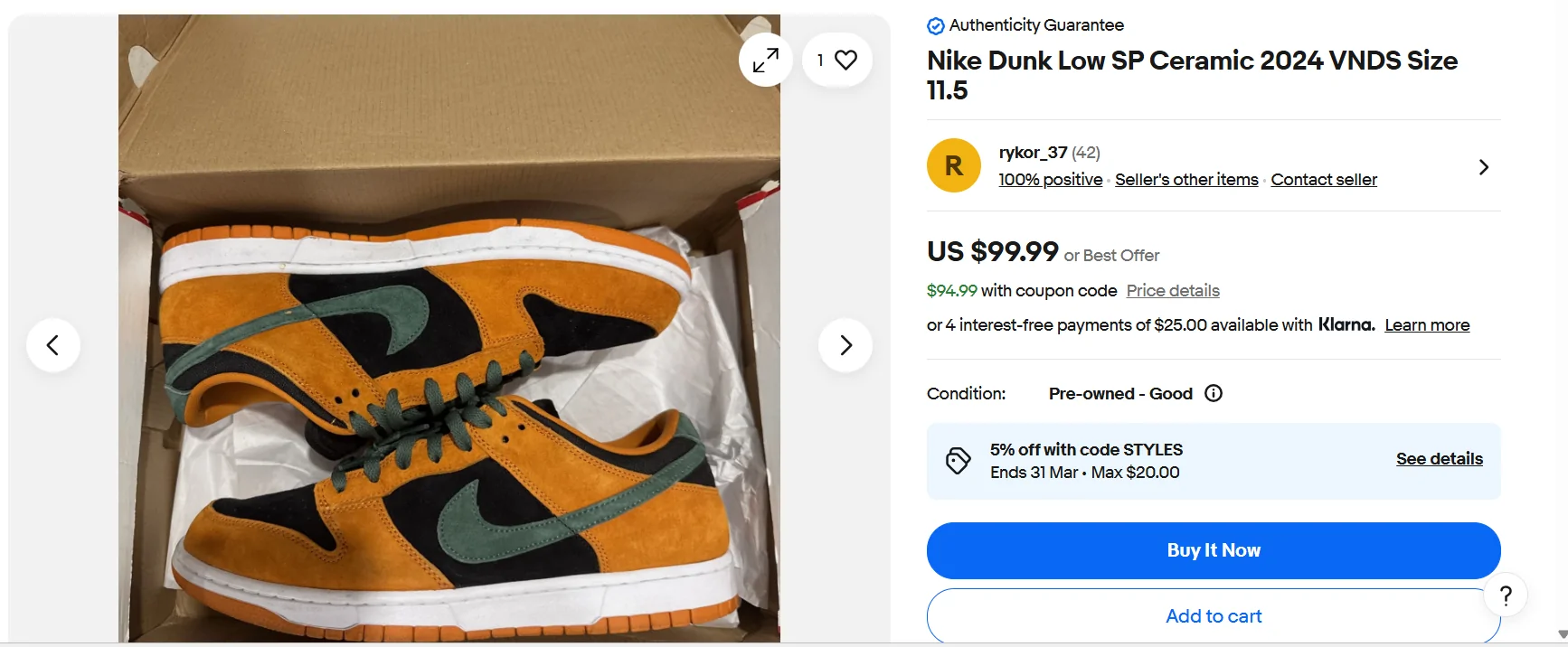
VNDS means Very Near Deadstock: an informal description for a sneaker the seller considers close to new. It is not an official grade, a wear-count limit, or an authenticity certificate. When you are considering a purchase, the useful question is not whether you agree with those four letters. It is whether you understand the actual pair well enough to decide.
Start with the listing, then separate what you can see from what the seller says. A clean outsole is an observation; “worn once” is a history claim. An original box is an included item; it does not establish wear or authenticity. Keeping those details separate makes a near-new listing much easier to assess.
Our VNDS definition and terminology guide covers the expression in depth. This guide applies those distinctions to comparing listings, requesting evidence, and deciding what remains uncertain before paying.
Start with the exact release and your intended use
Write down the model, colorway, release year, size, and style code when available. Two pairs with the same familiar nickname can come from different editions. A condition or price comparison is weak if one listing is for a different release, size, or set of accessories.
Decide whether you want to wear the pair, preserve it, or complete a particular collection. A missing box may not bother you as a wearer but may matter if you are collecting original presentation. An old, clean pair may interest a collector while requiring more investigation before it can be worn. Neither preference makes the other wrong.
VNDS does not tell you whether a model is rare, hyped, limited, or sold out. A general-release sneaker can be lightly worn, and an uncommon collaboration can be heavily worn. Treat rarity and condition as separate descriptions.
Read the wording before judging the photos
The Sole Collector Board Dictionary of 2010 recorded NDS and VNDS and already warned about overuse of VNDS. It documents the term at that time; it does not establish an inventor or first-use date. The lack of a universal standard is a reason to ask for detail, not to argue over a grade.
NDS means Near Deadstock. Adding Very, extra Vs, “95%,” or “9/10” does not create a standardized assessment. There is no universal maximum for wears, creases, or millimeters of heel drag. Ask what physical observations the seller means by the description.
“Worn once” is useful context only when you also know how the pair was used. Twenty minutes indoors and a full day on wet pavement both count as one occasion but can leave very different results. If the seller bought the pair secondhand, they may not know its complete history; an honest unknown is better than an invented number.
Request a photo set that shows both shoes
Catalog images identify a design, not the condition of the pair being offered. Ask for current pictures of the actual shoes and clear close-ups of anything that is hard to see. Review both shoes rather than assuming the better-looking one represents the set.
- Both outer and inner sides, photographed clearly enough to compare panels and finishes.
- Toe boxes from above and the side, plus heels and rear views.
- Complete outsoles, with closer views of heel and toe wear.
- Lining, insoles, interior, and internal size labels.
- The box and its label, if included, plus all accessories.
- Any stains, scuffs, repairs, or areas the seller says are imperfect.
Videos can help show suede, reflections, deformation, and creases from more than one angle. They do not automatically prove authenticity or guarantee that the filmed pair is what will arrive. If a material or area cannot be evaluated from the supplied images, keep that point open.
Inspect wear in a consistent order
Outsole: look beyond cleanliness
Look for abrasion, lost texture, embedded dirt, and wear at the heel and front of the sole. Heel drag and toe drag can show where material has worn away, but there is no universal amount that defines VNDS.
Some Jordan and Dunk outsoles have small molded stars that collectors examine for wear. That clue depends on the design; it is not a rule for every sneaker. A freshly cleaned sole can still have lost material, while dust alone does not prove extensive use. Compare the outsole with the upper and interior instead of judging one photograph in isolation.
Upper: interpret creases with context
Repeated flexing can leave creases, but a single crease may also reflect flexible materials, manufacturing, storage, or a try-on. Look at the pattern together with scuffs, staining, abrasion, color transfer, and damaged finishes. A close-up is most useful when a wider photo shows where that detail sits on the shoe.
Interior: check what exterior photos miss
Inspect lining wear, residue, deformation, and the insoles. An intact printed logo is not proof of minimal wear; a partly missing logo is not a universal measure of heavy wear. Print durability, materials, and construction vary. Ask about noticeable odor because photographs cannot communicate it, but do not invent an official VNDS odor test.
Ask about cleaning, repairs, and replacement parts
A deep clean can change appearance without erasing wear history. Ask separately about repainting, regluing, sole swaps, de-yellowing, touch-ups, and suede or other material restoration. Also ask whether the insoles or laces were replaced.
Repair and use are different facts. A lightly worn pair may have needed a glue repair; a heavily worn pair may never have been restored. Neither the word VNDS nor attractive photographs should hide that distinction. For a known repair, request a description of the work and photos of the affected area rather than treating all restoration as equivalent.
Make a separate inventory of the box and accessories
Record whether the pair comes with its original box, a replacement box, or no box. If there is a box, check its label and ask about dents, tears, or other significant damage. List spare laces, cards, hangtags, and other accessories appropriate to that particular release.
Losing a box does not create more wear on the shoes. It can still matter to you or affect comparison with another listing. Conversely, a complete original set does not make a worn pair new.
NWT means new with tags, and NIB means new in box. Those descriptions concern products presented as new. Tags and a box do not turn an already worn VNDS pair into an unworn one. DS usually describes an unworn pair, but community rules about try-ons and packaging vary, so ask about those directly too.
Treat an older pair as a material-condition question
Little outsole wear and a clean upper do not show whether aged foams, rubber, or adhesives remain sound. StockX warns about structural weakness in older footwear, including unworn pairs. That warning does not establish one age at which every shoe fails.
Identify the construction and materials of the particular model and generation. Do not assume that every Jordan, Dunk, or Air Max ages alike. Ask about storage and visible cracking, crumbling, or separation; where wearability remains uncertain, a near-new appearance is not a substitute for an appropriate assessment. Do not force fragile components simply to produce a photograph.
Evaluate authenticity through its own evidence
A genuine sneaker can be lightly worn or heavily worn; a counterfeit can be new or lightly worn. VNDS describes alleged condition and answers none of those authenticity questions.
Use the correct release references and consider the whole pair, its provenance, and the limits of the method. Our Legit Check guide explains why a label, box, or single detail cannot establish authenticity by itself. If photographs are insufficient, uncertainty should stay visible in your decision rather than becoming confidence because the price is appealing.
Compare listings without a fixed VNDS discount
There is no defensible universal rule that VNDS costs 10–30% less than DS. Two sellers may use the same label for noticeably different condition. Match the edition, size, market period, wear, repairs, and included items before comparing values.
These are illustrative comparisons, not observed listings or market-price claims:
- Two pairs are both described as worn once. One has clear photos showing little wear; the other omits the outsole and interior. The missing evidence is a reason to ask for photos, not a reason to assume equal condition.
- One pair has an original box and all release-specific accessories; another has a replacement box. Their wear could be similar, but they are different sets. Decide how much completeness matters to you before treating the prices as equivalent.
- An older pair looks almost untouched but has an unexplained glue line; a newer edition has visible wear and a documented repair. Neither a clean appearance nor a repair label settles wearability. Establish what happened to each pair before comparing them.
Look for genuinely comparable completed sales when available, while recognizing that public records may not show every condition detail. Asking prices tell you what sellers want, not necessarily what buyers paid. A low price warrants investigation; a high one does not prove quality or authenticity.
Send questions that the seller can answer concretely
Instead of asking only “Is it really VNDS?”, use questions tied to the missing evidence:
- Do you know approximately how often, where, and for how long the pair was worn?
- Has it been deep-cleaned, repainted, reglued, sole-swapped, or otherwise restored?
- Were the insoles or laces replaced?
- Are there stains, odors, damage, or repairs that are not clear in the photos?
- Is the box original, and exactly which accessories are included?
- Can you provide current photos of both outsoles, interiors, and the area I am unsure about?
Keep the answers with the listing information. A statement of condition is more useful when you can relate it to the pictured pair and the items the seller agrees to include.
Check the transaction before you pay
Read the seller history and the listing-specific authentication, buyer-protection, payment, and return terms. These vary by service and transaction. Neither a familiar marketplace name nor a VNDS label guarantees the purchase.
Before deciding, separate three outcomes: enough evidence to compare the pair, a specific question that still needs an answer, or uncertainty you are unwilling to accept. You can request more information or pass without proving that the seller is wrong. The aim is an informed purchase, not winning an argument over four letters.
If you are the seller, replace the grade with a description
You can use VNDS as shorthand, but show the entire outsole and disclose heel/toe drag, creases, scuffs, stains, cleaning, repairs, and restoration. State whether the box is original, replaced, or missing, list accessories, and give wear context only when you actually know it.
A useful description allows the next person to reach their own conclusion from current photos and specific information. If you are uncertain, say what you know about the physical condition instead of adding another V. The Sneakerhead Dictionary provides related condition and collecting terms.
For the wider context, explore Sneaker Buying Guide: Stores, Sizing, Resale, and Safer Shopping.