
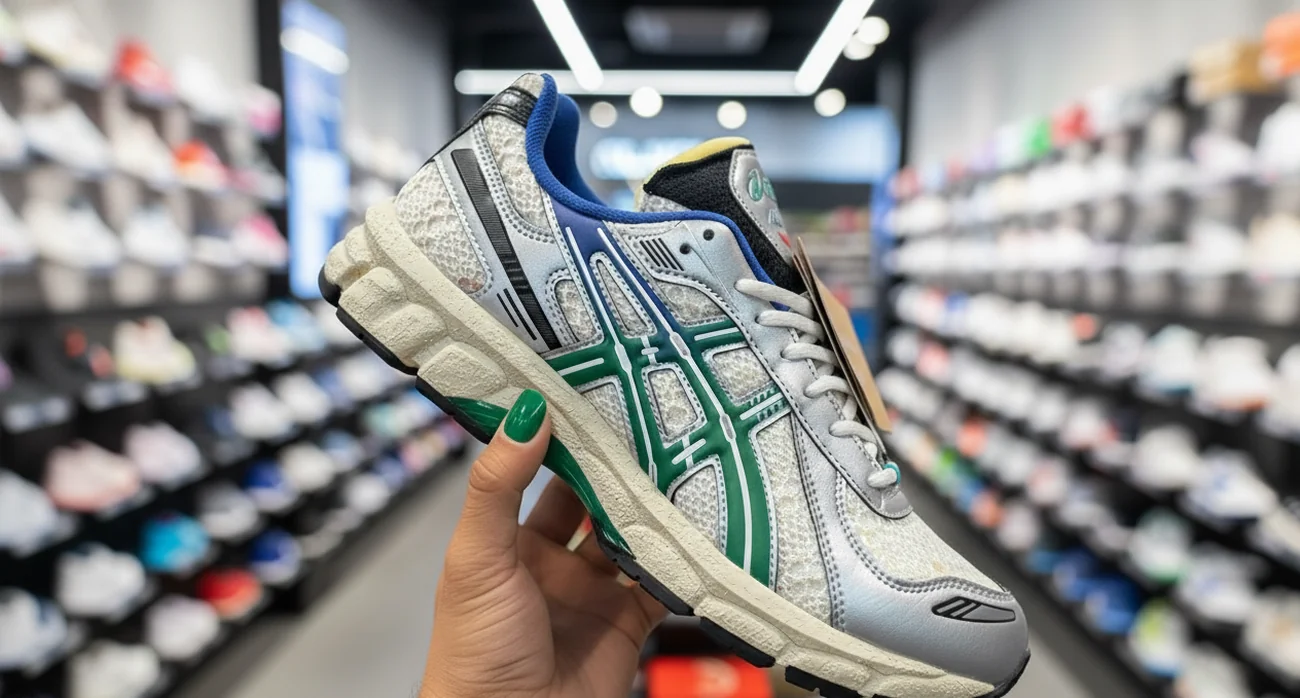
NWT stands for New With Tags. In listings, it usually indicates a product presented as new and unworn, with the relevant tags still included. The abbreviation does not guarantee authenticity, the original box, a complete set, or perfect condition, and criteria can vary by category and marketplace.
To properly understand an NWT listing, separate five questions: Has the sneaker been worn? Which tags are present? Are the box and accessories included? What is its current physical condition? And is the product authentic? These aspects are related, but they are not interchangeable.
Is NWT Exclusive to Sneakers?
No. New with tags belongs to the broader language of fashion retail, e-commerce, and resale. Sneaker culture adopted it as shoes increasingly circulated through listings, forums, marketplaces, buy-and-sell groups, and resale platforms.
eBay’s condition documentation uses “New with tags” in certain retail categories, while its footwear categories use other names, such as New with box, New without box, and New with defects.
For other expressions used in listings, forums, and conversations among collectors, see the Sneakerhead Dictionary.
What Does “With Tags” Mean in Practice?
“Tags” does not represent a universal label found on every sneaker. Its meaning depends on the product and release.
Depending on the item, it may include:
- a removable hangtag;
- a manufacturer-applied tag;
- a retail tag added by the store;
- a price tag;
- a removable card or retail label specific to that product.
The most useful question is not “Does it have a tag?” but “Which tags did this release actually have when it was sold?”
A Hangtag Is Different From an Internal Label
A hangtag is a removable label or piece included with certain products. It may hang from a lace, eyelet, or another area, depending on the release.
The internal size and manufacturing label, by contrast, is usually a permanent part of the sneaker. It may show the size, style code, dates, and other information, and it remains in the shoe even after substantial wear.
The presence of an internal size label therefore does not make a used sneaker NWT.
A Box Label Is Different, Too
The sticker on a box showing the size, SKU or style code, barcode, and other information is a box label. It helps establish whether the box and sneaker represent the same release, but it is not automatically the tag meant by “new with tags.”
A box label does not authenticate a sneaker by itself, either. Codes and labels can be copied.
A Marketplace Tag Is Not a Factory Tag
If StockX, a consignment store, or another service added its own tag during verification or handling, that tag belongs to the pair’s history with that platform.
It does not retroactively become an original Nike, Jordan Brand, adidas, or other manufacturer’s tag.
Not Every New Sneaker Has a Hangtag
Some releases come with prominent hangtags. Others have a card. Many have no removable tag of the kind people imagine when they read “with tags.”
It makes no sense to call a sneaker incomplete because it lacks a tag that never existed.
Do Tags Attached and Tags Included Mean the Same Thing?
Not exactly.
- Tags attached: the tags remain physically attached to the product.
- Tags included: the tags come with the set but may have been removed and placed loose in the box or packaging.
No universal authority determines that only one of these situations can be called NWT across every category. A detailed listing should therefore clearly state whether the tags are attached or simply included.
Removing a tag does not prove a sneaker has been worn, either. Someone can remove a label from a completely unworn product.
The reverse also applies: keeping a tag does not, by itself, prove there has been absolutely no try-on or handling.
Does NWT Require the Original Box?
Not necessarily. The T in NWT refers to tags, not the box.
A product listed as NWT may have:
- the original box;
- a replacement box;
- a damaged original box;
- no box.
The seller should state this separately. It is incorrect to assume NWT means “no box,” just as it does not automatically mean “with a perfect original box.”
NWT, DS, DSWT, NIB, NWOT, and VNDS
DS (deadstock) usually describes a new, unworn pair in the sneaker community. Criteria for the box, accessories, and try-ons vary. DSWT (deadstock with tags) adds the presence of tags. A listing can combine these descriptions with NWT; they do not form a universal quality scale.
NIB (new in box) emphasizes the box, while NWT emphasizes tags. A pair can meet both descriptions. NWOT, new without tags, indicates a product presented as new but without the relevant tags. Do not treat a hangtag as missing if that release never had one.
VNDS (very near deadstock) is a subjective assessment of near-new condition, often used for lightly worn pairs. No official wear count determines this classification. If a pair has been worn, that should be clearly described.
OG all concerns the original set: box, extra laces, dust bag, cards, and other accessories supplied with that release. Keeping the tags does not mean keeping all those items.
Can NWT Sneakers Have Been Tried On?
This is one area where community conventions and platform rules can differ.
The basic NWT concept presents a product as new and unworn, but a brief try-on to check sizing is not treated identically everywhere.
StockX’s current policy states that sneakers on its Verified Marketplace can pass verification even if they have been tried on for fit.
That is a specific StockX rule, not a universal definition of NWT.
The best practice is simple: if the pair has been tried on, say so. Transparency is more useful than an endless argument over who has the “correct” definition of the abbreviation.
Does Relacing Rule Out NWT?
There is no universal rule saying that it does.
A sneaker can be unlaced or relaced without being worn outdoors. StockX’s own verification policy says pairs may pass even if they have been unlaced.
That does not make factory lacing irrelevant. Some buyers value the original presentation. If the pair has been relaced, disclose it when relevant to the sale.
Does NWT Mean a Sneaker Is Authentic?
No. NWT does not answer the question of authenticity.
A sneaker can be:
- authentic and NWT;
- authentic and used;
- fake and new with tags;
- fake and used.
Counterfeits can copy tags, boxes, receipts, barcodes, style codes, box labels, and accessories.
That is why condition and authenticity are separate questions. For the latter, see how a sneaker legit check works.
Do a Receipt, Style Code, and Tag Prove Authenticity?
They can provide context, but they should not be used individually as absolute proof.
A style code helps identify which release a product is meant to represent. A receipt can help trace its provenance. Tags and labels can be compared with documented examples.
But the analysis needs to consider the entire sneaker because these elements can also be copied, replaced, or belong to a different pair than the one being sold.
Can an NWT Product Have Defects?
Yes. New does not mean perfect.
eBay currently has a footwear condition category called New with defects. It can include brand-new, unused, unworn products with particular imperfections disclosed in the listing.
That is an eBay condition category, not a universal definition of NWT. But it illustrates an important distinction: a product can be never worn without being in mint condition.
Storage marks, minor manufacturing irregularities, material changes, and packaging damage should be disclosed separately.
How Do eBay and StockX Handle New Products?
These two examples show why there is no single international sneaker condition system.
eBay
Its current footwear documentation uses categories such as:
- New with box;
- New without box;
- New with defects;
- Pre-owned – Excellent;
- Pre-owned – Good;
- Pre-owned – Fair.
In other retail categories, the platform also uses New with tags and New without tags.
Even within the same marketplace, the product category changes the terminology.
StockX
On StockX, the rules vary by marketplace.
On the Verified Marketplace, sneakers must be new and unworn and include the original box under the platform’s standards.
On the Listings Marketplace, available in the United States, StockX distinguishes the following conditions:
- New: new and unworn, with no signs of wear;
- New – Other: still new and unworn, but may have imperfections or lack tags and accessories;
- Used: used, with signs of wear.
Is NWT Worth More?
The abbreviation does not establish a price hierarchy relative to DS, NIB, or VNDS. Value depends on the release, size, physical condition, box, accessories, provenance, and demand. Missing tags or damage may matter to a buyer, but there is no fixed discount or premium.
Compare recent sales of equivalent pairs, not just asking prices. Our price check guide explains this process. NWT does not indicate production numbers or guarantee future appreciation.
Is an Older NWT Pair Still Truly “New”?
It may still be new in the sense of unworn. That does not mean it has remained chemically unchanged since the day it was made.
Over time, depending on its construction and materials, a never-worn sneaker may develop:
- yellowing;
- oxidation;
- aging adhesives;
- component separation;
- drying;
- cracking;
- degradation of certain foams;
- color changes;
- storage marks.
That does not mean every old sneaker has all these problems. EVA, polyurethanes, rubber, adhesives, leather, textiles, and coatings age through different mechanisms.
StockX also warns buyers about the integrity of older sneakers, noting that older pairs may have structural weaknesses and reduced durability because of their age.
That warning does not establish an age at which every sneaker becomes unusable. Before wearing an old pair, inspect the midsole, outsole, glued joints, and any signs of cracking, crumbling, or separation. If there is weakness, seek a specialist’s assessment; tags and a lack of wear do not prove structural safety.
Our vintage sneaker guide explores the differences between age, condition, and historical originality.
How Should You Evaluate Sneakers Listed as NWT?
NWT should be the start of your assessment, not the final verdict.
- Confirm the exact release. Model, colorway, size, and SKU or style code should be clear.
- Review current photos of the actual pair. Stock photos do not show the condition of the shoes being sold.
- Examine the outsole. Look for dirt, abrasion, or signs inconsistent with a product listed as unworn.
- Check the insole and interior. Wear or residue can add context about use.
- Ask which tags are present. Do not accept “with tag” without knowing which one.
- Confirm those tags belong to the release. Not every sneaker has a hangtag.
- Find out whether they are attached or simply included.
- Check the box. Original, replacement, damaged, or missing.
- Check accessories. Extra laces, dust bags, cards, and other items depend on the release.
- Ask about try-ons. If the pair has been tried on, that should be clear.
- Ask about relacing when relevant.
- Look for defects and storage marks. New does not mean perfect.
- Check for repairs or restorations. Repainting, regluing, and other work should be disclosed.
- Assess aging in older pairs. Materials change even without wear.
- Assess authenticity separately. Tags and a box do not replace a legit check.
- Check the seller. Their history, reviews, and identification available on the platform help you assess the transaction.
- Read the platform’s policies. Accepted condition, authentication, returns, and protection vary.
- Compare prices with truly equivalent pairs. Use recent sales when available.
An invoice or proof of purchase can add provenance context, but neither should be treated as absolute authentication.
How to Describe an NWT Pair for Sale
Alongside the abbreviation, say whether the pair has been tried on, which tags come with it, and whether they are attached or loose. Describe the box, missing accessories, changes to the lacing, defects, storage marks, and repairs. Current photos should show both shoes and any alterations.
For more of the language used in listings and negotiations, see the Sneakerhead Dictionary.