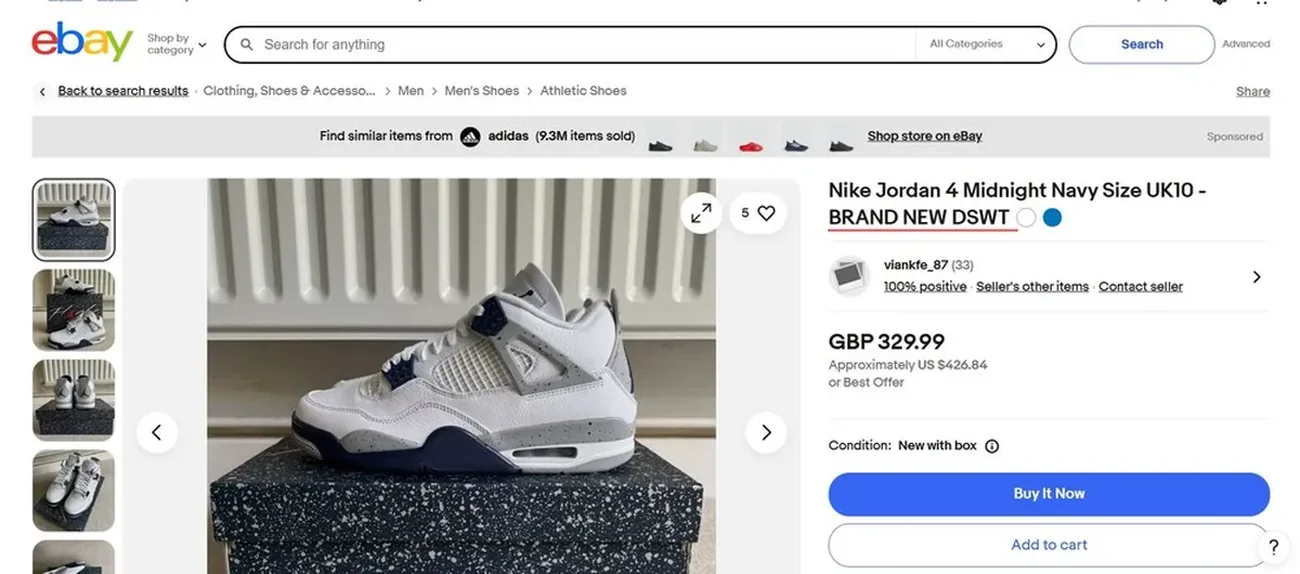
DSWT stands for Deadstock With Tags. In sneaker language, it usually describes a pair considered deadstock, meaning new and unworn, that still has the tags associated with its release. The abbreviation is not an authenticity certification and does not guarantee a perfect box, every accessory, or flawless materials.
The “WT” adds with tags. Ask which tags come with the pair and whether they are still attached or loose in the box.
To understand DSWT, separate six things that listings often mix together: wear, tags, box, accessories, material condition, and authenticity. They may be related, but they are not the same question.
What Does “With Tags” Mean in Practice?
This is where the words alone are not enough.
“Tags” does not mean one universal label that comes with every sneaker. Depending on the release, there may be different removable tags, or none at all.
Hangtag
A hangtag is a removable label or piece attached to a product, often hanging from a lace, eyelet, or another part of the sneaker.
Some releases have specific hangtags. Others leave the store without any.
There is no rule that “every Nike needs a tag on its laces” or “every Air Jordan should have a hangtag.” Those claims would simply be false.
Retail Tag or Price Tag
Depending on the retailer and region, a product may have a retail tag showing the price, barcode, store identification, or other information.
That tag can be part of that pair’s presentation without necessarily having been added by the manufacturer.
Brand Tag or Release-Specific Tag
Some sneakers do come with tags specific to the brand or release. When they do, keeping those tags may matter a great deal to someone looking for a more complete set.
The right approach is always to check what that specific release originally included.
The Internal Size Label Is Different
The internal size label, usually sewn or applied inside the sneaker, identifies the shoe itself.
It usually remains in place even after substantial wear.
That is why, in a DSWT listing, “with tags” usually refers to the relevant retail or removable tags, rather than simply the internal size label.
Is a Marketplace Tag the Same as an Original Manufacturer’s Tag?
No.
Tags added later by marketplaces, consignment stores, or authentication services are part of that service’s history with the pair. They do not retroactively become original Nike, Jordan Brand, adidas, or other manufacturer tags.
In other words:
- factory/brand tag → belongs to the manufacturer’s or release’s original presentation;
- retail tag → may have been added by the retailer;
- marketplace/authentication tag → was added later by a platform or service.
These categories should not be mixed up.
DSWT, DS, NWT, NIB, and VNDS: The Differences
DS stands for deadstock and usually indicates an unworn pair. DSWT adds the presence of tags. A DS pair can still have its tags; DS does not mean they have been removed.
NWT, new with tags, is a retail description also used for clothing and accessories. A new sneaker with tags may be described as NWT or DSWT, depending on context.
NIB, new in box, emphasizes the box. A DSWT pair can be NIB if it is new and comes with its packaging, but tags do not replace a box.
VNDS, very near deadstock, is a subjective assessment of near-new condition. If a pair has been worn, tags do not justify listing it as never worn.
Are DSWT and OG All the Same Thing?
No.
OG all is used in the community to emphasize that the set retains the original components appropriate to the release.
Depending on the product, that may include:
- the box;
- extra laces;
- cards;
- sleeves;
- dust bags;
- other release-specific accessories.
A DSWT pair may still have its tag while missing an accessory.
A worn sneaker can still be OG all because all its original accessories remain with the set.
Wear history and completeness are separate aspects of condition.
Does DSWT Require the Original Box?
The literal meaning of with tags does not automatically include “with original box.”
There is therefore no linguistic basis for saying every DSWT pair must have a box.
In practice, many buyers of collectible sneakers also want the original box. That is an additional preference or question of completeness.
Box status should be clearly stated in the listing:
- no box;
- replacement box;
- original box;
- original box with damage.
The important thing is not to make the abbreviation answer a question it does not address.
How Does StockX Handle Boxes, Tags, and Condition Today?
StockX has its own condition requirements, which do not use DSWT as a certification.
On the Verified Marketplace, sneakers must be brand new and unworn, with a box that meets the platform’s requirements. The original accessories relevant to the product must also be included.
StockX says pairs that have been unlaced or tried on for fit can pass verification under its criteria.
That does not mean StockX is calling a tried-on pair DSWT. It simply means a platform’s operating rules do not have to match the strictest interpretations of sneaker slang exactly.
The StockX Listings Marketplace, available in the United States, has categories such as New, New – Other, and Used. It is a separate experience from the Verified Marketplace, with verification available only for eligible items.
In New – Other, a sneaker can still be new and unworn without original tags or accessories. A listing can also disclose imperfections; the photos and description show the actual pair’s condition.
This again illustrates that absence of wear and completeness are different characteristics.
Does a Loose Tag in the Box Still Count as DSWT?
There is no universal consensus.
Some sellers and collectors interpret “with tags” to mean the original tags are included with the set. Others are stricter and expect them to remain physically attached as originally presented.
There are clearer ways to describe this:
- tags attached → the tags remain physically attached;
- tags included → the tags come with the set but may be loose.
If a tag has been removed and placed in the box, “original tag included” tells buyers more than trying to settle the entire issue with DSWT alone.
Can a DSWT Sneaker Have Been Tried On?
There is no universal rule accepted throughout sneaker culture.
Stricter buyers may consider any try-on incompatible with a DSWT description.
Other selling conventions allow a brief sizing try-on without signs of outdoor wear.
StockX, for example, says sneakers on its Verified Marketplace may pass verification if they have been tried on for fit.
That does not create a universal definition of DSWT. The best practice is simpler:
if a pair has been tried on, say so.
A tag that remains attached during a try-on does not prove the sneaker has never been on someone’s foot.
Do Tags Prove a Sneaker Has Never Been Worn?
No.
A tag can remain attached during a try-on, be saved after removal, or even be reattached.
Wear history also needs to be assessed by examining the sneaker:
- outsole;
- heel;
- toe box;
- lining;
- insole;
- flexing and creases;
- consistent signs of wear.
Even these details must be interpreted together, because storage, try-ons, materials, and manufacturing can also leave marks.
Does DSWT Prove a Sneaker Is Authentic?
No. A counterfeit can also be unworn and have copied tags, a box, codes, or accessories. A tag is one detail to compare, not standalone proof of authenticity. To investigate whether a pair is genuine, see how a legit check works.
Does DSWT Mean Mint Condition?
No.
DSWT primarily describes a claim of deadstock condition with the relevant tags.
Mint is a different concept, referring to exceptional physical preservation.
A sneaker can be unworn with tags and still have:
- yellowing;
- discoloration;
- storage marks;
- box damage;
- drying;
- oxidation;
- aging adhesives;
- other age-related effects.
Unworn with tags does not mean unaged.
Does Vintage DSWT Mean a Sneaker Is Still Wearable?
Not automatically.
A sneaker can be never worn, retain its tags, and still have age-related structural deterioration.
StockX’s current documentation warns that older sneakers may have reduced durability and structural weaknesses regardless of storage conditions.
That does not mean every old sneaker is doomed, or that there is a universal age at which every pair becomes unwearable.
Materials and construction vary. Before wearing a vintage pair, assess its:
- age;
- midsole type;
- adhesives;
- rubber;
- foams;
- current structural condition.
DSWT does not certify that a sneaker is fit to wear.
Is DSWT Always Worth More Than DS?
There is no standard price premium for having tags. They can matter to someone looking for a complete set, especially with older releases, but comparisons also depend on the model, size, physical condition, box, accessories, and demand. Compare equivalent pairs; DSWT does not promise appreciation.
How Do You Evaluate a DSWT Listing?
Start with a simple question:
“Which tags?”
Then assess the entire set.
- Confirm the exact release. The model, colorway, size, and style code need to make sense together.
- Research whether that release originally included a hangtag or another removable tag.
- Find out which tags are present. A brand tag, retail tag, price tag, or something else.
- Ask whether they are attached or simply included.
- Look at photos of the actual outsole. A tag does not replace an assessment of wear.
- Examine the toe box, heel, lining, and insole.
- Ask about try-ons. Do not assume everyone uses DSWT the same way.
- Ask about relacing. Especially if factory lacing matters to you.
- Check the box. Original, replacement, damaged, or missing.
- Check the accessories. Extra laces, cards, dust bags, or other relevant items.
- Assess aging in vintage pairs. Unworn does not mean the materials are structurally new.
- Authenticate separately. Tags do not replace a legit check.
- Read the platform’s rules. Marketplace condition categories and sneaker slang may use different systems.
Stock photos are not enough to assess condition. They show the release, not the actual pair you will receive.
How Can You List a DSWT Pair Transparently?
If DSWT accurately describes the pair, use it. Just do not let the abbreviation replace the description.
A better listing includes:
- confirmation that the pair is unworn;
- whether it has been tried on;
- which tags are present;
- whether the tags are attached or included;
- whether the pair has been relaced;
- whether the box is original, a replacement, or missing;
- box damage;
- which accessories are present and missing;
- yellowing or storage marks;
- any defect, repair, or restoration;
- current photos of the actual pair.
Transparency is worth more than trying to make four letters carry the entire description.
Is It Safe to Buy a DSWT Pair Online?
The abbreviation does not guarantee a safe transaction. Check current photos, the description, the seller’s reputation, and the return and buyer-protection policies. If marketplace authentication is offered, check whether the listing is eligible and whether the service is included or must be purchased separately.
The Sneakerhead Dictionary covers other descriptions of condition, wear, and packaging used in listings.
For the wider context, explore Sneaker History and Culture: From Rubber Soles to a Global Movement.