
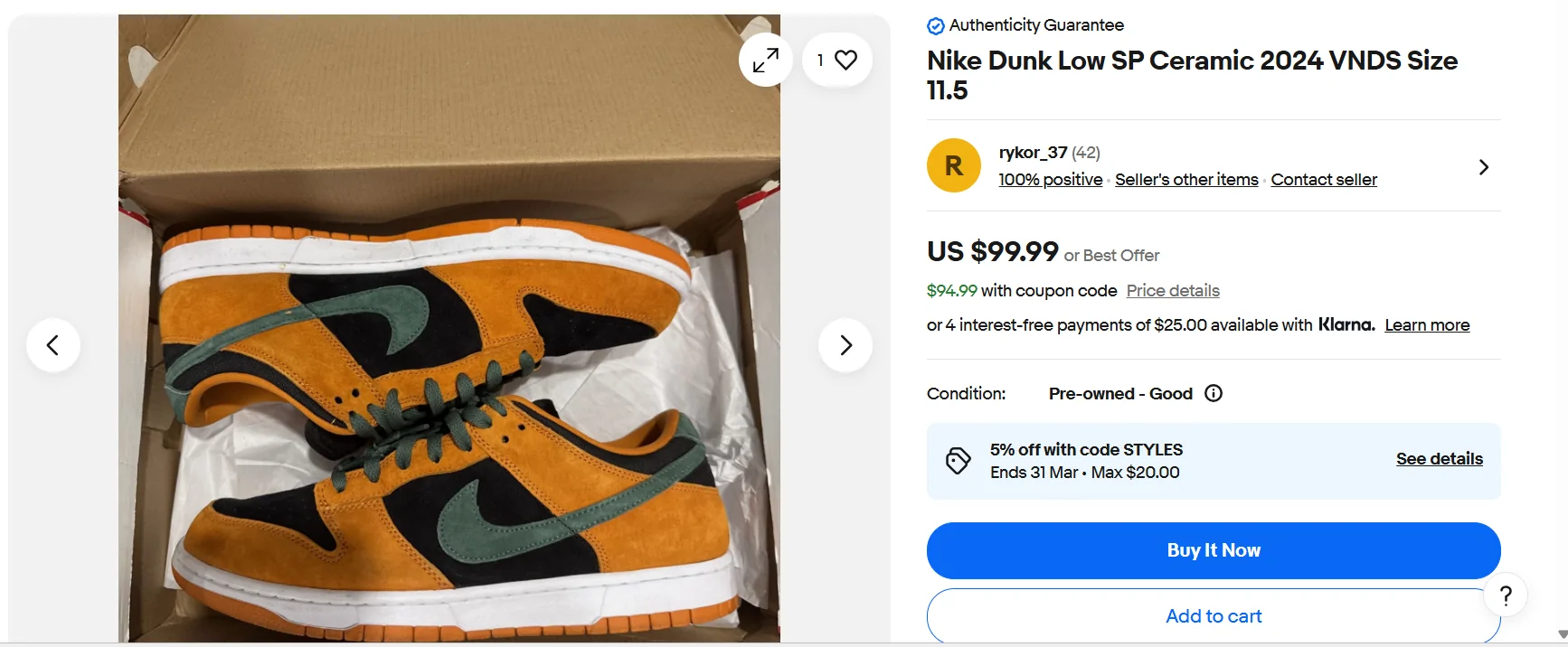
VNDS stands for Very Near Deadstock. In sneaker culture, it is an informal description for a pair that is no longer being presented as deadstock but that the seller considers very close to new condition. The most important detail is that there is no universal standard for how many wears, creases, or marks still qualify as “VNDS.”
The word near is exactly what makes the abbreviation useful and subjective at the same time. What one seller calls VNDS may simply be “pre-owned in excellent condition” to another person or under a marketplace’s condition categories.
Four letters can help sum up a listing, but they cannot replace photos of the outsole, upper, interior, and areas of wear.
VNDS is community language for condition, not a manufacturer’s certification or an authentication system. The Sneakerhead Dictionary helps distinguish these categories.
Where Did VNDS Come From in Sneaker Culture?
There is no reliable evidence establishing who invented VNDS or the exact day it first appeared. What we do have are historical records of its use.
One particularly interesting record is the Sole Collector Board Dictionary, published in 2010. The old glossary listed NDS as Near Deadstock and VNDS as Very Near Deadstock, describing the latter as almost exactly new and lightly worn.
Even more telling, the glossary itself warned that VNDS was overused. The ambiguity did not begin with today’s marketplaces.
The 2010 record establishes that the expression was already part of sneaker vocabulary at that time. It does not prove VNDS was coined in 2010 or that Sole Collector invented it.
Does VNDS Have an Official Definition?
There is no official, universal definition of VNDS.
No central authority in sneaker culture sets a maximum number of wears, allowable millimeters of heel drag, number of creases, or minimum percentage of preservation for a pair to receive the label.
Descriptions such as “VNDS 95%,” “VNDS 9/10,” or “VNDS, worn no more than twice” may reflect a seller’s personal assessment, but they should not be presented as universal standards.
The best principle for reading a listing is simple: a detailed description and current photos matter more than the abbreviation.
How Many Times Can VNDS Sneakers Have Been Worn?
There is no universal maximum.
VNDS does not officially mean “worn once,” “worn twice,” or “no more than three wears.” These descriptions appear in listings, but they describe the seller’s claimed history, not a grading formula.
Counting wears is actually a fairly limited way to assess condition.
Imagine two sneakers, each worn exactly once. The first was on someone’s feet for 20 minutes indoors. The second spent an entire day on pavement, in rain, and on dirt. Both could be described as worn once, yet their resulting physical condition could be completely different.
Wear count provides context; it does not replace an inspection of the pair.
What Is the Difference Between VNDS and DS?
DS stands for deadstock. In contemporary sneaker culture, it usually describes a new, unworn pair.
VNDS stands for very near deadstock and tells you the seller considers the sneaker very close to that condition, although they are no longer presenting it simply as deadstock.
That does not mean DS is synonymous with “perfect.” A never-worn sneaker can also age, yellow, or show manufacturing and storage-related characteristics.
Likewise, VNDS has no mathematical boundary defining exactly where DS ends and another classification begins.
Are VNDS and NDS the Same Thing?
They are not exactly the same expression.
NDS means near deadstock, while VNDS means very near deadstock. Sole Collector documented both forms in its 2010 Board Dictionary.
Linguistically, “very” suggests that VNDS is even closer to deadstock. In practice, however, no organization assigns objective scores to determine where NDS ends and VNDS begins.
There is therefore no basis for formulas such as “NDS = 90%” and “VNDS = 95%.”
What Do VVNDS, VVVNDS, and VVVVVNDS Mean?
They are informal extensions of the idea behind very near deadstock.
Historically, sellers began adding more Vs to emphasize that a sneaker was supposedly even closer to deadstock condition. Complex even poked fun at this escalation by documenting versions with a generous number of Vs.
But VVNDS, VVVNDS, and VVVVVNDS are not official grading categories.
There is no reliable conversion such as “VVVNDS = 99% new,” either. The more numerical precision a seller tries to extract from those letters, the more important it becomes to look at the actual sneaker.
VNDS, NWT, and NIB Are Not Synonyms
NWT means new with tags; NIB means new in box. Both describe products listed as new. A VNDS pair that has been worn is still used, even if it has its box and tags.
VNDS does not tell you whether the original box, a replacement box, or accessories are included. Those details need to be in the listing description.
Does VNDS Require the Original Box?
There is no universal community rule requiring an original box to use VNDS.
Packaging and physical wear are separate aspects of condition. A lightly worn sneaker does not become more worn because its box disappears.
But completeness is still important information for the buyer. A listing should make clear whether it has:
- the original box;
- a replacement box;
- no box;
- a matching box label;
- any significant packaging damage.
Depending on the buyer and platform rules, this can affect interest or negotiations. It should not be confused with a measurement of shoe wear.
How Can You Evaluate a Sneaker Listed as VNDS?
No official checklist automatically makes a sneaker VNDS. The goal of inspection is to see whether the seller’s description matches the actual condition shown by the pair.
Outsole, Heel Drag, and Toe Drag
The outsole often holds important evidence of use. Look for embedded dirt, abrasion, loss of texture, heel wear, and wear at the front of the sole.
Heel drag can be particularly revealing on certain models, but there is no universal maximum allowed for VNDS.
On some Jordans and Dunks, collectors also inspect wear on specific outsole details, such as the small stars molded into certain areas. That is a model-dependent clue, not a universal sneaker test.
And remember: a clean outsole does not automatically mean light use. Outsoles can be cleaned.
Creases and the Upper
Creasing can indicate flexing during wear, especially when it follows a pattern consistent with repeated walking.
But a single crease is not absolute proof. Flexible materials, manufacturing, storage, and try-ons can also leave marks.
Also look for scuffs, stains, abrasion, color transfer, and worn finishes. The important thing is to interpret the signs together.
Insole, Lining, and Interior
The insole and interior can reveal wear that is not immediately visible in exterior photos.
Look for wear, residue, deformation, the condition of the lining, and interior printed graphics where applicable. But do not turn an intact or partly worn-off insole logo into an automatic verdict: materials, printing, and construction vary by model.
Odor can also provide relevant information about storage or wear, but it is not part of an official VNDS definition.
Box and Accessories
Confirm exactly what comes with the sneaker. The box, box label, extra laces, cards, and accessories may matter for that release or that buyer, but they should be assessed separately from physical wear.
Cleaning, Repairs, and Restoration
This is one of the most overlooked questions in excellent-condition listings: Has the sneaker been cleaned, repaired, or restored?
A deep cleaning can greatly improve a used sneaker’s appearance. It does not erase its wear history.
When applicable, sellers should disclose work such as:
- deep cleaning;
- repainting;
- regluing;
- a sole swap;
- de-yellowing;
- touch-ups;
- suede or other material restoration.
Restoration and use are also separate details. A sneaker can have little wear and have been repaired; another can be heavily worn and never restored.
VNDS should not be used to hide any of this information.
Does VNDS Mean a Sneaker Is Authentic?
No.
VNDS describes a claimed condition. Authenticity answers a different question.
A sneaker can be:
- authentic and VNDS;
- authentic and heavily worn;
- fake and new;
- fake and lightly worn.
Writing VNDS in a listing therefore authenticates nothing. Authenticity should be assessed separately, as we explain in our legit check guide.
Does VNDS Mean Rare, Hyped, or Sold Out?
No.
Any sneaker that fits a seller’s intended description can informally receive the abbreviation, whether it is a collaboration, a limited release, or a mass-produced model.
VNDS describes a claimed condition, not rarity.
Can a Vintage VNDS Sneaker Be Deteriorating?
Yes. This is a fundamental difference between appearance and structural integrity.
Imagine an older sneaker with little outsole wear and a very clean-looking upper. It may look like an excellent candidate for VNDS and still have age-related problems.
StockX warns about structural weakness in older footwear, even unworn pairs. A clean appearance and lightly worn outsole do not show that adhesives and foams have retained their strength.
That does not establish a universal age at which every sneaker becomes unsafe. Construction and materials vary substantially across models and generations.
It is also incorrect to assume every Air Jordan, Dunk, or Air Max ages the same way. Each construction needs to be assessed according to the materials it actually uses.
How Much Less Is VNDS Worth Than DS?
There is no universal percentage.
Rules such as “VNDS is worth 10% to 30% less than DS” sound precise, but they cannot be applied across the entire sneaker market without data specific to the release, size, time period, and market being analyzed.
Two pairs described as VNDS can also be in very different condition precisely because the classification is subjective.
Compare genuinely equivalent sales and listings when estimating a price. The abbreviation alone does not produce a mathematical discount.
How Should You Buy a Sneaker Listed as VNDS?
Start by treating VNDS as the seller’s condensed opinion of condition, then check whether the evidence supports that description.
Request or review current photos of:
- the lateral side;
- the medial side;
- the toe box;
- the heel;
- the entire outsole;
- areas of heel drag and toe drag;
- the lining and interior;
- the insole;
- the internal label;
- the box and box label, if present;
- included accessories;
- any damage, repair, or restoration.
Videos can help show suede, reflections, deformation, and creases from different angles, but they are not automatic proof of authenticity, either.
Useful Questions to Ask the Seller
- Approximately how many times has the sneaker been worn, if known?
- Where was it worn, and for how long?
- Has it been deep-cleaned?
- Has it been repainted, reglued, sole-swapped, or otherwise repaired?
- Is there any damage that is not obvious in the photos?
- Is there any noticeable odor?
- Is the box original?
- Which accessories come with the pair?
- Have the insoles or laces been replaced?
Wear count provides context. Photos and physical condition remain more important.
Is It Safe to Buy VNDS Sneakers Online?
It can be a reasonable purchase, but the word VNDS does not reduce transaction risk on its own.
Check the description, photos, actual condition, seller history and reputation, and the authentication, buyer-protection, and return rules that apply to that platform and that specific listing.
A very low price may warrant more investigation, but it does not alone prove that a sneaker is fake or its condition is misrepresented. Likewise, a high price proves neither authenticity nor quality.
VNDS condition and authenticity need to be verified separately.
How Can You List VNDS Sneakers Transparently?
If VNDS accurately sums up your assessment of condition, it can be useful. Just do not make it the entire description.
- use current photos of the actual pair;
- show the entire outsole;
- do not hide heel drag, toe drag, or creases;
- disclose stains, scuffs, and other flaws;
- disclose deep cleaning;
- disclose repainting, regluing, a sole swap, or restoration;
- say whether the box is original, a replacement, or missing;
- list included and missing accessories;
- if you know, give approximate context for how much the pair has been worn;
- when in doubt, describe the physical condition instead of trying to settle it by adding more Vs.