
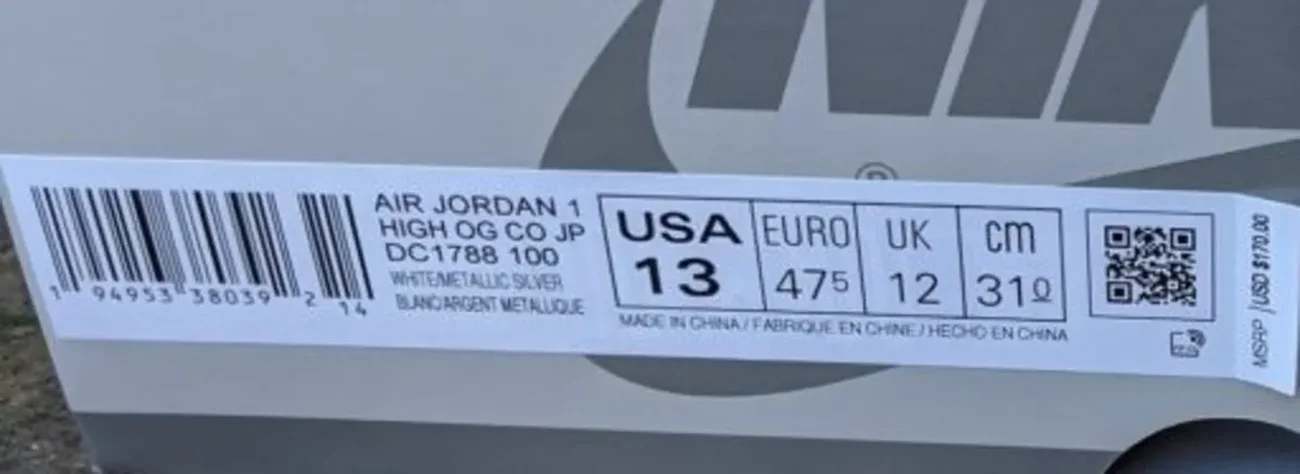
CO.JP looks simple because “JP” clearly points toward Japan. The confusion starts when people expand “CO” into “Company” and invent a supposed “Jordan Company Japan.” That is not what the sneaker designation means.
In Nike history, CO.JP is widely known as Concept Japan: a name associated with products, colorways, and releases developed around Nike’s Japanese market strategy. On an Air Jordan, CO.JP can signal a connection to that history, but it does not mean the shoe was manufactured in Japan or that every pair was sold only there.
The easiest way to understand the designation is to follow one story from Japan in 2001 to the wider world in 2020. Along the way, there is an Air Jordan 1, a metallic briefcase, 2,001 pairs, and a useful lesson: three letters never tell the whole release story.
What Does CO.JP Mean in Nike and Jordan?
In sneaker culture, CO.JP is historically associated with Concept Japan. The term became connected with Nike products developed for, launched through, or strongly tied to the Japanese market, especially during the late 1990s and early 2000s.
Specialist sneaker histories use Concept Japan to describe the program and its Japan-focused releases. That is a historical explanation of the nickname and program—not a reason to treat every modern product carrying CO.JP as if it followed one rigid rule.
CO.JP also extends beyond Jordan Brand. Nike Air Force 1, Dunk, and other families were part of the broader story. Releases such as the Air Force 1 “Linen” and Japan-exclusive Dunks helped make CO.JP important to U.S. collectors who had to hunt for pairs that were difficult to access from overseas. Before SNKRS, global launch calendars, and today’s resale infrastructure, finding a Japan-only pair from the United States could require import shops, magazine knowledge, early online forums, eBay sellers, or a personal connection in Japan.
Does CO.JP Mean Concept Japan?
Yes. Concept Japan is the historically documented reading used throughout sneaker media and collector culture. The key is not to turn that phrase into a universal technical specification that every release must follow.
CO.JP does not mean “Jordan Company Japan,” “Company Japan,” “Collaboration Japan,” or “Country of Japan.” It also does not automatically mean the product is a collaboration. Many CO.JP pairs were Nike or Jordan releases without an outside creative partner.
Why Does CO.JP Look Like a Japanese Web Address?
Because .co.jp is a real Japanese domain category. Japan Registry Services explains that .jp is Japan’s country-code top-level domain and that CO.JP names are available to corporations officially registered in Japan.
That makes the Nike naming especially memorable because it visually echoes Japanese internet identity. But the sneaker term should not be reverse-engineered as if “CO” were a literal company name. In the sneaker context, the historical reading is Concept Japan.
Does CO.JP Mean the Sneaker Was Made in Japan?
No. CO.JP describes product history and market context. “Made in” or “Country/region of origin” identifies manufacturing location. Those are different pieces of information.
Nike’s own page for the 2020 Air Jordan 1 Retro High OG CO.JP “Tokyo” lists China as the country of origin. The sneaker carries Japanese CO.JP heritage without being manufactured in Japan.
The reverse is also true: buying an Air Jordan in Japan does not automatically turn it into a CO.JP release. Market of sale, country of manufacture, and official release identity are separate facts.
How Did the Nike CO.JP Era Begin?
During the late 1990s and early 2000s, Japan occupied an unusually influential position at the intersection of sneakers, streetwear, specialty retail, and collecting. Nike developed region-specific colorways and limited distribution strategies that gave the Japanese market its own product stories.
For U.S. sneakerheads, that regional structure added another layer to collecting. Before global launch calendars and modern resale platforms made overseas releases easier to discover, Japan-exclusive pairs often required personal connections, importers, forums, eBay searches, or travel. The difficulty was not only buying the shoe; it was often learning that the release existed, identifying the correct colorway, and finding a seller willing to move it across borders.
CO.JP became associated with that mix of local focus and product experimentation. That does not mean every release used better materials, had a tiny production run, or followed identical distribution rules. The program matters more as a chapter in Nike’s regional product strategy than as one fixed formula.
Why Was Japan So Important to Nike?
Japan had a sophisticated ecosystem of specialty retail, street fashion, archival interest, and sneaker collecting. Nike Dunks, Air Force 1s, Air Max models, and other silhouettes could build strong followings there even when the same products received much less attention in the United States.
The point is not to rank one country above another in sneaker culture. The important lesson is that Japan demonstrated how a global brand could create highly local product chapters—and how those local chapters could later influence U.S. collecting, boutique distribution, collaborations, and the broader global market. For American collectors, CO.JP became shorthand for a period when some of Nike’s most interesting products seemed to exist just beyond the normal U.S. retail system.
The 2001 Air Jordan 1 CO.JP: The Historic Release
The central Jordan example is the Air Jordan 1 in Neutral Grey and Metallic Silver, often referred to today as the “Tokyo.” Nike officially documents that the original colorway released only in Japan on January 1, 2001, in a run of 2,001 pairs.
That number belongs to this specific release. It is not the standard production quantity for Concept Japan, not the quantity of every Japanese Air Jordan, and not evidence that all CO.JP sneakers were made in 2,001 pairs.
The Metallic Briefcase Became Part of the Story
The Japanese release became famous for special metallic briefcase-style packaging and individually numbered pairs. In this case, packaging, quantity, and regional distribution combined to create a very specific historical release story. The briefcase matters because collectors often remember a release through more than the shoe itself: packaging, numbering, distribution method, and regional context can become part of the object’s identity and later affect how complete examples are described on the secondary market.
To understand why the same silhouette can carry so many layers of naming and memory, continue with the history of the Air Jordan 1.
The Air Jordan 1 CO.JP Returned in 2020
In 2020, Jordan Brand revisited that history with the Air Jordan 1 Retro High OG CO.JP “Tokyo,” style code DC1788-029. Nike released a Japan-exclusive version with the special briefcase presentation and also launched a sneaker-only version internationally. Nike’s Japanese SNKRS documentation explicitly connected the retro to the 2,001-pair 2001 release while explaining that the wider version would use the same shoe without the Japan-only briefcase presentation.
That return is the clearest argument against the rule that “CO.JP always means Japan-only.” The 2001 original was exclusive to Japan, while the 2020 retro carried the same CO.JP heritage into a much broader release. The designation is historical context, not a permanent geographic restriction.
Tokyo / Neutral Grey
On the 2020 “Tokyo,” Nike highlighted CO.JP branding on the insoles and added an interior tongue detail referencing the shoe’s early-2000s roots. Those features belong to that release and should not be treated as mandatory markings on every CO.JP product.
Midnight Navy
The 2020 Air Jordan 1 High OG CO.JP “Midnight Navy,” style code DC1788-100, brought back another colorway linked to the Japan releases of roughly two decades earlier. Nike documented CO.JP branding on the insoles and an interior tongue tag referencing the early-2000s history.
This is an important nuance: honoring a historical release does not require reproducing every component exactly. A modern retro, updated materials, altered branding, and CO.JP heritage can all exist in the same shoe.
Why Could a CO.JP Release Be Sold Outside Japan in 2020?
Because distribution belongs to the specific release, not permanently to the four letters. Nike can revive a colorway or designation born in Japan and distribute the later retro globally. The 2020 “Tokyo” is direct evidence of that.
For U.S. collectors, this distinction matters. An original release may have required importing from Japan, while a later retro carrying the same CO.JP story can receive official distribution in the United States or other markets. A resale listing that simply says “Japan exclusive” can therefore be misleading if it fails to identify the year and version. Always check the release year rather than assuming the geography from the name alone.
Where Does CO.JP Branding Appear on the Sneaker?
It varies by release. Nike documented CO.JP branding on the insoles of the 2020 “Tokyo” and “Midnight Navy,” along with tongue details referring to their early-2000s roots. The letters can also appear in official product names, packaging, or release communication.
Do not treat CO.JP as a marking that must appear on the internal size tag. Size tags primarily carry identification and manufacturing information such as size, style code, production data, and country of origin. Whether CO.JP appears there depends on the product.
Is Every Air Jordan Sold in Japan a CO.JP?
No. An Air Jordan can be sold normally in Japan without belonging to a CO.JP release. The place where someone buys a sneaker does not rewrite the official product name.
The reverse is not absolute either: a modern CO.JP retro can be distributed outside Japan. The designation points to the project or release heritage; availability must be checked separately.
Does CO.JP Mean Limited Edition or Rare?
Not by definition. Some historical CO.JP launches had regional distribution and documented production figures, such as the 2,001 pairs of the 2001 “Tokyo.” That does not turn CO.JP into a promise of low production.
Geographic restriction and production quantity are different. A product can be sold in one country and still have substantial inventory; another can launch globally and remain extremely difficult to buy. “Japan-exclusive,” “limited to 2,001 pairs,” and “CO.JP” are three different kinds of information. They happened to overlap on the 2001 Tokyo release, but they should not be treated as interchangeable labels for every product in the program.
CO.JP also does not guarantee a high resale price. Value depends on the model, release year, size, condition, packaging, supply, demand, region, and timing. Historical significance can increase collector interest, but the letters do not determine market value by themselves.
Does CO.JP Prove an Air Jordan Is Authentic?
No. CO.JP branding, insoles, tongue tags, boxes, briefcases, and style codes can all be copied on counterfeit products. The presence of the designation does not authenticate the physical pair, and its absence does not make a non-CO.JP Jordan fake.
The style code helps identify which product the sneaker is supposed to be—such as DC1788-029 for the adult 2020 “Tokyo” or DC1788-100 for the adult 2020 “Midnight Navy”—but one correct code is not a Legit Check. For authentication, use a release-specific process and our Legit Check guide.
How Can You Identify Which CO.JP Release You Have?
Instead of asking only “Is it CO.JP?”, gather the details that identify the exact release:
- full official product name and colorway;
- style code or SKU;
- release year;
- size and size category;
- box and special packaging, when applicable;
- official Nike product or launch documentation.
That process prevents a historical colorway, a modern retro, and a special-package edition from being collapsed into one description. In a resale listing, “Air Jordan 1 CO.JP” is still incomplete information.
Why Is CO.JP Important to Sneaker History?
CO.JP documents an era when the global sneaker market was built from much more fragmented local experiences. A pair could be designed for Japanese specialty retail, become legendary through magazines, forums, imports, and collectors, and only years later receive broader international recognition. That history is especially relevant in the U.S. because many American sneakerheads encountered CO.JP releases indirectly—through photos, collectors, resale listings, or stories from people who had managed to source them abroad.
It also shows a two-way relationship. Nike created products for Japan, while the demand and creativity surrounding those products helped make Japanese colorways, retailers, and collecting practices increasingly important to the global sneaker conversation—including in the United States. Later retros made that influence easier to see: products once remembered as remote regional exclusives could re-enter the market as global releases without erasing the Japanese history that made them notable in the first place.
To keep decoding names and abbreviations without losing the cultural context, use the Sneakerhead Dictionary and explore more stories in Sneaker History & Culture.
Jordan CO.JP FAQ
What Does CO.JP Mean in Nike?
CO.JP is historically known as Concept Japan, a designation associated with Nike products and releases connected to its Japanese market strategy. It is not exclusive to Jordan Brand.
Does CO.JP Mean Company Japan?
No. “Jordan Company Japan” is an incorrect expansion. In sneaker history, the documented term is Concept Japan.
Does CO.JP Mean the Sneaker Was Made in Japan?
No. Nike’s 2020 Air Jordan 1 Retro High OG CO.JP “Tokyo,” for example, lists China as its country of origin. CO.JP and manufacturing location answer different questions.
Was Every CO.JP Release Exclusive to Japan?
No. Many older releases were Japan-focused or Japan-exclusive, but later retros could receive international distribution. The 2001 “Tokyo” was Japan-only; the 2020 return included a broader worldwide release.
How Many Pairs of the 2001 Air Jordan 1 CO.JP Were Made?
Nike documents 2,001 pairs for the Neutral Grey/Metallic Silver colorway released exclusively in Japan on January 1, 2001. The quantity is specific to that release.
Where Does CO.JP Appear on the Air Jordan 1?
It varies by release. On the 2020 Air Jordan 1 CO.JP examples discussed here, the branding appeared on the insoles, with additional references on the inside of the tongue. It is not a mandatory size-tag marking.
Does CO.JP Mean Limited, Rare, or More Expensive?
Not automatically. Production quantity, geographic distribution, condition, size, supply, demand, and release history all influence rarity and price.
Does CO.JP Prove the Sneaker Is Authentic?
No. The designation and visible product details can be copied. Authenticity has to be evaluated using evidence specific to the exact release.
CO.JP Is a Story, Not a Magic Stamp
The short answer is that Jordan CO.JP points back to Concept Japan. The better answer includes everything behind it: Japan’s importance to Nike’s regional strategy, the era of hard-to-access local releases, the 2001 Air Jordan 1, the metallic briefcase, and the global return in 2020.
CO.JP does not mean “made in Japan,” does not authenticate a pair, and does not promise rarity. It tells you that Japanese sneaker history is built into the name. For collectors, understanding that context is usually more valuable than treating the letters like a secret grading code.