
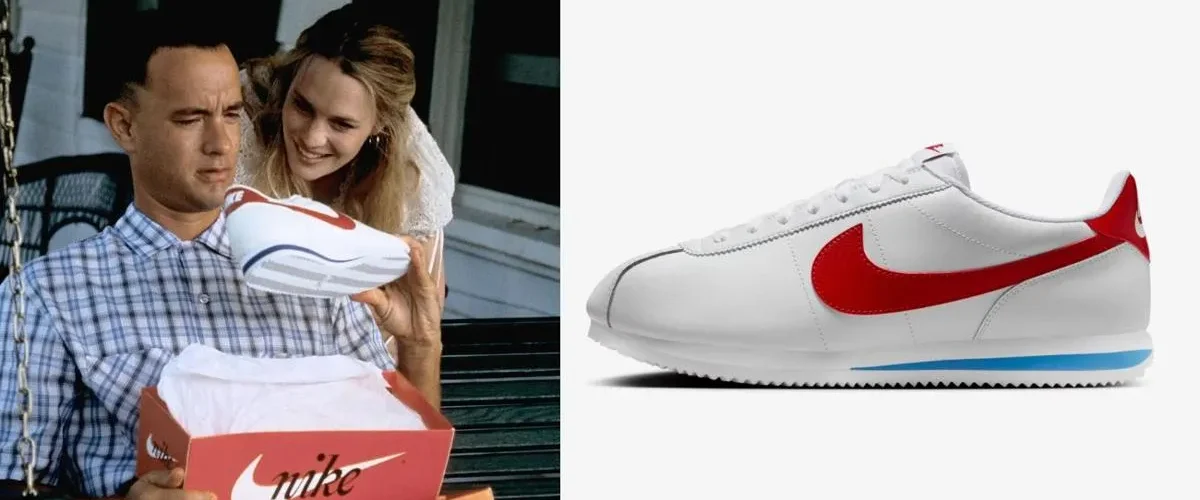
The Cortez, Air Force 1, Air Jordan 1, and Air Max 1 tell the stories of different Nike eras. This selection brings together twenty models from the 1970s through the 1990s, chosen for innovation, athletic history, design influence, and cultural staying power.
The numbering creates an approximate timeline, rather than an objective ranking of importance. Models released after 2000 appear at the end to show how the story continued.
How did we choose the most iconic models?
A sneaker did not make this selection simply because it sold well or commands a high resale price. We considered four factors: technical innovation, athletic significance, design influence, and cultural staying power.
We also distinguish original innovations from later marketing. Some models became famous through stories that were simplified over the decades, including the “Banned” Air Jordan 1 and the supposed bullet-train inspiration behind the Air Max 97.
1. Nike Cortez (Nike, 1972)

The Nike Cortez story begins before there was a shoe carrying that exact name.
Bill Bowerman, a track coach and future Nike co-founder, worked on a better-cushioned running shoe while Blue Ribbon Sports still distributed products from Japan’s Onitsuka. The Tiger Cortez came out of that period. When Bowerman and Phil Knight moved forward with their own brand, the concept carried over to Nike and became one of the products that defined its early years.
The Cortez combined a full-length midsole with layers of different densities to provide more protection for distance runners. At a time when running-shoe construction was much simpler, that helped set it apart.
Over the decades, the Cortez moved from performance technology to lifestyle icon. Its presence in Los Angeles culture, movies, and fashion kept a running silhouette recognizable more than half a century later.
2. Nike Waffle Trainer (1974–1975)

The famous waffle-iron story is more than an advertising legend, though it is often oversimplified.
Looking for a lightweight sole that improved traction without metal spikes, Bill Bowerman experimented with pouring urethane into a household waffle iron. The early tests were far from finished products: there were prototypes, improvised molds, and the development of the shoe known as the Moon Shoe.
The concept evolved into commercial products and culminated in the Waffle Trainer, refined around 1974 and becoming one of Nike’s major commercial successes in 1975.
More important than the kitchen anecdote is the thinking behind it: Bowerman treated the sole as an engineered component, rather than simply rubber keeping a foot off the ground. That mindset became central to Nike’s approach to innovation.
3. Nike Air Tailwind (1978)

If the waffle sole showed Nike could rethink traction, the Air Tailwind showed it could rethink cushioning as well.
The model appeared in 1978 in connection with the Honolulu Marathon and became the first commercial Nike shoe to use the technology that would be known simply as Nike Air.
The system, developed from engineer Frank Rudy’s ideas, used a flexible, pressurized unit encapsulated in the midsole. At the time, Air was hidden: there was no side window revealing the bladder.
That distinction matters because the Tailwind marks the technological beginning of Nike Air, while the Air Max 1, nine years later, made the technology a visible part of the design.
4. Nike Air Force 1 (1982)

Designed by Bruce Kilgore, the Nike Air Force 1 brought Nike Air to basketball in 1982.
That is its essential technical milestone: it was Nike’s first basketball shoe equipped with Air.
Its legacy, however, was built both on and off the court. After its initial performance era, retailers and urban communities helped keep the model alive. The white Air Force 1 Low eventually became one of Nike’s most recognizable lifestyle silhouettes.
The AF1 also illustrates something that would happen repeatedly in Nike’s history: a product can stop being cutting-edge technology for its sport and still find a second life as a cultural object.
5. Air Jordan 1 (1985)

The Air Jordan 1 may best represent the connection among athlete, product, and storytelling in Nike’s history.
Designed by Peter Moore and released in 1985, the model put Michael Jordan’s name directly on his own line as he became an NBA sensation.
The “Banned” story requires care. The NBA did challenge black-and-red footwear Jordan wore in 1984, but historical evidence connects the original episode to the Nike Air Ship, which he wore while the AJ1 was still in development. Nike later incorporated the controversy into Air Jordan 1 advertising.
That does not diminish the AJ1’s impact. It shows how product and storytelling combined to create a model that moved through basketball, skateboarding, music, fashion, and collecting.
6. Nike Dunk (1985–1986)

The Nike Dunk was created for college basketball in the 1985–86 cycle. Nike’s archives use different milestones for College Colors development, the product and the advertising campaign, a distinction explored in the model’s full history.
Nike’s College Colors Program coordinated sneakers, clothing, and accessories in American universities’ colors. The “Be True to Your School” campaign made school identity an explicit part of the product.
The Dunk is also interesting as a design object because it did not emerge from nowhere. Peter Moore and the team drew on the design language and components of existing Nike basketball shoes while working to a tight deadline.
Starting in the 1980s, skateboarders found inexpensive Dunks and discovered that the sturdy upper and construction worked well for skating. That adoption helped lay the groundwork for the Nike SB Dunk’s rise beginning in 2002.
7. Nike Air Max 1 (1987)

The Air Tailwind put Air inside the shoe. The Air Max 1 also made Air a visual language.
Tinker Hatfield had worked as an architect before moving into footwear at Nike. On a trip to Paris, the Centre Pompidou, a building that exposes parts of its structure and systems on the outside, helped inspire the idea of revealing what would normally stay hidden.
In 1987, the Air Max 1 arrived with a window showing the heel cushioning unit. The technology became something people could literally see, rather than only a promise described in advertising.
That principle launched a lineage still receiving new technologies and silhouettes decades later. See our guide to Nike Air technology for more.
8. Nike Air Trainer 1 (1987)

The Air Trainer 1 helped establish the cross-training category.
Tinker Hatfield noticed a common problem: people were using overly specialized footwear at gyms where they switched among running, lateral exercises, and weightlifting. The idea was to create a less specialized, more versatile product.
The construction combined features from different kinds of shoes and used a midfoot strap. John McEnroe ended up wearing project prototypes for tennis, while Bo Jackson would become one of the most important faces of the training category’s growth.
The Air Trainer 1’s legacy goes beyond aesthetics: it helped persuade the market that “training” could be its own footwear category.
9. Nike Air Revolution (late 1980s)

The Air Revolution brought the new visible-Air aesthetic to basketball in the late 1980s.
Its midsole shared the emerging technological design language of the first Air Max generation, applied to a tall, structured court shoe.
10. Air Jordan 3 (1988)

The Air Jordan 3 began one of Nike’s most important design partnerships: Tinker Hatfield and Michael Jordan.
Released in 1988, the AJ3 introduced elephant print, visible heel Air, and a lower construction that differed from the first two Jordans.
This was also when the Jumpman became central to Jordan footwear’s visual language. The photographic image of Michael Jordan in flight already existed, but the AJ3 helped turn that silhouette into a product symbol.
The AJ3 remains fundamental both for its design and for showing that Air Jordan could build its own identity beyond traditional Nike Basketball styling.
11. Nike Air Tech Challenge II (1990)

The Air Tech Challenge II brought an attitude to professional tennis that looked far removed from the sport’s traditionally conservative uniforms.
Designed by Tinker Hatfield for Andre Agassi, the model became particularly associated with 1990 and the Hot Lava colorway.
Agassi was already known for aggressive play, long hair, and clothes that broke with convention. Nike turned that identity into a product: fluorescent colors, splatter graphics, and a silhouette that looked equally at home in early-1990s pop culture and on a tennis court.
That is the ATC II’s significance: it showed that performance tennis footwear did not have to look visually neutral.
12. Nike Air Max 90 (1990)

Before it was known as the Air Max 90, the model was the Air Max III, the third major evolution of the line launched in 1987.
Tinker Hatfield made the Air unit more visually prominent and used geometric panels, contrast, and color to deliberately draw attention to the cushioning system.
The combination known as Infrared became inseparable from the silhouette. Instead of hiding the engineering, the intense red directed the eye toward the Air window.
In 2026, the Air Max 90 continues to receive reinterpretations and collaborations, a sign that its value to Nike stopped depending on being a contemporary running shoe long ago.
13. Nike Air Huarache (1991)

The Air Huarache grew out of something Tinker Hatfield noticed while water-skiing.
The neoprene boot used in the water wrapped the foot with a comfortable, adaptable fit. Hatfield brought that approach to a running shoe, combining a flexible inner sleeve with an external support structure.
The 1991 result was so different that the designer deliberately reduced the Swoosh’s presence on the sides. The product’s shape was meant to be recognizable on its own.
The Huarache also led to important basketball and training offshoots, showing how a solution initially developed for running could become a broader design platform.
14. Air Jordan 6 (1991)

The Air Jordan 6 holds a special place through its direct connection to Michael Jordan and the Chicago Bulls’ first NBA championship in 1991.
Tinker Hatfield developed a silhouette partly inspired by Jordan’s interest in sports cars. The model used neoprene, visible Air, and translucent rubber elements.
While some sneakers become historic regardless of an athlete’s performance, the AJ6 has a direct sporting connection: it was the model Jordan wore as he went from individual superstar to NBA champion.
15. Nike Air Max 180 (1991)

The name Air Max 180 describes its major visual innovation: Air exposed through approximately 180 degrees around the heel.
That does not mean it had a visible Air unit extending along the full length of the foot.
Bruce Kilgore and Tinker Hatfield helped develop an architecture intended to remove part of the visual barrier between the unit and the ground. The construction also mattered to the development of blow-molding processes that would advance within the Air Max family.
The 180 shows how Nike began treating the Air unit’s size and exposure as areas for experimentation in their own right.
16. Air Jordan 7 (1992)

The Air Jordan 7 accompanied Michael Jordan through an extraordinary season: his second consecutive NBA championship and a gold medal with the U.S. team at Barcelona 1992.
Tinker Hatfield also moved the design away from reliance on traditional Nike visuals. The AJ7 had neither a side Swoosh nor an external Air window, helping create an increasingly independent Air Jordan identity.
The inner sleeve recalled Nike’s experiments with the Huarache family, while graphics and panels gave the shoe a character distinct from earlier Jordans.
17. Nike Air Max 93 (1993)

After 180 degrees, the effort to expose more Air continued.
The Air Max 93 introduced a blow-molded unit with roughly 270 degrees of visibility around the heel. Tinker Hatfield connected its shape to the geometry of molded containers, such as milk-jug handles.
The 93 also used a sock-like collar, reflecting the period when ideas from the Huarache family were influencing other Nike categories.
Its legacy is more specific than “more comfort”: it advanced the manufacturing that allowed Air units to take larger, more complex shapes.
18. Air Jordan 11 (1995)

The Air Jordan 11 began appearing publicly in 1995, when Michael Jordan wore prototypes during the playoffs after returning to the NBA.
Tinker Hatfield created a silhouette mixing materials unusual for basketball at the time, especially the glossy patent leather that became its visual signature.
The platform also included a structural carbon-fiber plate and, in various versions, a translucent sole.
In 1995–96, Jordan and the Bulls won 72 regular-season games and the championship. The connection among the AJ11, Jordan’s return, and one of the most dominant teams in NBA history gave the shoe significance beyond its already striking visual innovation.
19. Nike Air Max 95 (1995)

The Air Max 95 showed that the Air Max line did not have to keep looking like an evolution of Tinker Hatfield’s work.
Sergio Lozano created a new design language inspired by the human body’s structure and forms found in nature. The central area and sole recalled a spine; the eyelets suggested ribs; and the upper’s layers evoked muscles and tissue.
Technically, the AM95 mattered because it introduced visible forefoot Max Air alongside the heel unit.
The original combination of graduated grays, black, and Neon addressed both practical and visual concerns: darker lower sections concealed dirt, while fluorescent yellow highlighted functional components.
20. Nike Air Max 97 (1997)

The Nike Air Max 97 closes this historical selection with one of the 1990s’ most futuristic silhouettes.
Contrary to a widely repeated myth, Christian Tresser says the wave-like design did not primarily originate with Japanese bullet trains.
His central reference was the concentric ripples created when a droplet hits water. The metallic look and reflective details related to his interest in mountain bikes and their components.
The Air Max 97 also advanced the technology: it was the first Nike with full-length visible Air.
That combination of engineering and design made the Silver Bullet one of the Air Max era’s most recognizable images, and it continues to influence futuristic Nike designs.
What about major Nike releases after 2000?
Nike’s story continued through new ways of making uppers, structuring midsoles, and working with skateboarding.
The models below fall outside the pre-2000 focus but expand the comparison across generations.
- Nike SB Dunk Low: beginning in 2002, it made the Dunk a central platform for skateboarding and modern collaborations.
- Nike Flyknit Racer: introduced in 2012, it helped launch digitally engineered Flyknit upper manufacturing.
- Nike Vaporfly: its combination of highly responsive foam, high-stack geometry, and a stiff plate helped redefine the contemporary racing shoe.
- Nike Alphafly: further developed the generation of super shoes associated with the pursuit of exceptional marathon performances.
- Air Max 1000 and Air Max 95000: between 2024 and 2026, they showed a new direction based on additive manufacturing and 3D-printed structures.
These products do not make the twenty earlier classics less important. They simply show that “iconic” is an evolving category: some models need years or decades to demonstrate lasting influence.
What was Nike’s most important sneaker?
The answer depends on the criteria.
For the origins of the company’s identity, the Cortez and Waffle Trainer are essential. For technology, the Tailwind and Air Max 1 changed how Nike presented cushioning. For basketball and culture, the Air Force 1 and Air Jordan 1 are hard to surpass. For subcultural history, the Dunk has lived several lives across college sports, skateboarding, music, fashion, and collaborations.
This list therefore works best as a timeline of turning points rather than an absolute competition among twenty pairs.
To follow these changes in a chronology that also considers the business and its controversies, read the history of Nike.


