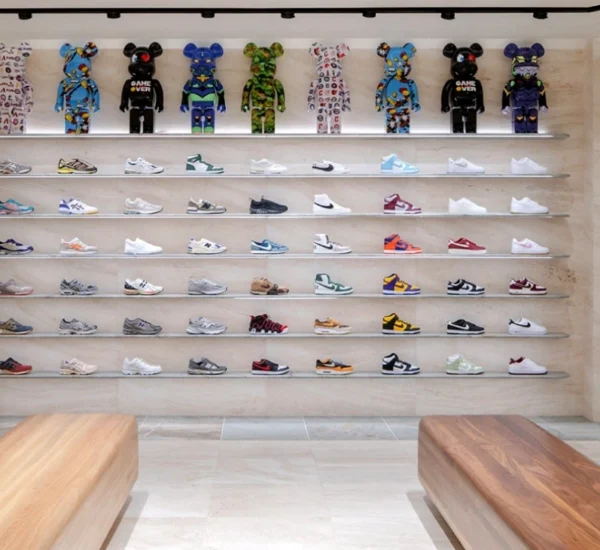

Released in 1997 and designed by Christian Tresser, the Nike Air Max 97 made its mark by pairing a wave-lined upper with a major innovation: it was Nike’s first shoe with full-length visible Air, extending the window from heel to forefoot.
There is also a historical detail worth clearing up from the start: despite the frequent association with Japanese bullet trains, Nike now states that they were not the design’s primary inspiration. Tresser explained that the upper’s lines came from the ripples created by water droplets hitting a surface, while the metallic, mechanical look of the famous Metallic Silver version drew on mountain bikes and their metal components.
That combination of nature, an engineered aesthetic, and technology made the Air Max 97 one of Nike’s most recognizable designs. Its story took on particular significance in Italy, where the Silver Bullet became known simply as “Le Silver.”
The Air Max line before 1997
The Air Max 97 did not emerge in isolation. It was part of a technological and visual evolution that had been developing for years.
In 1987, Tinker Hatfield’s Air Max 1 made Air visible in the heel, turning the cushioning window into part of the design itself. Further experiments with the unit’s volume, placement, and visibility followed.
The Air Max 180 expanded that exposure to 180 degrees. The Air Max 93 advanced the unit’s manufacturing through blow molding. In 1995, Sergio Lozano’s Air Max 95 brought visible Air to the forefoot as well, with a design known for references to human anatomy and organic structures.
By 1997, then, the question was not simply how to put Air into another shoe. It was how to advance visible Air technology again.
Who designed the Nike Air Max 97?
The lead designer of the Air Max 97 was Christian Tresser.
Tresser already had experience in athletic footwear before taking on the project, working in running and soccer design. His name would also become associated with other important products, including the Nike Air Zoom Spiridon and 1990s soccer projects.
The Air Max 97, however, became his best-known creation. In later accounts, Tresser said the project had passed through two other designers’ hands before reaching his desk. This should be understood as his recollection of the process, rather than an official Nike inventory of the earlier concepts.
How did Christian Tresser arrive at the final design?
Tresser needed an upper that could visually match an already radical new cushioning platform: a full-length visible Air unit.
Rather than build the design around a single reference, he brought together two seemingly different worlds: the organic movement of ripples on water and the technical appearance of metal mountain-bike components.
The result was a sneaker with horizontal lines that seem to spread around the foot, metallic and reflective surfaces, a low profile, and a lacing system integrated into the upper’s design.
Was the Air Max 97 inspired by Japanese bullet trains?
Not as the primary inspiration described by Christian Tresser.
This is one of the most repeated Air Max 97 stories, partly because Metallic Silver, fluid lines, and a sense of speed fit the image of a Shinkansen so well.
For years, even Nike promotional materials and product pages repeated the bullet-train connection. The Department of Nike Archives later clarified the issue directly: Japanese bullet trains were not the origin of the Silver Bullet’s design.
That does not mean the cultural association is imaginary. It exists and helped shape the popular story around the sneaker. The key is not to confuse that later interpretation with the inspiration described by the designer himself.
The real inspiration: Ripples on water
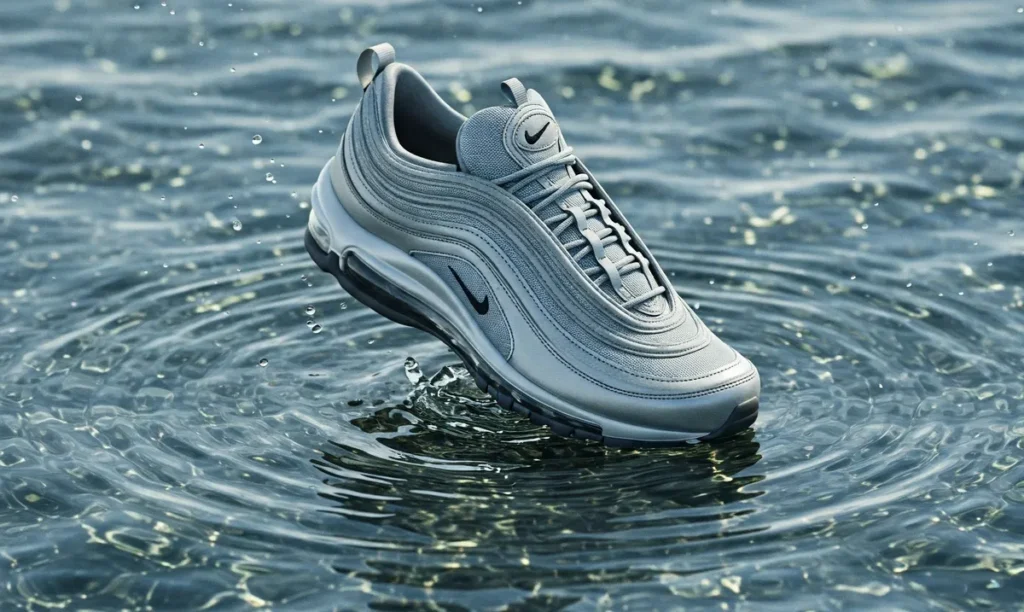
Nike records Tresser’s explanation in concrete terms: the idea was water falling onto a surface and radiating outward toward the Air unit.
Those concentric ripples became the upper’s visual framework. Instead of large, separate panels, the Air Max 97 appears to have lines flowing continuously around the foot.
How did mountain bikes influence the Silver Bullet?
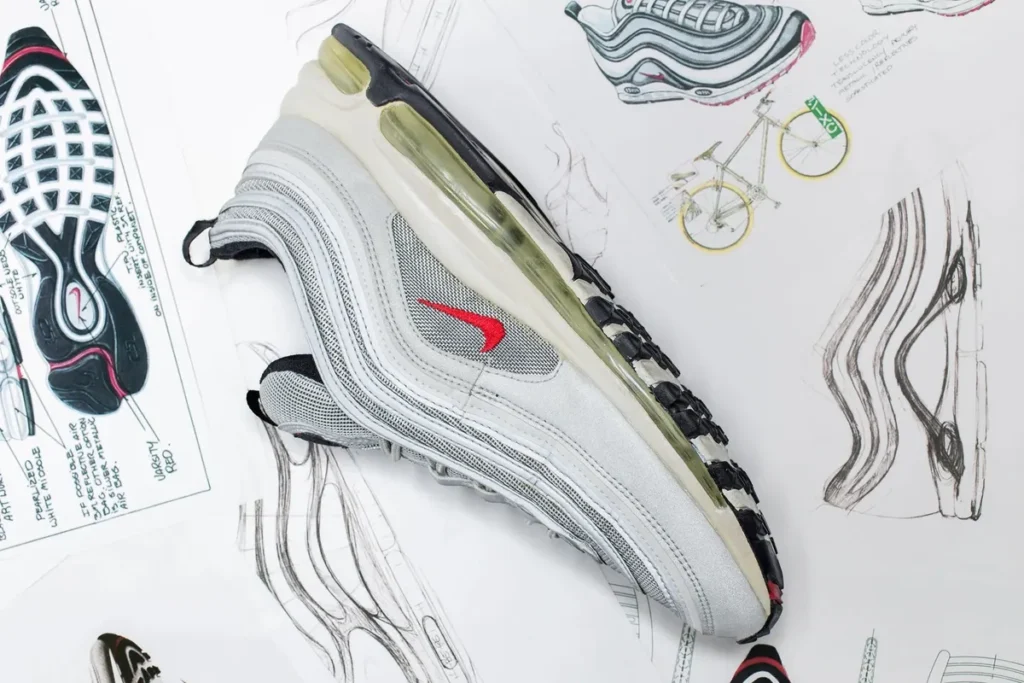
The Air Max 97’s mechanical side came from another of Tresser’s interests: mountain bikes.
At the time, high-performance bikes used metal components and finishes that conveyed technology, precision, and speed. Tresser cited materials and looks associated with aluminum and polished titanium as part of that visual world.
That helps explain why Metallic Silver works so well on the 97. It was not chosen simply because “silver looks futuristic”; it reflected specific product-design and technical-material references that interested the designer.
Where did the Silver Bullet name come from?
Today, Silver Bullet is an established name that Nike itself officially uses for the Metallic Silver Air Max 97.
The nickname’s exact origin remains uncertain: the cited references do not document who coined it or confirm that it was already the official retail name at the 1997 launch.
Two things should therefore be kept separate: the metallic inspiration from mountain bikes is documented; the exact story of who coined “Silver Bullet” is less clear. The name naturally suited the silver look and the popular bullet-train association, but that does not make the train the source of the design.
What made the Air Max 97 technologically important?
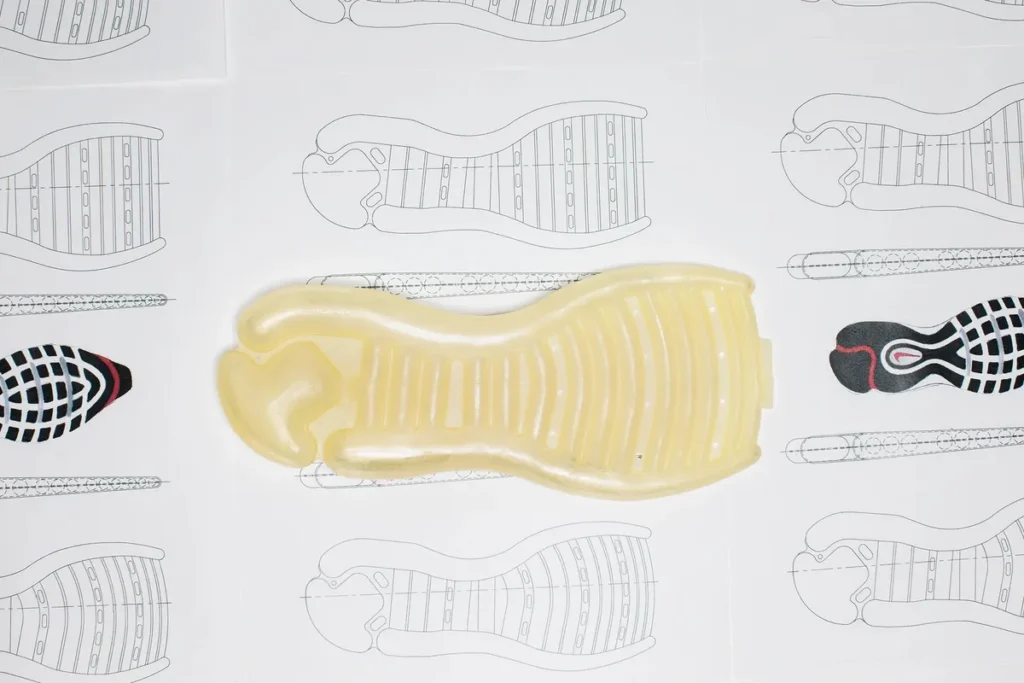
Full-length visible Air
According to Nike, the Air Max 97 was the brand’s first shoe with full-length visible Air.
Precision matters here. The 97 did not invent Nike Air, and it was not the first Air Max to show the technology. Its specific innovation was making the Air unit visible along nearly the entire length of the foot.
For the platform’s development up to that point, read our guide to Nike Air technology.
What changed from earlier Air Max models?
The Air Max 1 made the Air window a central visual feature. The Air Max 180 increased the visible area. The Air Max 93 introduced manufacturing advances that opened up more possibilities for the unit’s geometry. The 97 carried that evolution through to a full-length visible unit.
The technology was integrated into the design, too: the upper’s lines seem to draw the eye directly toward the Air unit.
What was the original Air Max 97 like?
The original 97 combined the ripple design, reflective details, a Metallic Silver finish on its most famous version, small Swoosh branding, visible Air, and a lacing system integrated into the upper.
Reflective details help identify the original design, but the manufacturer and composition of those materials vary among releases. “3M” is not a generic name for every reflective surface.
Materials also differ among OG pairs, retros, collaborations, and current colorways. There is no single material specification that applies to every Air Max 97 made since 1997.
Was Silver Bullet the first colorway?
Metallic Silver with red and black details, now known as Silver Bullet, is one of the model’s defining OG colorways and the version most closely associated with the Air Max 97’s debut.
Regional distribution in 1997 means that a current name cannot establish one universal release sequence. Silver Bullet belongs at the heart of the 97’s original identity.
For more on this use of OG, see what OG means in sneakers and our guide to OG colorways.
Why did the Air Max 97 become a phenomenon in Italy?
Few parts of the Air Max 97 story are as well documented as its relationship with Italy.
There, especially in Milan, Metallic Silver moved beyond the running-shoe category to reach clubgoers, DJs, graffiti artists, fashion professionals, and shoppers from different groups. Reducing this story to the paninari creates an anachronism: the paninaro movement is associated mainly with the 1980s and cannot by itself explain the Air Max 97’s adoption in the late 1990s.
Le Silver
In Italy, the model became affectionately known as “Le Silver.” The name captures how that particular colorway became recognizable almost independently of the shoe’s full product name.
The relationship remained strong enough for Nike to arrange a special Silver Bullet return for Italy in 2016, ahead of the global 20th-anniversary cycle.
Milan, clubs, and street culture
Italian club culture in the late 1990s was one setting where the 97 gained visibility. Accounts collected in histories such as Le Silver show the sneaker moving through nightlife and crossing boundaries that had separated athletic footwear from fashion-oriented dress codes.
Graffiti and fashion
The Air Max 97 is also linked to graffiti crews such as Lords of Vetra and, later, Italian fashion circles. This helps explain the breadth of its adoption: it did not depend on a single subculture to find an audience.
Some writers draw parallels between the 97’s fast, metallic, mechanized aesthetic and Italian Futurism. That is an interesting later cultural interpretation, but it does not establish that Christian Tresser designed the sneaker with the Italian Futurist movement as his inspiration.
Was the Air Max 97 equally successful worldwide?
There is no reason to treat its trajectory as uniform.
Italy developed an exceptional relationship with the silhouette, while other markets adopted it at their own pace and in their own contexts. The 97’s global impact grew through retros, fashion, streetwear, Air Max Day, and later collaborations.
Italian adoption and global retro cycles are distinct chapters; no single popularity curve represents every market.
Key Silver Bullet reissues
Like other Air Max icons, the Silver Bullet has returned in several release cycles.
- 1997: the original era of the Air Max 97 and its Metallic Silver version.
- 2016: a special return in Italy with details referencing the Italian tricolor, ahead of the anniversary celebration.
- 2017: the expanded 20th-anniversary cycle and the 97’s global return, accompanied by new colorways and collaborations.
- 2022: another Silver Bullet return for the silhouette’s 25th anniversary.
These retros are newly manufactured shoes. A Silver Bullet made in 2022 is not physically a 1997 pair just because it reproduces an OG colorway.
Collaborations that helped keep the Air Max 97 relevant
UNDEFEATED x Air Max 97
In 2017, UNDEFEATED released an Air Max 97 collaboration in two colorways. Nike includes the project in its official retrospective of the model, reflecting its importance within the 20th-anniversary cycle.
Off-White x Nike Air Max 97: The Ten
Also in 2017, Virgil Abloh reinterpreted the Air Max 97 as part of The Ten.
The 97 belonged to the “Ghosting” group, which used translucent or partially revealing materials to expose the construction visually. The project should not be confused with the Silver Bullet: it used Abloh’s characteristic deconstruction rather than simply offering a silver version of the OG.
Read our complete Nike x Off-White history for more.
Skepta x Air Max 97 SK
Skepta’s Air Max 97 SK brought a different story. Nike documented references to both London and Marrakesh, along with the influence of the Air Tuned Max 99, the artist’s first Air Max purchase, on the iridescent finish and yellow Air unit.
Sean Wotherspoon Air Max 1/97: Why is it not a standard Air Max 97?
The Sean Wotherspoon shoe often appears on “Air Max 97” lists, but technically it is an Air Max 1/97.
Nike invited creatives to take part in Vote Forward, a program in which the public would choose a concept for release on Air Max Day 2018. Sean Wotherspoon’s winning design combined:
- an Air Max 97-inspired upper;
- the Air Max 1’s midsole and outsole;
- multicolored corduroy;
- references to vintage Nike pieces.
Calling it “an Air Max 97 colorway” therefore misses the project’s most important feature: it is a hybrid of two silhouettes.
Is the Air Max 97 still sold in 2026?
The Air Max 97 still has product pages in Nike’s official catalog. Distribution varies by country, color, size, and edition.
That also means two different questions should not be confused:
- Does the Air Max 97 still appear in Nike’s catalog? Yes, the silhouette remains active.
- Is the Silver Bullet always available? No. This colorway returns in cycles and can spend long periods out of stock.
Is the Air Max 97 comfortable today?
Comfort depends on fit and on what you expect from the cushioning.
The Air Max 97 has full-length Max Air and a foam midsole, and Nike continues to position those elements as cushioning features. That does not mean everyone will find the shoe soft or light.
Compared with many modern sneakers and running shoes, the 97 may feel more structured and firm to some wearers. Its main role today is lifestyle wear, rather than competing with contemporary running platforms built to maximize lightness or energy return.
Is the Air Max 97 good for running?
The Air Max 97 started as a performance running shoe. That is a genuine part of its history.
In 2026, however, it is primarily a lifestyle/heritage model. For running today, it makes more sense to choose a line developed and updated specifically for modern running, taking your distance, biomechanics, and training goals into account.
Heritage running footwear is not the same as contemporary performance running footwear.
Is the Air Max 97 heavy?
The model should not be described across the board as “lightweight.” Its full-length Air, foam, rubber outsole, and multilayered upper can create a more substantial feel than minimalist modern running shoes.
Weight varies by size, version, and materials. Compare the specifications for the exact style code rather than applying one number to every Air Max 97.
Does the Air Max 97 fit true to size?
No answer applies to every release forever, but Nike has offered an important piece of guidance: official men’s Air Max 97 product pages in some markets describe the model as running small and recommend considering a half size up.
That should not automatically be applied to every women’s version, GS release, collaboration, or historical retro. Always check the product page and size chart for the specific SKU. On international listings, distinguish U.S., UK, EU, and Brazilian sizing rather than treating their numbers as interchangeable.
Can an old Air Max 97 crumble?
It can deteriorate, but not because “Air technology hydrolyzes.”
A genuinely old Air Max 97 may contain several aging components:
- midsole foam or carrier;
- adhesives;
- rubber;
- upper materials;
- coatings;
- the Air unit.
Some susceptible polyurethane materials can undergo hydrolysis; adhesives can fail; rubber can harden or crack. These are different mechanisms.
The Air unit is a separate component and should not be treated as another name for a PU midsole. For the distinction, read our guide to hydrolysis and sneaker aging.
OG, retro, and vintage: What is the difference for the Air Max 97?
OG can refer to the original release or a configuration or colorway associated with the model’s origins.
Retro refers to a later production that brings back an earlier design.
Vintage primarily describes the age or era of the physical pair.
A recently made Air Max 97 Silver Bullet retro can therefore reproduce an OG colorway without being an actual 1997 pair.
See our guides to retro sneakers and vintage sneakers.
Water, mountain bikes, and full-length visible Air explain the 97’s design; Italian adoption and collaborations help explain its staying power. Find the broader context in the history of Nike and more journeys from sports to the street in History and Culture.
Frequently asked questions
When did the Air Max 97 launch, and who designed it?
Released in 1997 and designed by Christian Tresser, the Nike Air Max 97 made its mark by pairing a wave-lined upper with a major innovation: it was Nike’s first shoe with full-length visible Air, extending the window from heel to forefoot.
Was the Air Max 97 really inspired by a Japanese bullet train?
There is also a historical detail worth clearing up from the start: despite the frequent association with Japanese bullet trains, Nike now states that they were not the design’s primary inspiration. Tresser explained that the upper’s lines came from the ripples created by water droplets hitting a surface, while the metallic, mechanical look of the famous Metallic Silver version drew on mountain bikes and their metal components.
What was new about the Air Max 97 cushioning?
According to Nike, the Air Max 97 was the brand’s first shoe with full-length visible Air. Precision matters here. The 97 did not invent Nike Air, and it was not the first Air Max to show the technology. Its specific innovation was making the Air unit visible along nearly the entire length of the foot.
What was the original Air Max 97 colorway?
Metallic Silver with red and black details, now known as Silver Bullet, is one of the model’s defining OG colorways and the version most closely associated with the Air Max 97’s debut.
Is the Air Max 97 retro intended for modern running training?
The Air Max 97 started as a performance running shoe. That is a genuine part of its history. In 2026, however, it is primarily a lifestyle/heritage model. For running today, it makes more sense to choose a line developed and updated specifically for modern running, taking your distance, biomechanics, and training goals into account. Heritage running footwear is not the same as contemporary performance running footwear.