In 2023, Shoe Palace found a way to mark its thirtieth anniversary: a Jurassic Park clothing collection, celebrating another 1993 debut. The official announcement described tees, camouflage pieces and a themed vest. A retail anniversary and a film anniversary became material for the same wardrobe. The pairing shows how the chain uses popular culture to give its apparel a recognizable identity.
The combination also raises an interesting question about the name above the door. What happens when a shoe retailer becomes a place to wear a favorite film, musician or artist? Shoe Palace’s history offers several answers, rooted in a family’s California business and expanded through partnerships. Its identity emerges from that mixture rather than from footwear alone.
A San Jose beginning
Shoe Palace’s official history dates its first shop to San Jose in 1993 and identifies the Mersho family as its founders. The site presents that original single-store business as the starting point for the later chain. Keeping San Jose in view is important: the company’s national reach came after a specific Bay Area beginning.
The retailer’s published family account adds an earlier chapter. Agob Mersho moved his family from Syria to the United States in 1978; the first Shoe Palace followed fifteen years later. This is the company’s account of its founder’s path. It locates the business within an immigrant family history without requiring a generalized story about every customer or neighborhood it later served.
The family origin should be distinguished from subsequent ownership. JD’s December 2020 announcement records the completed acquisition on December 14 through its U.S. holding company. It also stated that the Mersho brothers would continue managing Shoe Palace. Family involvement and membership in a larger corporate group could coexist; describing the contemporary business simply as independently family-owned would obscure that change.
Making a collection out of a cultural reference
Shoe Palace’s 2022 collaboration retrospective shows the breadth of its licensing activity. It identifies a January project with Bruce Lee’s estate and a collection with Paramount Consumer Products for The Godfather. The important distinction is the collaboration itself: these were branded apparel projects built around existing cultural properties, rather than claims that the retailer created those films or their surrounding cultures.
That distinction leaves room to examine design as an act of selection. Choosing a performer’s photograph, a familiar character or a film’s visual language gives an ordinary garment a second function. It can become a statement of taste. A retailer working in this space is selecting references for a wardrobe, just as it selects sneaker silhouettes, colors and brands.
The Bob Marley assortment announced in April 2026 illustrates the material side of that process. Shoe Palace described denim pieces, embroidered imagery, a soccer jersey and accessories using photographs and iconography associated with Marley. The music reference crossed several garment types. The announcement documents a particular collection, not a guarantee that every piece remains available.
Its June 2023 Gilbert Baker collection extended that approach into art and activism. The retailer announced clothing honoring the rainbow-flag designer and said a portion of sales would go to the Gilbert Baker Foundation. That dated pledge belongs to the collection’s public record; it should not be converted into an unsupported claim about the amount ultimately donated.
Shoe Palace also presents Maison Article and Sacre as in-house clothing lines. Those labels sit beside the recognizable outside names in its merchandise vocabulary. Together, they show two routes to differentiation: developing a retailer-controlled apparel identity and collaborating with cultural properties that already carry meaning for an audience.
Basketball keeps the Bay Area connection visible
Footwear remains central to the story. In July 2022, Shoe Palace announced an Under Armour Curry Flow 9 inspired by Stephen and Ayesha Curry’s Eat. Learn. Play. Foundation. The project connected a basketball signature shoe to a named community organization. It also placed the retailer alongside an athlete strongly associated with the region where the business began.
A later partnership is documented by Under Armour itself. During the 2025 NBA All-Star weekend, Shoe Palace’s Union Square store hosted a Curry-focused retail presentation. Autographed shoes were displayed there for an auction supporting the foundation and related youth-sport work. This was a specific event in San Francisco, rather than a permanent service or feature shared by every branch.
These projects reveal another dimension of collaboration. A film collection moves an image into clothing; a basketball event can move a player’s product history into a physical display. Both allow a store to organize material around something its audience recognizes. The scale and purpose differ, but each adds a narrative layer to the merchandise.
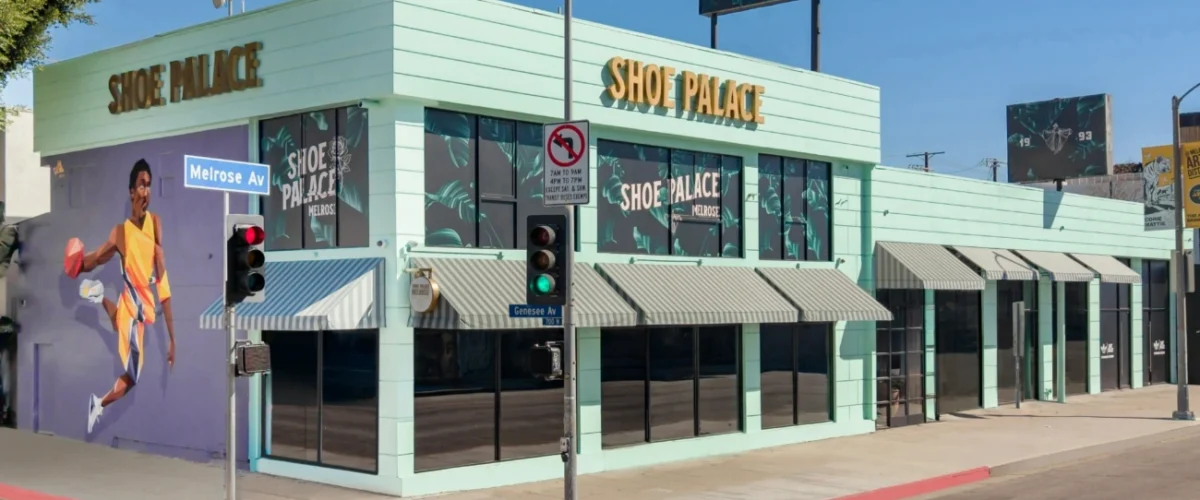
The Bay Area connection is also visible in the ordinary store network. The official locator listed a San Jose branch at 3000 Story Road when checked in October 2026. It is a contemporary point of reference in the founding city, without implying that this address was the original 1993 premises.
Shoe Palace’s cultural story is therefore best understood through the company’s choices of company: a family, a sportswear partner, a film rights holder, an artist’s estate or a foundation. Each relationship contributes a different kind of memory and recognition. Together they explain how a business named for shoes developed a broader vocabulary for what people wear.
The December 2020 acquisition
The Jurassic Park anniversary collection
Under Armour on the 2025 Bay Area event
Frequently asked questions
Who founded Shoe Palace and where did it start?
Shoe Palace’s official history dates its first shop to San Jose in 1993 and identifies the Mersho family as its founders.
Is Shoe Palace still an independent family business?
JD’s December 2020 announcement records the completed acquisition on December 14 through its U.S. holding company. It also stated that the Mersho brothers would continue managing Shoe Palace. Family involvement and membership in a larger corporate group could coexist; describing the contemporary business simply as independently family-owned would obscure that change.
Does Shoe Palace have its own clothing brands?
Shoe Palace also presents Maison Article and Sacre as in-house clothing lines.
Why did Shoe Palace release a Jurassic Park collection?
In 2023, Shoe Palace found a way to mark its thirtieth anniversary: a Jurassic Park clothing collection, celebrating another 1993 debut. The official announcement described tees, camouflage pieces and a themed vest.
Has Shoe Palace collaborated on a Stephen Curry shoe?
In July 2022, Shoe Palace announced an Under Armour Curry Flow 9 inspired by Stephen and Ayesha Curry’s Eat. Learn. Play. Foundation. The project connected a basketball signature shoe to a named community organization. It also placed the retailer alongside an athlete strongly associated with the region where the business began.
Related store histories
Shiekh
WSS