
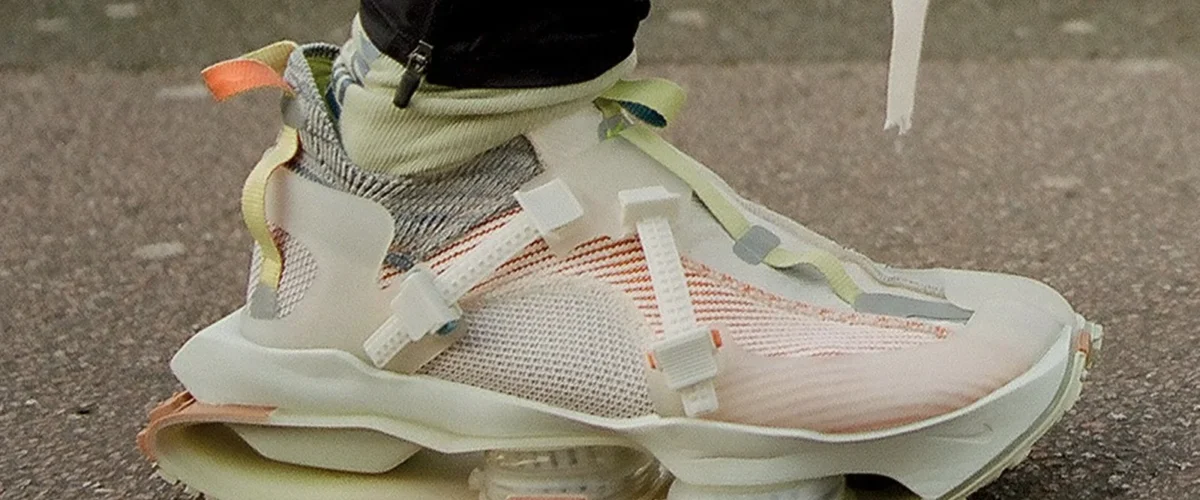
A sneaker’s future can be visible in a sculptural sole or hidden in the way it was made. These ten Nike experiments explore both possibilities.
Nike has explored electronic lacing, deconstructed structures, recycled materials, unusually shaped Air units, and, more recently, 3D-printed footwear. In 2026, the brand also began exploring sensory stimulation through its Mind platform, while continuing to develop a motorized system for walking and running.
The order is an editorial choice based on visual experimentation, fit or cushioning technology, and manufacturing methods. It covers models that have been sold commercially; Project Amplify, which Nike still describes as a project in testing, appears separately.
Launch price, rarity, and resale value are not ranking criteria. A shoe does not become more futuristic simply because it is expensive or hard to find.
What makes a Nike sneaker feel genuinely futuristic?
Nike built much of its history by experimenting with solutions that initially looked strange. Bill Bowerman’s waffle sole, encapsulated and later visible Nike Air, Zoom Air, and other technologies changed the form and function of athletic footwear over the decades.
Learn more about that evolution in our guide to Nike Air technology.
In the models below, “futuristic” can mean different things: a new production method, an electronic fit system, a radical construction, or technology that departs from traditional sneaker architecture. For the components behind these ideas, explore the materials and technology guides in Sneaker Lab.
10. Nike Mars Yard Overshoe x Tom Sachs

The Nike Mars Yard Overshoe, created with artist Tom Sachs, remains one of the most unusual and recognizable projects in NikeCraft’s recent history.
Rather than simply creating another Mars Yard version, the project wraps the sneaker concept in a tall outer structure developed for adverse weather. Closures, straps, technical materials, and exaggerated proportions make the whole shoe look like experimental equipment.
The result resembles exploration gear more than a conventional casual sneaker. That combination of art, utility, and space-age aesthetics keeps it on the list even after the innovations introduced between 2024 and 2026.
9. Nike Space Hippie 03

The Space Hippie 03 represents another kind of futurism: exploring how industrial waste and repurposed materials could become part of a sneaker with its own identity.
According to Nike, the Space Hippie 03 was made with at least 45% recycled material by weight. The upper’s Space Waste Yarn contains around 85% recycled polyester, while the construction also uses Nike Grind, blended foams, and ZoomX scraps.
Those figures come from the brand and should not be confused with an independent environmental-impact assessment. What makes the Space Hippie relevant here is how it reveals its process and materials: the speckled texture, visibly repurposed-looking foam, and FastFit system are deliberate parts of the aesthetic.
8. Nike Adapt Huarache “Opti Yellow”

The Nike Adapt Huarache is pictured above in the “Opti Yellow” colorway.
The project took the Air Huarache’s fit concept and reinterpreted it through the electronic FitAdapt system. At launch, wearers could adjust the shoe’s tension through the Nike Adapt App, use an Apple Watch, and even create Siri shortcuts.
For anyone looking for a pair today, there is an important limitation: Nike removed the Adapt App from app stores on August 6, 2024, and said it would not develop new Adapt shoes.
The physical buttons still allow existing pairs to be adjusted. An already-installed app may continue to work, but Nike warns that it cannot be transferred to a new device and that operating-system updates may limit or end its functionality.
7. Nike Zoom 004 x MMW

The Nike Zoom 004 x MMW came from a collaboration with Matthew M. Williams, founder of 1017 ALYX 9SM.
The silhouette combines references to 2000s running shoes with a much more industrial structure. Nike used high-tenacity polyester knit, a Zoom unit, and mechanical cushioning plates to build a sole that almost looks like a piece of equipment.
It works particularly well as futuristic design because the technology is not hidden. The sole exposes volumes, cutouts, and components that a conventional sneaker would usually smooth over.
6. Nike ISPA Road Warrior

The ISPA Road Warrior still looks radical years after its debut.
ISPA stands for Improvise, Scavenge, Protect, Adapt, a Nike philosophy focused on solving problems through experimental construction. The Road Warrior took that approach to an extreme with an open structure, separate underfoot elements, an unusual closure, and references drawn from different sports categories.
Its open sole and exposed components give the Road Warrior the look of a prototype, even though it reached retail.
5. Nike Air Max Dn8
Released globally in 2025, the Air Max Dn8 extended the Dynamic Air concept along nearly the entire foot.
The Dn8 has two Air units with eight tubes in total. The configuration uses different pressures among its chambers; within each chamber, air can move between tubes as the foot applies load during a step. Gas does not continuously mix across all the chambers.
The Dn8 goes beyond futuristic looks. The functional geometry of the cushioning defines the silhouette and remains exposed, recalling the Air Max philosophy of the late 1980s but using a much more complex architecture.
For the differences among Air, Air Max, and Air Zoom, see our dedicated technology guide.
4. Nike Mind 002
The Nike Mind 002 reached the market in 2026 as part of the new Nike Mind platform.
Rather than focus innovation solely on cushioning or energy return, Nike developed an underfoot structure with movable elements intended to create sensory stimulation during wear.
The brand presents Mind 001 and Mind 002 as its first shoes based on its “mind science” research, developed over more than a decade.
It is important to distinguish physical technology from marketing: the sensory system exists, but claims about improved focus, calm, or mental state should be understood as positioning and research shared by Nike itself, rather than a clinical guarantee for every wearer.
Even so, moving sneaker experimentation from traditional biomechanics toward sensory perception makes the Mind 002 one of Nike’s most unusual projects in 2026.
3. Nike Air Liquid Max
The Nike Air Liquid Max, released in March 2026, reinterprets Air Max with an entirely different unit geometry.
Nike developed a contoured, flexible, relatively low-profile Air unit. Rather than filling a large uniform area, the design places Air at selected points and leaves open spaces around them.
The brand calls the approach point-loaded Air. This structure directly shapes the sole’s organic appearance, while the low-profile upper uses three-layer textured printing.
The combination of open space, curves, and visible Air makes the Liquid Max an example of futurism built from the sole up, without relying on electronics.
2. Nike Air Max 1000 x Zellerfeld
The Air Max 1000 marked an even deeper shift because it changes not only the shoe’s design, but also how a large portion of it is manufactured.
Nike developed the model with Zellerfeld using 3D printing. First presented at ComplexCon in 2024, the project reinterprets the Air Max 1 through a printed structure with surfaces, densities, and volumes that would be difficult to reproduce through traditional assembly methods.
In 2026, the project moved beyond being an event curiosity. Nike confirmed the expansion of its 3D-printing research through the Air Works program and announced that the Air Max 1000 would be offered through Nike By You.
That makes the model particularly significant: it points toward a future in which digital customization and additive manufacturing could become part of Nike products on a larger scale.
1. Nike Air Max 95000
The Nike Air Max 95000 takes the top spot in this selection for combining 3D printing, the Project Nectar process, and two Air applications in a commercial silhouette.
Developed again with Zellerfeld, it uses a 3D-printed chassis but goes beyond the Air Max 1000 by introducing Project Nectar, a Nike-developed printing process that applies functional material to areas such as the sole.
The design pays tribute to the Air Max 95 without trying to reproduce it literally. A “Big Bubble” Max Air unit sits at the heel, with a smaller Air unit in the forefoot, while the rest of the construction takes on sculptural forms enabled by additive manufacturing.
The Air Max 95000 is not merely a display prototype: Nike released the Black/Volt colorway in late 2025.
The standout feature here is integration: the shoe’s design, printed structure, and use of Project Nectar were developed together.
What about Project Amplify, Nike’s motorized footwear?
If this list placed prototypes still in development alongside commercial products, Project Amplify would easily contend for first place.
Introduced in 2025, the system was developed by Nike with robotics company Dephy. It combines a motor, a drive belt, a rechargeable battery mounted around the lower leg, and a running shoe with a carbon-fiber plate.
Nike’s stated goal is to supplement natural lower-leg movement during walking and recreational running. The company tested different hardware versions with hundreds of participants.
The official Project Amplify announcement describes a system in testing, with a broad release planned for subsequent years. That publication does not confirm an on-sale date, which is why it remains outside the commercial-model ranking.
Other projects that help explain the evolution
Nike’s earlier experimental work also produced models worth considering alongside the ten selected here.
Nike Air Zoom Type

The Air Zoom Type remains interesting for its N.354 design language, which made its prototype and development-process influences visible. The exposed forefoot Zoom Air unit and unusual midsole still create an experimental look, but the 3D-printing projects of 2025 and 2026 took that idea much further.
Nike Air Zoom Alphafly NEXT%

The Alphafly family remains technologically significant. It combines ZoomX foam, a carbon-fiber plate, and forefoot Air Zoom units.
One historical detail deserves precision: Eliud Kipchoge ran 1:59:40 in Vienna in 2019 wearing an Alphafly NEXT% prototype. It was not simply the same retail product that later reached stores.
Nike Adapt Auto Max

The Adapt Auto Max brought FitAdapt to a bulky lifestyle silhouette, combining electronic adjustment with illuminated elements. It is historically fascinating, but it now shares the other Adapt models’ software limitation: the official app was retired in 2024.
Nike Adapt BB

The Adapt BB launched in 2019 as one of Nike’s major attempts to turn self-lacing into a connected sports product. Wearers could change fit tension electronically and access features through the app.
The model remains important in the history of high-tech sneakers, but the Adapt App’s retirement illustrates a challenge for any software-dependent shoe: the hardware can outlast the digital system supporting it by many years.
Nike Air Max Furyosa

The Air Max Furyosa stands out for its stacked Air, substantial proportions, and asymmetrical lacing system. It is a useful reference for anyone who associates futurism with a shoe’s design, without requiring a new manufacturing technology.
What has changed most in Nike’s futuristic sneakers?
The most interesting part of comparing 2019 with 2026 is the change in direction.
At the height of Adapt, “the future” meant putting electronics, batteries, apps, and motors inside a sneaker. Nike enabled fit adjustment through smartphones, Apple Watch, and voice commands.
Today, some experimentation has shifted toward additive manufacturing, more complex Air geometries, new printing methods, computationally designed surfaces, and sensory systems.
The Air Max 95000 can look futuristic without Bluetooth. The Air Liquid Max explores an unusual Air geometry. The Mind 002 shifts the discussion toward sensory stimulation. And Project Amplify takes electronics and robotics further by adding external motorized assistance.
3D printing and sensory systems have expanded design possibilities, while the Adapt App’s retirement exposed the reliance on digital support. To see how these experiments connect to classic models, read the history of Nike.


