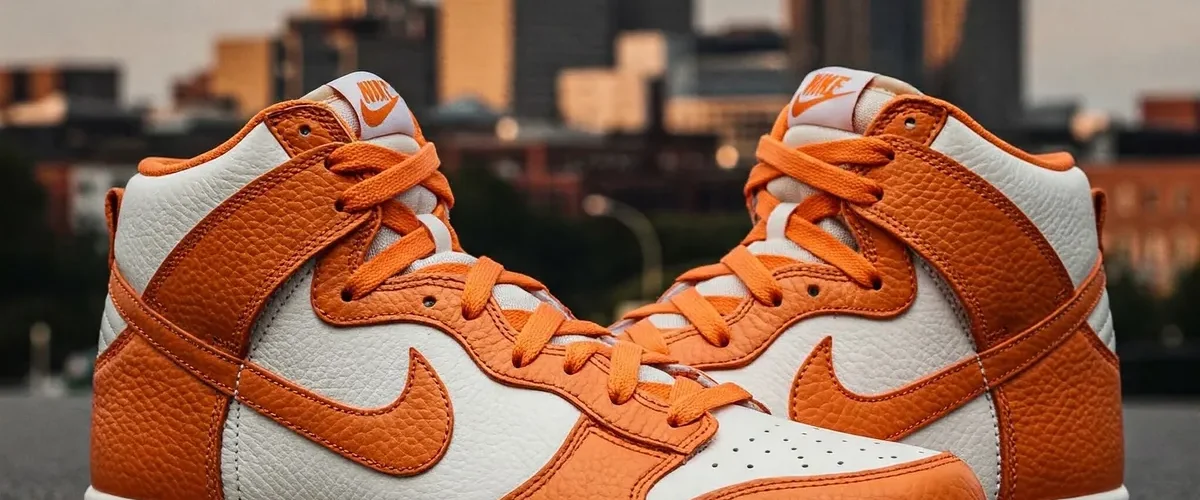
The Nike Dunk started in college basketball as part of the 1985 College Colors Program, with a design by Peter Moore. University colors gave it its first identity. Skateboarders later adopted the silhouette, and Nike developed a skate-specific version: the SB Dunk, released in 2002.
The Dunk and SB Dunk share a visual foundation, but they are different products. The original came from basketball; the SB received changes to its cushioning, padding, and construction for skateboarding. Collaborations with Supreme, Diamond Supply Co., Staple, and Concepts helped shape the releases collectors know today.
Did the Nike Dunk come out in 1985 or 1986?
1985 marks the development of the project within College Colors. Nike’s historical archive dates the commercial initiative to June of that year, with samples expected in August, and identifies the Be True to Your School advertisement as a 1986 campaign.
Nike DNA, meanwhile, gives 1986 as the launch year. These dates describe stages of the same 1985–86 college basketball season: development, product release, and advertising do not have to share a single milestone.
The College Colors Program went beyond the Dunk
College Colors brought together footwear, apparel, and bags in university colors. The idea was to let players and fans represent their school throughout an outfit, rather than only on a uniform.
Be True to Your School, often shortened to BTTYS in sneaker circles, was the campaign’s message. The name does not refer to a separate sneaker model.
Who worked on the College Colors Program?
Peter Moore played a central role in the design. Nike’s archive also credits Rob Strasser, Jack Joyce, and a team that included Mary Bodecker McGoldrick with creating the program. The college campaign involved product development and commercial strategy as well as the Dunk’s design.
Which universities were part of Be True to Your School?
Nike’s archive documents 12 universities in the initial College Colors Program launch:
- UNLV;
- Arizona;
- Iowa;
- Purdue;
- Michigan;
- St. John’s;
- NC State;
- Georgia;
- Maryland;
- Syracuse;
- Georgetown;
- Kentucky.
This list refers to the College Colors Program, which included other products. It should not be confused with a list of 12 original Dunk colorways: Georgetown, for example, has its own connection to the Terminator.
Peter Moore and the Nike Dunk’s design
The high-top design initially appeared as the College Color High. Moore also helped create the Air Jordan 1, released in 1985. Both shoes share the layered panels and contrasting colors of Nike basketball footwear from that period.
Legend, Terminator, and Air Jordan 1: Where did the Dunk’s design come from?
According to Nike, the College Color High used the same last as the Legend, which debuted in 1982. A last is the three-dimensional form that gives a shoe its shape and internal volume. The archive also connects its sole to the Air Jordan 1 and Big Nike. The project drew on existing solutions rather than starting with an entirely new construction.
The Terminator came out of the same college basketball context, with a particular connection to Georgetown. These shared references explain the similarities among the models without reducing one to a copy of another.
Why does the Dunk look so much like the Jordan 1?
Both use layered panels, a side Swoosh, and proportions typical of 1980s Nike Basketball. Their origins differ: the Jordan 1 was Michael Jordan’s signature shoe, while the Dunk was created for the college program. The Dunk was not a precursor to the Jordan 1.
How are the Dunk and Terminator related?
Georgetown was already wearing the Legend, and coach John Thompson wanted to retain features of that shoe while giving his team a distinct look. According to Nike, Mike Aveni modified the design to create the Terminator. Player versions had HOYAS across the back; the retail version said NIKE.
Is the Dunk a stripped-down Air Force 1?
The Air Force 1 arrived in 1982 with Nike Air cushioning for basketball. The Dunk came from College Colors and had a different construction. Nike acknowledges familiar details between them, but that does not make the Dunk a version of the AF1.
Dunk High or Dunk Low: Which came first?
The centerpiece of College Colors was a high-top. The Dunk Low later built its own history in skateboarding and collaborations. The Low’s prominence today does not mean it was the focus of the original college campaign.
Did the original Nike Dunk have Nike Air?
The original Dunk did not have the Air unit that distinguished the Air Force 1. Zoom Air entered the story with the SB Dunk in 2002. Do not assume a lifestyle Dunk has that technology just because the shoes look alike.
Was the Dunk an immediate hit?
Nike describes its early retail performance as moderate. College Colors expanded the use of university colors across products, but the Dunk’s reputation among skateboarders and collectors developed over later chapters of its history.
How did the Nike Dunk become a skate shoe?
Skateboarders adopted the Dunk before Nike SB existed. In its 20-year retrospective, Nike SB dates that use to the 1980s, helped by the shoe’s construction and discounted pairs left over from overproduction.
A streamlined profile, leather upper, and grippy sole made it useful on a skateboard. Over the following years, that adoption gave Nike a foundation for developing a skate-specific Dunk.
Had Nike tried skateboarding before the SB Dunk?
Yes. Nike made attempts in the 1990s, before the SB line arrived in 2002. The new approach brought professional skateboarders and independent shops into product development and distribution.
Sandy Bodecker and the birth of the Nike SB Dunk
Sandy Bodecker began developing a skate-specific Dunk in 2001. It launched in 2002. His role was to adapt the silhouette for a new line; Peter Moore had designed the original in the 1980s.
What changed with the 2002 Nike SB Dunk?
The first generation of SB Dunks incorporated a Zoom Air unit, a padded tongue, additional cushioning, and changes to traction. These updates addressed skateboarding needs while preserving the Dunk’s basic appearance.
Construction varies by version and generation. Tongue thickness alone cannot identify an SB, and you should not assume every standard Dunk has Zoom Air.
Who were the first four Nike SB Dunk skaters?
Nike put four professional skateboarders at the center of the launch:
- Reese Forbes;
- Richard Mulder;
- Gino Iannucci;
- Danny Supa.
Each contributed a personal colorway to the Colors By series. The launch connected the product to the preferences of people who actually skated in it.
Why were skate shops so important?
Nike SB arrived at select shops in 2002. Distribution through skate shops brought the products into local skateboarding communities; collaborations with the shops themselves deepened those relationships.
Supreme, Concepts, and other partners began drawing on their customers and cities for Dunk designs. Their involvement helps explain the line’s wide range of stories and materials.
What is the difference between the Nike Dunk and Nike SB Dunk?
The standard Dunk is sold primarily as a lifestyle sneaker, retaining its 1980s basketball look. The SB Dunk was developed for skateboarding and can differ in its tongue, padding, insole, cushioning, traction, and fit.
Look up the specifications for the exact SKU. The official description for the SB Dunk Low Pro HF3704-100, for example, lists Air Zoom. That does not mean every Dunk has the same construction.
Supreme and the beginning of major SB collaborations
The 2002 Supreme x Nike SB Dunk Low brought the elephant print associated with the Air Jordan 3 to the Dunk. That crossover was the appeal: a signature detail from Michael Jordan’s basketball shoes found a new home in skate shops.
Paris, London, and Tokyo: The Dunk as a cultural object
The series connected to the White Dunk exhibition brought the sneaker closer to art and urban identity. Paris used works by Bernard Buffet; Tokyo featured a light-colored canvas upper; London added an embroidered line representing the River Thames.
The London leg of the exhibition was canceled, and the pairs were sold through Footpatrol. That distinction matters: the shoe existed, but the event did not take place as planned.
Staple Pigeon: The Dunk that made headlines

In 2005, Jeff Staple drew on New York City’s pigeons for the Nike SB Dunk Low NYC Pigeon. The Reed Space release drew lines and press coverage, as the image shows.
The episode brought the competition for a limited release to an audience beyond sneaker circles. The connection between the city, the store, and the shoe’s design became part of the pair’s history.
The “Tiffany Dunk” was not a Tiffany & Co. collaboration
The 2005 shoe is the Diamond Supply Co. x Nike SB Dunk Low. Its Tiffany nickname refers to the turquoise color scheme; Nike’s collaborator was Nick Tershay’s skate brand, not the jeweler.
The Diamond Dunk combined leather, a crocodile-embossed texture, and a silver Swoosh. Those details help identify it without confusing who made the collaboration.
Freddy Krueger Dunk: A sample rather than a standard release
Designed by Todd Bratrud, the Freddy Dunk Low Pro SB featured stripes, splatter effects, and visual references to the character. Nike SB’s archive records problems before full production was reached.
It did not receive a conventional retail release. Pairs circulating as samples do not, on their own, establish a reliable total of how many exist.
What The Dunk: SB revisits its own archive
Released in October 2007, the What The Dunk brought together elements from 31 Nike SB Dunks. Part of the campaign for the video Nothing But the Truth, the shoe combined colors and materials from earlier releases into a visual recap of the line’s first era.
Concepts Lobster: A collaboration that became a series
The Red Lobster, released in June 2008, gave the Dunk a lobster’s color and texture, with a band around the forefoot and bib references on the insole. The Concepts x Nike SB collaboration expanded into other colors over the years while keeping its New England theme.
Ben & Jerry’s Chunky Dunky
In 2020, Ben & Jerry’s and Nike SB released the Chunky Dunky. Cow print, clouds, the ice cream brand’s colors, and a melting-look Swoosh carried the theme across the upper.
Travis Scott and the next SB Dunk wave
The 2020 Travis Scott x Nike SB Dunk Low mixed bandana and plaid patterns. It added the artist to a roster of collaborators that had already included skateboarders, shops, musicians, and brands since 2002.
Nike SB boxes and collector terminology

Orange Box, Silver Box, Pink Box, Black Box, Gold Box, and other names identify Nike SB packaging eras. The brand’s own archive organizes many releases by these periods.
A box’s color helps place a pair in context, but it does not prove authenticity or replace identification of the model, year, and SKU.
Panda Dunk: Black and white for everyday wear

Panda is the nickname for the black-and-white lifestyle Dunk Low. It is neither a collaboration nor part of the SB line. The colorway has been released and restocked widely, unlike the limited projects that defined parts of the Dunk’s history.
Does Nike still sell Dunks in 2026?
Yes. Nike’s U.S. catalog includes Dunk and Nike SB Dunk models, with availability varying by color and size. The SB Dunk Low Pro HF3704-100 is one example whose official product description documents Air Zoom cushioning; that example does not establish current U.S. stock for the specific colorway.
Before buying, decide whether you want a lifestyle sneaker or a skate shoe. Then check that version’s sizing, materials, and technology: the Dunk name covers different generations and constructions.
Is a regular Dunk good for skateboarding?
Skaters wore Dunks before Nike SB existed, but a current lifestyle Dunk is not automatically equivalent to an SB. For a shoe developed for skateboarding, look for an SB version and check its construction.
Are Nike Dunks comfortable?
The Dunk’s basic construction comes from 1980s basketball and can feel firm compared with sneakers that use thicker foam cushioning. SB Dunks may have extra padding and Zoom Air, depending on the version.
Fit matters, too: upper materials, toe room, and internal volume all affect how the shoe feels. Extra foam will not fix a shoe that is too tight.
Do Nike Dunks fit true to size?
There is no single sizing recommendation for the entire family. Low, High, and SB versions can differ in volume and padding. Check the guidance for the specific SKU and the Nike size chart, taking both foot length and width into account. For international listings, distinguish U.S. men’s and women’s sizing from UK, EU, and Brazilian sizing; Brazilian and European sizes are not interchangeable.
Rarity and resale prices do not tell the whole story
Resale prices vary by SKU, size, condition, box, accessories, and the timing of the sale. A high asking price in a listing does not prove that a sale took place at that price.
Older pairs can also show material deterioration even if they have never been worn. Assess history, condition, and provenance alongside the price; rarity does not guarantee future appreciation.
Popularity also brought counterfeits

The image compares examples labeled real and fake, but it is not a universal authentication test. Year, size, factory, and production batch can account for legitimate differences; one photograph cannot establish the authenticity of another pair.
Examine the actual pair, its provenance, and the terms of the purchase. The legit check guide explains what information to gather and the limits of a visual assessment.
To connect the Dunk with other Nike projects, explore the history of Nike and our History and Culture articles.