ACG stands for All Conditions Gear, Nike’s outdoor product brand. The name conveys gear for a range of conditions. Officially launched in 1989, ACG includes footwear, technical apparel, and accessories for activities such as trail running, hiking, and outdoor exploration.
In February 2026, Nike reintroduced ACG as a dedicated outdoor-performance brand. The change reinforced athlete-focused product development, brought Nike Trail into ACG’s strategy, and clarified three areas of use: running, hiking, and exploring.
That does not mean every Nike ACG product is waterproof, uses GORE-TEX, or suits every trail. All Conditions Gear is the brand’s name and philosophy; actual capabilities depend on the specifications of each shoe, garment, or piece of equipment.
What does ACG mean at Nike?
ACG stands for All Conditions Gear. The literal wording should not be understood as a guarantee that a product will work in every climate, temperature, or terrain.
In practice, the name expresses an approach to outdoor products that considers the activity, environment, and weather. A rain jacket, a trail running shoe, and a casual shoe inspired by ACG’s archive may share the initials while offering different functions and levels of protection.
Nike now describes ACG as a dedicated outdoor-performance brand. It remains part of Nike but has its own identity, products, athletes, and strategy. “A brand within Nike” therefore describes the positioning announced in 2026 more accurately than treating it as an occasional clothing and sneaker collection.
What is Nike ACG today?
Today’s ACG serves three main areas: trail running, hiking, and outdoor exploration. Its catalog includes performance footwear, apparel developed for specific conditions, and accessories. Nike also connects product development with athlete involvement and activity-specific testing.
That definition is broader and more technical than “rugged sneakers for city wear.” Historic models and reissues still matter to sneaker culture, but Nike’s announced 2026 strategy puts outdoor athletes back at ACG’s center.
- Run: products for trail running, racing, ultradistances, and routes combining roads with natural terrain.
- Hike: footwear and equipment for outdoor walks and hikes, selected according to distance, terrain, and conditions.
- Explore: products for outdoor exploration, including new concepts and reinterpretations of silhouettes from ACG’s archive.
These categories help guide choices, but they do not make products interchangeable. An ACG running shoe does not necessarily have the ideal construction for hiking, while a casual archive reinterpretation should not automatically be treated as equipment for a technical activity.
How did Nike ACG begin?
ACG officially launched in 1989, but its roots go back more than a decade earlier. The Department of Nike Archives’ 2026 chronology shows how work with mountaineers, lightweight running shoes, and early Nike Hiking products prepared the way for the category.
1978: The K2 expedition and ACG’s roots
In 1978, Nike supplied LDV, or Long Distance Vector, shoes to members of an American K2 expedition. Rick Ridgeway and John Roskelley used the lightweight shoes on the long approach to base camp, at a time when stiff leather boots were common among mountaineers.
The LDVs were running shoes, not mountaineering equipment. They were damaged by the end of the journey and needed patching. Back home, the climbers sent their worn pairs to Nike with suggestions, including a tougher upper and sole while retaining lightness and flexibility.
The episode influenced Nike’s outdoor thinking, but ACG was not founded in 1978. The K2 expedition represents one of its historical roots.
1981 and 1982: Lava Dome, Magma, and Approach
In the early 1980s, Nike began combining running-shoe expertise with constructions better suited to outdoor terrain. The Lava Dome, Magma, and Approach were part of those early efforts.
Released before ACG’s debut, the Lava Dome became an example of the lightweight-hiking approach. It should be described as a precursor to Nike’s outdoor category, rather than an original 1989 ACG shoe.
The Department of Nike Archives identifies the Approach, released in 1982, as Nike’s first shoe with a GORE-TEX lining. It combined a waffle outsole with a leather-and-Cordura upper. That specification belongs to the Approach and does not establish that all later Nike outdoor products used GORE-TEX.
1984: Nike Escape and the move into trail running
In 1984, Nike introduced the Mark Parker-designed Escape. According to the brand’s historical documentation, it marked Nike’s formal entry into trail running.
The Escape connects Nike’s running expertise with outdoor use before ACG became official. That continuity helps explain why trail running has a central role in the brand’s current direction.
1989: All Conditions Gear officially launches
In 1987, an internal team began organizing the scattered hiking, trail running, and outdoor-apparel projects. Under Kirk Richardson’s leadership, the plan became an integrated footwear and clothing range in 1989 for people who ran, hiked, climbed, and explored outdoors.
The first ACG collection launched in the second half of 1989. Its products included the Air Wildwood, Lava High, fleece apparel, and specific GORE-TEX garments.
The chronology is therefore straightforward: 1978 represents an important root; the 1980s brought Nike Hiking precursors and the Escape; 1989 marks Nike ACG’s official launch.
To place this development within the company’s broader story, read the history of Nike.
Where did the All Conditions Gear name come from?
The name was more than a generic description of outdoor use. According to the Department of Nike Archives, Nike Running was already using “All Conditions Gear” for a small performance-apparel line designed for different weather conditions.
When the outdoor team sought an identity to unite footwear and apparel, it recognized that the phrase also expressed its goal of designing for movement across different terrain and conditions. The new category launched in 1989 adopted the name.
That origin helps explain why ACG has always been connected to both apparel and footwear. The initials do not identify a single sneaker technology.
What changed at Nike ACG in 2025 and 2026?
ACG has not remained unchanged since 1989. Over the decades, technical products, shifts in creative direction, archive reissues, and urban adoption changed how it was perceived. At certain points, its lifestyle side became especially visible.
The latest shift is a concrete return to outdoor performance. In August 2025, Nike introduced the All Conditions Racing Department, a group of trail running athletes who contribute to development through prototype testing and feedback.
In February 2026, Nike formally announced ACG’s reintroduction as a dedicated outdoor-performance brand. In April, it detailed its activity- and terrain-based footwear organization through Run, Hike, and Explore.
“Reintroduction” does not mean ACG had disappeared completely. It continued releasing products before 2026. The announcement represents a renewed strategic commitment, a more focused identity, and an expanded role in trail running and hiking.
Did Nike Trail become part of ACG?
Yes. In its February 2026 announcement, Nike said Nike Trail would transition to ACG. The move brings Nike’s running experience together with All Conditions Gear’s outdoor identity.
That explains why names previously associated with Nike Trail began appearing within ACG’s strategy. The change does not need to be reduced to “Nike Trail ended”: trail running products, expertise, and categories were incorporated into ACG’s new positioning.
It also means ACG and performance are not opposing categories. Today’s ACG includes footwear specifically developed for trail training and racing.
What features define a Nike ACG product?
No single technical checklist applies to every ACG product. The brand spans running shoes, hiking footwear, historical reinterpretations, jackets, insulating layers, and accessories. Each responds to a particular combination of activity, weather, and terrain.
A trail running or hiking product’s specifications may include:
- outsole geometry and lugs tailored to the terrain;
- specific rubber compounds;
- cushioning selected for the distance and activity;
- a rock plate;
- an upper with drainage, ventilation, or targeted reinforcement;
- a waterproof membrane in a particular version;
- construction designed to limit debris entry.
Finding one of these features on a particular shoe does not establish its presence across the brand. For the differences among upper, midsole, and outsole, see our guide to sneaker anatomy.
Is Nike ACG waterproof?
Not necessarily. The ACG name does not make a product waterproof. Look for an explicit waterproof specification, a confirmed waterproof membrane, or another construction officially designed to prevent water penetration.
“Water-resistant” generally describes limited protection from splashes or light rain. “Waterproof” describes protection against water penetration within the manufacturer’s stated conditions and limitations. The two terms are not equivalent.
Water-repellent treatments applied to an outer fabric do not automatically make a garment waterproof, either. Seams, membranes, openings, and maintenance all affect the actual level of protection.
For rain, snow, or wet crossings, check the product specifications and assess the route’s demands. The All Conditions Gear name does not replace specialized equipment or safety planning.
Does Nike ACG use GORE-TEX?
Some ACG products use GORE-TEX; many do not. The historical connection is longstanding: Nike documents the Approach, an ACG precursor, as its first GORE-TEX-lined shoe. The inaugural 1989 collection also included specific products using the technology.
In later eras, products such as the Mountain Fly GORE-TEX, Air Nasu GORE-TEX, and certain ACG jackets used GORE-TEX constructions. That does not justify a blanket statement that “ACG has GORE-TEX.”
When buying, confirm that the exact style code’s name and specifications mention GORE-TEX. A standard Mountain Fly and a Mountain Fly GORE-TEX, for example, should not be assumed to provide identical weather protection.
Models that help tell the Nike ACG story
The models below represent different stages: hiking precursors, ACG’s launch, cultural adoption, and the recent focus on trail running.
Lava Dome: A precursor rather than an original ACG
The Lava Dome appeared in the early 1980s as one of Nike’s first lightweight hiking shoes. Its importance lies in building the outdoor category that preceded ACG. Because it launched before 1989, it should not simply be presented as one of the first “Nike ACG” models.
Air Wildwood: Part of the official 1989 debut
The Air Wildwood was part of ACG’s official 1989 launch. Drawing on ideas from the Escape and Pegasus, it combined running references with outdoor-oriented details.
The original version documented by Nike had a microperforated synthetic upper, a serrated waffle outsole, a variable-width lacing system, a polyurethane structure, and an encapsulated heel Air-Sole unit.
It is appropriate to connect that model with Nike Air technology. That does not mean every ACG product must use Nike Air.
Air Mowabb: A defining model of the early era
Released in 1991, the Air Mowabb became one of ACG’s most recognizable silhouettes. Designed by Tinker Hatfield, it is connected to the landscapes of Moab, Utah, and shares fit concepts and visual language with the Huarache family.
Its historical value lies in how it combined outdoor construction, running expertise, and expressive design. Later reissues brought the Air Mowabb to new audiences and helped establish it as a sneaker-culture collectible.
Mountain Fly: Running technology applied to modern outdoor footwear
The ACG Mountain Fly belongs to a much later era and was not part of the brand’s founding. The family became significant by applying ideas from Nike running shoes to modern outdoor construction.
The original Mountain Fly GORE-TEX, for example, was introduced with Nike React foam, a carbon-fiber plate, a traction-focused rubber outsole, and a GORE-TEX membrane. Those features apply to that specific version; other Mountain Fly models need to be checked individually.
ACG Ultrafly: Today’s trail-racing direction
The ACG Ultrafly represents the new focus on performance trail running. Announced for 2026, it was developed as a trail racing shoe with ZoomX foam, a ZoomX sockliner, a redesigned carbon-fiber FlyPlate, and a Vibram Litebase outsole.
Nike also emphasizes an upper designed for ventilation and drainage. That distinction is important: drainage lets water escape more easily, but it does not make the Ultrafly waterproof.
The model was developed with input from athletes and runners across different regions. This information establishes its intended use but does not replace an independent assessment or guarantee it is right for every runner.
ACG Zegama: Maximum cushioning for trail running
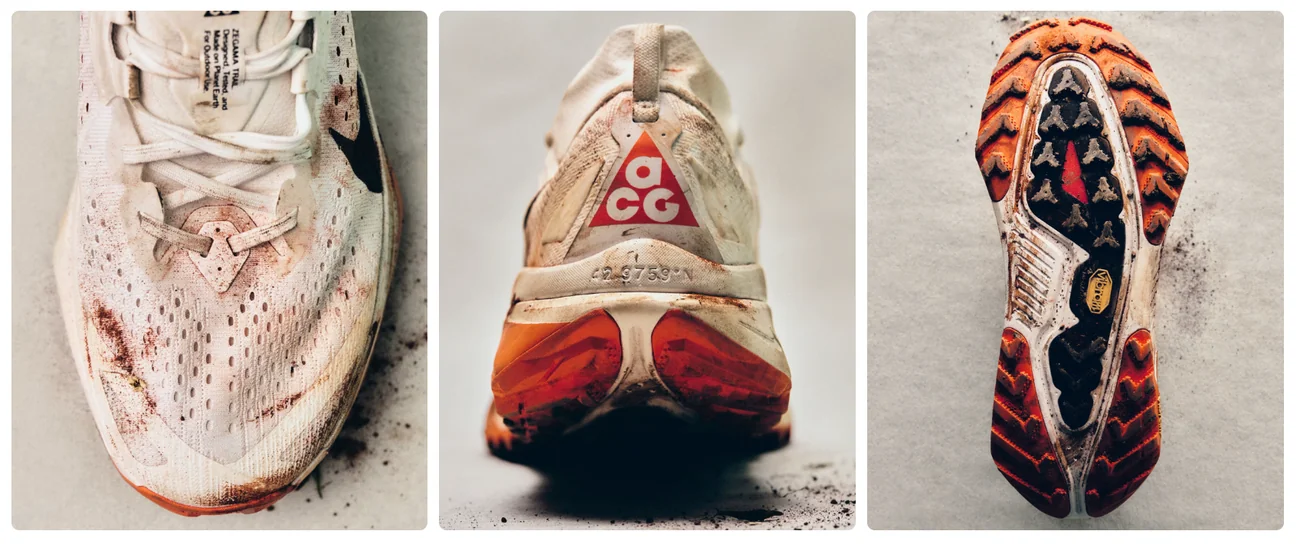
The ACG Zegama announced for 2026 continues a name previously found in Nike Trail. The current version combines ZoomX and Cushlon 3.0, a Vibram Megagrip outsole, a forefoot rock plate, and a trail-specific last.
Its official positioning is maximum cushioning for long distances and demanding terrain. Its traction, protection, and cushioning should not be attributed to every ACG shoe.
Zegama’s move into ACG is a concrete example of Nike Trail’s transition into the brand’s new structure.
ACG, sneaker culture, and outdoor fashion
Outdoor function comes first in ACG’s history, but its cultural influence is real. Silhouettes such as the Air Mowabb and Air Wildwood offered colors, proportions, and utilitarian details that stood apart from conventional athletic models.
Over time, reissues allowed models originally intended for outdoor use to become casual sneakers and collectibles. Pockets, adjustment cords, durable materials, substantial soles, and nature-inspired palettes also brought the ACG aesthetic closer to streetwear.
The growth of gorpcore, wearing clothing and gear associated with the outdoors in urban settings, expanded cultural interest in these products. Gorpcore alone, however, does not explain ACG’s present relevance.
The 2026 reintroduction is a concrete sports and business decision grounded in trail running, hiking, technical products, and athlete-led development. The fashion trend runs alongside it, rather than fully explaining the new strategy.
For other abbreviations and expressions from this world, see the sneakerhead dictionary.
Is Nike ACG only for trails?
No. ACG spans trail running, hiking, exploration, technical apparel, accessories, and reinterpretations of historic models. The presence of casual products, however, should not reduce the brand to an outdoor aesthetic.
Some ACG shoes are made for racing; others are intended for hiking. Certain garments provide specific weather protection, while some silhouettes are sought mainly for their history or appearance.
Can you run in Nike ACG shoes?
Some models are specifically made for trail running. The ACG Ultrafly, ACG Zegama, and ACG Pegasus Trail are examples from the current line serving different off-road running needs.
That does not mean any shoe with an ACG logo is suitable for running. The Air Mowabb, Mountain Fly, and a modern racing shoe have different constructions, weights, and purposes.
Is Nike ACG suitable for hiking?
Some ACG products are developed for hiking. In 2026, Nike began explicitly organizing part of its catalog under Hike, distinct from Run and Explore.
Before choosing, consider distance, elevation change, terrain, pack weight, and weather. A lightweight hiking shoe does not automatically replace a boot or equipment appropriate for technical mountaineering, snow, or higher-risk terrain.
Can you wear Nike ACG every day?
Yes, if the model’s fit and construction suit your routine. ACG silhouettes have been worn casually for decades, and many reissues are sought more for their design than their outdoor use.
A highly technical product can involve trade-offs in city wear, though. Waterproof membranes may breathe differently from open uppers; deep lugs may be unnecessary on pavement; and protective construction can add stiffness or weight.
Those effects vary by product. The ACG logo alone cannot tell you whether a shoe will be comfortable for a particular person.
How should you choose a Nike ACG product?
Start with the activity rather than the appearance or initials. Check:
- Purpose: trail running, hiking, exploring, or casual wear.
- Terrain: hard-packed trails, mud, gravel, rocks, snow, or mixed routes.
- Weather protection: confirm whether the product is breathable, water-resistant, or genuinely waterproof.
- Outsole: examine the rubber compound, geometry, and lug depth when relevant.
- Cushioning: consider distance, personal preference, and the model’s intended role.
- Fit: assess length, width, toe room, and heel lockdown.
- Weight and flexibility: rugged construction and membranes can change the experience.
- Exact version: do not transfer specifications from a GORE-TEX version to one without a membrane.
For remote or technically demanding activities, footwear is only part of the equipment. Weather, navigation, clothing, water, food, and emergency planning also need consideration.
Is Nike ACG worth buying?
Nike ACG can be worthwhile when the product matches the intended activity. For trail running, choose a model categorized for running. For hiking, assess footwear suited to the terrain. For rain, confirm waterproof construction. For casual wear or collecting, consider fit, materials, and the silhouette’s historical value.
The initials do not guarantee superior durability, universal comfort, waterproofing, or safety in every environment. The best approach is to compare a model’s specifications with the actual conditions in which you will use it.
Sources and further reading
The chronology and updates in this article were checked primarily against Department of Nike Archives and Nike Newsroom publications: The Birth of ACG: The Summit that Launched a Legacy, Nike Reintroduces ACG, Ready for the Wild: How ACG Designs for All Conditions, and All Conditions Racing Department.
For more on the company’s evolution and its products’ influence, explore the history of Nike and the history and culture of sneakers.