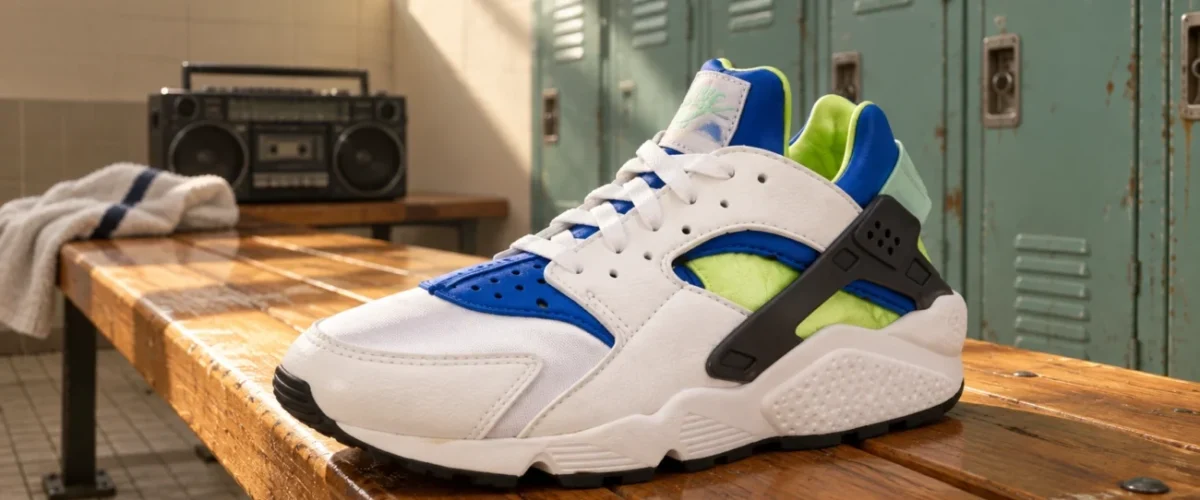
The Nike Air Huarache debuted in 1991 with an idea that still stands out: wrap the foot from the inside, then reduce the structure required outside it. Designed by Tinker Hatfield, it became recognizable through its bootie construction, open heel support and lack of a large lateral Swoosh.
Its story captures an important shift in athletic footwear. Rather than starting with the outline of a conventional shoe and filling its interior, the Huarache made contact with the foot central to the design. Its unusual appearance followed that reorganization. The concept later moved through basketball, collaborations and new material combinations.
The idea came from water-skiing
In Nike’s official Huarache history, Hatfield connects the inspiration to the fit of a neoprene water-ski boot. The 1991 design combined that wrapping sensation with an external support structure. Leaving out the large Swoosh reflected his confidence that the shoe’s shape could identify it as Nike.
Tinker Hatfield’s work is often remembered for striking silhouettes. Here, however, the question begins inside: how much conventional upper is still necessary when a flexible component already surrounds the foot? The exterior responds to that functional reorganization.
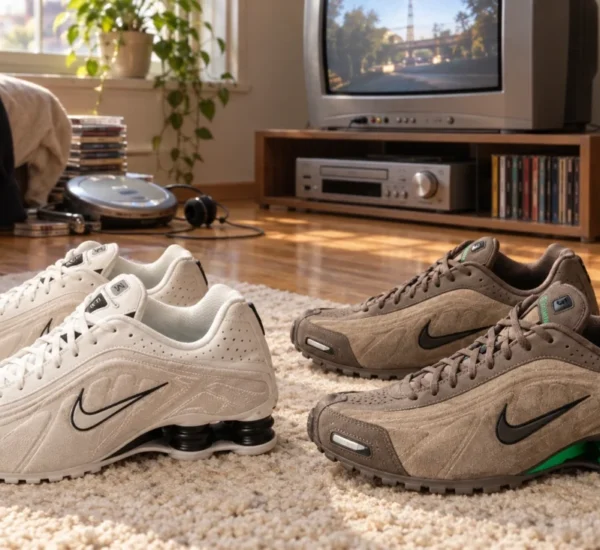
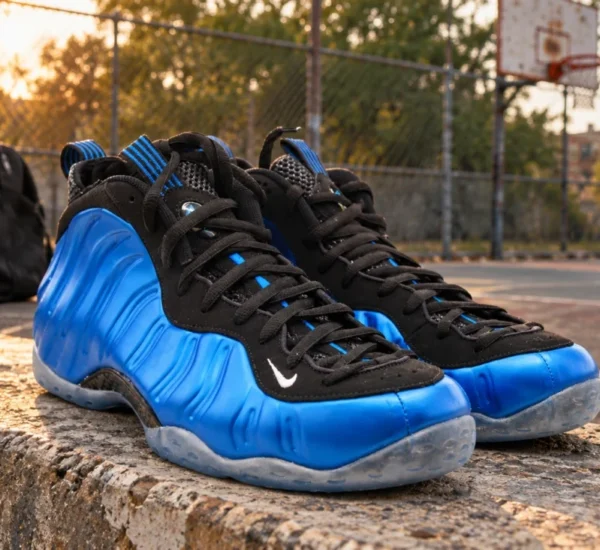
A comparison with the Foamposite clarifies the difference: its molded shell defines the upper, while the Huarache relies on a bootie and external support. Shox instead moves the visual focus to columns beneath the foot.
Reading the Huarache’s construction
An internal bootie surrounds areas that other shoes divide among a separate tongue, lining and side panels. Overlays and lacing then help regulate the fit. The rear clip visually connects the sides without covering the entire heel in a conventional panel.
That arrangement creates two levels of detail. Up close, there are textiles, seams and connections. From a distance, the heel opening, midsole volume and contrast between inner sleeve and overlays define the shape. The composition may look straightforward, but its areas perform different tasks.
Our sneaker anatomy guide separates the upper, lining, heel counter and midsole to explain their roles. The Huarache shows why that division varies between designs. An integrated construction can combine functions that another shoe handles through several individual components.
Making a concept visible without exposing the Air
The word Air can create an expectation of a transparent cushioning window. The original Huarache does not need one to establish its identity. Its main visual subject is the upper and its fit, while the system underfoot is less conspicuous. Our Nike Air technology guide explains why Air and visible Air Max are not interchangeable terms.
The Scream Green reissue described by Nike retains the clip, low collar and bootie-like construction, along with an original-associated color combination. Viewed as design, its brighter areas act as a map: they highlight an inner component that a more conventional shoe might hide.
A close fit is not necessarily the correct size
The wrapped sensation belongs to the concept, but it should not be confused with insufficient room. The Air Huarache DD1068-001 listing says the model fits small and recommends going half a size up. That guidance concerns that version and the retailer’s size system, rather than creating a rule for the entire family.
When trying a pair, separate three issues: difficulty getting through the opening, pressure across the instep and inadequate toe room. They are not the same problem. Going up a size may relieve one area while leaving another loose. Sock thickness, foot width and the edition’s construction also matter.
From running to basketball: a family of different shoes
Huarache soon became a name for more than one solution. Nike’s Air Zoom Huarache 2K4 archive connects the 1992 Flight Huarache with Eric Avar’s work and documents the 2K4’s arrival in 2004. The later shoe paired Zoom Air with a structure developed for basketball.
Adapting the Air Flight Huarache involved changing the rear strap, reinforcing lateral areas and extending the exoskeleton toward the ankle. Nike’s history records the University of Michigan wearing it during the 1992 NCAA tournament. Its openings and reduced structure gained a court setting and a team that helped make the design visible.
The 2K4 revisited the idea through a different architecture: a Phylon midsole, heel and forefoot Zoom Air units and a carbon-fiber shank. According to the DNA Artifact archive, it debuted during the 2004 All-Star festivities in Los Angeles. The first edition carried Nike LA branding and the date 2-15-2004 inside the collar, turning the product itself into a record of the event.
Stüssy and the power of a different palette
Nike documents the Air Huarache for Stüssy Desert Oak as a return to a collaboration originally released in 2000. Earth tones and suede accents change the impression of the design without removing its bootie and rear support.
For the 2000 project, Stüssy’s Michael Kopelman and Nike’s Fraser Cooke developed colors sold at Stüssy’s London store, as documented in the Desert Oak product history. The partnership matters to streetwear and sportswear collaboration history: an archive choice and a palette could create an identity without requiring a completely new model.
It demonstrates how color and material can reposition an athletic silhouette. The geometry remains recognizable, but less reflective surfaces and softer contrasts direct attention toward different details. The shoe no longer depends exclusively on the bright colors often associated with the early 1990s.
Patta continued the idea through a hybrid
For the 2024 Nike x Patta Running Team collection, Nike described a hybrid combining a Huarache Plus-derived upper with a Pegasus sole unit. Straps and an internal sleeve kept fit central to the project, but the combination was not a reproduction of the 1991 shoe.
The presentation included three colorways and a campaign featuring runner Sifan Hassan. Patta cofounder Edson Sabajo had established Patta Running Team in Amsterdam in 2010. That collective reference gives the hybrid context: the Huarache archive returns in connection with a running group, beyond a meeting of logos.
The legacy is the relationship between structure and foot
Within sneaker history and culture, its place comes from both its image and its capacity to change. Openings, color and the heel clip catch the eye. The construction explains why those details are there, and why they remain interesting decades later.