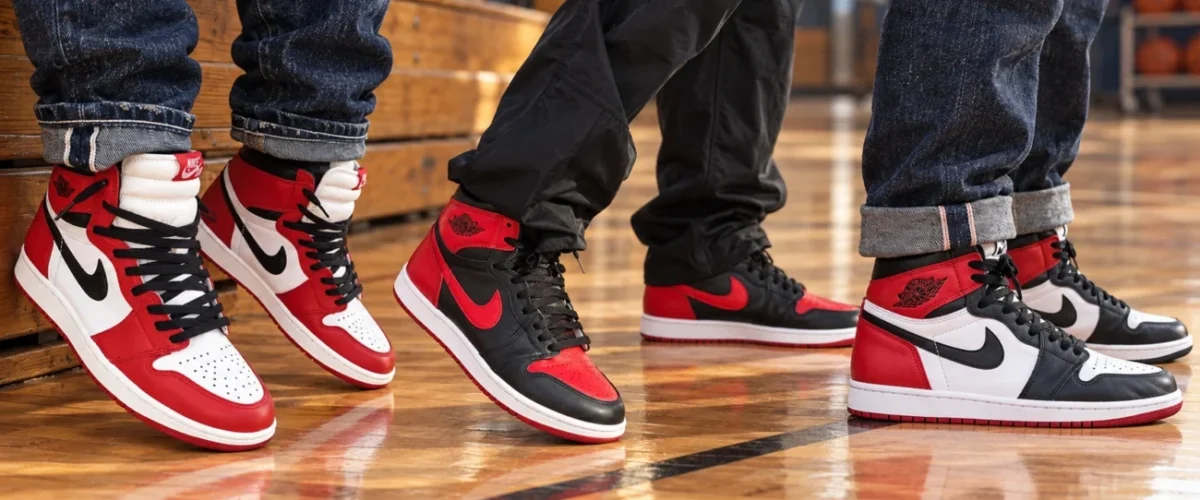
The fastest way to tell an Air Jordan 1 Chicago, Bred, and Black Toe apart is to look at the toe panel and the leather surrounding it. The classic Chicago pairs a white perforated panel with red overlays. Bred puts a red panel inside black overlays. Black Toe keeps the white center but frames it in black.
All three belong to the first Jordan’s familiar red, black, and white vocabulary. They are still different colorways, and their nicknames do not identify an exact year or product. This guide explains the visual differences and the historical distinctions that matter when comparing releases. For the broader origin story, start with our Air Jordan 1 history.
Read the panels before reading the nickname
A Jordan 1 upper is divided into clearly visible pieces. The perforated panel over the toes is separate from the overlay wrapping around it. The side panel is separate from the Swoosh laid across it. The heel and ankle area introduce further surfaces that can change color independently. Our guide to sneaker anatomy gives those pieces a more precise vocabulary.
Color blocking is the arrangement of color across that structure. It explains why two shoes with the same list of colors can look very different. A box label that lists white, black, and red does not tell you which shade covers the toe, whether the side panel is dark, or how the Swoosh contrasts against it.
Chicago puts red around a white center
On the classic Chicago layout, the toe panel and side panels are white. Red surrounds the forefoot, runs along the lace area, and returns around the rear overlays. The black Swoosh crosses the white side panel. Black near the top of the collar adds another accent, while a light midsole separates the upper from the red outsole.
The layout has an almost diagrammatic clarity: red outlines the shoe and white opens up its center. A different lace color can change the balance at the top, but the underlying panel map remains recognizable. That is why identifying Chicago by laces alone is less reliable than following the larger leather sections.
Bred makes the upper much darker
Bred combines black and red in its nickname. On the familiar original-style Jordan 1 arrangement, the perforated toe panel is red, the side panels are black, and the Swoosh is red. Red also appears at the rear. Compared with Chicago, the white areas largely retreat from the upper to the midsole.
The Nike DNA account of the Banned colorway describes this black-and-red layout while acknowledging the Air Ship’s role in the initial controversy. Bred is a cultural shorthand rather than a unique product identifier. The same nickname appears elsewhere in the Jordan line, so the model number and release designation still matter.
Black Toe changes the front outline
Black Toe uses a white perforated toe panel, white sides, a black Swoosh, and red rear panels. The defining contrast is the black overlay around the white forefoot, together with black along the lace area. Nike’s official Black Toe release page provides a reference for the original color arrangement.
The name can be misleading if you assume the entire toe must be black. The central perforated piece is white in this classic layout. The black area is the framing overlay. That distinction is especially useful when sellers use Black Toe loosely for shoes that borrow only part of the design.
Why a Bulls palette produces three different identities
Red, black, and white place these designs in the visual world of Michael Jordan’s early Chicago career. Yet their graphic effects are different. Chicago emphasizes bright framing around open white panels. Bred makes red accents stand out against a dark body. Black Toe combines a sharply outlined front with a red rear section.
That is a design reading rather than a claim that every wearer attaches the same meaning to each pair. Colorways can become personal through photographs, family memories, local scenes, or the first release somebody could buy. Their appeal does not require everybody to agree on a single ranking.
Banned is a story that needs the Air Ship
The banned-shoe episode began with the Nike Air Ship worn by Jordan in 1984. The black-and-red Air Jordan 1 inherited the rebellious advertising identity. Conflating those two shoes turns a complicated sequence into a much simpler legend, usually with a claim that Nike paid a documented fine after every game.
It is more accurate to keep the product and the campaign distinct. Bred identifies a color arrangement in this context. Banned connects it to a marketing story. Neither nickname proves that a specific photographed game featured that exact retail shoe. Our main Jordan 1 history examines the episode in greater detail without making the color comparison depend on the myth.
A colorway is not the same thing as an edition
A colorway describes color organization; an edition identifies a particular release. The construction describes the physical execution. Shape, collar height, leather finish, padding, and branding can vary while a recognizable color arrangement stays in place. A familiar nickname therefore gives you a starting point, not a complete specification.
High, Mid, and Low also belong in the product name. A low-cut shoe in a Chicago-like palette should not be silently compared with a High as though the only difference were the photograph. Likewise, OG and retro are contextual terms rather than blanket guarantees that a new pair duplicates every feature of a 1985 example. Our sneaker glossary explains the language used around these releases.
A useful comparison names its standard. Are you comparing the color map, the overall silhouette, the feel of the materials, or the packaging? Someone interested in the graphic design may reach a different conclusion from a collector focused on the shape of an early pair. Both comparisons can be meaningful if their criteria are stated.
Lost & Found shows how one colorway can tell another story
The 2022 Chicago Lost & Found is an example of an edition built around a historical color scheme. Nike’s design explanation for Lost & Found describes deliberate aged-looking finishes and packaging that evokes forgotten store inventory. The shoe imagines a discovery from the past; it is not a newly discovered batch manufactured in 1985.
This matters when looking at condition. A factory-applied cracked appearance is part of the release design. Damage caused by years of wear or poor storage is a condition issue. They may look similar in a small image, but they cannot automatically be judged the same way. A seller should still describe what happened to the individual pair.
Black Toe Reimagined changes the branding reference
The Black Toe Reimagined provides another concrete example. Nike Chile identifies the High OG release as DZ5485-106, while Hibbett’s release description documents Air Jordan lettering in place of the lateral Wings logo and a black tongue. Missing Wings can therefore be an edition-specific feature. That difference alone neither proves a fake nor authenticates an individual pair.
How to compare releases without guessing
Start with the full product name and style code, then look for images of that exact edition. Use an outside profile, inside profile, top view, heel view, tongue, and size label. One dramatic angled picture can hide the panel that would settle the colorway question immediately.
Compare the same size category where possible. Do not turn a photo of a different release into a universal rule for Swoosh size, collar shape, or stitch placement. A visual discrepancy may be a release difference, a size-related difference, a repair, a customization, or a reason to investigate further. It is not automatically an authentication verdict.
Keep color identification separate from purchasing judgment as well. Recognizing a Black Toe layout does not establish the seller’s ownership, the shoe’s condition, or its authenticity. Those require their own evidence. Conversely, a legitimate variation should not be dismissed merely because it differs from the edition you remember best.
Common questions
Does a lace swap change the colorway?
Usually, replacing the laces changes the styling rather than the main color map. The large upper panels still identify the classic arrangement. For an exact release description, record whether the current laces were included with the shoe or added later. That prevents a personal styling choice from being mistaken for the factory presentation.
Which one is the most original?
That depends on what original means. It may refer to an early color arrangement, a pair actually produced in the original era, or an authentic product. Those are separate questions. Comparing historical accuracy also requires a named reference and attention to more than color alone.
What should I check first?
Check the perforated toe panel and its surrounding overlay, then confirm the side panel, Swoosh, and rear colors. It is a short process with a useful payoff: Chicago, Bred, and Black Toe stop being interchangeable labels and become three distinct ways of reading the same influential design.
Sources and documents
Nike DNA: How the Air Jordan 1 Banned Colorway Sparked a Sneaker Revolution; Nike SNKRS: Air Jordan I Black Toe; Nike: Air Jordan 1 Lost and Found Chicago design.
Nike Chile: Jordan 1 Retro High OG Black Toe Reimagined; Hibbett: Black Toe Reimagined release description.