The adidas Superstar began as a low-top basketball shoe, but its rubber shell toe became recognizable far beyond the court. Its origin is often dated either 1969 or 1970. adidas offers a useful distinction: the original design belongs to 1969, while the public introduction came in 1970. Those dates can describe different stages of the same product history.
The rest of the story is about people changing what the shoe meant. Run-DMC made it part of hip-hop‘s public image, skateboarders gave it another context, and collaborations reworked a shape that audiences already knew. Our sneaker history and culture hub follows this larger pattern of athletic footwear gaining new lives outside its original sport.
Basketball development came before the famous name
The adidas Basketball timeline identifies the Supergrip and Pro Model in 1965 as predecessors to the Superstar era. That background matters. The shell-toe shoe emerged from an existing basketball effort rather than appearing as an isolated design with no earlier work behind it.
Kareem Abdul-Jabbar provides a concrete link to that on-court history. Sotheby’s cataloged a Superstar pair attributed to his 1979–80 Lakers season, with purple and gold details. The object places the model in a player’s equipment history rather than treating its familiar streetwear appearance as the whole story.
That is particularly important when a caption compresses a long development process into one sentence. The Superstar’s story is more informative when the earlier basketball work stays visible, because it connects a later cultural icon to the practical design problems that preceded its fame.
Was the Superstar released in 1969 or 1970?
adidas’s official shell-toe history describes a 1969 design and a 1970 introduction to the public. The clearest summary is that the shoe was developed at the end of the 1960s and publicly introduced as a low-top basketball model in 1970.
Product histories often contain several legitimate milestones: a drawing, prototype, first presentation, retail introduction, or anniversary campaign. They are not automatically interchangeable. When a source supplies a year, ask what event it dates. This simple habit prevents a commemorative label from being mistaken for a complete development timeline.
It also helps when comparing editions. A modern shoe that celebrates an early year is still a modern release. Its anniversary reference explains the theme; it does not establish that its shape, materials, and manufacturing are identical to a pair from the original period.
What makes the shell toe so distinctive?
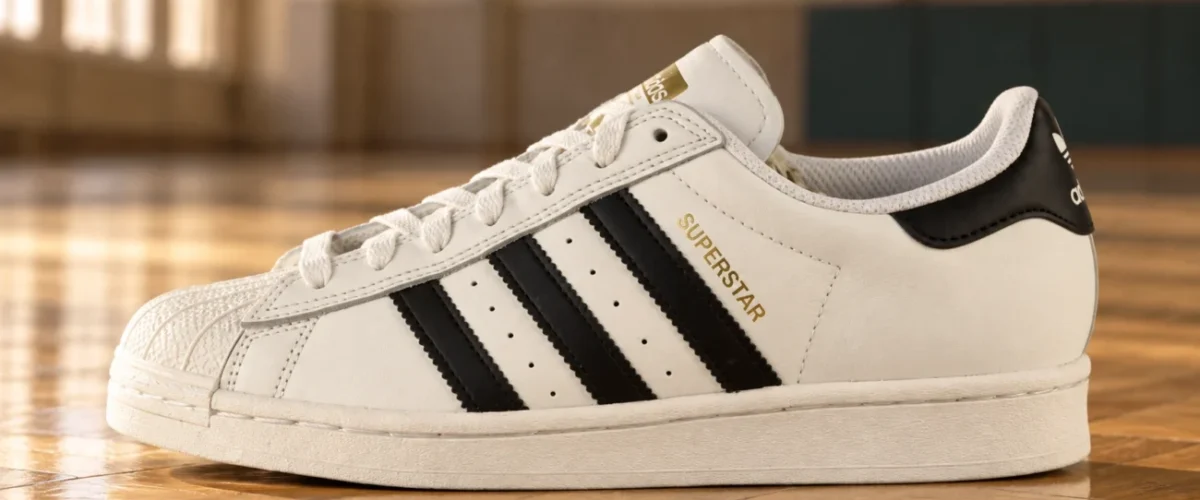
The shell toe is a molded rubber front with ridges that suggest the form of a shell. It creates a clearly defined surface apart from the surrounding upper. Even on a mostly white pair, its texture and contours separate the front of the shoe from the lace area and side panels.
It is a physical component rather than a graphic printed on leather. That distinction helps explain its visual strength. The piece has volume, changes the profile, and gives the forefoot an immediately legible shape. Our sneaker anatomy guide explains how a toe cap differs from the rest of the upper and sole unit.
The original context was athletic, but the detail’s cultural longevity also comes from recognition. You can often identify the design before seeing its product name. The shell toe, low profile, and three stripes work together, so its identity can survive substantial changes in color.
How to read the classic side profile
Look first at where the rubber toe meets the upper. Follow the sole line toward the heel, then notice how the stripes occupy the center of the side panel. On the familiar white-and-black version, the stripes concentrate the contrast while the light toe anchors the front.
This is also a useful way to compare releases. A different tongue, material, sole finish, or proportion can change the feel of a version without erasing its family resemblance. Identifying a Superstar is therefore an easier task than identifying every detail of a particular Superstar edition.
Run-DMC made the shoe part of a public identity
The Ohio State University exhibition on Run-DMC and adidas connects the group’s unlaced footwear and street-oriented appearance with the 1986 song My Adidas and the subsequent brand relationship. The historical importance lies in artists making everyday clothing part of how they represented themselves to a large audience.
Guinness World Records dates the endorsement to 1986 and values it at $1.6 million. Its account also describes a Madison Square Garden performance where the group asked fans to raise their adidas items in front of executive Angelo Anastasio. The clothing became a visible connection between the stage and the audience.
The sequence matters commercially as well. The relationship among performers, fans, and clothing had value before a formal agreement recognized it. Treating the style as something invented entirely by a brand would overlook the cultural work already being done by the artists and their audience.
That makes the Superstar useful for thinking about later music partnerships. A credible connection is not only a name printed on a familiar product. It can emerge from the way people actually wear something, the meanings audiences recognize, and the continuity between an artist’s public image and the object.
One recognizable form can carry several histories
On a basketball court, the shoe’s components belonged to an athletic design. Onstage or in the street, the same visible elements could communicate taste, belonging, or cultural memory. The object remained recognizable while the reason for wearing it changed.
There is no need to force all wearers into one route. Someone may discover the model through music, another through skate footage, and another through its basic color arrangement. Those histories can coexist. A classic often accumulates associations instead of replacing one audience neatly with the next.
This is why a list of celebrity wearers is a limited way to explain the shoe. Names establish visibility, but they do not necessarily explain what each new setting changed. The more useful question is what people did with the existing form and what that use made visible to others.
Skateboarding belongs in the archive too
adidas Skateboarding’s 2015 Respect Your Roots announcement honored Kareem Campbell, Joey Bast, Drake Jones, and Richard Angelides through Superstar editions. That record adds a skate chapter to a story often reduced to basketball followed by Run-DMC.
An official tribute and a community’s first adoption are different events. A commemorative release documents how a brand chose to acknowledge a connection; it does not mean the connection began on launch day. This distinction is useful across sneaker history, especially when later collaborations become better known than the earlier use that inspired them.
Collaborations work against an established reference
adidas’s record of the 2005 35th-anniversary program shows how a widely recognized shoe can support multiple interpretations. A familiar baseline gives changes meaning. A new texture, inscription, or color placement stands out because viewers already have an idea of what the standard form looks like.
BAPE offers a concrete example, beginning with the 2003 Super Ape Star partnership. Its continuing design vocabulary appears in the 2025 pack, with embossed camouflage and alternating BAPE STA and three-stripe details. The familiar base allows the two brand identities to be read against one another.
In 2020, adidas marked five decades with Change Is a Team Sport, including a film directed by Jonah Hill. Anniversary campaigns are useful historical documents in their own right: they show how a company chooses to present its past to a new audience.
What the Superstar name does and does not specify
Superstar identifies a design family, not a permanently fixed technical specification. Before making claims about materials, fit, or faithfulness to an older shape, check the full version name and product details. The familiar outline can coexist with important differences between releases.
The same care applies to words such as vintage and retro. Our sneaker glossary helps separate historical inspiration from the actual age of an object. A new pair can use an aged-looking finish, while an old pair can have replacement components or restoration work. A single descriptive word cannot settle those questions.
The shell toe is the continuity in a changing story
The Superstar brings together a basketball origin, an unusually clear visual signature, and a series of cultural reinterpretations. Its recognizability allowed new audiences to add meaning without needing an entirely new shape each time.
Understanding the different roles of 1969 and 1970, the significance of Run-DMC beyond a contract, and the skate references in the archive gives the shoe more depth than a simple court-to-street slogan. The rubber toe remained recognizable while the places, people, and reasons for wearing it continued to change.
Sources and documents
adidas: The History of adidas Basketball; adidas: Superstar Shoes, a History of Shell-Toe Style; Ohio State University: Walk This Way, New School Rap, Run DMC and Adidas; adidas: Respect Your Roots Superstar; adidas: Change Is a Team Sport.
Sotheby’s: Kareem Abdul-Jabbar game-worn Superstar; Guinness World Records: First non-sporting sneaker endorsement; adidas: Originals and BAPE introduce the Superstar pack.