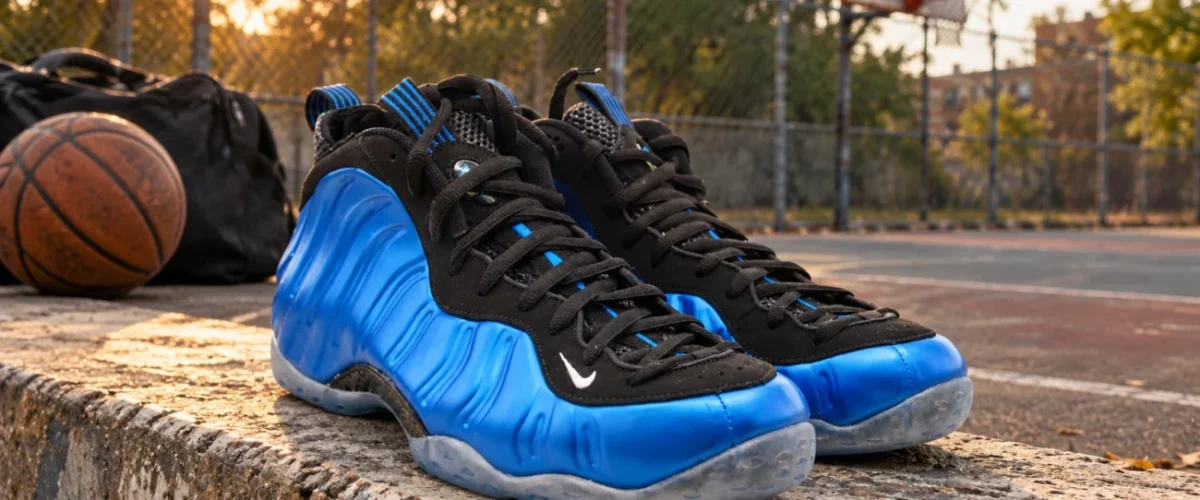
The Nike Air Foamposite One debuted in 1997 with an upper that looked like a molded shell, a striking departure from the leather-panel construction common in basketball footwear. Eric Avar’s project made the shoe’s surface central to its identity. Its connection with Penny Hardaway helped fix that image in basketball memory.
The story goes beyond futuristic styling. Foamposite proposed a different way of constructing an upper, then showed how that same surface could carry colors, graphics and new sculptural treatments. Understanding it means distinguishing the molded material from cushioning, the original project from its reissues and the associated athlete from the full development story.
Eric Avar’s question concerned construction
In Nike’s behind-the-design interview, Avar describes an experimental project developed with the advanced engineering team and Jeff Johnson. He imagined material surrounding the foot. The process used polyurethane in a mold to create the outer structure rather than relying only on conventional panel assembly.
Avar places development at three to four years. The construction required the internal geometry and the mold’s external-wall details to be considered together. The challenge was turning a visual idea into a structure suitable for basketball. The result belongs to design and engineering history as much as to material selection.
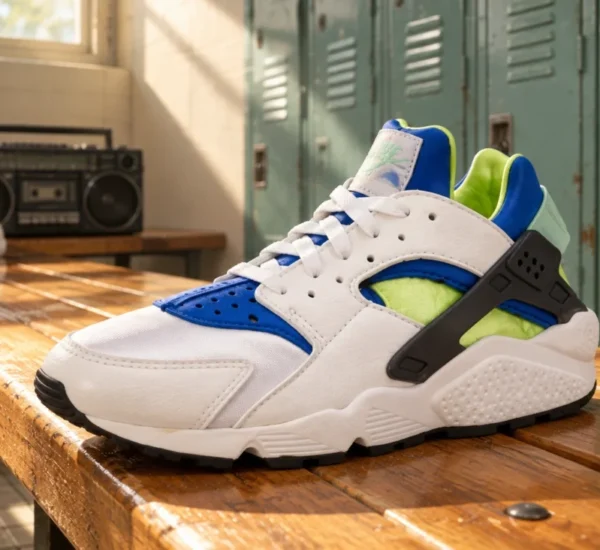
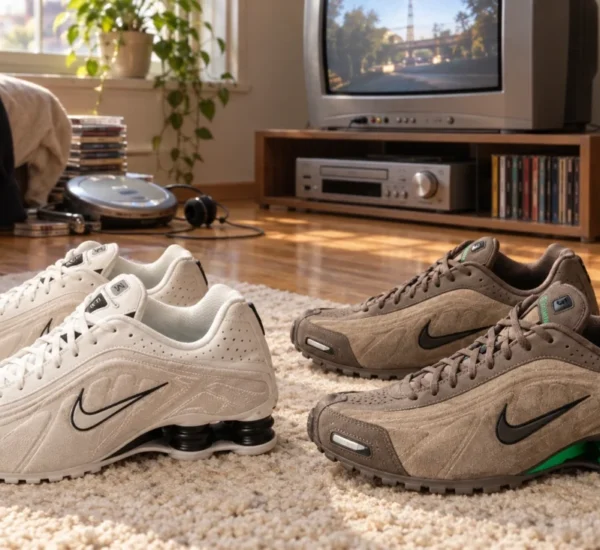
The Huarache expresses fit through a bootie and open support. Shox columns expose another part of construction. Foamposite concentrates its identity on the surface surrounding the foot, making upper volume itself the central detail.
What changes when a surface is molded
On a conventional upper, panel edges and seams help organize the shape. On the Foamposite, the eye follows raised contours and curves across what appears to be a continuous surface. Volume takes the lead: light changes as it passes over the ridges, and color can strengthen or soften the effect.
The entire shoe is not one component. Its shell works alongside the lacing area, interior, tongue, underfoot components and outsole. Our sneaker anatomy guide separates those functions. A visually integrated upper does not eliminate every connection in a shoe.
For a designer, this kind of surface offers possibilities different from cut leather. Texture can become part of the volume itself, while finishes change how that volume appears. That is why a monochromatic Foamposite remains visually complex: a single color does not erase its relief.
1997, Penny Hardaway and the Royal identity
Nike’s DNA Artifacts archive confirms the 1997 debut, college-basketball presence and association with Penny Hardaway. It also records the Dark Neon Royal blue and the athlete’s 1Cent mark. Those elements made the One particularly recognizable.
In Avar’s recollection, a prototype was in a sample bag during a meeting with Hardaway. The player became interested in a project that had not yet been formally presented to him. The story explains their later connection without removing the earlier experimentation: Penny gave a recognizable face to an idea already in development.
College basketball also belongs to the beginning. Sports Illustrated’s interview with Mike Bibby recalls the Arizona guard wearing Foamposites during the 1997 period. The model can therefore be followed across more than one stage, without reducing its public introduction to a single appearance.
The Royal palette reinforces that memory. A broad blue surface meets darker areas around the lacing, while the molded upper retains visual movement with relatively few colors. The relationship between shape and finish explains the combination’s continued recognizability without requiring later editions to repeat it.
Foamposite is the upper; Zoom Air is another system
Air Foamposite brings different concepts together in a name. Nike’s development account identifies Zoom Air in the final One. That does not make the blue shell an Air bag. The material surrounding the foot and the cushioning beneath it occupy different positions and serve different functions.
The prototypes described by Nike included visible Max Air proposals and versions without the 1Cent identity. The final configuration used full-length Zoom Air with an additional heel unit. The upper’s appearance and the underfoot assembly were not settled all at once; the project passed through alternatives before reaching its familiar identity.
The distinction becomes clear when appearance is compared with construction. The exterior dominates photographs but does not reveal everything underfoot. Similarly, a shoe can contain Air without a lateral window exposing it. Our guide to Nike Air and its variations explores that separation.
One and Pro: a visible distinction
Nike identifies the Air Foamposite Pro by its lateral Swoosh, contrasting it with the Penny-associated identity of the One. It is a useful starting point for reading the family, while particular materials, logos and finishes remain edition-specific.
The large Swoosh changes how the eye travels across the upper. On the One, attention can follow the molded surface more continuously. On the Pro, the mark introduces another point of contrast and direction. This is a difference in composition as well as the name on the box.
Galaxy: the shell became a canvas for an image
The official Air Foamposite One Galaxy page dates the original version to 2012 and its return to 2025. Constellation graphics, a glow-in-the-dark outsole and Remove Before Flight tags create the theme. The molded structure remains recognizable beneath a much busier visual surface.
The change in language is clear. On the Royal, the finish emphasizes the relief. On the Galaxy, an image travels across it and adds another layer of information. The shoe remains identifiable by shape, but the print now competes with the sculpture for attention.
Supreme brought Foams into its streetwear calendar
Supreme’s archive records its collaboration announcement on March 31, 2014. The release used red and black versions with an ornamental print. Contemporary Village Voice reporting documented the crowd and cancellation of sales at the New York store over safety concerns. The event became part of the release’s history alongside the design itself.
The collaboration played on the contrast between a technological surface and elaborate graphics. Rather than reducing the Foamposite’s presence, it emphasized its volume with another layer of information. That differed from the Royal’s almost industrial reading and the Galaxy’s space theme.
Comme des Garçons explored the sculpture itself
In its 2021 retail presentation, END. documented the Comme des Garçons Homme Plus versions in black and white with a new spiral-like relief pattern. The collaboration changed the reading of the surface rather than relying only on a new color combination.
Compared with the Galaxy, it reveals another possibility. One edition works through imagery placed over a form; the other reorganizes the relief itself. Both make the upper central to the project, but reach substantially different results.
Baltimore and Washington belong on the map
In 2023, Social Status announced Dream A World as a tribute to Baltimore, with local priority access at Social Status Baltimore and A Ma Maniére in Washington. It is a documented example of the Foamposite’s relationship with the DMV, shorthand for Washington, Maryland and Virginia. Regional history appears through the presentation and distribution method as well as the palette.
That chapter expands a map that begins on basketball courts. The Foamposite can be remembered through Penny’s identity, Arizona’s college run or a regional sneaker scene. Special editions make some of those connections explicit by giving names and context to relationships that a technical specification cannot capture.
The limits of the indestructible-shoe image
A robust shell can create the impression that nothing ages. Footwear, however, combines materials and connections. Outsoles, adhesives, textiles and internal components can change even when the exterior looks well preserved. A durable-looking surface does not establish an unlimited lifespan.
The future of 1997 remains recognizable
The Foamposite made a particular contribution to sneaker history and culture: a construction decision could define a shoe’s image for decades. The upper became a signature, then a graphic surface and a place for further design interventions.
Sources and references
- Behind the Design: Nike Air Foamposite One
- DNA Artifacts: Air Foamposite One
- Interview with NBA Legend Mike Bibby
- Air Foamposite One Galaxy, FQ4303-400
- Supreme News Archive
- Supreme x Nike Air Foamposite One Release Date
- NYPD Shuts Down Foamposite Sneaker Release Because of Big Crowd
- The Comme des Garçons Homme Plus x Nike Foamposite Pack
- Dream A World, An Ode to the City of Baltimore