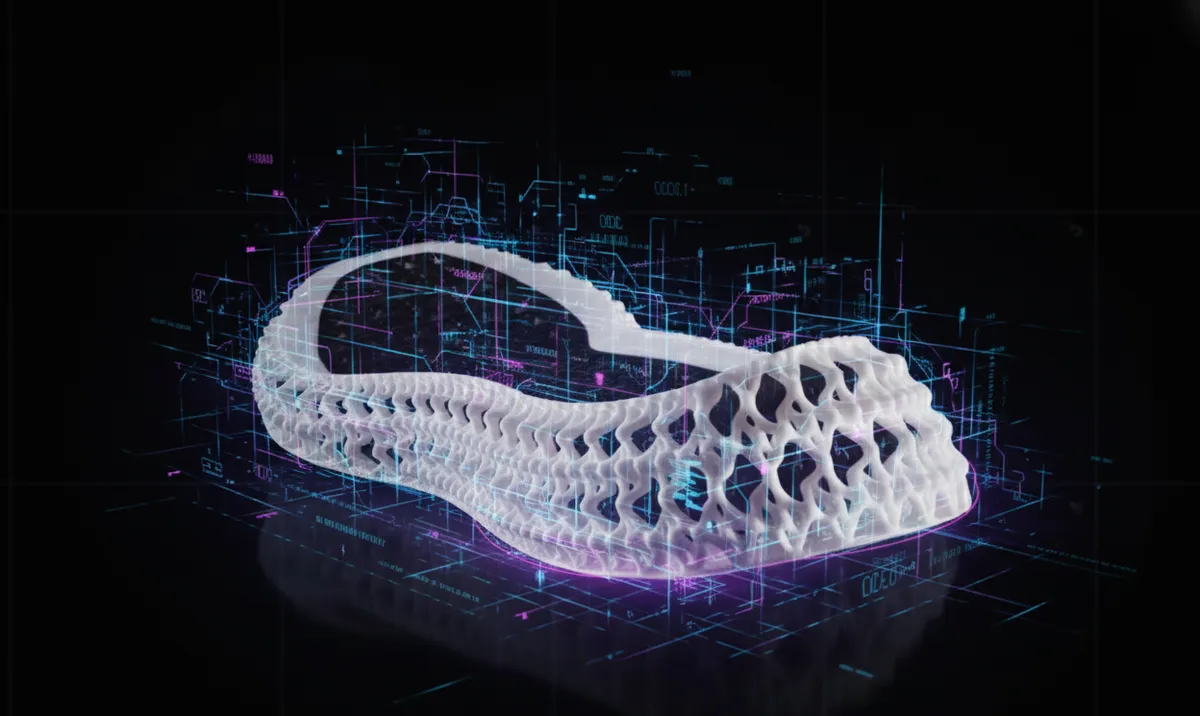
adidas 4D technology is a platform of lattice midsoles digitally manufactured using Digital Light Synthesis (DLS), a process developed by Carbon and applied to footwear by adidas. The partnership took commercial shape with the Futurecraft 4D in 2017, then evolved into products such as the AlphaEdge 4D, 4D Run 1.0, Ultra 4D, and the 4DFWD family.
Although many descriptions reduce the technology to “3D-printed foam,” that definition is imprecise. 4D serves as a midsole, but its structure is a three-dimensional network of interconnected elastomeric elements. Instead of relying only on a foam formulation, adidas and Carbon can also tune the component’s behavior through the network’s geometry.

Does “4D” mean a fourth dimension?
4D is the platform’s commercial name. The midsole does not gain another physical dimension or transform over time like a programmable “4D-printed” material. Its distinguishing feature is the digitally designed elastomeric network.
When did adidas 4D technology begin?
Futurecraft 3D in 2015: the precursor
The story did not begin directly with Carbon. On October 7, 2015, adidas introduced Futurecraft 3D, a 3D-printed midsole concept developed with Materialise. The project explored adapting cushioning and shape to individual athlete data.
Futurecraft 3D was a prototype and a statement of intent. It showed that adidas was researching additive manufacturing before 4D, but it should not be confused with the technology introduced two years later.
Futurecraft 4D in 2017
On April 7, 2017, adidas officially introduced Futurecraft 4D and announced its strategic partnership with Carbon. The innovation was applying Digital Light Synthesis to a midsole intended for commercial use, rather than prototyping alone.
In that announcement, adidas planned an initial release of 5,000 pairs in fall/winter 2017 and stated an ambition to exceed 100,000 pairs by the end of 2018. Those are different claims: the first belonged to the initial launch schedule; the second was a company-announced scaling target, rather than a figure that should automatically be repeated as verified production.
Who created the technology used in adidas 4D?
adidas did not independently invent Digital Light Synthesis. The manufacturing technology was developed by Carbon, a U.S. digital manufacturing company. adidas used the platform to design and manufacture footwear-specific applications.
Saying “Carbon created the shoe” would also be simplistic. The collaboration combines different capabilities: Carbon works on processes, materials, hardware, software, and lattices; adidas contributes product expertise, athlete data, footwear design, and use requirements.
What is Digital Light Synthesis?
Digital Light Synthesis, or DLS, is Carbon’s name for its additive manufacturing process based on digital light projection, oxygen-permeable optics, programmable liquid resins, and subsequent processing stages.
DLS is built on a Carbon technology called CLIP, or Continuous Liquid Interface Production. Instead of depositing filament like an FDM printer, it uses a vat of liquid resin and a sequence of projected images to determine where polymerization occurs.
Light projection
According to Carbon, CLIP projects ultraviolet light through an oxygen-permeable window. The projected images control which regions of resin participate in forming the part as the platform moves.
Why does oxygen matter?
Near the window is a thin, uncured liquid interface that Carbon calls the dead zone. Controlled oxygen helps maintain that region and prevents the part from attaching directly to the window. Fresh resin can then flow into the build area as the part grows.
That does not mean the midsole is “made of oxygen.” Oxygen and light are part of the process. The finished product is a polymer material.
Liquid resin
Carbon uses liquid resins that react to light during manufacturing. In 4D midsoles, the material needs to combine elasticity with enough strength to withstand repeated deformation.
Post-processing
Manufacturing does not end when the part leaves the machine. Depending on the material, the DLS workflow may involve cleaning and a second curing stage. Carbon explains that its dual-cure materials can undergo heat treatment to develop their final mechanical properties. For the 4DFWD project, the company also documented automated cleaning followed by dual curing.
Is adidas 4D 3D printing?
In broad terms, yes: adidas and Carbon both place DLS within additive manufacturing and 3D printing. The mistake is assuming all 3D-printing methods work the same way.
The adidas 4D process differs from FDM, where thermoplastic filament is deposited successively. It should not be treated as a simple version of conventional SLA, either. Carbon developed CLIP/DLS to combine resin production with continuous flow, engineering materials, and greater practicality for end-use parts.
What material is an adidas 4D midsole made of?
Carbon developed different generations of elastomeric polyurethane, or EPU, for adidas. In a public discussion with the development team in 2021, Carbon’s Jon Bruner explained that earlier generations used EPU 41 and that 4DFWD received a new formulation with 39% bio-based components. Those details do not disclose the complete chemical recipe.
Avoid statements such as “all 4D is TPU” or “every 4D uses exactly the same resin.”
Is EPU the same as the eTPU in BOOST?
No. This distinction clears up one of the most common points of confusion between adidas BOOST and 4D.
Traditional BOOST has historically been associated with eTPU, or expanded thermoplastic polyurethane, a foam made from expanded particles fused together. The 4D platform instead uses a digitally manufactured lattice made from elastomeric resins compatible with Carbon’s process.
Both technologies may involve the broad polyurethane chemical family in certain contexts, but their architecture, processing, and behavior are not equivalent.
What is a lattice structure?
A lattice is a three-dimensional network of interconnected elements. In a 4D midsole, the geometry may resemble an open mesh, but it is more than simply “a sole full of holes.”
Mechanical behavior can be changed through element thickness, orientation, cell size, density, and geometry. That allows two regions made from the same material to respond differently because their structures are designed differently.
Why does geometry matter so much?
This is one of the most interesting differences between a lattice and a conventional foam midsole. In foams, composition, density, expansion, and component shape are fundamental variables. In lattices, the network’s three-dimensional architecture becomes another powerful engineering tool.
Futurecraft 4D was developed as a component capable of incorporating zones with different mechanical responses. Geometry and resin selection belong to the same design process; changing either one can alter the midsole’s behavior.
How did athlete data contribute to development?
adidas presented Futurecraft 4D as the result of a process informed by its running-data library. In later 4DFWD communications, it again emphasized years of athlete performance data.
That should be understood as data-driven design: data helped engineers and designers set requirements, evaluate behavior, and choose geometries. It does not automatically make the process “artificial intelligence” or mean the midsole learns as you run.
Is adidas 4D personalized for each person?
Not in standard commercial products. Digital manufacturing creates possibilities for geometric customization, and adidas has historically presented personalization as part of its Futurecraft vision. That is different from saying every customer walks into a store, has their gait scanned, and automatically receives a unique lattice.
Futurecraft 4D, Ultra 4D, 4DFWD, and other commercial releases use production geometries defined for their respective models and sizes.
Key adidas 4D models and generations
Futurecraft 4D
Introduced in 2017, this application put the adidas and Carbon partnership at the center of the conversation about digital footwear manufacturing. Treat it as a specific project and model, rather than using “Futurecraft 4D” as the name of every subsequent 4D shoe.
AlphaEdge 4D
AlphaEdge 4D brought the technology to wider commercial distribution. In 2018, adidas announced its global launch with a 4D midsole, positioning it for running and training with its own upper and outsole construction. That AlphaEdge’s features should not be generalized across the platform.
4D Run 1.0
The 4D Run 1.0 marked another stage in applying a lattice to a running shoe. It also provides historical context for understanding why adidas later compared cushioning and geometry changes when developing 4DFWD.
Ultra 4D
The Ultra 4D is especially useful for understanding that Ultraboost, BOOST, and 4D are not synonyms. It combined styling and upper elements associated with Ultraboost with a 4D midsole. It was not simply a conventional Ultraboost using the same BOOST platform.
4DFWD
In 2021, adidas introduced 4DFWD, a specific evolution of the lattice concept for running. Its major innovation was the geometry called FWD CELL, rather than just a new name or colorway.
Ultra 4DFWD
Ultra 4DFWD later combined an upper derived from the Ultraboost family with the 4DFWD platform. It should not be confused with Ultra 4D: their tooling and midsole geometries belong to different stages of the technology’s evolution.
What is adidas 4DFWD?
4DFWD is an evolution of the 4D family designed for a more directional mechanical response. According to adidas, its FWD CELL was selected from more than five million candidate lattice structures.
Carbon describes 4DFWD as an anisotropic lattice midsole. In plain English, anisotropy means a structure can respond differently depending on the direction of the applied load.
What is the FWD CELL?
The FWD CELL has a shape adidas describes as a bow tie. The company says the cell was designed to deform forward under the vertical load of a stride, contributing to a smoother transition.
Keep that mechanism separate from exaggerated claims. It does not turn the midsole into a motor, create energy from nothing, or guarantee every runner will become faster. It is a geometric strategy for managing structural deformation.
adidas 4D vs. BOOST: what’s the difference?
BOOST and 4D provide cushioning through different approaches. Traditional BOOST belongs to the expanded bead-foam family, historically associated with the eTPU developed with BASF. 4D uses an elastomeric lattice digitally manufactured through DLS.
- BOOST: expanded foam whose behavior depends heavily on formulation, density, and midsole geometry.
- Light BOOST: a later, lighter evolution within the BOOST family.
- 4D: a lattice structure that also uses three-dimensional geometry to tune mechanical response.
- 4DFWD: a specific 4D development featuring directional FWD CELL geometry.
4D did not universally replace BOOST. The two technologies coexisted in adidas’ portfolio as Light BOOST, Lightstrike, and other foams continued to evolve. For a comparison focused on use and feel, see Ultraboost vs. 4D.
Is 4D softer or firmer than BOOST?
There is no universal answer. The feel depends on lattice geometry, material, base width, upper, size, and the particular model. The 4D name alone does not tell you how soft a shoe is.
Softness is not synonymous with better cushioning or performance, either. A relatively firm platform can still manage deformation and distribute loads appropriately for its design.
Does adidas 4D have good energy return?
adidas has used terms such as “energy return,” “forward motion,” and “smooth transition” across different 4D generations. Interpret those terms within the context of each product’s testing and marketing.
It is technically unsound to claim that “4D returns more energy than EVA” or “is better than BOOST” without specifying the model, protocol, load, and measurement. A wearer’s perceived responsiveness is also different from laboratory-measured energy return.
Is adidas 4D good for running?
It depends on the product. Futurecraft 4D originated in a running context, the 4D Run 1.0 was developed for running, and 4DFWD is explicitly a running family. That does not make every sneaker with a 4D midsole a performance running shoe.
Ultra 4D, for example, also gained a strong casual and lifestyle presence. For running in 2026, consider the specific model, weight, geometry, fit, intended pace, and personal preference rather than the lattice alone.
Is adidas 4D heavy?
There is no single “weight of 4D technology.” Some historical 4D models were relatively heavy compared with certain modern foam shoes, but weight needs to be specified by SKU, size, and generation.
adidas’ own catalog illustrates that variation: the Ultra 4DFWD and later 4DFWD models have different specifications. Using one model’s weight to characterize the whole platform would be misleading.
Is adidas 4D sustainable?
Digital manufacturing alone does not make the technology sustainable. Additive processes may reduce tooling requirements and allow one-piece geometries, but environmental impact also depends on energy, material chemistry, post-processing, transportation, durability, and end-of-life handling.
The bio-based material in 4DFWD
In the 2021 4DFWD announcement, adidas reported 39% bio-based material in the structure; its annual report rounded the figure to 40%. That figure applies to that generation, rather than every 4D shoe.
Bio-based does not mean recycled. A material can use some biologically sourced feedstocks without containing recycled material or being automatically recyclable.
Does adidas 4D have sensors or connect to an app?
4D is not an electronic system. The lattice responds mechanically to loads; being 4D does not make it monitor posture or send data to the adidas Running app.
Keep two things separate: adidas may use athlete data to develop a product, but that does not mean the finished product collects new user data during a run.
Does adidas 4D have a carbon plate?
Do not infer that from the partner’s name. Carbon is the company that developed DLS; in this context, “Carbon” does not mean “carbon-fiber plate.”
Whether a structural plate is present must be checked in the specific shoe’s design. A 4D midsole is not, by definition, a carbon-fiber plate.
Does adidas still sell 4D in 2026?
As of October 5, 2026, the official U.S. page for the 4DFWD 4, SKU JI1452, remains live but marks that item sold out. A product page confirms a catalog listing, rather than current availability of every model, color, or size.
Earlier models such as Futurecraft 4D and Ultra 4D have their own distribution cycles. An old page or a pair on the secondary market does not prove that generation is still being manufactured.
Is 4D technology still worth considering in 2026?
It can make sense if you are interested in a lattice’s distinctive mechanical feel and appearance, find a model suited to your use, or want to explore one of footwear’s most significant commercial applications of additive manufacturing.
That does not automatically make 4D the best choice. Someone prioritizing low weight, substantial softness, or specific current racing technologies may prefer other platforms. In 2026, adidas offers different midsole families with different goals, and the most appealing technology depends on what the wearer needs.
A lattice makes internal geometry a midsole-design variable. That distinguishes 4D from bead foam, without establishing a winner for every use. Explore other cushioning systems in the Sneaker Lab and locate the components in our sneaker anatomy guide.