
Choosing sneakers for work involves more than finding the most comfortable or understated pair. They need to suit your company’s dress code, the time you spend standing or walking, and, above all, your own feet.
In casual, creative, or business casual workplaces, clean-lined sneakers can work well with jeans, chinos, relaxed tailoring, skirts, dresses, and blazers. Formal offices or industries with specific rules may require traditional shoes. There is no single “best office sneaker” for everyone.
This selection covers 10 casual models, organized by silhouette and construction. If you spend the whole workday on your feet, fit should matter more than matching your outfit. If that is your priority, our comparison of adidas shoes for standing at work focuses on construction and what to check during a try-on, without promising the same comfort for everyone.
What should you look for in work sneakers?
Before choosing by appearance, consider how you will use the shoes. Someone who sits for most of the day has different needs from someone who walks between buildings, takes public transit, or spends hours standing.

- Dress code: confirm whether sneakers are allowed and what level of informality is appropriate.
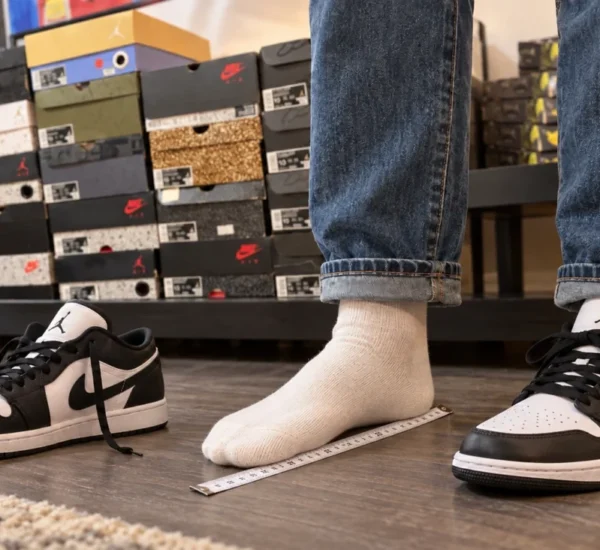
- Fit: length, width, upper volume, and the shape of the last matter more than simply buying your usual size.
- Cushioning: it can improve the underfoot feel, but more softness does not automatically mean more comfort for everyone.
- Materials: leather, synthetics, suede, and mesh look and behave differently. A material’s name alone does not make it “premium.”
- Color: white, black, gray, brown, beige, and navy are usually easier to coordinate, but that is a styling choice rather than a universal workplace rule.
- Maintenance: a clean, well-kept pair usually works better with office clothing than a heavily worn version of the same model.
1. Nike Air Force 1 Low

The Nike Air Force 1 Low is an easy-to-style choice for anyone who prefers a classic leather-sneaker silhouette. Originally created for basketball in 1982, it has become predominantly a lifestyle shoe.
The Air Force 1 ’07 uses a foam midsole and encapsulated Nike Air cushioning. Versions may have leather, synthetic, or textile uppers, so check the composition of your chosen pair. For the office, white, black, and neutral shades tend to draw less attention.
It is not a lightweight or exceptionally flexible shoe. Anyone who prefers the softer feel of a modern running shoe may find its construction relatively firm. Learn more about its origins in our Nike Air Force 1 history.
2. Nike Court Vision Low
The Nike Court Vision Low is an alternative with a look inspired by 1980s basketball. Some versions have synthetic uppers, stitched overlays, perforations, and rubber outsoles.
Its relatively simple design works with jeans, chinos, and casual office clothing without adopting a performance-shoe silhouette. Assess comfort individually, though: this is a traditionally constructed lifestyle sneaker, rather than a highly cushioned running shoe.
3. adidas Stan Smith

The adidas Stan Smith has understated lines and few overlapping elements on its upper. The silhouette began in tennis and is now sold in different materials and lifestyle versions.
Some versions feature a minimalist construction, lace closure, and rubber cupsole. Upper materials vary by SKU, so it is inaccurate to say every current Stan Smith uses exactly the same leather as the historical model.
For a business casual setting, white, off-white, black, or subtly detailed versions are especially easy to work into an outfit without making the sneakers its dominant feature.
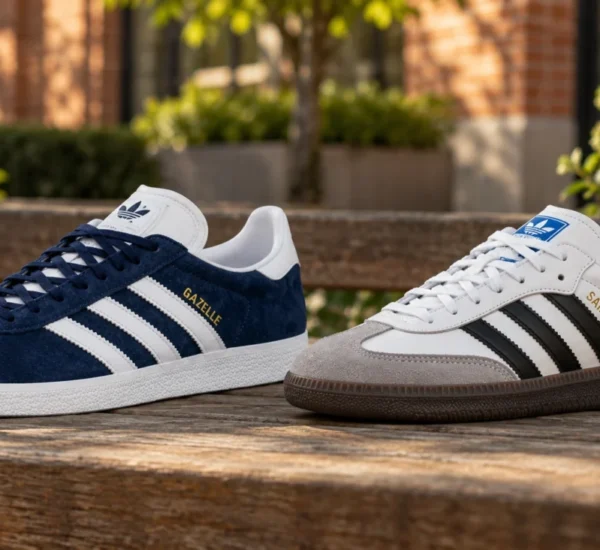
4. adidas Gazelle
The adidas Gazelle offers a different approach from the Stan Smith. On many versions, suede and a low-profile silhouette create a more textured, informal look that is still relatively simple.
The Gazelle family includes the standard Gazelle, Indoor, Bold, and other variations. Sole height, materials, and fit can therefore change considerably. For office wear, assess the specific model rather than generalizing across the family.
Suede also needs different care from smooth leather. Water, dirt, and friction can alter its appearance, which matters if you will wear the pair every day.
5. PUMA Suede Classic

The PUMA Suede combines a suede upper and rubber sole in a low-profile silhouette. Its appeal for the office is a simple look with more texture than smooth-leather models.
The Suede Classic XXI has a lace closure and an understated profile. It is an option for anyone looking beyond white court sneakers, provided suede is practical for their commute and everyday care routine.
Brown, black, gray, navy, and other muted colors can work well with casual work clothing. As with any suede sneaker, its appearance changes with wear and calls for specific cleaning methods.
6. PUMA Palermo
The PUMA Palermo has a low profile and terrace-style references. It pairs well with straight-leg or wider pants and offers an alternative to basketball-inspired models.
There are leather, suede, and mixed-material versions. Do not evaluate the Palermo as if every colorway were the same product. For a more understated office look, lower-contrast options are usually easier to coordinate.
7. New Balance 574

The New Balance 574 is a good alternative if you do not want an all-white sneaker or a court-shoe construction. Its combination of suede, mesh, and retro-running design creates a sportier look that is nevertheless well established as lifestyle footwear.
The 574 Core uses ENCAP, which combines foam with a firmer polyurethane structure around the midsole. New Balance also offers different widths in certain versions, an important consideration for people who struggle with one-width sneakers.
That does not automatically make the 574 more comfortable for everyone: foot shape, selected width, socks, and time spent wearing it still matter.
8. New Balance 327
The New Balance 327 combines references to 1970s running shoes with contemporary lifestyle construction. Its large lateral “N” logo and outsole that extends up the heel make it more visually pronounced than the 574.
For work, neutral colorways make the 327 easier to pair with jeans, chinos, and casual tailoring; high-contrast versions create a sportier effect.
9. ASICS JAPAN S

The ASICS JAPAN S is a particularly fitting choice for anyone seeking a simple, low-profile silhouette. The current model draws inspiration from a 1981 court shoe but uses updated construction for lifestyle wear.
The line comes in different combinations of materials and colors. White, black, and low-contrast versions can fill a role similar to the Stan Smith or Court Vision in casual work outfits.
10. ASICS GEL-LYTE III OG
For anyone who prefers a retro-running look, the ASICS GEL-LYTE III OG remains a relevant option. Designed by Shigeyuki Mitsui and originally released in 1990, it is known for its split tongue and period-specific construction.
Current versions retain heel GEL technology and come in combinations of suede, nubuck, leather, and textiles, depending on the SKU. In muted colors, they can work in creative or informal workplaces; at companies with conservative dress codes, their running-shoe look is more noticeable than that of models such as the Stan Smith or JAPAN S.
What are the best sneakers for the office?
There is no universal answer. If an understated look is the priority, the Stan Smith, JAPAN S, Court Vision Low, and Air Force 1 Low offer relatively simple lines. Fans of retro runners may prefer the New Balance 574, 327, or GEL-LYTE III OG. For suede and terrace styling, the PUMA Suede, Palermo, and adidas Gazelle offer another direction.
If you spend the whole day standing, both walk and stand still in the pair during a try-on. Check toe room, heel hold, and pressure points. Casual sneakers also do not replace any safety footwear required at work.
Can you wear white sneakers with dress clothes?
Yes, particularly with relaxed tailoring and business casual outfits. Neatly fitting dress pants, chinos, a button-down, polo, sweater, or blazer can make a cohesive match with clean-lined sneakers.
That does not make a white sneaker formal footwear. If the dress code requires a traditional suit, dress shoes, or a specific uniform, the workplace’s rules take priority.
Do sneakers need to be leather to look professional?
No. Smooth leather often creates a more uniform appearance, but suede, synthetics, and textile combinations can work, too. Color, proportions, condition, and how the shoes coordinate with your clothing matter as much as the material.
Can you wear running shoes to the office?
It depends on the workplace. Modern running shoes usually have bulkier midsoles, technical mesh, and visibly athletic geometry. That may be irrelevant at an informal company; in a business casual environment, a lifestyle model or retro runner generally looks more understated.
How should you care for sneakers worn to work?
- Remove dust and dirt before they build up on the upper.
- Choose your cleaning method by material: leather, suede, and mesh do not necessarily need the same product.
- Avoid putting a pair away while it is still damp.
- Rotate shoes when possible to allow drying between wears.
- Before applying a new product, test it in an inconspicuous area.
For more detailed care advice, consult our guide to sneaker-cleaning products and methods.
Common mistakes when choosing work sneakers
- Choosing by looks alone: an attractive pair that pinches or slips at the heel is unlikely to feel good through a full workday.
- Assuming more foam always means more comfort: the cushioning feel is only part of the experience.
- Ignoring the dress code: the same sneaker can be appropriate in a design studio and unsuitable in a formal workplace.
- Buying without checking the version: families such as Gazelle, Stan Smith, 327, and GEL-LYTE can use different materials and fit differently across SKUs.
- Using another brand’s size as a rule: internal shape varies between manufacturers and models.

To explore other buying considerations, including materials, technology, sizing, and model differences, see the 90sneakers Buying Guide.