
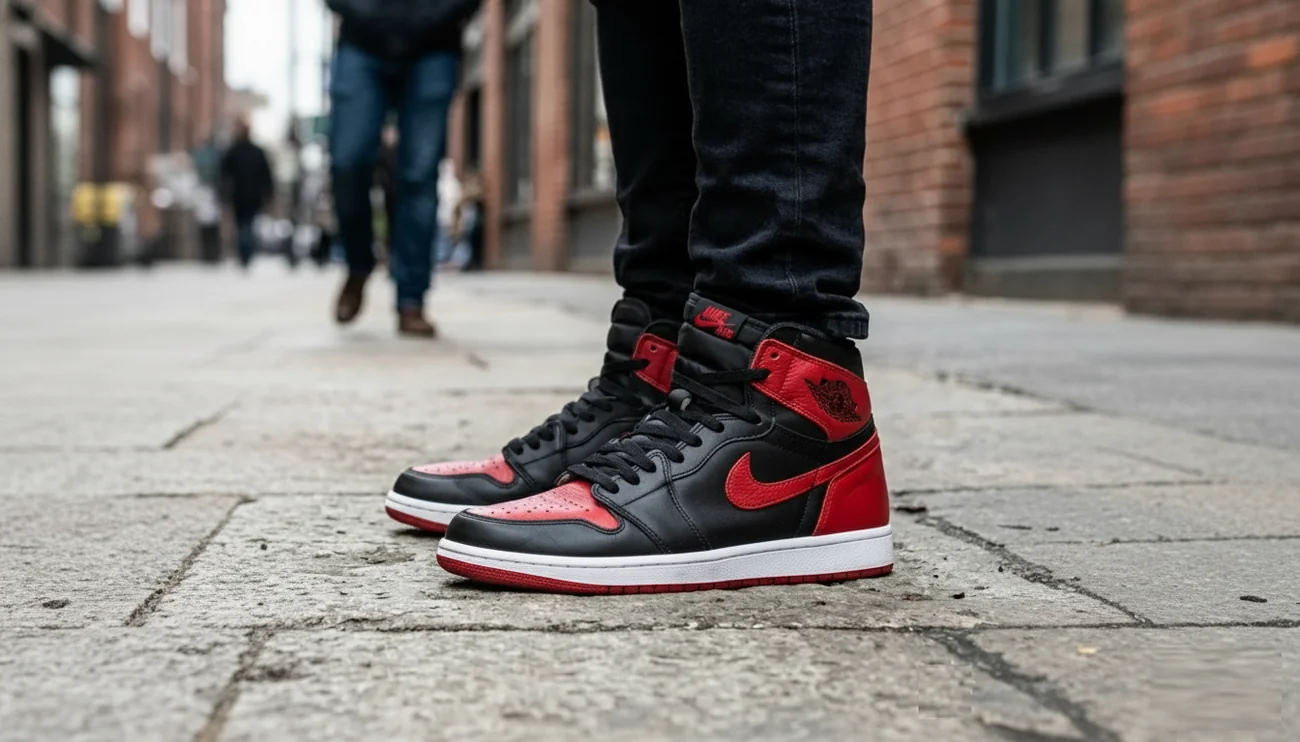
OG is a contextual sneaker term connected to originality and origin. Depending on where it appears, it can refer to the original release of a model, a colorway from the original era, a historical configuration, or simply part of the official name of a modern product.
That is why defining an “OG sneaker” as “a retro that is faithful to the original” creates more problems than it solves. Jordan Brand still sells modern products called Air Jordan 1 Retro High OG. The letters OG in the name do not open a time portal back to 1985.
To understand what OG actually means, look at the context: which model, which release, which year, which colorway, and who is using the term?
What Does OG Mean in Sneakers?
In contemporary sneaker language, OG usually points to “original” or “origin.” The thing being described as original can change depending on the sentence.
OG can be used to talk about:
- an original release;
- a physical pair manufactured during that original release period;
- an OG colorway;
- a historically original configuration of a silhouette;
- the original lineage or design language of a model;
- or commercial naming on a modern product, such as Air Jordan 1 Retro High OG or adidas Samba OG.
So OG is not a universal technical certification. The better first question is: “original in what sense?”
Where Does the Term OG Come From?
The story starts before sneakers.
According to Merriam-Webster and other major dictionaries, the linguistic origin of OG is Original Gangster or Original Gangsta. The abbreviation is associated with Los Angeles gang culture in the 1970s and later spread much more widely through hip-hop and popular culture.
Dictionary.com likewise traces OG to Los Angeles gang culture and documents how the term broadened over time to describe people or things regarded as original, pioneering, authentic to their lineage, or old-school.
Ice-T’s 1991 album O.G. Original Gangster played an important role in bringing the term into mainstream rap culture, but the phrase and abbreviation predate that album.
That does not mean someone has to translate “OG sneaker” literally as “Original Gangster sneaker” every time the letters appear in a product name. Etymology is one thing; the specialized meaning the term developed inside sneaker culture is another.
How Did Sneaker Culture Start Using OG?
The broader meaning of OG fits the way sneaker history is discussed.
A single silhouette can survive for decades, receive dozens of colorways, change materials, return as a retro, and appear in new configurations. At some point, collectors need language that distinguishes the historical reference from what came later.
That is where OG appears most often: as a way to point back toward the origin.
But origin of what? The release? The colorway? The configuration? The official product name? That is exactly why the word is contextual rather than a one-definition label.
If you like these layers of terminology, the Sneakerhead Dictionary covers more expressions used to describe releases, condition, history, and sneaker culture.
What Is an OG Release?
OG release, or original release, refers to the historical first release of a particular model, version, or product configuration.
Here, the emphasis is on the physical product created in that original period—not just on an old color combination returning decades later.
Imagine a silhouette that debuted in 1985 and is reissued in 2026. A pair actually manufactured for the 1985 release and a pair manufactured in 2026 are not the same historical object, even if they share the same name, basic shape, or color blocking.
That difference looks obvious when stated plainly. In sneaker listings, however, the word OG can blur the distinction between a period-original object and a modern product inspired by it.
What Is an OG Colorway?
OG colorway is a more specific use of the concept: a color combination associated with the original era of a silhouette or line.
A silhouette can have more than one OG colorway. OG does not necessarily mean “the first and only color combination ever released.”
An OG colorway can also return decades later.
When a brand produces a modern retro in a historically original colorway, the colorway can be OG while the physical pair is still a modern production.
For that concept specifically, see our guide to what an OG colorway means.
Are OG Release and OG Colorway the Same Thing?
No.
Original release mainly answers:
“Does this model or version belong to the historical first release?”
OG colorway answers:
“Does this color combination belong to the model’s original-era color palette?”
That is why a retro manufactured today can reproduce an OG colorway without becoming a physical example from the original release period.
The age of the object and the history of the colorway are different pieces of information.
Air Jordan 1: A Perfect Example for Understanding OG
The Air Jordan 1 makes the distinctions especially easy to see because Nike maintains official historical documentation for the model.
In the official Air Jordan 1 archive, Nike documents:
- Original Release: 1985;
- Designer: Peter Moore;
- Artifact of Origin: Department of Nike Archives;
- Color: Black/Red on the historical example highlighted by Nike;
- Style Code: 4281 in the archive record.
An Air Jordan 1 physically manufactured in 1985 therefore belongs to the model’s original-release context.
An Air Jordan 1 manufactured decades later is a later production even when it restores colors, branding, or design cues associated with the original era.
For the broader story of the silhouette, read our history of the Air Jordan 1.
Is Black/Red the Only OG Air Jordan 1 Colorway?
No.
Nike highlights Black/Red in its historical archive, and sneaker culture often calls that combination “Bred.” But the original Air Jordan 1 existed in multiple colorways during its first era.
A silhouette can therefore have multiple OG colorways.
That is also why saying “the OG colorway of the Air Jordan 1” can be too vague. In many cases, “one of the OG colorways” is the more accurate wording.
What Does Air Jordan 1 Retro High OG Mean?
Air Jordan 1 Retro High OG is a modern product name used officially by Jordan Brand.
It does not mean that the physical pair was manufactured in 1985.
It also does not automatically mean that the colorway itself existed in the original 1985 lineup.
In 2026, for example, Nike sells the Air Jordan 1 Retro High OG “Love Letter”, style DZ5485-201, in Shadow Brown, Light British Tan, and Team Red.
Nike describes it as a new AJ1 High OG. That makes the point clearly: “Retro High OG” remains part of the commercial naming of a contemporary product.
The full product name matters more than trying to assign one rigid definition to the two letters by themselves.
Can a Retro High OG Use a New Colorway?
Yes. Retro High OG does not universally require the color palette to come from the original release period.
The contemporary “Love Letter” shows that Jordan Brand can apply the High OG naming to a modern colorway with its own identity.
So:
- Retro High OG can appear in an OG colorway;
- Retro High OG can also appear in a contemporary colorway.
OG in the product name does not automatically mean OG colorway.
Is Retro High OG the Same as an Original 1985 Air Jordan 1?
Not as a historical object.
A modern production can restore many details associated with the historical Air Jordan 1. That does not make it literally the same industrial product that was manufactured in 1985.
Across releases separated by decades, brands can change:
- shape;
- molds and tooling;
- materials;
- foams;
- rubber compounds;
- stitching;
- branding;
- finishing;
- padding;
- packaging;
- manufacturing processes.
Some retros aim for closer historical fidelity in certain areas, while others make more visible changes.
OG in the name is not a certificate of a technical 1:1 reproduction.
Are OG and Retro the Same Thing?
No.
Retro usually describes a later edition, reintroduction, or re-release connected to an earlier product.
OG is more contextual: it can point to an original release, historical colorway, original configuration, or simply be part of the naming of a current model.
The two terms can appear together—as in Air Jordan 1 Retro High OG—without becoming synonyms.
There is also no universal rule that says “every modern OG is a retro.”
For the other side of the comparison, see what Retro means in sneakers.
Are OG and Vintage the Same Thing?
No.
Vintage is mainly about the physical age of an object. OG is about historical origin, lineage, or naming context.
An Air Jordan 1 actually produced in 1985 can now be both: it belongs to the original-release period and is physically vintage.
A newly manufactured Air Jordan 1 Retro High OG does not become vintage just because OG appears in the name.
A retro produced many decades ago can eventually become vintage because of its own physical age even though it was never part of the original release.
Our guides to vintage sneakers and Retro vs. Vintage vs. OG go deeper into that distinction.
Is OG Exclusive to Nike and Jordan Brand?
No. OG belongs to a broader cultural vocabulary and also appears officially in the naming used by other footwear companies.
adidas, for example, sells products called Samba OG. The name connects a contemporary product to the design lineage of the Samba without implying that every current pair was manufactured in the shoe’s earliest era.
adidas has also used names such as LA Trainer OG for archive-driven products described as tributes to the original model while still being updated or remodeled for modern use.
That is a useful example because two ideas can coexist: OG in the product name and a product that the brand explicitly describes as a modern reinterpretation.
So OG should not be turned into a Jordan-only technical formula.
Does OG Mean the Sneaker Is Authentic?
No.
In English, the confusion is slightly different from languages where “original” commonly doubles as a synonym for “not fake.” In sneaker terminology, OG still does not function as an authentication result.
A counterfeit listing can say “OG,” “OG colorway,” or “Retro High OG” and still be counterfeit.
The OG question is:
“How does this release, colorway, configuration, or name relate to the product’s historical origin?”
The authentication question is:
“Is this physical pair actually a genuine, authorized product?”
Those are different questions. If authenticity is the issue, see our Legit Check guide.
Does the Style Code Prove a Sneaker Is OG or Authentic?
A style code helps identify the release the product is supposed to represent. It can connect the model name, size category, colorway, release period, and official documentation.
But a code does not authenticate the physical object by itself.
Counterfeits can copy style codes, labels, and boxes. Release identification and physical authentication are separate steps.
Does OG Tell You Anything About Condition?
Not necessarily.
A pair from an original release can now be:
- new and unworn;
- heavily worn;
- restored;
- missing the original box;
- incomplete;
- oxidized or yellowed;
- structurally deteriorated;
- repaired or altered.
OG describes origin or naming context; it does not replace terms about wear and condition such as DS, VNDS, used, restored, or vintage.
A 1985 pair can be historically OG and still be in poor physical condition.
Is Every OG Sneaker Rare or Limited?
No.
OG does not tell you how many pairs were produced.
A historical colorway can receive multiple retros over the years. A modern product with OG in the name can have broad distribution. A silhouette can also be culturally important without being numerically rare.
OG therefore does not automatically mean:
- limited edition;
- exclusive;
- sold out;
- grail;
- small production run.
Are OG Sneakers Always More Expensive?
No rule says they are.
Price depends on the model, release, year, colorway, size, condition, box, accessories, provenance, authenticity, availability, supply, demand, region, and timing.
A physical example from a rare historical original release can cost a great deal. A modern sneaker with OG in the name can be sitting at retail. An OG colorway can also be re-released several times.
The letters alone do not determine price.
Is OG an Investment Category?
No. OG is a contextual description of origin or naming, not an investment category.
The presence of OG does not guarantee future appreciation, profit, or liquidity.
Specific releases can rise or fall in price for many reasons. That has to be evaluated case by case.
Does OG Mean Better Materials or Quality?
Not automatically.
OG is not a certification of premium leather, superior comfort, better durability, or more accurate craftsmanship.
If a brand says a specific release restores a material, shape, branding detail, color treatment, or historical construction cue, verify that claim on the documentation for that release.
The same applies to Retro High OG. Materials, molds, foams, rubber, padding, finishing, and packaging can change between generations.
The specific release matters more than a generalization about OG.
How Should You Interpret “OG” in a Listing or Product Name?
Instead of trying to “spot OG” by looking for one stitch, start with the documentary context.
- Check whether OG is part of the official product name. Does the brand actually use OG, or did the seller add it?
- Identify what is being called original. Is it the release, colorway, configuration, or lineage?
- Confirm the year of the physical pair. The silhouette’s origin year is not automatically the year of the pair.
- Confirm the specific release. Search the full name and SKU or style code.
- Determine whether it is a retro production. A retro comes after the historical release it references.
- If the claim is “OG colorway,” verify the history of the color combination.
- Do not assume 1:1 technical fidelity. Check materials and details for that exact release.
- Do not use OG to infer age. A current product can have OG in its name.
- Do not use OG to infer condition. An original-release pair can be worn, restored, or incomplete.
- Do not use OG as authentication. Perform a separate Legit Check when necessary.
That approach may sound less exciting than hunting for a “secret OG stitch,” but it is much more useful.
Common Mistakes When Interpreting OG
- “OG only means Original.” Original/origin is the key sneaker-use idea, but the etymology comes from Original Gangster/Original Gangsta.
- “Every OG is an old physical pair.” No. OG appears in the names of new products.
- “Every Retro High OG uses an OG colorway.” No.
- “OG colorway means the pair was manufactured in the original era.” No. The colorway can be historical while the retro is modern.
- “Every modern OG is a retro.” There is no universal rule.
- “OG means vintage.” No.
- “OG means authentic.” No.
- “OG means Deadstock.” No.
- “OG means limited edition.” No.
- “OG guarantees better materials.” No.
OG Sneaker FAQ
What Does OG Mean in Sneakers?
In sneaker culture, OG usually points to original or origin, but the exact meaning depends on context. It can refer to an original release, an OG colorway, a historical configuration, or part of the name of a modern edition.
Does OG Come From “Original Gangster”?
Yes. The linguistic origin of OG is tied to Original Gangster or Original Gangsta. Over time, the term broadened to describe something original, pioneering, old-school, or authentic to its roots. Sneaker culture mostly uses that expanded idea of origin.
What Is an OG Release?
It is the historical original release of a particular model or version. A physical pair manufactured during that period is a different object from a retro made decades later.
What Is an OG Colorway?
It is a color combination connected to the original era of a particular silhouette or line. A silhouette can have multiple OG colorways.
Are OG Release and OG Colorway the Same?
No. OG release concerns the historical release itself; OG colorway concerns the history of the color combination.
What Does Retro High OG Mean?
Retro High OG is naming used by Jordan Brand on modern Air Jordan 1 releases. It does not mean the physical pair was manufactured in 1985.
Is Retro High OG Always an OG Colorway?
No. Jordan Brand can use the Retro High OG naming on contemporary colorways as well.
Can a Retro Reproduce an OG Colorway?
Yes. In that case, the color combination has historical origin while the physical pair belongs to a modern production run.
Are OG and Retro the Same Thing?
No. Retro usually describes a later edition of a historical product. OG can refer to release, colorway, origin, configuration, or naming. The terms can appear together without being synonyms.
Is Every Modern OG a Retro?
No universal rule says that. OG is used differently by different brands and in different contexts.
Are OG and Vintage the Same?
No. Vintage concerns the physical age of the object. OG concerns historical origin or naming context.
Can an OG Release Also Be Vintage?
Yes. An authentic pair manufactured during the original release period can now also be vintage because of its age.
Does OG Mean the Sneaker Is Authentic?
No. OG does not authenticate a product. A counterfeit listing can also use the word OG.
Does a Style Code Prove an OG Sneaker Is Genuine?
Not by itself. The style code helps identify the release the product is supposed to represent, but authentication requires evaluating the physical pair and additional evidence.
Does OG Mean Deadstock?
No. OG does not describe wear condition. An original-release pair can be new, worn, restored, damaged, or incomplete.
Is Every OG Sneaker Rare?
No. OG does not tell you production quantity, availability, or rarity.
Does OG Mean Limited Edition?
No. Limited edition and OG describe different things.
Are OG Sneakers Always More Expensive?
No. Price depends on the release, year, size, colorway, condition, supply, demand, and many other variables. OG alone does not determine value.
Does OG Use the Same Materials as the Original Release?
Not necessarily. Modern reissues can change materials, shape, molds, foams, finishing, and other components. Check the specific release.
Is OG Exclusive to Nike and Jordan Brand?
No. Other brands use OG commercially too, including adidas in names such as Samba OG and LA Trainer OG.
Conclusion: OG Points to Origin, but Context Tells You Which One
OG is a contextual term. Its linguistic origin is Original Gangster or Original Gangsta, while sneaker culture generally uses the expression to point toward originality, origin, and historical lineage.
That can mean original release, OG colorway, historical configuration, or simply part of the official name of a modern production.
The Air Jordan 1 summarizes the issue perfectly. Nike documents the model’s original release in 1985 and Peter Moore as the designer, yet decades later Nike still sells products called Air Jordan 1 Retro High OG. The history stays connected; the physical object belongs to the year it was actually produced.
That is why OG should not be used as shorthand for “vintage,” “retro,” “authentic,” “rare,” “Deadstock,” “better materials,” or “more expensive.” Those are separate questions.
When you see OG in a listing, the useful response is simple: identify which origin is being discussed. Model, release year, colorway, configuration, and official naming matter much more than two letters in isolation.
To keep decoding sneaker terminology without turning slang into invented rules, use the Sneakerhead Dictionary.