
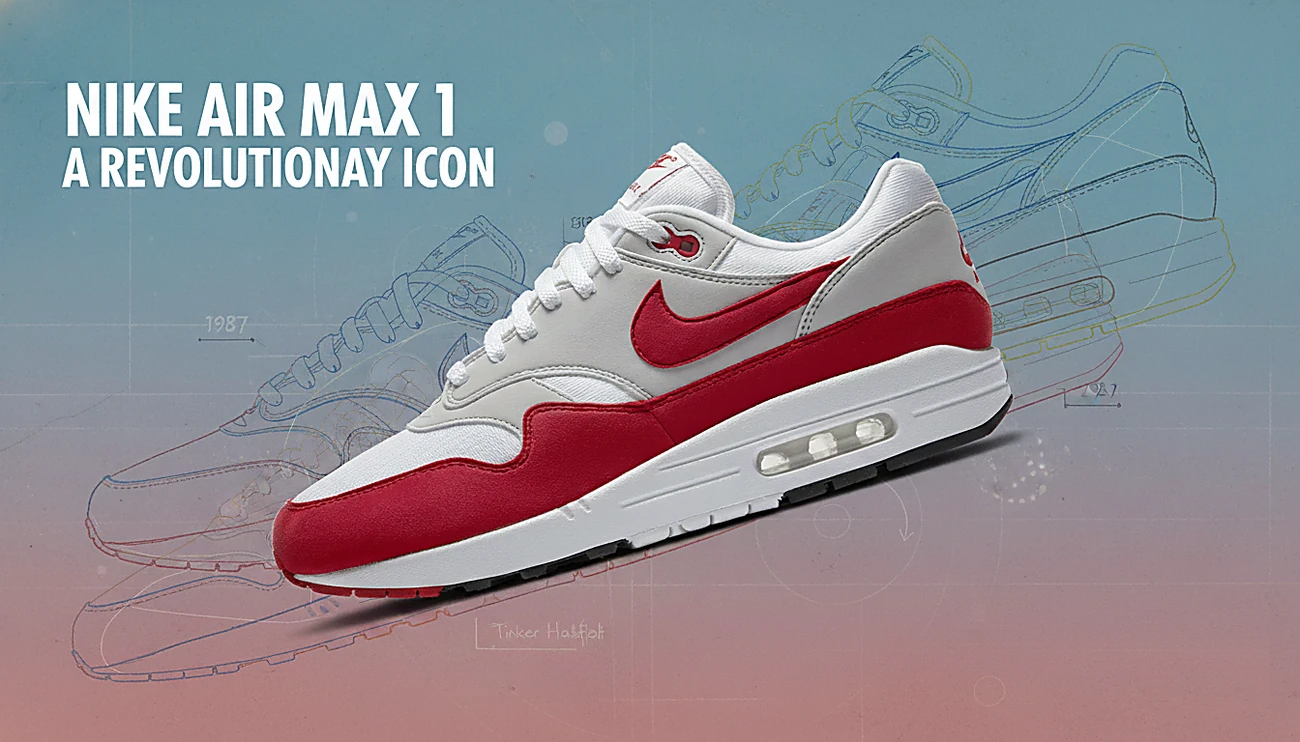
There are moments in design history that transcend their time, becoming cultural milestones that echo for decades. The Nike Air Max 1, released on March 26, 1987, is one of those moments. More than just a running shoe, it represented a radical shift in how we understand athletic footwear, technology, and aesthetics. To truly grasp the magnitude of this icon, we must travel through time—from NASA labs to the streets of Paris, through the desert of rejection and the genius of two men who refused to accept “impossible.”
The Origin of Air: Frank Rudy and the Technology That Almost Didn’t Exist
Before the Air Max, before visible “Air,” there was a stubborn aerospace engineer named Marion Franklin Rudy. Born in 1925, Rudy wasn’t a runner, a shoe designer, or a sneakerhead. He was a NASA scientist working on cutting-edge projects involving the Saturn and Apollo rocket engines—the ones that took man to the Moon.
During his time at the space agency, Rudy was exposed to a process called “blow rubber molding”. It was there that the idea that would forever change the footwear industry was born: What if he could encapsulate dense gases in rubber membranes to create a cushioning chamber? The concept was elegantly simple—a “pocket of air” that would compress under pressure and instantly return to its original shape, absorbing the impact of every step.
But Rudy’s journey to realizing this dream was a testament to almost superhuman persistence. In 1977, he began pitching his invention to shoe manufacturers. Twenty-three companies rejected his idea before he reached door number 24 in Beaverton, Oregon—the headquarters of Nike.
The objections were always the same: the air pockets would burst under pressure, leak gas over time, or fail to withstand the constant stress of running miles. Plus, who would pay extra for invisible technology that couldn’t be seen or touched? Company after company told Rudy his idea was a “gimmick,” impractical, something out of comic books and science fiction.
The story could have ended there. Most people would have given up after five rejections. Maybe ten, if they were particularly persistent. But Frank Rudy kept going. And when he finally sat down with Phil Knight, Nike’s co-founder, something magical happened.
Knight, in his memoir Shoe Dog, describes Rudy as a “mad professor,” full of incoherent equations scribbled on a blackboard. Initially skeptical—”Air shoes sounded to me like jet packs and moving sidewalks. Comic book stuff”—Knight did something the other 23 companies didn’t: he tested it personally.
He put the prototypes on his feet and went for a six-mile run. The result? “Not bad,” he said, jumping up and down. “A pretty good run.”
That night, after dinner with Rudy where the engineer explained the science behind Air technology in greater depth, Knight was convinced. Nike struck a deal where Rudy would receive royalties for every pair sold—a figure that ended up “somewhere in the middle” between the 10 cents initially offered and the 20 cents Rudy had asked for.
From Lab to Streets: The Birth of the Air Tailwind
The development of Air technology between 1977 and 1978 was Nike’s most ambitious and expensive project to date. The challenges were immense: air units leaked, rubber membranes degraded under repeated stress, and the manufacturing process was inconsistent. Every solution created new problems.
But Rudy’s experience as an aerospace engineer proved invaluable. The principles he had applied to NASA projects—understanding the behavior of gases under pressure, rubber compound formulation, membrane integrity testing—translated directly into footwear innovation. He wasn’t guessing; he was applying genuine scientific methodology to a problem that had never been properly solved.
Finally, in 1978, Nike was ready. The Nike Air Tailwind debuted at the Honolulu Marathon in a limited release—not just as a marketing stunt, but as a real-world test under actual conditions. Runners who wore them consistently reported less fatigue, better cushioning, and enhanced comfort over long distances. The technology worked exactly as Rudy had promised.
The following year, 1979, the Air Tailwind was released worldwide. And that same year, Frank Rudy successfully patented his air cushioning design—U.S. Patent No. 4,183,156, granted in 1980, detailing “a cushioning device for footwear having polyurethane bags filled with pressurized inert gas.”
This patent wasn’t just legal protection; it was Nike’s competitive moat for years. While other companies could develop their own cushioning technologies, Rudy’s patent gave Nike exclusive rights to this specific approach of using pressurized gas-filled membranes for shoe cushioning.
The Problem of Invisibility: Why Air Needed to Be Seen
Despite the technical success of the Air Tailwind, there was a fundamental problem: the technology was completely invisible. Hidden inside the foam midsole, the air unit was a mystery to anyone looking at the shoe. You had to trust it was there, working with every step. How could you convince skeptical consumers to pay more for something they couldn’t see?
Nike tried to address this with creative marketing, but the real revolution would come from an unlikely source: a newly hired architect who barely knew how to design shoes.
Tinker Hatfield joined Nike in 1981 as a corporate architect, hired to design buildings on the company’s Oregon campus. It wasn’t until 1985, four years later, that he began working on shoe design—and even then, by accident, fulfilling a specific request. To learn more about this legendary figure, check out our complete history of Tinker Hatfield.
Hatfield applied his architectural background to shoe design, bringing a structural and spatial approach that was entirely new to the industry. He didn’t just see a shoe; he saw a three-dimensional object that should interact dynamically with the human body. And he had a natural inclination for creative rebellion.
In the 1980s, Nike was at a crossroads. After dominating 50% of the American athletic footwear market in the early part of the decade, competition was closing in. Vibrant colors, bold patterns, and audacious neon defined the era, and Nike needed something more impactful. The Cortez, Waffle Racer, and Tailwind had been popular, but they didn’t capture the experimental spirit of the moment.
Hatfield saw the importance of taking risks. And a trip to Paris would provide the spark for an idea that would burn brightly.
The Encounter with the Pompidou: The Inspiration That Changed Everything

In the mid-1980s, Nike sent Tinker Hatfield to Paris in search of design inspiration. The City of Light is known for its luxurious, gilded buildings, but it was a different kind of structure that captured Hatfield’s attention: the Centre Georges Pompidou.
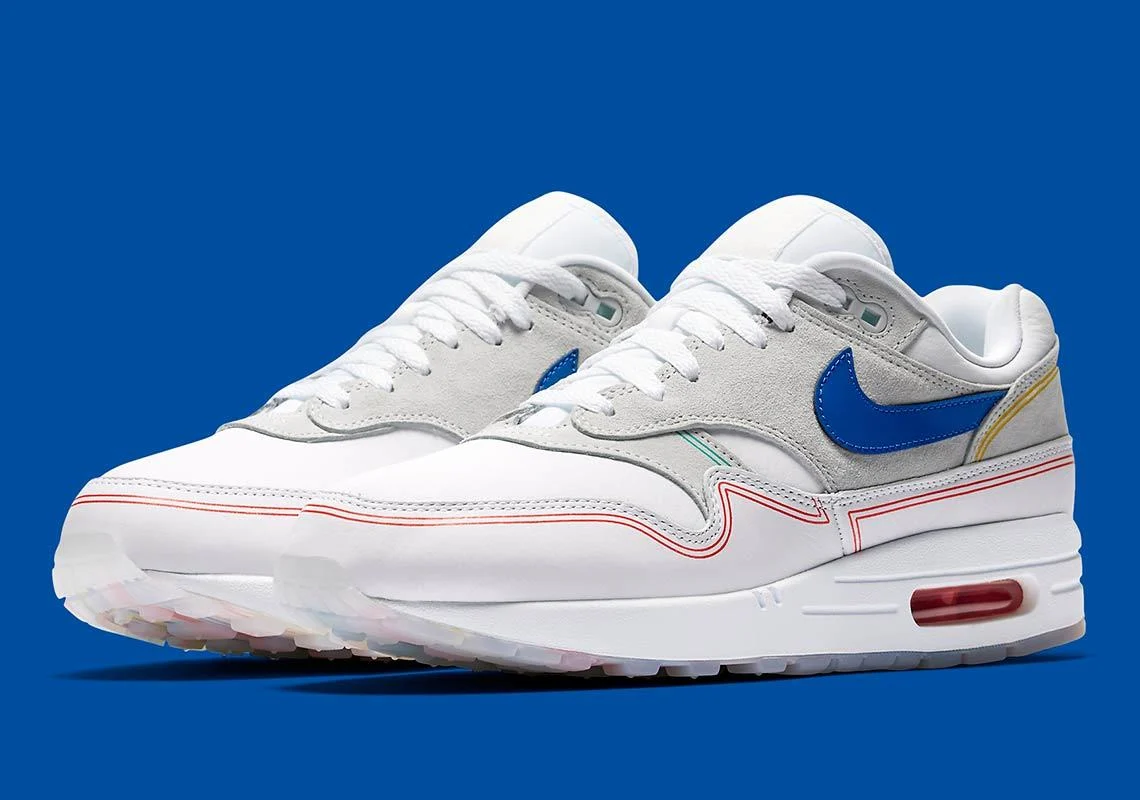
Opened in 1977, the Pompidou was an architectural provocation. Designed by Renzo Piano, Richard Rogers, and Gianfranco Franchini, the building appeared to be inside out. All the internal structure was exposed on the exterior: blue heating pipes, green air ducts, red escalators, yellow electrical cables. It was a celebration of functionality as aesthetics, a refusal to hide what made the building work.
Hatfield was fascinated. The Pompidou’s “inside-out” architecture became the catalyst for what would become one of the most important silhouettes of all time. If a building could be beautiful by exposing its guts, why couldn’t a shoe?
He returned to Nike’s headquarters and began visualizing and sketching different ideas, cutting away part of the midsole to expose the air pocket. Meanwhile, Nike’s Air lab was making technological advancements that would allow Hatfield’s vision to become a reality.
But there was internal resistance. Many at Beaverton thought the idea of making air visible was absurd, unfashionable, “too revolutionary.” Hatfield later commented: “It was widely discussed that I had gone too far. People were trying to get us fired.”
Undeterred, and with each new prototype, Hatfield inched closer to creating the Visible Air Unit. By 1986, his “masterpiece” was complete—though it faced launch issues due to reported problems, requiring adjustments before its re-release the following year.
March 26, 1987: The Day the World Stepped on Air
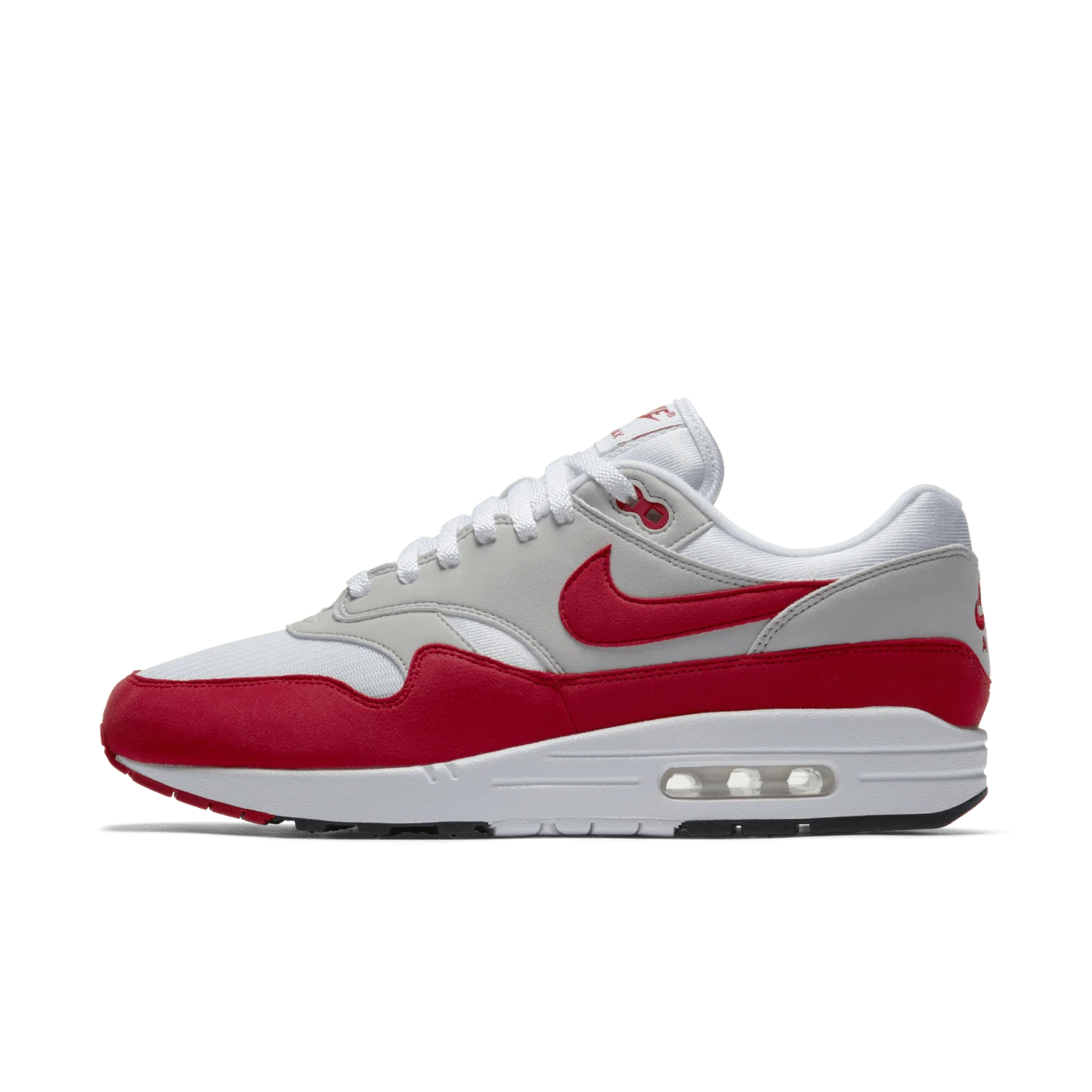
Finally, on March 26, 1987, the Nike Air Max 1 was officially released. It was the first shoe with visible Air cushioning—a window in the midsole that revealed the technology that had previously only been felt, never seen.
The design combined mesh and suede, providing not just breathability but also weight reduction. The visible air unit in the heel was a revolution in shoe design and laid the foundation for the successful Air Max series.
Hatfield explained his fundamental contribution: “My main contribution to the Air, if you will, was visualizing and sketching the idea that if we actually cut away part of the midsole and exposed the air bag so you could see it, then people could understand it. It was hard for anyone to comprehend Air, what that means.”
Você também pode se interessar por:


Another crucial element of the design process was the passage of light through the air bubble. Hatfield noted that, rather than being an opaque feature, “it was just a dark hole. We did some versions where it was just on one side. You needed to have light passing through it, so it was truly like a window.”

The original colorway—known as “University Red” or simply “Big Bubble” due to the generous exposed air unit—featured a light gray base with vibrant red suede overlays, white details, and the iconic red Swoosh. It was bold, it was different, it was… revolutionary.
Hatfield recalls a particularly revealing moment: “I remember sitting on an airplane with Mark Parker and we didn’t want anyone else to see the Air Max sample because we had just come from the factory. I was looking at it and he was looking at it, and we were looking at each other and saying, ‘Man, this is crazy!’ I remember both of us basically thinking the same thing: ‘This is nuts, but this is going to work, and people are going to go nuts!’”
And go nuts they did.
Immediate Impact and Lasting Legacy
The Air Max 1 wasn’t just a commercial success—it was an instant cultural phenomenon. The iconic silhouette sparked an immediate cultural frenzy, becoming a favorite among sneaker collectors and establishing a marketing formula that included striking imagery, clever messaging, and high-profile endorsements from the likes of Michael Jordan and John McEnroe.
But the impact of the Air Max 1 goes far beyond initial sales. It represented a paradigm shift in the footwear industry:
- Technology as Aesthetics: Before the Air Max 1, performance technology was functional but hidden. Hatfield proved that functionality could be beautiful, that engineering could be art.
- Sport-to-Fashion Transition: The AM1 helped build the bridge between the world of sports and fashion, showing that a performance shoe could be an object of aesthetic desire.
- Brand Identity: The visible “Air” became Nike’s distinctive signature, a visual identity that set the brand apart from all others.
- Sneaker Culture: The Air Max 1 helped found what we now know as sneaker culture. It proved that sneakers could be collectible, coveted, and part of a lifestyle.

The Evolution of a Legend: From Air Max 1 to Today
The success of the Air Max 1 opened the floodgates for an entire lineage of innovations. The Air Max Light (1989) reduced weight using a new two-piece midsole. The Air Max 90 (1990)—originally called the Air Max III—expanded the air window and introduced the iconic “Infrared” colorway that would define European street aesthetics for decades.
Each new Air Max model built on the legacy of the original, but all carried the visible heritage of the AM1: the refusal to hide technology, the celebration of the “inside-out” aesthetic Hatfield brought from the Pompidou. If you want to learn more about this evolution, check out our analysis of Nike’s most futuristic sneakers.
In 2013, during the Air Max celebration event in Paris—the “spiritual home” of the Air Max 1—Hatfield reflected on his creative process. Due to his disruptive and innovative approach, he is often called the “Thomas Edison of Sneaker Culture”. And for good reason. Hatfield illuminated our world with designs that revolutionized an entire industry.
He described his inspiration from the Pompidou as “romantic storytelling”—a narrative that connects art, architecture, engineering, and fashion into a single object.
The Story Behind the Story: Marion Franklin Rudy and Tinker Hatfield
It’s impossible to tell the story of the Air Max 1 without recognizing that it is, in fact, the intersection of two stories: the scientific persistence of Frank Rudy and the artistic vision of Tinker Hatfield.
Rudy, who passed away on December 12, 2009, at the age of 90, never sought the spotlight in the same way as athletes or designers. In one of his last interviews, you see a humble man who understood the magnitude of what he had achieved but never sought fame. Until his death, his invention had become so fundamental to Nike’s identity that it was genuinely difficult to imagine the company without it.
Every Air Jordan. Every Air Max. Every Air Force 1. Every visible air unit, every pressurized gas chamber, every innovation bearing the “Air” name—it all traces back to Rudy’s idea and his refusal to give up after 23 rejections.
Hatfield, on the other hand, became the public face of this revolution. Born on April 30, 1952, in Hillsboro, Oregon, he transformed his architectural background into a new language for shoe design. Beyond the Air Max 1, he created some of the most iconic sneakers in history, including the Air Jordan III, Air Jordan XI, and countless other Air Max models.
In 2014, Hatfield was inducted into the Footwear Hall of Fame, recognition of a career that not only revolutionized the look of athletic footwear but also contributed to the evolution of streetwear fashion.
The Air Max 1 Today: A Timeless Icon
Nearly four decades after its release, the Air Max 1 remains as relevant as it was in 1987. It is regularly re-released in original colorways and special collaborations, each generating virtual and physical lines of eager enthusiasts. Some of these collaborations have become the most valuable sneakers in the world.
Sugestões para você
 Top Air Jordan 1 Collaborations: A Legacy of Style, Culture, and Innovation→
- Is Flight Club Legit? Your Ultimate Guide to Buying Authentic Sneakers Safely→
- Best Sneaker Stores in Manhattan: Discover New York’s Ultimate Sneaker Heaven→
- Is Stadium Goods Legit? An Inside Look at the Premium Sneakerhead Haven→
- DS Sneakers Explained: What Is Deadstock & Why It’s Worth More Than VNDS or Used→
- Is Kickscrew Legit? Discover the Truth About This Global Sneaker Platform→






Air Max Day, celebrated annually on March 26 (3/26, referencing Air Max), has become a global event in sneaker culture, with Nike releasing special editions and celebrating the heritage of the line. It’s the equivalent of an annual drop that every sneakerhead eagerly awaits.
In 2015, Nike released the Air Max Zero—based on Hatfield’s original sketches for the Air Max 1, which were deemed “too futuristic” for 1987. The Zero was marketed with the slogan “The One before the One”, acknowledging that Hatfield’s vision was ahead of its time.
The influence of the Air Max 1 extends beyond Nike itself. It set the precedent that performance technology can—and should—be seen, that functionality is a form of beauty, and that creative boldness—even when “widely discussed” as having gone too far—is the path to true innovation.
The Air Max 1 also influenced other brand icons, such as the Air Max 97 with its futuristic design inspired by Japanese bullet trains, and the Nike Dunk, which shares the bold 80s aesthetic. Even modern collaborations like Nike x Off-White draw from the well of boldness that Hatfield opened in 1987.
Conclusion: Stepping on Air, Seeing the Future
The story of the Nike Air Max 1 is a story about vision—both literal and metaphorical. It’s about a NASA engineer, Frank Rudy, who envisioned the potential of air in our shoes after 23 rejections. It’s about an architect, Tinker Hatfield, who saw beauty in the exposed pipes of the Centre Pompidou in Paris and dared to apply that aesthetic to a shoe. It’s about a company that chose to take a risk when 23 others said no.
But more than that, it’s a story about how innovation happens when different worlds collide: aerospace and footwear, architecture and fashion, science and art. The Air Max 1 is not just an object; it’s a monument to persistence, creativity, and the refusal to accept limits. It’s about the courage to show the invisible, to transform what is hidden into something everyone can see, admire, and desire.
I’ve had the opportunity and joy of owning a pair of Air Max 1s in my collection. It’s not just a shoe; it’s an experience. The comfort is excellent! The style is timeless, matching everything from a casual look to something more sophisticated. And the variety of outfit combinations you can create with it? Endless. It’s a shoe that adapts to you, not the other way around.
When you wear an Air Max 1 today, you’re not just wearing a shoe. You’re stepping into the legacy of Frank Rudy, walking in the vision of Tinker Hatfield, and carrying a piece of history that proves sometimes the most revolutionary ideas are the ones everyone says are impossible—until someone makes them real. It’s a celebration of boldness, creativity, and the belief that the future can be shaped by those who dare to dream.
The Air Max 1 is more than footwear; it’s a symbol that innovation has no limits. And every time I wear it, I feel like I’m part of this incredible story of overcoming and transformation.
And in that visible window on the heel, you can see not just Air technology, but the reflection of two minds that refused to give up, turning the impossible into the iconic, one air bubble at a time.
Want to dive deeper into the history of the sneakers that changed the world? Explore our articles on the history of Tinker Hatfield, the evolution of Nike Air technology, and the 20 most iconic Nike sneakers of all time. If you’re new to the sneaker universe, check out our sneakerhead dictionary to understand all the terms of the sneaker world, discover what “OG” means, and what a “drop” is in sneaker culture.
