

Why a guy who designed buildings became the most important sneaker designer in history—and saved Nike from an uncertain fate
There’s a story few people know, but it defines everything we understand about sneakers today. In 1988, Michael Jordan was on the verge of leaving Nike. Frustrated with the Air Jordan 2—which he found rigid, uncomfortable, and lacking personality—the greatest basketball player in the world had one foot out the door. Adidas was waiting with open arms. Nike, which had built its empire around Jordan, was on the brink of losing its most valuable asset.
It was at this moment of crisis that an ex-architect, originally hired to design offices and stores, stepped in. His name? Tinker Hatfield. And he didn’t just convince Jordan to stay—he created a shoe that would forever change the relationship between sports, design, and pop culture. The Air Jordan 3 wasn’t just a sneaker; it was the act of salvation that kept one of the most profitable partnerships in sports history alive.
But that’s just one page of the story. To truly understand the magnitude of Tinker Hatfield, we need to go back to the beginning—and recognize how an injured athlete from the University of Oregon became the mastermind behind the most iconic shoes ever created.
From Tracks to Design: The Making of a Visionary
Tinker Hatfield was born in 1952 in Oregon, USA, and grew up in a family deeply connected to sports and creativity. His father, Tinker Hatfield Sr., was a legendary track and field coach, and young Tinker seemed destined to follow in the family’s athletic footsteps. At Central Linn High School, he excelled as a basketball player, a running back in football, and, most notably, as a track and field athlete—specializing in pole vault and hurdles.
In 1970, Hatfield was named the best high school athlete in the state of Oregon. His pole vaulting prowess earned him a spot at the University of Oregon, where something curious happened: his track coach was Bill Bowerman, the co-founder of Nike. Bowerman, famous for creating the first sneaker prototypes using a waffle iron in his garage, saw in Hatfield more than just a talented athlete—he saw a creative mind.
“I didn’t just tell him what I thought; I drew images with possibilities and revisions for him.”
— Tinker Hatfield on his relationship with Bill Bowerman
Hatfield studied architecture at the University of Oregon, graduating in 1977. During this time, he set college records in pole vaulting and even placed sixth in the 1976 Olympics. But a serious injury cut his athletic career short. This unexpected end pushed him fully into architecture.
After graduation, Hatfield worked at an architecture firm in Eugene until 1981, when he received an intriguing offer: Nike needed someone to design its first warehouses, stores, and showrooms. Hatfield accepted, moving to Beaverton without knowing he was about to redefine not just physical spaces, but the very concept of athletic footwear.
The Unlikely Transition: From Concrete to Leather
For four years, Hatfield designed buildings for Nike. He closely observed the company’s design culture but remained on the sidelines of the footwear creative process. Then, in 1985, everything changed.
Nike was in crisis. The company had laid off about 25% of its workforce, and there were “suspicions that some Nike designers weren’t that good,” in Hatfield’s words. The company needed fresh blood, different perspectives. In a desperate move, Nike organized a 24-hour design competition. Hatfield participated—and won by a wide margin.
The company’s reaction was direct: “You’re now a designer; forget about that architecture thing.”
This transition wasn’t just a department change; it was a methodological revolution. Hatfield brought fundamental architectural principles to footwear design: the idea that you can’t design a great house without knowing the people who will live in it. This user-centered approach—rare in the footwear industry at the time—would become his trademark.
“Architecture is, by nature, quite comprehensive. It’s technical and creative, and rich in cultural education.”
— Tinker Hatfield, named by Fortune as one of the 100 Most Influential Designers of the Century in 1998
The Air Max 1: When Paris Met Beaverton
In 1985, newly transferred to the footwear design team, Hatfield was given an apparently impossible mission: create something no one had ever seen before. Nike had developed Air technology—encapsulated air bags that provided superior cushioning—but there was a fundamental problem: no one could see the technology. And if you can’t see it, you can hardly appreciate it.
Hatfield was sent to Paris for inspiration. The City of Light is known for its classic, gilded, and imposing architecture. But it was one specific building, completely unconventional, that captured his attention: the Centre Pompidou.

Designed by Renzo Piano and Richard Rogers, the Centre Pompidou is an “inside-out” structure—all the piping, escalators, and structural systems are exposed externally, painted in vibrant colors. It’s a building that uses its own engineering as an aesthetic element. Hatfield had an epiphany: What if he did the same with the Air Max?
Back in Beaverton, Hatfield started sketching. He envisioned cutting part of the sole to expose the air unit—a visible window to the technology. The idea was controversial; many at Nike thought exposing the air bag would make it vulnerable to punctures. Hatfield nearly got fired for insisting on such a radical design.
But he persisted. In 1987, the Nike Air Max 1 launched—and changed everything.

The shoe featured a visible Air unit in the heel, combined with mesh panels, suede overlays, and vibrant colors. It wasn’t just a running shoe; it was a design statement. For the first time, technology wasn’t hidden—it was the visual protagonist.
The success was instant. Runners loved the comfort; sneakerheads (before the term even existed) loved the aesthetics. The Air Max 1 transcended its athletic roots to become an urban fashion icon. And, most importantly, it established a new paradigm: visible technology as an element of desire.
If you want to deeply understand how this technology works and why it revolutionized the market, it’s worth exploring our full article on the history of the Air Max 1 and the evolution of the Air Max line up to the iconic Air Max 97.
The Meeting That Changed Destiny: Tinker and Michael
While the Air Max 1 solidified Hatfield as a visionary, another crisis loomed. In 1987, Peter Moore, the designer of the first two Air Jordans, abruptly left Nike for Adidas—taking with him Rob Strasser, the executive who had signed Michael Jordan in 1984. The duo was determined to bring Jordan with them, offering him his own product line at the competitor.
Michael Jordan was dissatisfied. The Air Jordan 1, despite being iconic, didn’t offer the cushioning technology he needed—he had suffered a foot injury wearing the model. The Air Jordan 2, manufactured in Italy with luxurious leathers, was beautiful but stiff and uncomfortable. Jordan felt that Nike didn’t understand his needs as an athlete and a stylish individual.
Nike had one last chance: the Air Jordan 3. And Hatfield was assigned to the task—with only weeks to deliver a prototype.
But Hatfield did something no designer had done before: he didn’t just design a shoe; he listened to the athlete. He flew to Chicago and spent an entire day with Jordan. He watched him choose fabrics for suits at a tailor. He noticed his eye for materials and details. He realized Jordan wanted something between a basketball sneaker and an Italian luxury shoe.
“Michael had a very good sense of style. I don’t think anyone in the business had realized there were athletes capable of being true collaborators.”
— Tinker Hatfield
The presentation meeting was tense. Jordan arrived four hours late, coming straight from a golf game with Moore and Strasser—who had made a compelling pitch about their new brand. Phil Knight, Nike’s founder, waited patiently. The atmosphere was like a corporate funeral.
When it finally began, Hatfield didn’t show drawings first. He asked Jordan about his preferences—about the height of the collar, about soft leathers, about the Italian style he admired. Then, he revealed the prototype: “tumbled” leather that looked already broken in, elephant print on the heels and toe box (inspired by luxury bags), a mid-cut (never before seen in basketball shoes at the time), and, on the tongue, something that would change everything: the Jumpman logo.
Você também pode se interessar por:



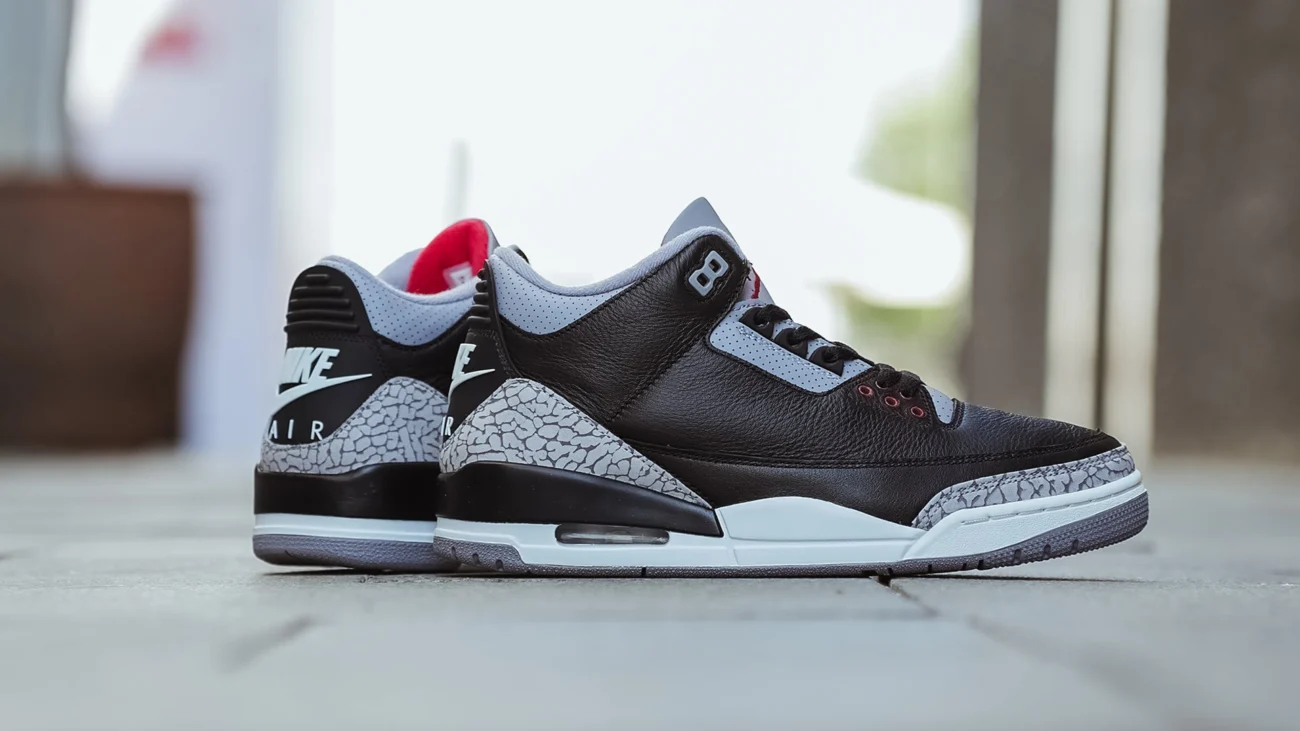
Jordan took the shoe from Hatfield’s hands. He examined it. Turned it over. And smiled. For the first time, someone had turned his words into reality. The Jumpman, previously just a marketing element, was now the center of the design. And the Swoosh? Hatfield removed it from the side, placing it only on the heel—a last-minute decision that created the independent visual identity of the Jordan line.
“It was a turning point. At the last minute, I chose to leave the Swoosh out and go with the Jumpman. There was some discussion with marketing people at the time, so I gave them a bone and put Nike on the back. Nobody knew. I had made the last-minute decision.”
— Tinker Hatfield
The Air Jordan 3 launched in February 1988. Michael Jordan wore it to win the Slam Dunk Contest—that famous free-throw line flight—and was named MVP of the season. The “Mars Blackmon” campaign, directed by Spike Lee, became legendary. And the Jordan line, which was dead before it began, became the cultural phenomenon we know today.
Phil Knight often says the Jordan 3 “saved Nike.” Hatfield, with his characteristic humility, recounts asking Jordan years later if it was true. Jordan replied that part of the decision to stay came from the shoe, but also from his father, who scolded him in the parking lot after the meeting for disrespecting Knight. “Don’t repeat that to Mr. Knight,” Hatfield joked, “because he thinks I’m the guy who really saved Nike.”
The Golden Era: Innovations That Defined Generations
After the success of the Jordan 3, Hatfield entered a prolific creative phase. He didn’t just design shoes; he told stories through them. Each model carried a narrative, an unexpected inspiration, a technical solution that seemed like magic.
Air Safari (1987): Inspired by an ostrich leather sofa he saw in a luxury furniture store in New York. After being kicked out by a snobby salesman, Hatfield decided to bring luxury “to the masses.” The result was the Safari print, which would become one of Nike’s most enduring patterns.
Air Trainer 1 (1987): The first cross-training shoe in history. Hatfield realized athletes didn’t want to change shoes between different activities. The model debuted on the feet of the controversial John McEnroe in the “Chlorophyll” color—and remains one of the most influential designs of the decade.
Air Tech Challenge II “Hot Lava” (1990): Created for Andre Agassi, with vibrant, deliberately “subversive” colors that reflected the tennis player’s rebellious behavior. It was a shoe that screamed rebellion in a traditionally conservative sport.
Air Huarache (1991): The idea came while Hatfield was water skiing. After falling into the water, he observed his neoprene boots and noticed how they stretched to fit any ankle shape. The result was a shoe with an inner neoprene sock and a supportive exoskeleton—light, comfortable, and revolutionary. The campaign asked: “Have you hugged your foot today?”
Air Jordan 5 (1990): Inspired by the shark teeth painted on World War II fighter planes. Hatfield looked to the sky and brought aeronautical aggression to the courts.
The list goes on: Air Max 90 (1990), Air Max 180 (1991), Air Max 97, and dozens of collaborations with athletes like Roger Federer, Pete Sampras, and Picabo Street. Hatfield designed the Air Jordans 3 through 15, the XX, and the XX3—the latter considered by many his sustainable masterpiece, reducing waste and eliminating solvent-based glues.
To better understand the anatomy of these legendary shoes, check out our complete guide to the anatomy of a sneaker and explore our list of the 20 most iconic Nike sneakers of all time.
The Legacy: Why Tinker Hatfield Matters
In 2019, Hatfield was still at Nike as Vice President of Special Projects and Innovation, continuing to work with Michael Jordan and mentoring new designers. His work isn’t just in museums—it’s on the feet of millions of people every day.
But Hatfield’s legacy goes beyond specific shoes. He changed three fundamental paradigms:
1. The Athlete as Collaborator: Before Hatfield, athletes were just endorsers. He demonstrated that athletes can be true creative partners, with valuable insights into design and style. This approach paved the way for collaborations like Nike x Off-White and the countless brand and creator partnerships we see today.
2. Technology as Aesthetic: The Air Max 1 proved that functionality can be beautiful. The “air window” wasn’t just technical; it was an element of desire. This influenced generations of designers to think about how to expose, not hide, innovations.
3. Narrative as Product: Hatfield never just designed a shoe; he told a story. Whether it was Parisian architecture, fighter plane shark teeth, or water skiing boots, each model carried a narrative that connected the product to broader culture. This transformed sneakers from sports equipment into cultural artifacts.
Sugestões para você
 Sneaker Stores in New York: The Ultimate Guide to Finding Your Perfect Pair→
- What Is a Sneaker Drop? The Ultimate Guide to Limited Releases & How to Cop→
- What Is an OG Colorway? Meaning of Original Colors in Sneakers→
- What Is a Sneaker Price Check? How to Find the Resale Value of Rare Sneakers→
- Best Sneaker Stores in Manhattan: Discover New York’s Ultimate Sneaker Heaven→
- What Does Nike NRG Mean? Understanding Nike’s Most Exclusive Line→






If you identify with the passion for sneakers and want to better understand this emotional connection, read our article on the psychology behind the love for sneakers and why we collect these objects of desire.
The Man Behind the Myth
What makes Hatfield’s story particularly human is his journey of reinvention. A promising athlete whose career was cut short by injury. An architect who never designed a skyscraper but drew the future of footwear. A designer who listens more than he speaks.
He remains an Oregon native, married, a father of three daughters, who volunteers as a track coach and turned his home into a space for teens to play pool and basketball. It’s the same community-centered approach he brought to Nike—the belief that design should serve people, not just profits.
“In the mid-1980s, the brand was falling behind competitors, and the only shoe at the top of the market was the Air Jordan 1. As an architect, I felt I could bring something new to the table in terms of design, especially compared to the shoes that were on the market at the time.”
— Tinker Hatfield in an interview with Designboom
This humility, combined with creative boldness, defines his work. He wasn’t afraid to take risks—he nearly got fired for the Air Max 1, bet everything on the Jordan 3—but always grounded his risks in genuine empathy for the user.
Conclusion: The Architect of Sneaker Culture
Tinker Hatfield is not just a sneaker designer. He is a cultural architect—someone who understood that footwear can be bridges between performance and expression, between technology and art, between athletes and dreamers.
When you wear an Air Max 1, you’re not just wearing cushioning; you’re wearing the vision of a man who saw beauty in an “inside-out” building in Paris. When you admire a Jordan 3, you’re not just looking at leather and rubber; you’re seeing the result of a genuine partnership between designer and athlete. When you experience a Huarache, you’re not just feeling comfort; you’re feeling innovation born from a water skiing accident.
Nike, now one of the most valuable brands in the world, may have many fathers—Bill Bowerman, Phil Knight, Michael Jordan—but Tinker Hatfield is, without a doubt, the architect who shaped its cultural empire. He proved that design isn’t just about how things look; it’s about how things work, how they tell stories, and how they connect people.
And in the end, that’s the true measure of a designer: not just creating products, but creating meaning. Hatfield did that, step by step, for nearly four decades. And we’re all—sneakerheads, athletes, collectors, dreamers—better for it.
Explore more about the sneaker universe:
• Learn the complete history of the Air Force 1, another icon that revolutionized the market
• Discover the evolution of the Nike Dunk and its role in skate culture
• Dive into the history of the Air Jordan 1, the shoe that started it all
• Check out the most expensive sneakers in the world and what makes them special
• See our selection of the 10 sneakers with the most futuristic Nike designs
• Explore our sneakerhead dictionary to master the culture’s vocabulary
• Understand what OG and Colorway mean in the sneaker world
• Find out what a Drop is and how the release market works
And you, what’s your favorite Tinker Hatfield design? The Air Max 1 that changed everything, the Jordan 3 that saved a company, or maybe a lesser-known but equally revolutionary model?
