The Nike Air Force 1 debuted in 1982 as a basketball shoe designed by Bruce Kilgore, becoming the first basketball model to incorporate Nike Air technology. What followed was less straightforward: it moved away from the center of Nike’s performance strategy, found a second life in Baltimore, spread along the East Coast, earned the nickname “Uptowns” in New York, and became a key part of the relationship between sneakers, hip-hop, streetwear, and fashion.
Designers, athletes, retailers, and local communities all gave the same shoe new roles. The basketball High, the Baltimore return, the white Low, and Nelly’s song belong to different moments. Following that sequence explains how the AF1 traveled so far beyond its original purpose.
When did the Nike Air Force 1 come out?
The Air Force 1 debuted in 1982. Nike dates its arrival at retail to late October of that year and credits the design to Bruce Kilgore.
Its technical significance lay in its cushioning: the AF1 was Nike’s first basketball shoe to incorporate Nike Air. The technology was already used in running shoes, with the Tailwind bringing Air to that category earlier. Calling the AF1 the “first Nike with Air” is therefore incorrect.
Who designed the Air Force 1?
The designer was Bruce Kilgore, an important figure in Nike’s footwear development history. The AF1 was more than an attempt to create a striking look: Kilgore was addressing specific basketball needs of the era and figuring out how to build a shoe around the new cushioning system.
Nike’s archive even shows an early prototype that used mesh for breathability. The marketing team ultimately favored leather construction, and that sturdier appearance became one of the silhouette’s recognizable features.
How did Bruce Kilgore design the Air Force 1?
The influence of the Nike Approach
One of Kilgore’s documented references was the Nike Approach, a hiking boot from Nike’s own range. The Approach had a heel construction that dipped lower at the back to reduce pressure around the Achilles tendon during uphill and downhill movement.
Kilgore applied some of that thinking to basketball support. This does not mean the Air Force 1 “almost became a hiking boot”; it means a solution from another kind of footwear helped him work through the AF1’s construction.
The outsole’s pivot circles
The outsole became recognizable for the concentric circles associated with pivoting in basketball. They provide a visible reminder of the athletic origins of a design now seen primarily on the street.
The original Air Force 1 was a High
The silhouette’s first retail chapter centers on the Air Force 1 High, with its ankle strap. The Low quickly gained ground as the line expanded and would be essential to the model’s move into lifestyle wear. The Mid belongs to a later stage of the story.
How does Nike Air work in the Air Force 1?
The Air Force 1 uses a pressurized Air unit encapsulated within its cushioning construction. In the classic AF1, it is hidden inside the midsole, unlike the visible window that defines the Air Max 1.
An early-1980s advertisement even showed a cutaway of the shoe to reveal the hidden Air-Sole. At launch, Nike advertised 30% more shock absorption and 20% more resilience than a “standard shoe.” These figures should be understood as Nike’s own historical advertising claims from 1982, not independent test results proving the superiority of today’s AF1.
Why is it called Air Force 1?
The name references Air Force One, the designation associated with the aircraft carrying the president of the United States. Nike, however, officially writes the sneaker’s name as Air Force 1, or AF1.
“Nike Air Force One” still appears in searches and casual conversation, but it is not the product’s official name.
1983 and the Original Six
In 1983, Nike featured six prominent NBA players in an Air Force 1 High campaign that became one of the best-remembered chapters in the model’s history.
- Michael Cooper;
- Bobby Jones;
- Moses Malone;
- Calvin Natt;
- Mychal Thompson;
- Jamaal Wilkes.
They became known retrospectively as the Original Six. They were not a single team; they were a promotional group of Nike athletes.
Moses Malone and the 1983 season
Moses Malone stood out because he was one of the leading players in professional basketball at the time and won the 1983 NBA championship with the Philadelphia 76ers. That reinforced the AF1’s connection to top-level basketball, but it does not make him the sole face responsible for its launch.
Was the Air Force 1 an instant success?
The model found an audience in basketball and in particular cities, but Nike’s approach at the time was to replace older products with new generations, without today’s system of ongoing retro releases.
That approach explains why the Air Force 1 came close to disappearing from the regular catalog. The chapter that changed its course took place in Baltimore.
How did Baltimore help save the Air Force 1?
Baltimore did not create sneaker culture on its own, nor was it the only city to embrace the AF1. It did, however, play an exceptionally important role in this particular silhouette’s survival.
The story centers on three local retailers: Cinderella Shoes, Charley Rudo Sports, and Downtown Locker Room. They recognized that local demand remained strong even as Nike moved toward other products.
Paul Blinken of Cinderella and Harold Rudo of Rudo Sports were among the retailers involved in discussions about bringing back the AF1. Their interest reflected local demand that had outlasted the product’s initial cycle.
1985: 3,000 pairs in Baltimore
Nike’s current official chronology dates the re-release to 1985. According to the brand, the three retailers brought the AF1 back in royal blue and chocolate brown, with 3,000 pairs in total.
Nike gives 3,000 pairs as the total for that reintroduction, not the quantity of each colorway.
1985 or 1986: When did the Air Force 1 return?
This helps explain the different timelines found online. Nike’s current timeline places the re-release in 1985. Another Nike history page says that, beginning in late 1985, the AF1 and Cortez were sold in limited quantities through the Shoe of the Month program.
The brand’s broader timeline identifies 1986–1991 as the “Shoe of the Month Club” era. The most precise way to reconcile these accounts is that Baltimore enabled an important reintroduction in 1985, and the limited-release strategy took shape from late 1985 into the following years.
Shoe of the Month or Color of the Month?
Both phrases appear in AF1 histories, but they should not necessarily be treated as the same official name.
Nike’s current documentation uses “Shoe of the Month Club” for the 1986–1991 period and describes selected stores offering exclusive or limited designs. Historical sneaker-culture accounts also use “Color of the Month” for the initiative led by Baltimore retailers.
The limited versions began attracting shoppers from other cities. Nike describes the AF1’s spread along the East Coast corridor connecting Baltimore, Philadelphia, and New York. Baltimore was crucial to its commercial return; adoption elsewhere expanded its significance in basketball, street fashion, and hip-hop.
How did the Air Force 1 become part of hip-hop?
The relationship did not begin with a single corporate campaign or one song. The AF1 was already circulating in East Coast urban communities when it began appearing more often in lyrics, photographs, cover art, music videos, and clothing associated with rap.
Nike itself records that by the new millennium, the white-on-white AF1 was closely enough associated with hip-hop to receive a Roc-A-Fella Records edition. Long before that, East Coast artists and communities already treated the AF1 as part of their style vocabulary.
Why are Air Force 1s called “Uptowns”?
“Uptowns” is a historic Air Force 1 nickname tied to the model’s enormous popularity in uptown Manhattan, particularly Harlem.
Harlem is central to this story, but the nickname spread through communities without a clearly documented individual originator.
There is another interesting detail: before the AF1, other sneakers, including the Pro-Keds 69er, had already been called “Uptowns” in parts of New York. The nickname became strongly associated with the Air Force 1 as the model rose to prominence.
White-on-white: How did the white Air Force 1 become a symbol?
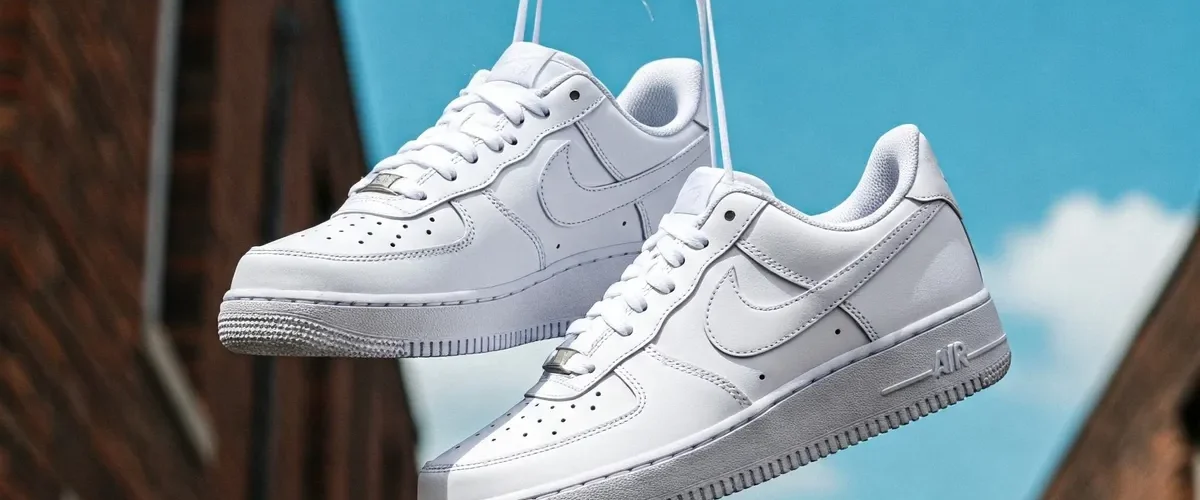
The all-white Air Force 1 Low is now one of the silhouette’s most immediately recognizable versions. Its cultural importance, however, should not be confused with a claim that it was necessarily “the first colorway in 1982.”
The white-on-white gained momentum through everyday wear and its association with New York, hip-hop, and the idea of a perfectly fresh pair. Rap, streetwear, and steady distribution turned it into a kind of cultural uniform across different communities.
Stories about wearing a pair only a few times or keeping white sneakers pristine are part of that mythology, but they should not be presented as rules followed by an entire city.
Did Nelly make the Air Force 1 popular?
No. In 2002, Nelly and the St. Lunatics released “Air Force Ones,” a song that brought the sneaker’s connection with rap to an enormous mainstream audience.
But the AF1 was already deeply rooted in hip-hop and East Coast culture. It is more accurate to say Nelly captured and amplified an existing popularity than to credit him with creating the phenomenon.
What was the first Air Force 1 colorway?
The answer depends on what counts as “first.” The Nike DNA archive documents a 1982 Air Force 1 High White/Silver prototype. It also documents Air Force 1 Pro Stock pairs in team colors that same year.
Another Nike DNA page identifies the 1983 White/Silver High as the “debut colorway” and an OG. Prototypes, athlete distribution, and retail debuts should not be compressed into a single claim.
The sound conclusion is that White/Silver belongs to the Air Force 1 High’s inaugural, OG configuration. The white-on-white Low that later dominated lifestyle culture is a separate chapter.
Air Force 1 Low, Mid, and High: Which came first?
The High is the silhouette’s original historical foundation. The Original Six are associated with the High and its distinctive ankle strap.
The Low gained ground very early and became especially important for casual wear and the white-on-white look. The Mid came later. It is therefore incorrect to say the Low, Mid, and High all launched together in 1982.
What is the Air Force 1’s dubrae?
The small metal or decorative piece on the laces is known in sneaker circles as a dubrae, or deubré. Different AF1 generations and editions have different versions of it, so it should not be treated as an identical component present on every original release.
What does Air Force 1 ’07 mean?
The Air Force 1 ’07 is a modern interpretation of the classic silhouette. “’07” refers to the update and the model’s 25th-anniversary era; it does not mean the Air Force 1 was created in 2007.
A current AF1 ’07 should not be described as physically identical to a 1982 pair, either. Construction, shape, materials, and suppliers can change across eras and versions.
How did the AF1 become a Nike Sportswear shoe?
The Air Force 1 began as basketball equipment, decades before Nike Sportswear existed in its current form. It endured precisely because it outlasted its performance relevance and gained a second cultural purpose.
Today, the classic AF1 is primarily a lifestyle/Sportswear product. For the broader change within Nike, read what Nike NSW means.
Key Air Force 1 collaborations
The AF1’s relatively simple design made it a recurring platform for collaborations, customization, and experiments with materials. Listing every project would turn its history into a catalog, but a few examples illustrate different eras.
Supreme
Supreme has worked on different Air Force 1 versions over the years, from more elaborate projects to a recurring collaboration based on the AF1 Low with understated branding. The relationship shows how the model fits a streetwear approach built on ongoing distribution and brand identity.
Nike x Stüssy
Stüssy has reinterpreted the AF1 at different points. In 2020, for example, it used tonal hemp on the Low; it later revisited the Mid as well. These projects connect the AF1 to Nike’s long relationship with streetwear, music, and urban culture.
AF-100: Virgil Abloh, Travis Scott, and others
For the model’s 35th anniversary in 2017, Nike brought together five collaborators to reinterpret the white-on-white AF1 for the AF-100 project. Virgil Abloh and Travis Scott were among them, but they were not the only participants.
Virgil’s AF1 connected directly to his work on The Ten, while Travis Scott explored removable elements, materials, and personal references. For more on the former, see the history of Nike x Off-White.
Louis Vuitton x Nike Air Force 1
Virgil Abloh also worked on the Air Force 1 at Louis Vuitton, but that project should not be confused with Off-White. The 47 Louis Vuitton x Nike Air Force 1 editions were presented in the men’s Spring-Summer 2022 collection, shown in June 2021.
In January 2022, Louis Vuitton, Nike, and Sotheby’s announced a charity auction of 200 special pairs; a broader release of selected versions followed through Louis Vuitton later in 2022.
Tiffany & Co. x Nike Air Force 1 1837
In 2023, Tiffany & Co. officially joined the model’s story with the Air Force 1 Low 1837, bringing one of the world’s best-known jewelers to a silhouette deeply associated with streetwear.
These projects do not place the AF1 in just one fashion category. They demonstrate its ability to move among sports history, streetwear, music, luxury, and design.
How many Air Force 1 colorways are there?
There is no sufficiently stable, real-time public count that supports a definitive answer. Nike has stated on official pages that more than 2,000 iterations of the Air Force 1 have been created.
That figure should be understood as the brand’s own historical statement, not a continuously updated tally of every colorway, collaboration, sample, and regional variation.
Is the Air Force 1 really Nike’s best-selling shoe?
Nike describes it as its best-selling shoe of all time. That superlative is the brand’s own claim.
Regardless of the superlative, the AF1 is among the longest-running and most recognizable products in Nike’s history.
Does Nike still sell Air Force 1s in 2026?
Yes. In 2026, the Air Force 1 family remains active in Nike’s catalog across multiple regions, with the AF1 ’07, Low, Mid, High, Shadow, premium editions, and other interpretations varying by market.
The family’s continued existence does not mean every colorway is permanently available. Stock, versions, and distribution change constantly. When shopping, check the exact style code, size, and current listing.
What about the 2026 Nike SB Air Force 1?
In 2026, Nike introduced a Nike SB Air Force 1 specifically modified for skateboarding. It has its own engineering, including a heel Air unit, a lower midsole for boardfeel, modified tread, and changes to fit and durability.
That does not make every historical Air Force 1 a Nike SB. The classic AF1 still has basketball roots and a primarily lifestyle role; the SB AF1 is a modern offshoot developed specifically for skateboarding.
Is the Air Force 1 still good for basketball?
The Air Force 1 has enormous historical importance in basketball, but a current lifestyle version is not a modern benchmark for competitive performance.
Today’s basketball shoes use very different geometries, foams, plates, rubber compounds, containment structures, and cushioning systems. Having Nike Air does not automatically make a heritage sneaker the ideal equipment for a modern game.
Are Air Force 1s comfortable?
That depends on your feet, the fit, and the version. The classic AF1 has sturdy construction, a relatively substantial midsole, and encapsulated Nike Air cushioning. Some people enjoy the firm, stable feel; others prefer lighter, softer modern foams.
There is therefore no basis for claiming that “Nike Air guarantees all-day comfort” for everyone.
Are Air Force 1s heavy?
They are often perceived as relatively substantial sneakers, but there is no single weight for “the Air Force 1.” Low, Mid, High, Shadow, Flyknit, ’07, and other versions use different materials and constructions.
Publishing a weight without specifying the version and size creates more confusion than useful information.
How do Air Force 1s fit?
Nike’s current official sizing guide describes the standard Air Force 1 as a model that generally runs large because of its roomy toe box. For a snugger fit, the brand recommends considering a half size down from your usual Nike size.
Nike says that people with wide feet may do better with their usual size. The recommendation should not automatically be applied to every version in the family, because different materials and midsoles can change the fit.
Why do Air Force 1s crease?
The upper has to flex as you walk. In leather or coated-material versions, that flexing can create creases, particularly across the toe box. This is normal behavior for many sneakers, not automatic evidence of a defect.
Size, internal volume, material, and walking style influence where creases form. See our guide to creases and toe box care.
Why can white Air Force 1s turn yellow?
A white AF1 can change in appearance because of dirt, oxidation, and the aging of different materials. That does not mean every pair will necessarily yellow in the same way or on the same timeline.
The sole, adhesives, upper, and finish have different compositions and can age differently. For more detail, read why white sneakers turn yellow and how to care for them.
OG, retro, and vintage Air Force 1s: What is the difference?
These words describe different concepts.
- OG: can refer to the original release or an original configuration or colorway, depending on the context.
- Retro/reissue: a later re-release of a historic model or configuration.
- Vintage: describes the age of an actual pair, rather than simply the year the silhouette was created.
An Air Force 1 made in 2026 does not contain 1982 materials just because the design dates to that year. Likewise, a recent White/Silver retro is not physically an OG pair preserved from the 1980s.
See our guides to OG, OG colorways, retro sneakers, and vintage sneakers.
Main sources
Explore the history of Nike and more articles on sneaker history and culture.