As listed by Guinness in October 2026, the auction record for a game-worn pair belongs to the Air Jordan XIII from the 1998 Finals: approximately $2.2 million. Michael Jordan’s Dynasty Collection reached $8,032,800, but it consists of six individual shoes, not a pair. That distinction changes the answer to which sneakers are the world’s most expensive.
The amounts below are historical results from identified sales. An asking price on StockX, GOAT, Flight Club, or eBay is not the same as money actually paid; an old sale does not establish what the same item is worth today, either.
Documented sales: Collections, pairs, and prototypes
Results are in nominal U.S. dollars, without inflation adjustments. Auction houses may publish totals that include the buyer’s premium; use the amount and category described by the source. A presale estimate is not a sale result.
| Item | Category | Sale price | Year |
|---|---|---|---|
| Dynasty Collection | Six individual shoes worn by Jordan | $8,032,800 | 2024 |
| Air Jordan XIII from the 1998 Finals | Game-worn, signed pair | Approximately $2.2 million | 2023 |
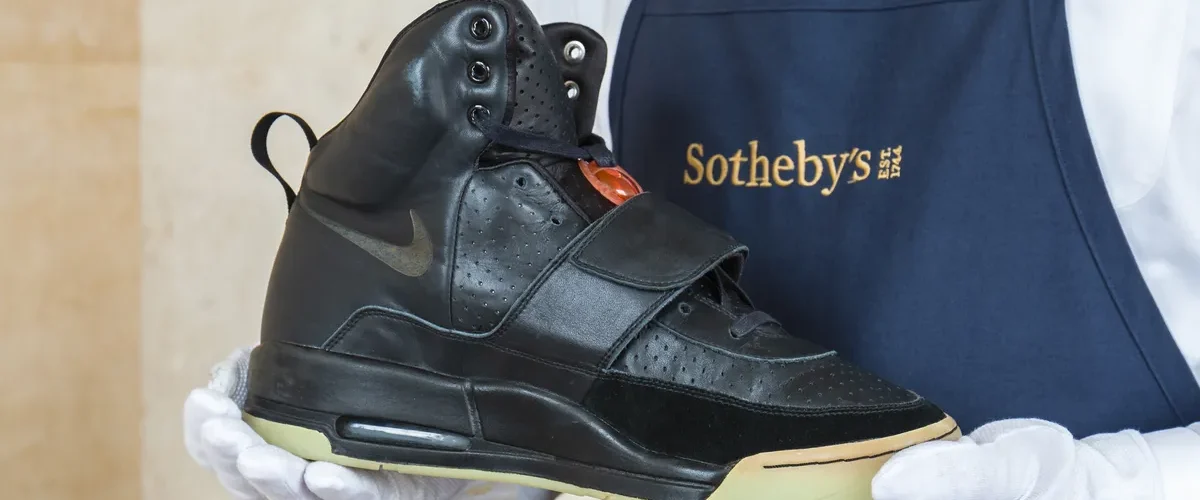
| Air Yeezy 1 Grammy | Prototype pair; private sale | $1.8 million | 2021 |
| Jordan’s Nike Air Ship | Game-worn, signed pair | $1,472,000 | 2021 |
| Air Jordan XII Flu Game | Game-worn, signed pair | $1,380,000 | 2023 |
| Air Jordan 1 Shattered Backboard | Game-worn 1985 pair | $615,000 | 2020 |
| Jordan’s 1985 Air Jordan 1 | Game-worn, signed pair | $560,000 | 2020 |
| 1972 Nike Moon Shoe | Unworn pair | $437,500 | 2019 |
| Jordan’s Converse from the 1984 Olympics | Game-worn, signed pair | $190,373 | 2017 |
Michael Jordan Dynasty Collection: $8,032,800
Sotheby’s sold the Dynasty Collection on February 2, 2024. Guinness records $8,032,800 for the collection of six shoes Jordan wore in the games that clinched his NBA championships.
The lot contains one shoe from each championship-clinching game:
- 1991: Air Jordan VI;
- 1992: Air Jordan VII;
- 1993: Air Jordan VIII;
- 1996: Air Jordan XI;
- 1997: Air Jordan XII;
- 1998: Air Jordan XIV.
According to the provenance published by Sotheby’s, Jordan gave the sneakers to Chicago Bulls executive Tim Hallam after each championship. The $8,032,800 price applies to the entire lot and should not simply be divided by six to create an “individual value” the market never established.
Michael Jordan’s “Last Dance” Air Jordan XIII: Approximately $2.2 million
Jordan wore the black-and-red pair in the second half of Game 2 of the 1998 Finals against the Utah Jazz and signed it. Guinness records the Sotheby’s sale on April 11, 2023, for approximately $2.2 million.
The result belongs to that specific game-worn pair, backed by its documentation. A retail Air Jordan XIII, even in the same colors, is a different collectible.
Nike Air Yeezy 1 Grammy Prototype: $1.8 million

Kanye West wore this Nike Air Yeezy 1 prototype at the 2008 Grammy Awards. In April 2021, Sotheby’s brokered a private sale to RARES for $1.8 million. The result was not a market price for a retail Air Yeezy or for the later Air Yeezy 2 Red October.
The same pair returned to the market and sold at Goldin for $180,106 in September 2023, according to Sneaker Freaker’s coverage. The 2021 transaction remains a historical fact, but it does not represent permanent appreciation.
Michael Jordan’s game-worn Nike Air Ship: $1,472,000
The pair Jordan wore and signed early in the 1984 season sold at Sotheby’s on October 24, 2021, for $1,472,000. An NPR report published by KPBS reproduces the auction house’s announcement of the result.
Jordan wore Air Ships before the Air Jordan 1 was ready. That connection to his NBA debut distinguishes the lot from a retail Air Ship or a recent reissue.
“Flu Game” Air Jordan XII: $1,380,000

In June 2023, the pair resold at Goldin for $1,380,000. UPI reported the result using the auctioneer’s announcement. It had previously sold for $104,765 at Grey Flannel Auctions in 2013.
Jordan wore it in Game 5 of the 1997 Finals, known as the Flu Game, and gave it to ball boy Preston Truman. This is a different pair from the 1997 shoe in the Dynasty Collection, which is associated with the championship-clinching game.
Air Jordan 1 “Shattered Backboard”: $615,000
Christie’s recorded $615,000 for the game-worn, signed Air Jordan 1 High Shattered Backboard Origin Story lot in its August 2020 Original Air sale. The official result applies to the 1985 pair, not the retro sneakers that later adopted the nickname.
Game-worn, signed 1985 Air Jordan 1: $560,000

On May 17, 2020, Sotheby’s sold a pair worn in a game and signed by Jordan for $560,000. The house announced the result as a world record at the time, surpassing the Moon Shoe’s 2019 sale.
The record was subsequently broken. A retail 1985 Air Jordan 1, however well preserved, does not automatically have the provenance of the Jordan-worn lot.
Nike Waffle Racing Flat “Moon Shoe”: $437,500

The 1972 pair sold at Sotheby’s in July 2019 for $437,500. Unworn, it set the sneaker auction record at the time, later surpassed by pairs associated with Michael Jordan.
Moon Shoe refers to the waffle sole’s marks, which were compared with lunar footprints. Its significance comes from Nike’s early history and the model’s construction; it belongs to a different category from a contemporary collaboration.
Michael Jordan’s Converse Fastbreak: $190,373

SCP Auctions reported $190,373, including the buyer’s premium, for the signed pair Jordan wore in the 1984 Olympic final against Spain. The sale took place in 2017.
It documents the period before the Air Jordan line. The result applies to the pair from that game, not to every Converse Fastbreak.
Rare resale sneakers: Why are they not in the same ranking?
The editions below help explain the collecting of retail pairs, collaborations, and samples. Their images identify models; they do not, by themselves, document a record-breaking sale.
To compare prices, identify the version, year, size, condition, box, and accessories. A 2005 original, a reissue, and a sample may look similar while belonging to different markets.
Air Jordan 1 x Off-White “Chicago”

The 2017 Chicago is part of The Ten by Virgil Abloh and Nike. When evaluating a pair, consider the edition and whether its accessories are complete. A retail DS pair is still a different category from memorabilia worn by Michael Jordan.
VLONE x Nike Air Force 1

The black-and-orange VLONE x Nike Air Force 1 Low comes from a limited-distribution collaboration. Compare the same release: the VLONE name also appears on other projects and samples.
Air Jordan 3 DJ Khaled “Grateful”

The Air Jordan 3 Grateful was associated with DJ Khaled’s album. Its distribution differed from a regular release; documentation, condition, and accessories help distinguish a complete example from an incomplete one.
Kanye West’s Louis Vuitton Jasper

The Jasper belongs to the 2009 Louis Vuitton x Kanye West collection. Named after Ibn Jasper, it combines a high-top cut with straps. The pictured Patchwork version uses shades of gray and a pink sole. Its history predates adidas Yeezy, but not the Nike Air Yeezy prototype seen at the 2008 Grammys.
Air Jordan 1 Dior High and Low


Dior and Jordan Brand created both High and Low Air Jordan 1 versions. Compare them separately, considering size, condition, and accessories. A shared collaboration name does not make their prices equivalent.
Tom Sachs NikeCraft Mars Yard

The Mars Yard is part of the NikeCraft project with Tom Sachs. Identify the generation and SKU before comparing pairs: different versions can have different materials, construction, and distribution.
adidas NMD Hu Pharrell x Chanel

The partnership brought adidas, Pharrell Williams, and Chanel together on the NMD Hu. The full collaboration name is necessary to distinguish it from other Pharrell NMDs, including similar color combinations.
Air Jordan 4 Manila

The Air Jordan 4 Manila was associated with the opening of Jordan Manila. Its green upper and textured details distinguish it from regular colorways. Production numbers cited by sellers require documentation, especially when used to justify a price.
Nike Air Force 1 “Entourage”

Entourage is associated with more than one Air Force 1 interpretation, including the Fukijama project. Check which version is listed and whether the seller provides identification and provenance consistent with it.
Travis Scott x PlayStation Dunk Low

Travis Scott’s PlayStation Dunk was tied to the PS5 campaign. It differs from the retail 2020 Travis Scott x Nike SB Dunk; do not use one shoe’s prices or production quantities to evaluate the other.
Air Jordan Kobe Pack 3/8

The Kobe Pack combines Air Jordan 3s and Air Jordan 8s in Lakers-related colors. A complete-set listing includes two pairs; an individual sale of one model is not directly comparable.
Nike SB Dunk Low “Freddy Krueger”

The Freddy Dunk is associated with samples of a project that never received a conventional retail release. Identifying it requires careful attention to provenance; Nike SB’s archive confirms the problems that prevented full production.
UNDEFEATED x Air Jordan 4

Distinguish the original 2005 collaboration from the 2025 reissue. The latter uses style code IB1519-200 and Nike Air heel branding, as documented in the release guide. The original’s rarity should not be transferred to the reissue.
Staple x Nike SB Dunk Low “Pigeon”

The 2005 NYC Pigeon is a chapter in Nike Dunk history. Identify the original edition, because the pigeon theme returned in other projects. A later colorway should not be valued as the 2005 New York release.
Nike Air Yeezy 2 “Red October”

Released in 2014, Red October belongs to the second generation of Nike Air Yeezy. It is not the Grammy prototype that sold for $1.8 million; that was a 2008 Air Yeezy 1.
Air Jordan 4 Eminem “Encore”

Pairs exist from the original 2000s edition and from a later charity-related recreation. Identify the year, version, and provenance before comparing values; Encore does not refer to just one production run.
Nike SB Dunk Low “Paris”

The 2003 Paris is tied to White Dunk and uses Bernard Buffet’s artwork on its panels. The artwork’s placement varies from pair to pair because it depends on how the material was cut. Comparisons need to account for the specific pair.
Nike Mag: 2011 and 2016 were different releases

The Back to the Future-inspired design had charity releases with technical differences. Motorized adjustment distinguishes the 2016 edition from the 2011 release.
Nike Mag 2011
Nike and The Michael J. Fox Foundation offered 1,500 pairs through eBay auctions. The 2011 announcement describes rechargeable lighting; motorized adjustment was not yet included.
Nike Mag 2016
The 2016 campaign offered 89 pairs with motorized adjustment through a charity draw and auctions. The foundation documents the campaign, including a final pair designated for its gala auction.
At a charity event, a bid may also reflect support for the cause. That context should accompany comparisons with ordinary resale transactions.
Why can game-worn sneakers be worth more than deadstock?
In resale of retail pairs, condition and lack of wear often matter. In memorabilia, documented use by an athlete in a specific game can be the very feature a buyer wants.
That explains why a worn pair from an NBA Finals game can sell for more than a DS example. Signatures, documentation, and the item’s history need to support its connection to the event.
What is provenance?
Provenance is documentation of an item’s origin and ownership history. Letters, collection records, and information about its transfer from the athlete to the first owner help assess the story a seller presents.
What is photomatching?
Photomatching compares an item’s features with photographs or video from the event: marks, stitching, patterns, and damage may allow it to be identified. Specialist companies perform this kind of memorabilia analysis.
A signature does not prove game use. Player-issued means the item was supplied to the athlete; PE identifies a player-exclusive version. Neither classification replaces proof that a shoe was game-worn.
Why does a $100,000 ask not mean a sneaker is worth $100,000?
An ask is an asking price; a bid is an offer. Last sale represents a transaction recorded on that platform for a particular size at a particular time. These are different kinds of information and should be read alongside the product’s condition.
For how purchases and verification work on each service, read our guides to buying on StockX, GOAT, and Flight Club.
What makes a sneaker reach such high prices?
The combination varies by item. For a retail pair, size, condition, box, accessories, and demand matter. For memorabilia, who wore it, the event, and documentation carry more weight. Scarcity without interested buyers does not establish a high price.
Are sneakers an investment?
A record sale does not guarantee future appreciation, as the Grammy Air Yeezy resale demonstrates. Fees, preservation, authenticity, and difficulty finding a buyer affect the outcome. A grail can have personal value without reaching auction-level prices.
How do you authenticate a high-value sneaker?
For retail pairs, gather photos of the actual shoes, labels, SKU, box, materials, and purchase documentation. The legit check guide explains the limits of visual assessment.
For memorabilia, add the chain of ownership, athlete-related documents, and a photomatch when applicable. The evidence needed to identify a model differs from the evidence needed to establish that it was worn in an NBA Finals game.
More collecting stories are available in 90Sneakers History and Culture.


