
Explore the timeless timeline of Nike’s history and discover how a small shoe importer transformed into the world’s largest sneaker empire. Dive deeper into our selections of top sneakers and innovations in technology:
- 1. The Dawn of an Empire (1970-1972)
- 2. The Birth of Identity: Name and Swoosh (1971-1972)
- 3. The Waffle Revolution: Innovation in the Kitchen (1971-1974)
- 4. Nike Cortez: The First Icon (1972)
- 5. Marketing and Culture: Building a Movement
- 6. Expansion and Structuring (1975-1979)
- 7. The Air Era: From Basketball to the Streets (1980-1989)
- 8. Just Do It: The Birth of a Philosophy (1988)
- 9. Air Jordan: The Cultural Revolution (1985-1989)
- 10. The Golden Era of the 90s: Globalization and Domination
- 11. The Genesis and Dominance of Nike SB: Skate Meets Hype (1997-Present)
- 12. The 2000s: Digital, Ethics, and Reinvention
- 13. 2010-2020: Flyknit, Vaporfly, and the Era of Cultural Collaborations
- 14. 2021-2026: Post-Pandemic, Technology, and the Future of Sneaker Culture
- Conclusion: For Sneaker Culture Lovers
- Complete Nike Timeline: Innovations and Collaborations (1970-2026)
1. The Dawn of an Empire (1970-1972)
The 1970s represent the most fascinating and transformative period in Nike’s history. Far from being just a sports footwear company, Nike in the 70s was an innovation lab, a story of American ambition, and above all, the materialization of a bold vision that began in the trunk of a car. At a time when the global sports market was dominated by established giants like Adidas and Puma, two unlikely men would start a revolution that would redefine not only how athletes dressed but how the world conceived the relationship between sports, style, and cultural identity.
It all began in 1964, when Phil Knight, a former middle-distance runner at the University of Oregon, and his former coach Bill Bowerman, founded Blue Ribbon Sports (BRS). With a modest initial investment of just $500 each—the equivalent of approximately $4,800 in today’s dollars—the two men started an operation that seemed more like an ambitious hobby than a multinational corporation in the making. Knight traveled to track meets on the West Coast of the United States, selling Onitsuka Tiger shoes (now ASICS) imported from Japan directly from the trunk of his blue Plymouth Valiant.
The choice of Japanese sneakers was not random. During his time at the Stanford Graduate School of Business, Knight wrote a seminal paper titled “Can Japanese Sports Shoes Do to German Ones What Japanese Cameras Did to German Cameras?” The thesis was bold: Knight believed that the superior quality of Japanese products, combined with cheaper labor, could challenge European dominance in the sports footwear market. What began as an academic hypothesis would, within a decade, become the most improbable reality in the business world.
The partnership between Knight and Bowerman was perfectly complementary, almost as if destiny had orchestrated their meeting. While Knight brought his business vision acquired at Stanford, fueled by an almost religious obsession with Japanese quality and import strategies, Bowerman contributed with a near-manic technical obsession for athletic performance. As a track coach at the University of Oregon, Bowerman was already legendary for his relentless pursuit of lighter and more efficient equipment for his athletes. He wasn’t just a coach; he was a born inventor, someone who believed that milliseconds could be gained not only through training but through engineering.
During the early years of Blue Ribbon Sports, Bowerman constantly experimented with the Onitsuka Tiger shoes that Knight imported. In his home workshop in Eugene, Oregon, he disassembled footwear, analyzed the anatomy of the sneaker in depth, and proposed modifications that he sent back to Japan. This informal collaboration became so valuable that Onitsuka began to seriously consider the suggestions of the American coach. Bowerman believed that the ideal shoe should be so light that the athlete would almost forget they were wearing it—a philosophy that would become the DNA of Nike.
Between 1964 and 1971, Blue Ribbon Sports grew organically, driven exclusively by word of mouth among athletes and coaches. In 1966, they opened their first physical store in Santa Monica, California, later expanding to Eugene. However, the true engine of growth remained on the roads: Knight traveled thousands of miles weekly, attending elite track meets, where his credibility as a former Oregon runner opened doors that would have been closed to traditional salespeople. He wasn’t just selling shoes; he was building a community.
2. The Birth of Identity: Name and Swoosh (1971-1972)
The year 1971 marked a turning point not only for the company but for the entire global sports industry. Relations with Onitsuka Tiger were deteriorating rapidly, fueled by mutual distrust, distribution problems, and a growing perception that the partnership had an expiration date. Knight and Bowerman realized they needed to create their own product line to survive, but this transition from distributor to manufacturer required something much deeper than just a new line of shoes: it required a completely new identity, a soul of its own.
The process of choosing the name was chaotic, almost comical, and absolutely emblematic of the improvised spirit that would define the company’s culture in the decades to come. Phil Knight favored **”Dimension Six”**, thinking it sounded futuristic, technological, and mysterious—qualities he associated with the emerging Silicon Valley. Other names on the table included “Falcon” and “Bengal,” attempts to evoke speed and animal strength. The company even printed some provisional materials with “Dimension Six,” a fact that today makes these items extremely rare collector’s pieces.
However, Jeff Johnson, the company’s first full-time employee and a marketing visionary ahead of his time, had an experience that would sound like corporate folklore if it weren’t documented by multiple sources. Johnson woke up one morning in 1971 with a vivid vision of a dream. The Greek goddess of victory, Nike, had appeared to him during the night, winged and majestic, and Johnson woke up convinced that this was the perfect name. He immediately called Knight, who initially rejected the idea—”It sounds like the name of a chewing gum,” he reportedly said—but finally gave in to Johnson’s passionate insistence.

It was then that Jeff Johnson, the company’s first employee, suggested a name inspired by Greek mythology.
This name was Nike, the goddess of victory.
In Greek mythology, Nike was represented as a winged deity who symbolized triumph, conquest, and success. Daughter of the Titan Pallas and the goddess Styx, Nike was often depicted alongside Zeus, personifying the very essence of victory in athletic and military battles. Her most famous representation, the Winged Victory of Samothrace, discovered in 1863 on the Greek island of Samothrace, became one of the most recognized icons of Hellenistic art—a marble sculpture that captures the exact moment of Nike’s landing on the bow of a ship, wings unfurled, robes wet with wind.
The name had perfect characteristics for a sports brand:
- Short and impactful, only two syllables
- Easy to pronounce in practically any language
- Strong competitive and universal symbolism
- Connotations of speed, grace, and transcendence through wings
- Connection to the Greek Olympic tradition, the cradle of the Modern Games
Thus, in 1971, Blue Ribbon Sports officially became Nike. The name change was accompanied by a profound transformation in the company’s structure. Knight and Bowerman were no longer just importing and selling; they were about to create something entirely new.
Why is the statue headless?
The statue was created around 190 BC, during the Hellenistic period of Greece, possibly to commemorate a naval victory. Over more than two thousand years, parts of the sculpture were lost in the depths of time.
When it was discovered in 1863, on the Greek island of Samothrace by French archaeologist Charles Champoiseau, it was already dramatically incomplete. Missing were:
- The head, never recovered
- The arms, lost to erosion
- Parts of the wings, fragmented
- The original ship-shaped base
These pieces were likely destroyed by time, earthquakes, or simply never found in the excavations. Curiously, this incompleteness made the Winged Victory of Samothrace even more mysterious and fascinating, perhaps symbolizing that victory is never total, always a process under construction—a perfect metaphor for a startup’s journey.
The Creation of the Swoosh: $35 That Changed the World
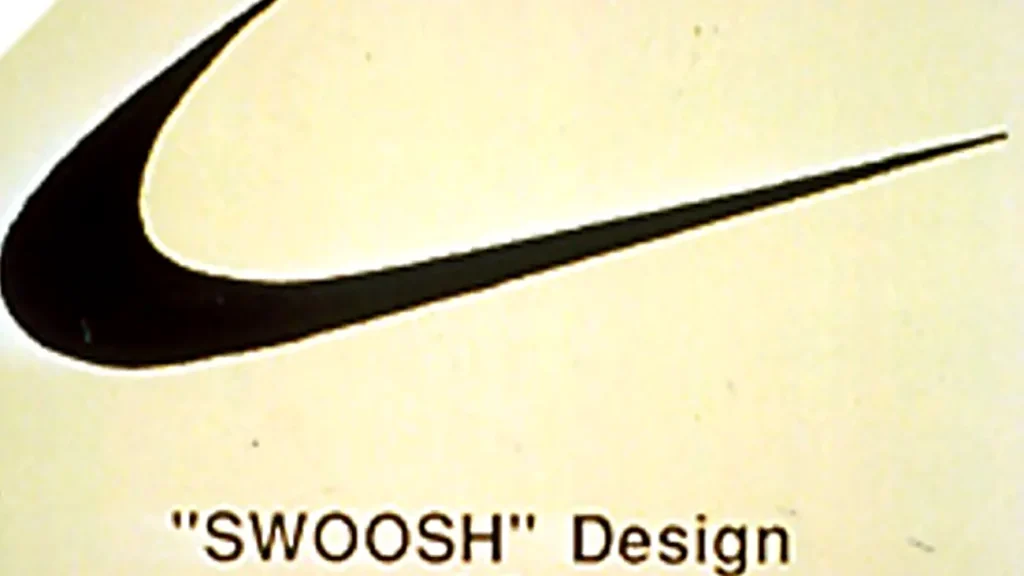
The creation of the Swoosh (the inverted checkmark symbol) was equally improvised, unpretentious, and, in retrospect, absolutely revolutionary. In 1971, Phil Knight, still an accounting professor at Portland State University to supplement the income of the fledgling company, found himself with an urgent need: he needed a logo for the new shoes that were being developed, and he needed it quickly.
Knight approached Carolyn Davidson, a graphic design student at the university whom he knew from an art class. Davidson, then 28 years old, accepted the freelance job. The brief was vaguely defined: Knight wanted something that represented movement, speed, something that suggested the wings of the goddess Nike without being too literal. Davidson worked for approximately 17 hours, creating various sketches that ranged from obvious wing designs to geometric abstractions.
When she presented her concepts, Knight hesitated. He chose the Swoosh—a fluid and dynamic curve that resembled both a wing and a streak of speed—but admitted with characteristic honesty: “I don’t love it, but I’ll grow to like it.” The payment? $35—approximately $2 per hour of work, a value that today sounds like the most lucrative deal in design history.
What Knight didn’t realize at the time was that Davidson had created not just a logo, but a cultural icon in the making. The Swoosh worked on multiple symbolic levels: it evoked the wings of the goddess Nike, suggested the sound of something cutting through the air at high speed, and had a geometric simplicity that made it instantly recognizable at any scale, from a shoelace to a giant billboard.
Carolyn Davidson’s story didn’t end in 1971. In 1983, when Nike was already a publicly traded company and the Swoosh had become one of the most valuable symbols in the corporate world, the company invited Davidson to a special ceremony. As a gesture of recognition, she received a gold ring encrusted with a diamond Swoosh and an undisclosed amount of company stock—a gesture of gratitude that turned her story into one of the most inspiring narratives in corporate design.
Today, Carolyn Davidson is recognized as the creator of one of the world’s most valuable logos, estimated to be worth tens of billions of dollars in brand value. The Swoosh has become a symbol of speed, movement, and victory—exactly what the goddess Nike represented in Greek mythology. But more than that, it has become a cultural phenomenon that transcends sports, appearing in art galleries, political protests, fashion runways, and street movements around the globe.
3. The Waffle Revolution: Innovation in the Kitchen (1971-1974)
If there is one story that encapsulates the innovative spirit of 1970s Nike, it is undoubtedly the creation of the waffle sole. This invention, born not in a sophisticated engineering lab but in a coach’s home kitchen, became the perfect symbol of what Nike would represent in the following decades: innovation through careful observation of the everyday world, a willingness to experiment without fear of failure, and the belief that great ideas can come from unexpected places.
In 1971, the University of Oregon decided to replace its traditional cinder track with a synthetic polyurethane surface—a change that reflected the growing modernization of American athletic facilities. Bill Bowerman, always obsessed with the balance between traction and lightness, faced an apparently unsolvable technical dilemma: how to create a sole that would grip this new smooth surface efficiently without resorting to traditional metal spikes, which increased weight and impaired athletes’ performance?
The Epiphany at the Breakfast Table
The inspiration came from a place as unexpected as it was profane: the breakfast table in Bowerman’s own home. One morning in 1971, while his wife Barbara was making waffles for the family, Bowerman observed the square grid pattern of the waffle iron. The square depressions created a perfect surface for holding maple syrup, but in the mind of the coach-inventor, they represented something much more valuable: an ideal traction pattern.
The epiphany was instant and irresistible. Bowerman realized that a similar pattern of small square cavities in a rubber sole would create multiple points of contact with the track, drastically increasing grip without adding significant weight. The concept was ingeniously simple: instead of trying to increase friction through stickier materials or complex textures, he would create a geometry that maximized surface contact while minimizing mass.
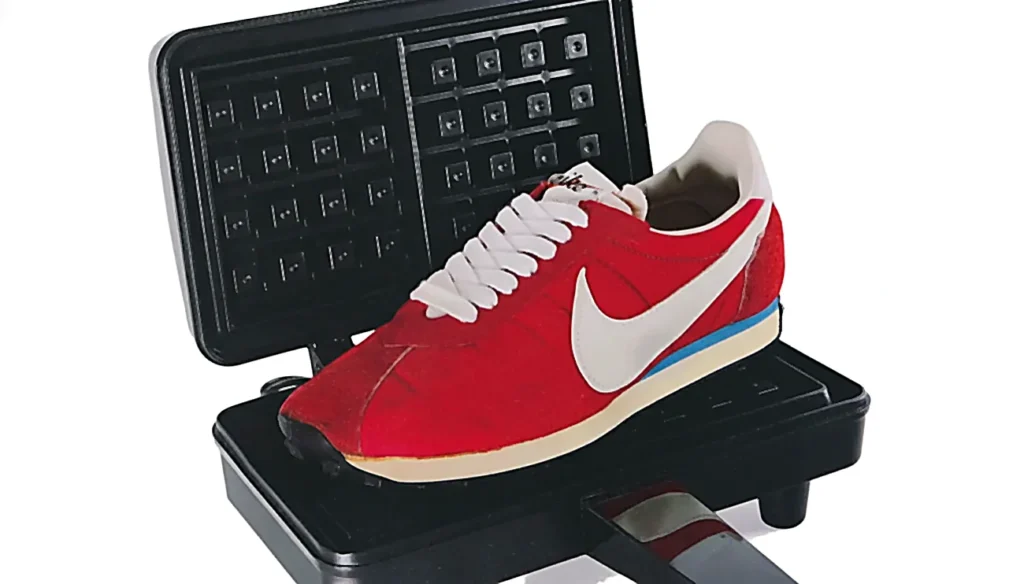
Immediately, Bowerman went to his “laboratory”—actually an improvised workspace in the garage or basement of his home in Eugene—and began experimenting with almost manic fervor. He poured liquid urethane rubber directly into his wedding waffle iron, crucially forgetting, in his excitement, to apply any non-stick agent or cooking spray. The result was predictable for anyone who has ever cooked, but catastrophic for the household appliance: the rubber hardened and permanently stuck to the grooves of the iron, rendering it useless for its original culinary purpose.
Barbara Bowerman, according to family accounts, was not particularly impressed with the destruction of her wedding appliance. However, the “accident” represented the birth of a revolution in the sports footwear industry. The waffle pattern created in that damaged iron provided exactly what Bowerman was looking for: a surface with countless small cavities that flexed independently, creating multidirectional traction while keeping the sole incredibly light.
From Prototype to Patent: The Birth of the Waffle Trainer
The first waffle sole prototypes were truly handcrafted. Bowerman manually cut the rubber urethane patterns, gluing them onto existing soles and testing them with his athletes at the University of Oregon. The process was laborious and imprecise, but the results were undeniable: runners reported a superior “grip” feeling on the new polyurethane track, combined with a lightness that seemed almost surreal.
On February 26, 1974, after years of refinements and extensive testing, Nike received U.S. Patent No. 3,793,750 for the waffle sole. The patent document described in detail a “sports shoe sole with a waffle configuration,” legally protecting the innovation that would become the company’s technical signature in the 1970s. The patent covered not only the general concept but specified the optimal dimensions of the cavities, their geometric arrangement, and the ideal composite materials—a level of technical detail that demonstrated the scientific seriousness behind what seemed like a simple idea.
The Waffle Trainer, officially launched in 1974, represented Nike’s first major commercial success. With its royal blue nylon upper dramatically contrasting with the vibrant yellow Swoosh, the model had a visual aesthetic as distinctive as its technical performance. The design was deliberately bold—while competitors like Adidas favored discreet tones of white and gray, Nike embraced colors that screamed confidence and youth.
The commercial success was overwhelming and immediate. By 1975, the Waffle Trainer had sold over 100,000 units—an extraordinary number for a company that, three years earlier, operated out of the trunk of a car. This success not only established Nike as a serious force in the athletic footwear market but also philosophically validated Knight’s business model: genuine technical innovation, sold directly to athletes through specialized channels, could compete with established giants that relied on mass marketing and traditional distribution.
The Waffle Trainer also marked a turning point in the brand’s visual identity. The waffle pattern became so recognizable that the sole of the shoe itself functioned as walking advertising. Athletes who wore Nike left distinct footprints on training tracks—a form of organic marketing that the company couldn’t have bought at any price. The “waffle footprint” became a status symbol within the running community, indicating that the wearer was at the forefront of sports technology.
4. Nike Cortez: The First Icon (1972)
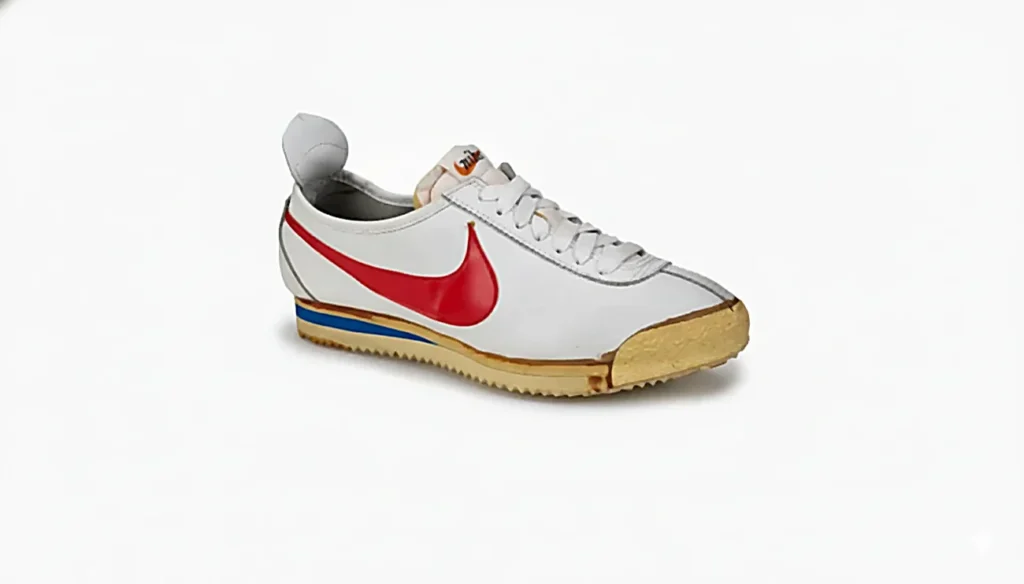
While waffle technology revolutionized traction and lightness, another creation by Bill Bowerman was about to set a completely new standard for comfort in running shoes. The Nike Cortez was not just another sneaker; it was the brand’s first true icon, a product that would transcend its original utilitarian function to become a lasting cultural artifact. Its story perfectly illustrates how Nike, even in its infancy, already had the ability to create objects of desire that combined technical innovation with a powerful emotional narrative.
The development of the Cortez began, paradoxically, in 1968—three years before the company was even called Nike. Bowerman, still working as a coach at the University of Oregon and a partner at Blue Ribbon Sports, identified a critical unmet need in the market: a shoe that offered genuine cushioning for long-distance runners. At the time, most running shoes were essentially minimalist—thin rubber soles that offered little protection against the repetitive impact of running on asphalt or hard tracks.
The Cortez made its official debut on May 30, 1972, during the Munich Olympic Games—a global stage that Nike carefully chose to introduce its flagship to the world. The choice was not accidental: the Olympics represented the pinnacle of world athletics, and the presence of American athletes wearing the new shoe would provide instant credibility and international visibility that years of traditional marketing couldn’t buy.
Revolutionary Technical Innovation
The Cortez introduced a technical innovation that seemed simple in retrospect but was revolutionary at the time: the first full-length midsole combined with a layer of spongy rubber strategically positioned beneath the upper. This layered construction—durable rubber outsole for durability, soft foam midsole for cushioning, and a comfort layer close to the foot—created an impact absorption system previously unknown in American running shoes.
The geometry of the Cortez also reflected Bowerman’s obsession with the biomechanics of running. The heel was slightly higher than the forefoot, a configuration that reduced tension in the Achilles tendons and allowed for a smoother transition from heel impact to toe-off. This internal “wedge,” combined with the variable-thickness foam, distributed the body’s weight more evenly during the stride, reducing fatigue and potentially preventing repetitive stress injuries.
The original launch price was approximately $12—equivalent to about $85 in today’s dollars adjusted for inflation. This pricing strategy was deliberate: significantly more expensive than generic department store sneakers but affordable enough for serious amateur runners. Knight understood that his target market wasn’t just Olympic elites but dedicated runners who were willing to invest in superior equipment to improve their personal performance.
The commercial success was as immediate as it was overwhelming. The Cortez sold so quickly that the young Nike company faced serious inventory and supply chain management issues—growing pains that, while stressful, represented the kind of “good problem” that validated the explosive demand for its products. Lines formed at specialty stores, and Nike frequently sold out its entire production before containers even arrived from Japanese manufacturers.
Beyond commercial success, the Cortez played a crucial role in solidifying the brand’s identity. It was the first product to prominently feature the “Nike” name and the Swoosh, marking the definitive and irreversible transition from Blue Ribbon Sports to the new era. For many consumers, the Cortez was their first introduction to the brand—an impression that would create lasting associations of quality, innovation, and distinctive athletic style.
Cultural Curiosity: From Corsair to Cortez
Originally, Bowerman named the model “Corsair”—a reference to the fast and agile ships associated with piracy and maritime exploration. The name evoked speed, adventure, and a certain romantic rebellion, qualities that Bowerman admired and that reflected the emerging jogging culture in the United States. However, as the launch approached, the marketing team led by Phil Knight felt that a more impactful, memorable, and conquering name was needed.
The decision to rename the model Cortez in reference to the Spanish conquistador Hernán Cortés was a bold, controversial, and absolutely revealing marketing choice of the brand’s unbounded ambition. Hernán Cortés was the Spanish explorer who led the conquest of the Aztec Empire between 1519 and 1521, destroying a millennia-old civilization and establishing Spanish dominion over Mexico. The association was intentionally provocative: just as Cortés conquered an empire with a determined small force, Nike aspired to conquer the American sports footwear market, dominated by established German giants.
The choice of name reflected the “guerrilla” mindset that would characterize Nike in its early decades. Knight and Bowerman saw themselves as innovative underdogs challenging corporate empires—a narrative that would resonate deeply with post-Vietnam War American culture, which valued individualism, determination, and overcoming seemingly impossible odds. The Cortez wasn’t just a shoe; it was a commercial declaration of war disguised as athletic footwear.
5. Marketing and Culture: Building a Movement
The Nike of the 70s didn’t just sell sneakers; it sold a philosophy of life, a mindset, an identity. While established competitors like Adidas and Puma obsessively focused on technical specifications, premium materials, and European heritage, Nike began building emotional narratives around athletics that spoke directly to the psychological aspirations of its consumers. This revolutionary approach would transform not only the company but the entire sports marketing industry in the decades to come.
Phil Knight intuitively understood something that his competitors would take decades to learn: athletes, especially amateur runners, didn’t buy equipment just to run faster. They bought to feel part of something bigger, to affirm an identity, to achieve personal transformation. The sneaker was just the vehicle; the emotional journey was the real product.
“There Is No Finish Line” (1977)
One of the first and most enduring examples of this philosophical approach was the “There Is No Finish Line” campaign, launched in 1977. This pioneering campaign represented a radical break from conventional sports advertising of the time. Instead of showing athletes winning competitions, technical close-ups of products, or lists of specifications, the campaign featured poetic images of solitary runners in natural landscapes, accompanied by texts that explored themes of perseverance, self-discovery, and continuous journey.
The slogan “There Is No Finish Line” perfectly encapsulated Nike’s emerging philosophy. It suggested that athletics wasn’t about destinations—winning races, breaking records—but about the eternal process of personal overcoming. This message resonated deeply with the jogging movement that was exploding in the United States in the 1970s, where millions of Americans began running not to compete but for health, mental clarity, and personal fulfillment.
The campaign sold a feeling, a mindset, a lifestyle—not a specific product. The ads rarely highlighted particular sneaker models; instead, they created an atmosphere of athletic aspiration that the Nike brand personified. It was the beginning of a strategy that would transform Nike from a shoe manufacturer into a builder of culture, from a product company into a company of meaning.
Phil Knight’s marketing strategy was equally innovative in its apparent simplicity. One of his first and most effective advertising tricks was to state, with characteristic statistical precision, that “four of the top seven finishers” in the men’s marathon at the 1972 Munich Olympics had competed wearing Nike footwear. This statement, factually true, created a powerful association between the brand and athletic excellence without resorting to empty superlatives or exaggerated promises.
Knight’s approach to athlete marketing was also revolutionary for its time. While Adidas and Puma focused on sponsoring established champions with lucrative contracts, Nike began investing in emerging athletes, young talents who had not yet achieved international stardom. This strategy was financially necessary—the company simply couldn’t compete for the biggest names—but it was also philosophically aligned with the brand’s underdog identity. Nike bet on potential, not pedigree; on the future, not the past.
The company also began cultivating direct relationships with track coaches at the collegiate and university levels—a network that Bowerman had built over decades in Oregon. These coaches, many of them former athletes of Bowerman or admirers of his methodology, became unofficial evangelists for the brand, recommending Nike to their athletes and creating an organic loyalty base that resisted larger competitors’ advertising campaigns.
6. Expansion and Structuring (1975-1979)
By the end of the 70s, Nike had completely transcended its humble origins to become a structured, professional, and ambitiously innovative company. What had started as an artisanal operation run by two obsessed men had evolved into an organization with hundreds of employees, international distribution, and an innovation pipeline that threatened to permanently redefine consumer expectations for sports footwear.
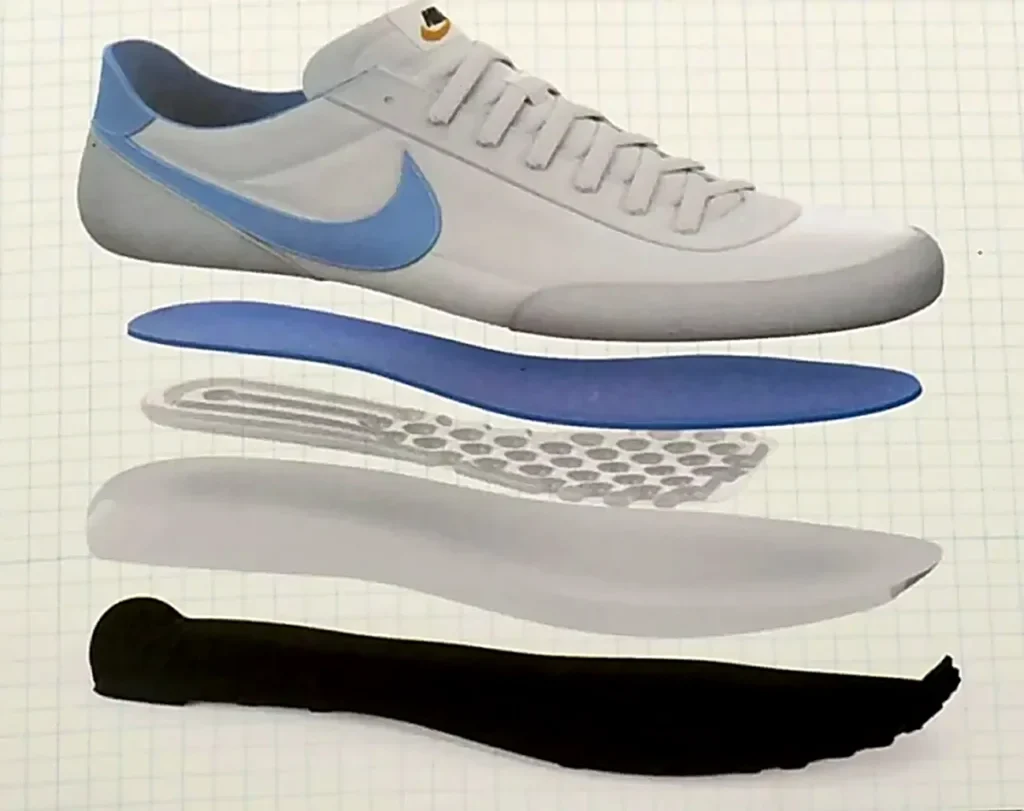
In 1978, the company introduced an innovation that promised to revolutionize the industry as deeply as the waffle sole had done four years earlier: Nike Air technology. Developed in collaboration with Frank Rudy, an aerospace engineer from NASA who had worked on astronaut helmet projects, Air technology consisted of flexible plastic bags filled with inert gas, inserted into the midsole of the shoe to provide superior cushioning with minimal weight.
The first model to incorporate this revolutionary technology was the Air Tailwind, launched in 1978. The concept was ingeniously counterintuitive: instead of using dense foams that degraded over time and with use, the Air Tailwind used compressed air capsules that compressed under impact and instantly returned to their original shape, creating a “floating” sensation that runners described as unprecedented. The innovation represented the application of aerospace technology—literally developed to protect astronauts—to mass-market athletic footwear.
Production evolved dramatically from artisanal to industrial during this period. While the first waffle prototypes were literally hand-cut in Eugene, Oregon, by Bowerman and assistants, the company established sophisticated relationships with specialized manufacturers in Japan and, later, in South Korea and Taiwan. This shift to Asian manufacturing, driven by competitive costs and growing technical expertise, would establish the global supply chain model that would become characteristic of the apparel industry in the following decades.
Nike Air represented more than just a new technology; it symbolized the future of the company. While the waffle sole had been a homemade invention, born from careful observation and practical experimentation, Air demonstrated that Nike was mature enough to invest in sophisticated R&D, collaborate with specialized engineers from other industries, and develop innovations that competitors would be unable to easily replicate. It was a declaration that the company had evolved from an artisanal disruptor to a systematic technological innovator.
By 1979, as the 70s came to a close, Nike had already sold millions of pairs of shoes, established a presence in international markets, and built a recognizable and aspirational brand identity. The boy who sold shoes from the trunk of a Plymouth Valiant had become the CEO of a company that threatened the hegemony of established giants. The coach who poured rubber in his kitchen had revolutionized the biomechanics of sports footwear. And the Swoosh, designed by a student for $35, had become one of the most recognized symbols on the planet.
The period from 1970 to 1979 established the foundations for one of the most influential companies of the 20th century. But more important than any patent, marketing campaign, or technological innovation, this decade forged a unique corporate culture: the belief that innovation can come from anywhere, that underdogs can defeat giants, and that sports are about much more than competition—they’re about the continuous pursuit of human potential. These values, established in the 70s, would continue to guide Nike through the following decades, transforming a small distributor of Japanese sneakers into a global empire of culture, style, and innovation.
7. The Air Era: From Basketball to the Streets (1980-1989)
When the 1980s began, Nike was no longer that artisanal company born in the trunk of a Plymouth Valiant. But it wasn’t yet the cultural empire we would come to know. It was a company in transition, caught between its running origins and the explosive future that basketball and urban lifestyle promised. What happened in the 80s was not just evolution—it was metamorphosis. And it all started with air. Compressed air, encapsulated, invisible at first, visible later. Air that you could feel under your feet with every step, air that would transform not only athletic performance but the very aesthetics of sports footwear.
At the start of the decade, American sports were experiencing an unprecedented boom. Road running, which in the 70s had been a counterculture hobby, had become a national fever—millions of Americans filled the streets on Sunday mornings, wearing short shorts and light sneakers. Basketball, driven by the magical rivalry between Magic Johnson and Larry Bird, gained prime-time national broadcasts, becoming a mass spectacle. And aerobics, with its colorful outfits and contagious energy, transformed into a lifestyle for a generation obsessed with fitness. Nike, which had launched Air technology in 1979 with the modest Tailwind, was still fiercely competing with Adidas, the German giant that dominated global markets with decades of tradition, and with a new growing threat: Reebok, which was quickly winning the hearts of female consumers with colorful aerobics shoes and designs specifically aimed at the female public.
Reebok was growing alarmingly fast. Its Freestyle models, launched in 1982, perfectly captured the spirit of 80s aerobics—vibrant colors, high tops, aesthetics that spoke of dance and movement. Nike, traditionally focused on the serious athlete, the dedicated runner, the elite competitor, realized it needed to evolve. It needed to conquer basketball, a sport that dominated American television and created instant cultural icons. It needed something that not only performed better but looked radically different. Something that told a powerful visual story.
Air Force 1: The First Empire (1982)
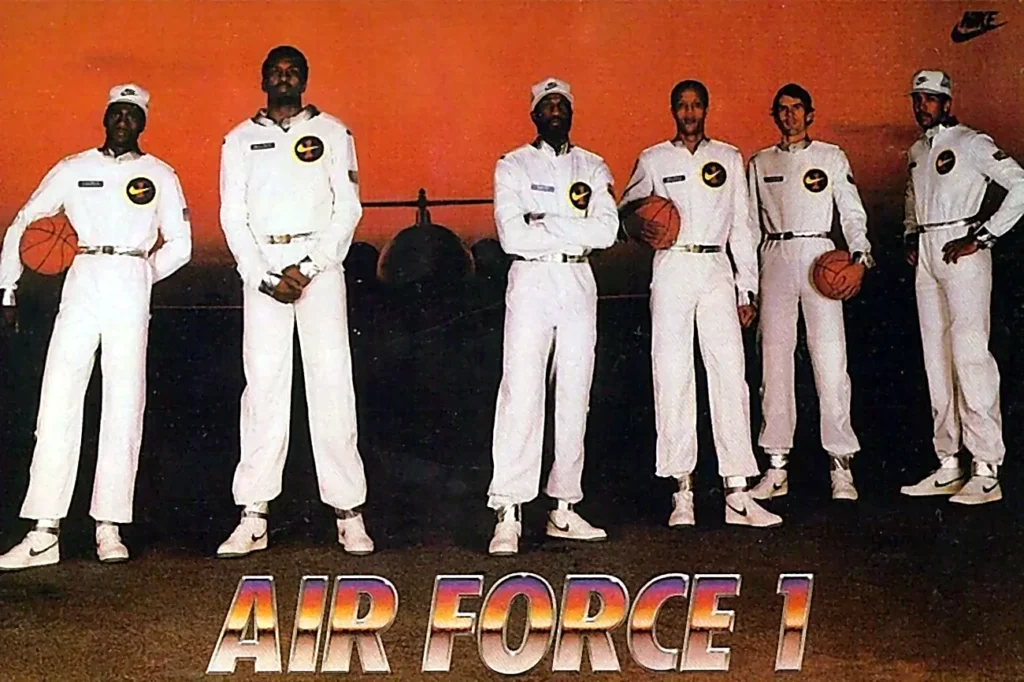
In 1982, before the visible air revolution, before Tinker Hatfield and his polycarbonate windows, Nike had already planted a seed that would grow silently and become one of the most enduring shoes in history: the Air Force 1. It arrived without the fanfare of NBA controversies, without holes in the side of the shoe, but with an equally bold proposition: to be the first basketball shoe with a full-length Air unit.
The project was entrusted to Bruce Kilgore, a designer who had never worked with basketball before. Kilgore came to Nike from the world of casual footwear and technical apparel, bringing a fresh mind uncontaminated by the conventions of traditional sports design. His lack of specific basketball experience became an unexpected advantage: instead of iterating on existing designs, he questioned fundamental premises.
Kilgore spent weeks observing basketball players on street courts and in professional gyms, noticing something that other designers had overlooked: lateral movement. Basketball required abrupt changes in direction, pivoting, sliding. Existing shoes, primarily designed for linear running, failed to provide stability during these multidirectional movements. Kilgore sought inspiration in unexpected places: deck shoes used by sailors on wet ship decks, which needed circular grip and stability on unstable surfaces.
The result was a unique circular sole—a “pivot point”—that allowed players to turn smoothly without losing balance. The outer edge of the sole, wider than the average basketball shoes of the time, created a stable base of support that inspired confidence in explosive movements. The high top, above the ankle, provided support without sacrificing mobility, using a padded collar that hugged the foot without constricting.
The Air unit, hidden inside the thick white midsole, extended the entire length of the foot—from heel to toe. It was the cushioning that Tailwind runners already knew, but that basketball players had never experienced. The sensation was strange at first: it felt like floating slightly above the court, impacts were absorbed differently, silently. Players who tested prototypes reported a “boat” sensation—floating stability that allowed them to play longer without fatigue in their knees and ankles.
The name Air Force 1 deliberately evoked the U.S. presidential airplane, the ultimate symbol of power, prestige, and cutting-edge technology. It was a declaration of ambition: this wasn’t just another basketball shoe; it was presidential footwear, an object of supreme status. Nike positioned the launch with heavy marketing, signing six NBA players—known as “The Original Six”—to endorse the model: Moses Malone, Jamaal Wilkes, Bobby Jones, Mychal Thompson, Calvin Natt, and Michael Cooper. Each represented different playing styles and geographic markets, creating immediate national reach.
Moses Malone, the dominant star of the Philadelphia 76ers who would lead the team to the championship in 1983, became the main face of the campaign. His image—burly, powerful, relentless—perfectly matched the aesthetics of the Air Force 1: technical strength, imposing presence, uncompromising performance. Commercials showed Malone dominating the paint, landing after violent dunks, while the narration highlighted “Air in a Force”—air in power, technology in strength.
But the true cultural phenomenon of the Air Force 1 didn’t happen on NBA courts. It happened on the streets of Baltimore, Maryland, where working-class Black communities adopted the shoe as a symbol of status and cultural identity. In 1984, when Nike decided to discontinue the model to make way for new releases, something unexpected happened: three stores in Baltimore—Downtown Locker Room, Cinderella Shoes, and Charley Rudo’s—intensely pressured the company to continue production.
These stores, located in neighborhoods that Nike had never directly targeted in its marketing, reported insatiable demand. Customers bought multiple pairs, keeping some “deadstock” (never worn) as investments, wearing others daily until complete wear. The Air Force 1 became a cultural currency, an indicator of belonging to a community that valued its own style, authenticity, and resistance to dominant narratives.
Nike, initially surprised by this phenomenon emerging from secondary markets, reacted with strategic intelligence. In 1986, it reintroduced the Air Force 1, this time with a different approach: instead of relying exclusively on endorsements from NBA stars, it began cultivating a direct relationship with the communities that had saved the model from oblivion. Exclusive colors were created for specific markets—”Baltimore” colorways that would never appear in stores in other cities. The strategy, called internally “Color of the Month,” turned the Air Force 1 into a sought-after object: collectors traveled between cities to acquire rare editions, creating a parallel sneaker economy before the Sneakerhead Community existed in its current form.
The aesthetics of the Air Force 1 evolved beyond basketball. The smooth leather upper, initially pure white with blue or red Swoosh, became a canvas for chromatic experimentation. “Triple black” versions—leather, sole, and laces all in dark tones—created an urban aesthetic that resonated with the emergence of hip-hop as a dominant cultural force. The high-top and low-top models offered style versatility: high-top for protection and imposing presence, low-top for casual versatility.
Between 1982 and 1987, while the Air Force 1 quietly built its empire on American streets, Nike continued to innovate technically. The Air Safari of 1987, designed by Tinker Hatfield, introduced elephant texture in running shoes—a bold aesthetic that foreshadowed later experiments. The Air Trainer 1, also by Hatfield, created a new category of multi-sport shoes. But nothing would eclipse what came in 1987, when Hatfield decided to cut a hole in the side of a shoe and forever change the history of footwear design.
Air Max 1: The Window to Technology (1987)
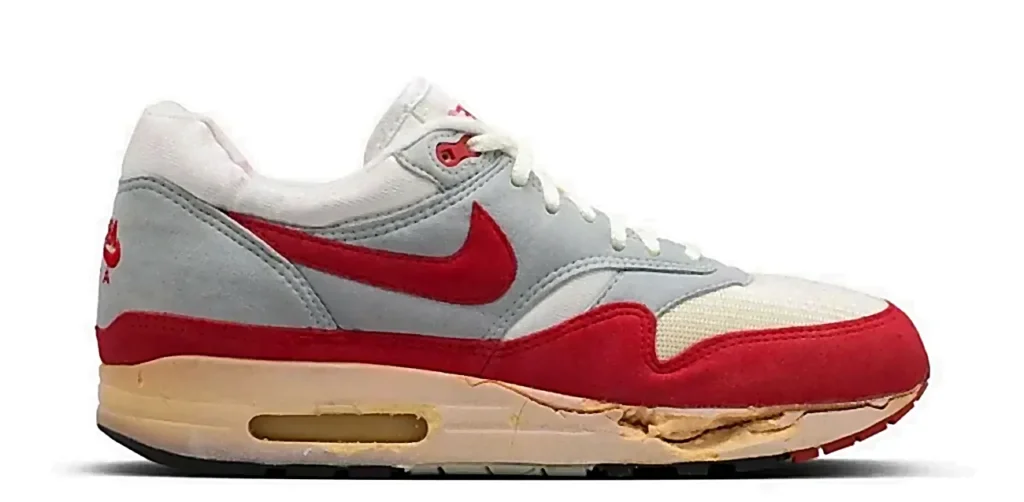
In 1987, five years after the launch of the Air Force 1, a man named Tinker Hatfield changed forever the way we look at sneakers. An architect by training, Hatfield had joined Nike to design stores and commercial spaces. But his visual mind, trained to think in structures, volumes, and user experience, found in footwear design a perfect field of expression. And in 1987, he presented something that sounded like heresy to some conservative executives: he wanted to cut a hole in the side of a shoe.
Not just any hole. A window. A polycarbonate opening that would reveal what was previously hidden: the compressed air capsule that provided cushioning. The idea seemed contradictory—exposing to view something that should be protected, displaying internal technology as if it were a showcase. But Hatfield wasn’t being arbitrary. Years earlier, during a trip to Paris, he had been fascinated by the Centre Georges Pompidou, that controversially modern building where the internal structures—piping, stairs, beams—were exposed externally, painted in vibrant primary colors. The building declared: we hide nothing, our engineering is our aesthetic.
The Nike Air Max 1 was born from this architectural epiphany. Hatfield developed a design that literally made the invisible visible. The Air unit, previously hidden inside the midsole as an industrial secret, now appeared in all its technical glory—a transparent plastic capsule, ergonomically curved, filled with inert gas, pulsing with energetic potential with every step. It wasn’t just impact reduction; it was visual proof, tangible, that Nike invested in real performance. It was technological honesty as a marketing strategy.
The impact was immediate and lasting. Runners reported a strange and pleasant sensation—they could see the technology working, the capsule compressing on heel impact and expanding on propulsion. But more importantly, the Air Max 1 transcended its original athletic function. Its design was so distinctive, so photogenic, so conversational, that it quickly migrated from running tracks to streets, schools, and nightclubs. It became an object of desire for people who had never run a single kilometer.
The original colors—neutral gray contrasting with vibrant red—created an aesthetic that seemed simultaneously technical and artistic. The gray suggested industrial precision, laboratory-like; the red screamed passion, speed, danger. This combination became the signature of the Air Max line, instantly recognizable even as the models evolved. The Air Max 1 wasn’t just a sneaker; it was the opening of a new mental category in the consumer: the shoe as a design object, as a technological sculpture, as a personal statement.
Curiously, the Air Force 1 and the Air Max 1, though separated by five years and different in philosophy, would converge culturally. Both became symbols of urban identity, both transcending their sports origins to become objects of pure desire. The AF1 represented heritage, tradition, roots in African American culture; the Air Max represented the future, technology, radical transparency. Together, they formed the pillars on which Nike would build its cultural dominance in the following decades.
8. Just Do It: The Birth of a Philosophy (1988)
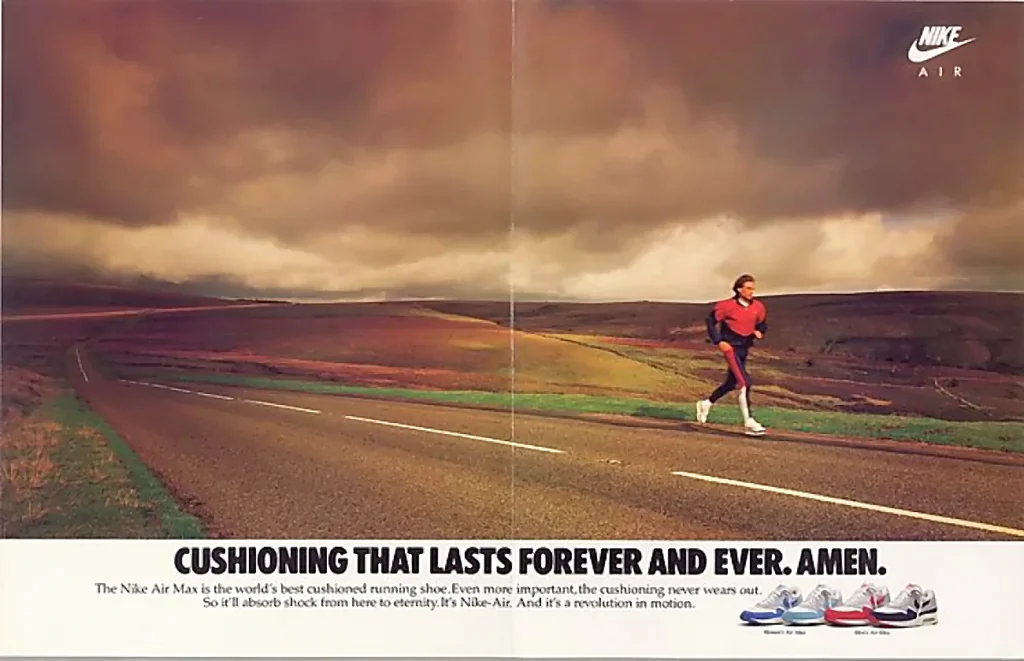
In 1988, three words transformed Nike from a shoe manufacturer into a builder of cultural meaning. “Just Do It” was not just a slogan; it was the crystallization of everything the company had represented since its Blue Ribbon Sports days—the mindset of the amateur athlete facing seemingly impossible challenges, the belief that action trumps hesitation, that the first step is more important than the perfect plan.
The origin story carries a somber irony that Nike rarely emphasizes. Dan Wieden, co-founder of the Wieden+Kennedy agency in Portland, was inspired by the last words of Gary Gilmore, a convicted murderer executed in Utah in 1977. Facing the firing squad, Gilmore reportedly said, *”Let’s Do It.”* Wieden slightly modified it—”Just Do It”—and created something that sounded simultaneously like a military order, a spiritual mantra, and a personal encouragement.
The first commercial of the campaign, launched the same year, was deliberately anti-heroic. It didn’t show Olympic athletes in slow motion. It showed Walt Stack, an 80-year-old man with a white beard and frail body, running slowly across the Golden Gate Bridge in San Francisco. Stack narrated his own story—he had started running at age 57, completed 62 marathons, and swam daily in the icy bay. The message was crystal clear: age, physical condition, natural talent, or elaborate excuses didn’t matter. What mattered was starting. Just starting.
This philosophy of radical inclusion—”anyone can be an athlete”—differentiated itself profoundly from competitors’ strategies. While Adidas sold European heritage and German precision, while Reebok sold female aerobics and specific empowerment, Nike sold universal grit, personal overcoming, and democratic inclusion. The Walt Stack commercial didn’t mention specific products, didn’t show close-ups of technology, didn’t cite prices. It just showed an ordinary human being doing something extraordinary through pure persistence.
The campaign quickly expanded to embrace controversial and complex figures. John McEnroe, the rebellious tennis player known for his on-court anger outbursts, became the face of the brand—not despite his temper, but because of it. Nike celebrated his intensity, his refusal to accept arbitrary rules, his visceral passion. Bo Jackson, the multisport phenomenon who played professional baseball and American football simultaneously, personified maximum versatility—”Bo Knows” became a cultural catchphrase.
Women, historically marginalized in sports marketing, appeared in emotional campaigns showing their own journeys of overcoming—not as objects of desire, but as agents of their own athletic narrative. Banners at marathons, full-page ads in specialty magazines like Runner’s World, epic television spots during major sporting events—all built a consistent aura: Nike didn’t sell shoes; it sold mindset, attitude, identity.
The commercial impact was astronomical. In the decade following the launch of “Just Do It,” Nike’s sales grew by 1,000%. The company transformed from a national niche, strong on the West Coast and among serious runners, into a global icon recognized from Tokyo to Timbuktu. But more significant than the numbers was the qualitative transformation: Nike now occupied a mental space that transcended product category. It was a philosophy of life masquerading as a shoe brand.
9. Air Jordan: The Cultural Revolution (1985-1989)
If the Air Force 1 represented the silent conquest of the streets, and the Air Max 1 the visual technological revolution, the Air Jordan embodied the complete cultural revolution. It wasn’t just a sneaker. It was the beginning of a new economic category—the shoe as a cultural asset, as a collectible object of desire, as a symbol of identity that transcends generations.
It all began in 1985, when a 21-year-old, fresh out of the University of North Carolina, signed a contract that would forever change the history of the Air Jordan 1 and the sports industry. Michael Jordan almost didn’t go with Nike. He almost went with Adidas. The young man, fascinated since childhood by the aesthetics of the three German stripes, had expressed a clear preference for the rival brand. But Adidas, overconfident in its dominance, underestimated Jordan’s potential. Nike, desperate for a basketball star who could compete with Magic Johnson (signed by Converse) and Larry Bird (also Converse), offered an unprecedented package: not just guaranteed money, but royalties on sales of the sneaker bearing his name. It was a bet that Nike was making for the first time, partially inspired by the contract model that Run DMC had negotiated with Adidas in the hip-hop world.
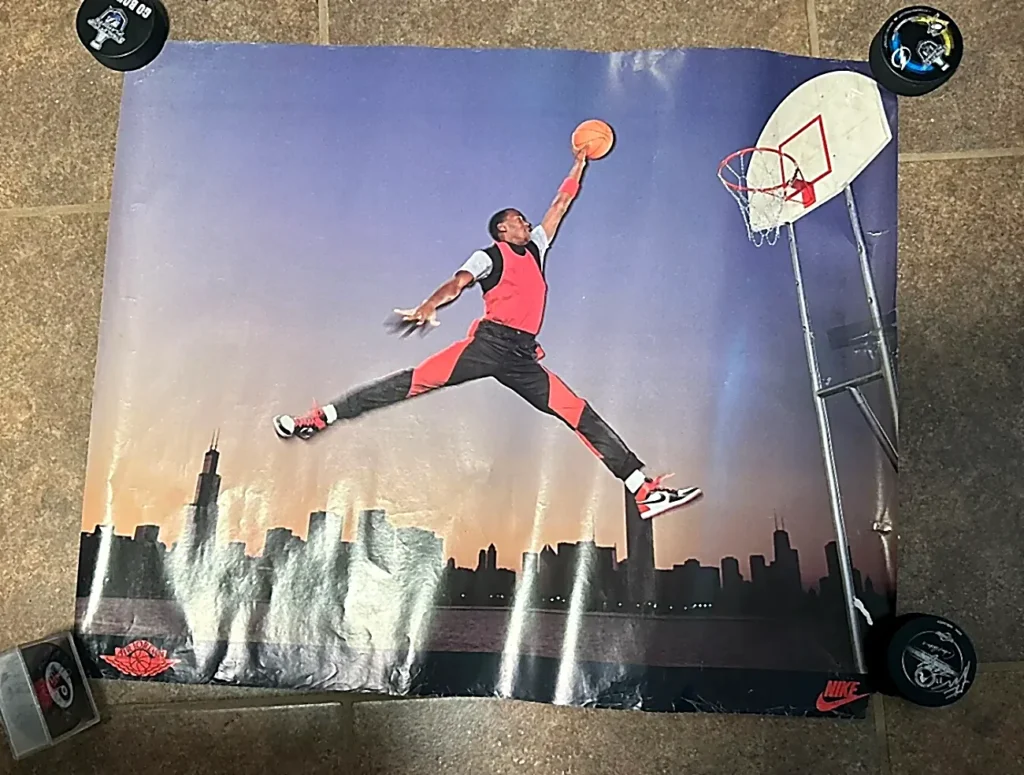
The design of the Air Jordan 1, created by Peter Moore, was deliberately provocative. Red and black—the colors of the Chicago Bulls—in a combination that explicitly violated the NBA’s uniformity rules. The league required that players’ footwear predominantly match the team’s uniform colors or be neutral black/white. The Air Jordan 1, with its blood-red exploding over a black base, openly defied this norm.
And then something happened that Nike couldn’t have planned better if it had tried: the NBA began fining Michael Jordan for every game in which he wore the shoes. $5,000 per game—a significant amount even for a professional athlete at the time. The instinctive reaction of any conservative company would have been to back down, obey, and protect the athlete and brand from controversy. Nike did exactly the opposite.
The True Story of the “Banned”
The legendary story, told and retold until it became corporate mythology, needs historical nuances. The official NBA letter, dated February 25, 1985, effectively banned the shoe that Jordan was wearing—but technically, the first model to attract the league’s attention during the 1984-85 preseason was the Nike Airship, a precursor to the Air Jordan 1 that shared its forbidden color palette. The specific ban cited violations of uniformity rules that required color coordination with team equipment.
Você também pode se interessar por:

Regardless of the technical details of which specific model was banned first, Nike capitalized on the controversy with Machiavellian genius. They created an iconic commercial that would never be forgotten: images of Jordan flying across the court, wearing the banned shoes, accompanied by the text “The NBA banned them. Fortunately, the NBA can’t stop you from wearing them.” They turned punishment into privilege, prohibition into desire, repression into rebellion.
The strategy worked beyond Nike’s wildest dreams. The original projection for Air Jordan sales in its first year was a modest $3 million. The actual result? $126 million—an explosion of 4,200% above expectations. What happened was more than consumption; it was a cultural phenomenon. Teenagers in housing projects and executives in wealthy suburbs wanted the same object for the same reason: it represented a challenge to authority, insider status, a connection to athletic greatness.
The Air Jordan 1 set standards that would define the line for decades: premium material quality, design that balanced on-court performance with street aesthetics, and a narrative of exclusivity. Every detail—the stylized wing on the collar, the audaciously large Swoosh, the foam midsole that hid the Air unit—was designed to create a lasting object of desire, not disposable consumption.
Between 1985 and 1989, the Air Jordan line evolved annually, each model telling a new story. The Jordan 2, designed by Bruce Kilgore and Peter Moore, eliminated the visible Swoosh—a branding boldness that only an already established brand could attempt. The Jordan 3, Tinker Hatfield’s first work on the line, introduced elephant print (cracked leather texture) and the Jumpman logo—the silhouette of Jordan flying to dunk, captured in a moment of pure athletic grace. The Jordan 4 consolidated the aesthetic, becoming a favorite of collectors for decades to come.
But more important than any individual design detail was the transformation that the Air Jordan brought about in the relationship between athletes, brands, and consumers. Before 1985, athletes endorsed products. After 1985, athletes became brands. Michael Jordan wasn’t just a Nike spokesperson—he was a business partner, an architect of his own product line, the protagonist of a narrative that the company told on his behalf. This “signature shoe” model—exclusive footwear bearing the athlete’s name—became the industry standard, yielding the top collaborations of the Air Jordan 1 in the following decades, replicated by hundreds of athletes across dozens of brands, but never matched in cultural impact.
10. The Golden Era of the 90s: Globalization and Domination
If the 80s were Nike’s explosive adolescence, the 90s were its dominant maturity. The brand that had started as an underdog challenging German giants had become, itself, the giant to be beaten. But what makes the 1990s particularly fascinating is not just the commercial growth—it’s the cultural sophistication, the transformation of technical footwear into objects of collective desire, the creation of a visual vocabulary that transcends sport, class, geography, and generation.
“Just Do It,” launched in 1988, and the Air Jordan, which was already a phenomenon, didn’t just continue in the 90s—they transformed into gravitational forces that shaped not only sports but streets, music, cinema, politics, and the way millions of people built their identities. How did this happen? How does a running or basketball sneaker become a symbol of cultural belonging as powerful as a flag or a national anthem?
The Golden Era of Air Jordan
In the 90s, each annual release of the Air Jordan line became a cultural event comparable to blockbuster movie premieres. The Jordan VI, launched in 1991, featured a design inspired by German race cars—transparent plastic reinforcements on the upper evoked automotive aerodynamics, while the exaggeratedly large tongue with openings allowed for quick lacing. This was the model Jordan wore when he won his first NBA championship, defeating Magic Johnson and the Lakers.
The Jordan VII (1992), also designed by Tinker Hatfield, abandoned the visible Air unit in favor of full encapsulation, creating a sleeker silhouette. The “Hare” colorway—gray, white, and vibrant red—made a deliberate reference to the animated shorts where Jordan appeared alongside Bugs Bunny, foreshadowing the Space Jam movie years before its release. This model accompanied Jordan at the Barcelona Olympics, where the “Dream Team” dominated world basketball and transformed NBA players into global ambassadors of American culture.
The Jordan VIII (1993) adopted a more aggressive aesthetic, with Velcro cross-straps over the laces and a non-marking sole—functionality that addressed the real needs of players who reported difficulties with previous models on dusty courts. But aesthetically, it was a shoe that demanded attention, that couldn’t be ignored, that communicated intensity.
And then came the hiatus. In 1993, after three consecutive championships, Michael Jordan announced an early retirement—supposedly to play professional baseball, in reality to process the murder of his father. Nike, without its maximum protagonist, faced an existential dilemma: how to continue a shoe line without the athlete who had inspired it?
The answer came in 1995, when Jordan returned to the courts with a simple phrase: “I’m back.” And with him, the Jordan XI—considered by many collectors as the absolute pinnacle of the line. Designed once again by Hatfield, the XI introduced patent leather on the upper, a material traditionally associated with formal dress shoes, in a performance basketball sneaker. The translucent carbon fiber sole, adapted from running technology, provided torsional rigidity without weight. It was a shoe that looked like a luxury shoe, that defied categories, that could be worn on the court or at a gala dinner.
Jordan won three more consecutive championships (1996-1998) wearing mainly variations of the XI and its successors XII and XIII. Each victory, each iconic moment—the decisive shot against Utah in 1998, the so-called “Last Shot”—increased the symbolic value of the shoes he wore. The sneakers became cultural relics, objects that connected their owners to shared historical moments.
They also became financial assets. The secondary market for Air Jordans—the resale between collectors—exploded in the 90s, with prices for rare models exceeding tens of times their original value. Specialty stores, dedicated magazines, collector conventions: a parallel economy emerged around objects that, technically, were just rubber and leather shoes. But symbolically, they were much more: pieces of cultural history, talismans of greatness, emotional investments.
The cultural references multiplied. Tupac Shakur, in his aggressive and poetic hip-hop lyrics, mentioned Jordans as a symbol of success achieved against the odds. Notorious B.I.G., in his narrative of rising from street dealer to musical stardom, used Jordans as a marker of achieved status. The movie Space Jam (1996), where Jordan starred alongside the Looney Tunes, functioned as a two-hour commercial for the line, especially for the XI that he wore extensively.
Air Max Evolution: From Running to Lifestyle
While the Air Jordan dominated the basketball universe, the Air Max line continued its parallel evolution in the world of running—or at least, that’s how it began. In 1990, the Air Max 90 (initially called Air Max III, renumbered later) took the logic of “visible air” to the maximum extreme. Designed also by Tinker Hatfield, the 90 featured the largest Air window yet seen, extending almost the entire length of the heel.
The aesthetic was deliberately aggressive. The original colors—the famous “infrared,” an electric red-orange that seemed pulsating even in photographs—created a violent contrast with dark gray and white bases. The design was asymmetrical, with material overlays that created a sense of speed even when the shoe was stationary. The Air Max 90 didn’t ask for permission; it demanded attention.
But the true cultural phenomenon came in 1995, with the Air Max 95. Designed by Sergio Lozano, a relatively unknown designer at the time, the 95 represented a radical break with everything Nike had done before. Lozano, inspired by human anatomy, designed the shoe as if it were a body in motion: the upper layers of mesh and leather evoked muscles and skin, the lateral support lines suggested ribs, the visible Air unit represented the spine.
The result was a design object that seemed alive. The Air Max 95 didn’t have the classic elegance of the 1 or the obvious aggressiveness of the 90; it had something more disturbing, more biological, more strange. And it was precisely this strangeness that made it irresistible to subcultures that Nike had never directly targeted.
Skateboarders, traditionally loyal to specific brands like Vans or DC Shoes, adopted the 95 for its apparent durability and anti-establishment aesthetic. British rappers from the jungle and drum’n’bass underground music scene in London made the 95 their unofficial uniform. Ordinary young people, with no connection to running or skateboarding, wanted the 95 because it looked different from everything else on the shelves—neon lemon yellow, dark industrial gray, acid greens that defied conventional good taste.
Nike, realizing it had created something bigger than its original intention, embraced this evolution. Marketing campaigns began to show the 95 not on athletic tracks, but on urban streets, nightclubs, and everyday life settings. The subtle but clear message: this shoe isn’t just for running; it’s for living.
This transition—from athletic performance to cultural lifestyle—would define Nike in the 90s and beyond. The company stopped selling just cushioning, traction, and lightness. It began selling attitude, aesthetics, and tribal belonging. The shoe became a uniform of identity, a flag that indicated allegiance to a certain urban tribe, musical generation, or lifestyle.
11. The Genesis and Dominance of Nike SB: Skate Meets Hype (1997-Present)
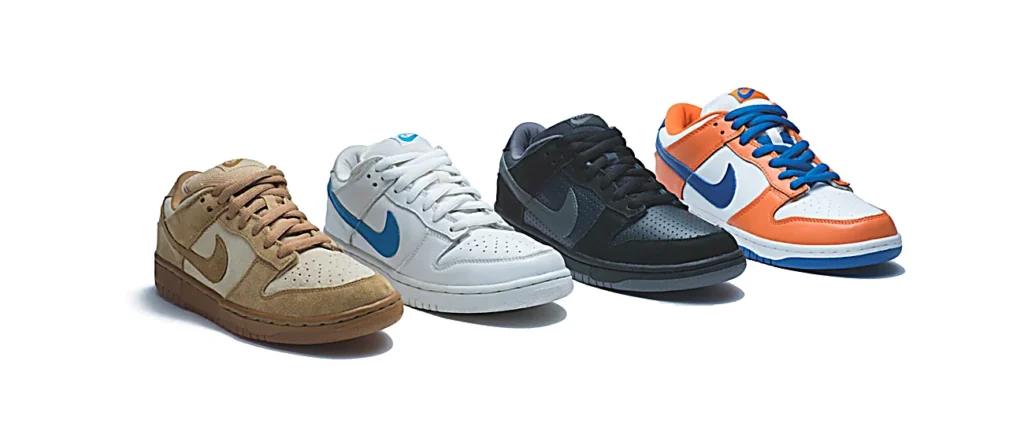
If basketball established Nike as a giant and running established it as a pioneer in technology, it was skateboarding that taught the corporation the art of patience, the need for subcultural legitimacy, and the mastery of premeditated scarcity. For many wondering what Nike SB means, the history of Nike Skateboarding is not a standard corporate success story. It is, rather, a story of humiliating rejection, deep adaptation, hard-earned respect, and, finally, absolute dominance not only in the skate scene but in the global market of streetwear and hype.
The First Frustrated Attempts (1997-2001)
In the late 90s, skateboarding was leaving the margins of punk subculture and entering a golden commercial era driven by the X-Games and the boom of video games. The market was dominated by endemic brands like éS, DC Shoes, Globe, and Etnies, known for their massive “puffy shoes.” Nike tried to force its entry in 1997 with models like the Choad, the Snak, and the Schimp. The result was a monumental failure. The skate community rejected corporate “outsiders,” and the designs were considered inauthentic.
Sandy Bodecker’s Midas Touch and the Birth of the SB Dunk (2002)
In 2001, Nike executives realized that brute force wouldn’t work. They entrusted the project to Sandy Bodecker, who made a crucial decision: instead of inventing a futuristic design, he looked in the rearview mirror. Bodecker realized that 80s skaters, like those from the Bones Brigade, skated in Air Jordan 1s and the original Nike Dunk (from 1985) due to the durability of the leather and the excellent “boardfeel” of the flat sole.
Bodecker revived the history of the Nike Dunk and reengineered it for skateboarding, adding the iconic “fat tongue” and Zoom Air cushioning. Thus, in March 2002, the Nike SB line was born. To ensure immediate legitimacy, Bodecker signed a team of elite skaters—Richard Mulder, Reese Forbes, Gino Iannucci, and Danny Supa—giving each the chance to design their own color palette (“Colors By”), distributed exclusively in independent core skateshops.
The Collaboration with Supreme and the Era of Orange Boxes (2002)
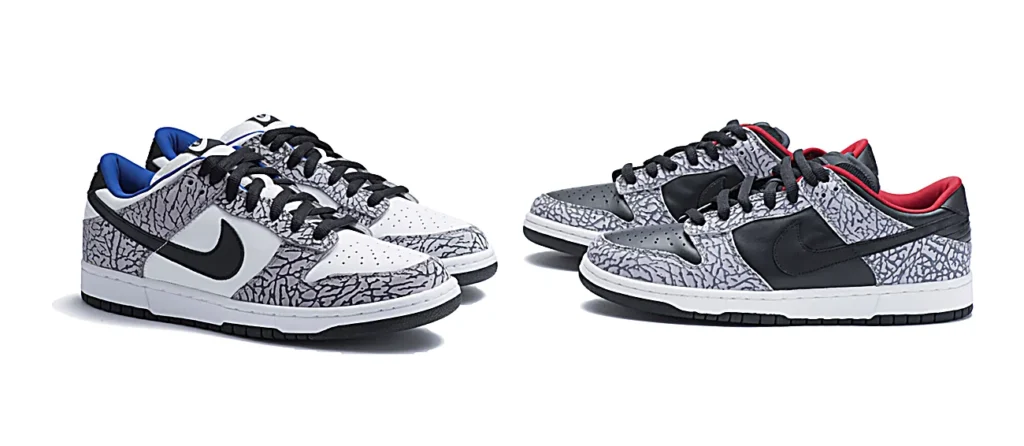
What triggered the global hype was the 2002 collaboration with the legendary New York skateshop Supreme. They applied the “Elephant Print” pattern to the SB Dunk Low. Limited to 500 pairs of each color and sold exclusively at Supreme stores, these shoes (released in the iconic original Orange Boxes) inaugurated the era of the treasure hunt, where sneakers became collectible urban art pieces and status symbols.
The “Pigeon Riot” and the Explosion in Police Pages (2005)
The definitive turning point for sneaker culture occurred in 2005, during the “Pink Box Era.” Nike commissioned Jeff Staple to create the Nike SB Dunk Low “Pigeon”. With an extremely limited production of 150 pairs, the release in Manhattan caused a true urban collapse. Fans camped out for days, gangs showed up with machetes, and the NYPD had to intervene and escort buyers in taxis. The next day, the headline of the New York Post proved that Nike SB had generated absolute frenzy in civilized society.
Signed Models and the Janoski Phenomenon (2009)
While the Dunk was the “fuel” of the hype, the division needed commercial sustainability. After the success of the first signature shoe with Paul Rodriguez (P-Rod) in 2005, the true golden goose emerged in 2009: the Nike SB Zoom Stefan Janoski. Brutally simple and inspired by nautical footwear, the minimalist vulcanized model transcended skate borders to become the daily casual shoe of millions, financing the brand’s wildest projects.
The Dunk Renaissance and the Olympic Stage (2019-Present)
After a period of stagnation, Nike orchestrated the “Dunk Renaissance” in late 2019. Drastically restricting supply and fueled by Travis Scott wearing vintage models, the division attacked with insane collaborations, culminating in the Ben & Jerry’s x Nike SB Dunk Low “Chunky Dunky” (2020), generating resale prices of thousands of dollars within hours.
Today, the SB division operates on an elevated plane. On one side, it dictates the resale market with exclusive boxes. On the other, it has consolidated its position as a giant by providing technical footwear and uniforms (such as the Nike SB BRSB) for skaters like Rayssa Leal and Yuto Horigome, dominating the Tokyo 2020 and Paris 2024 Olympic Games.
12. The 2000s: Digital, Ethics, and Reinvention
In the early 2000s, Nike was already a giant—but giants, paradoxically, are vulnerable. The resounding success of the 90s created impossible expectations, exposed the company to systemic criticism of its manufacturing practices, and attracted hungry competitors for slices of the market that Nike had created. What happens when the empire faces a global recession, accusations of labor exploitation, and the need to reinvent itself digitally?
Nike’s response came in two seemingly contradictory but strategically complementary fronts: radical transparency and accelerated technological innovation. Instead of retreating to defensive positions, the company advanced, embracing criticism and transforming it into opportunities for differentiation.
Forced Transparency and Accelerated Innovation
Starting in the mid-90s, but reaching maximum intensity in the early 2000s, Nike faced advocacy campaigns and investigative reports detailing working conditions in contracted factories in Asia—wages below minimum, exhausting hours, unsafe environments. The initial, defensive, and hesitant response damaged the brand’s reputation among conscious consumers. But something changed around 2005: Nike began publishing independent audit reports, detailing not only problems found but progress made in wages, safety, and labor rights.
This transparency, imposed by externalities but strategically embraced, became a competitive differentiator. While competitors maintained opaque supply chains, Nike offered verifiable data. It was a calculated risk—admitting imperfection to build credibility—that positioned the company as a leader in corporate responsibility, even when reality still fell short of the ideal.
Parallel to this, Nike invested heavily in digitization before most of its competitors understood the importance of the movement. In 2006, in partnership with Apple, it launched Nike+—a system that integrated a sensor in the shoe (specifically the Nike+ Air Zoom model) with a receiver connected to the iPod Nano. For the first time, ordinary runners could precisely track distance, pace, and calories burned, syncing data with software that visualized progress over time.
The Nike+ was revolutionary not only technologically but also socially. It created a digital community of amateur athletes, allowing time comparisons, route sharing, and virtual challenges between geographically separated friends. Before Strava, before the Apple Watch, before the explosion of wearables, Nike was already collecting real performance data from millions of users—extremely valuable information for the development of future products and personalized marketing.
In the world of shoes themselves, releases like the Air Max 360 (2006) took Air technology to its logical conclusion: air units that occupied the entire length of the sole, eliminating the need for traditional foam. The slogan “Run on Air” became both a technical and poetic mantra—literally running on air, on nothing, on invisible technology that transformed impact into propulsion.
And in basketball, where it all began, a new star emerged to inherit Jordan’s mantle. LeBron James, signed in 2003 at the age of 18 fresh out of high school, received a $90 million contract—an unprecedented amount for such a young athlete. Campaigns like “We Are All Witnesses” (2007) transformed “King James” into an epic narrative even before his first championship. The LeBron shoes, from the original model in 2003, combined cutting-edge technology (Zoom Air, Flywire, lightweight composite materials) with storytelling that positioned James as a hero on a mythological journey.
By 2009, when the first decade of the new millennium came to a close, Nike was no longer just a manufacturer of sports footwear. It was a wearable technology company, a platform for athletic data, a curator of urban culture, and a builder of heroic narratives. The shoes—Air Force 1, Air Max, Jordan, LeBron, SB, and dozens of other lines—remained at the center, but now they were nodes in a much larger network of meaning, community, and continuous innovation.
From the Air Force 1 of 1982, saved from the streets of Baltimore, to the Air Max 1 of 1987, revealing technology through plastic windows; from the “Just Do It” of 1988, inspired by a condemned man’s last words, to the Jordan empire that redefined relationships between athletes and brands; from the forced transparency of the 2000s to pioneering digitization—Nike built something beyond a company. It built a global visual language, a system of signs that millions of people use to say who they are, without uttering a single word. The shoe, once a mere utilitarian protection for the feet, became an extension of identity, a declaration of values, a connection to stories larger than generations.
13. 2010-2020: Flyknit, Vaporfly, and the Era of Cultural Collaborations
Flyknit: The Knit Revolution (2012)
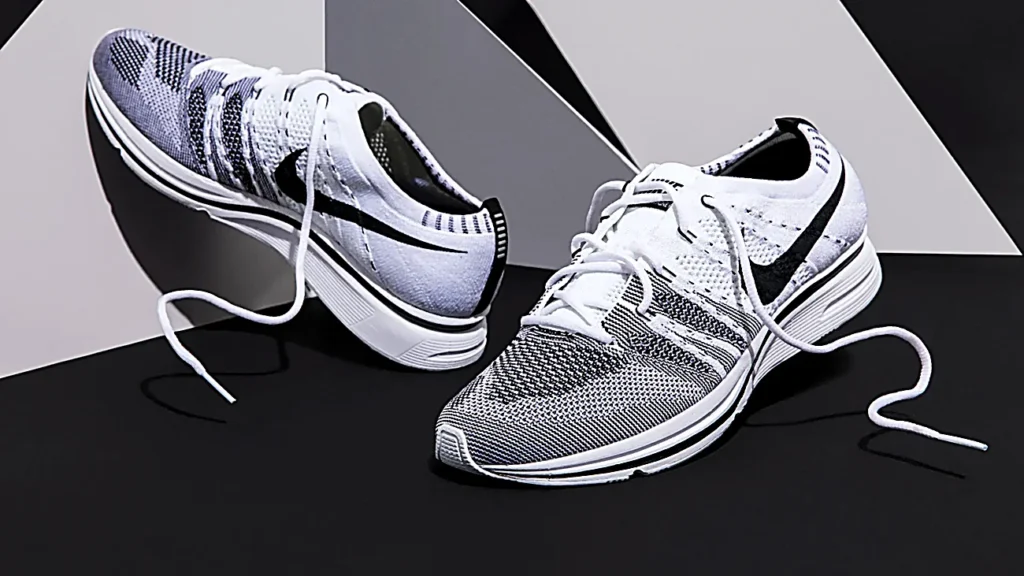
What changes when technology allows a shoe to adapt to the foot like a second skin? In 2012, Nike Flyknit revolutionized not only the manufacturing of sports footwear but the very conception of how a sneaker could be constructed. The knitted upper, as light as a feather and as breathable as high-end fabric, represented a 60% reduction in material waste compared to traditional cut-and-sew methods—a green breakthrough disguised as pure performance.
The Flyknit Racer, the first model in the line, was developed for elite runners but quickly transcended athletic tracks. Its “sock with a sole” aesthetic, initially controversial, became desirable precisely for its futuristic strangeness. The Flyknit Trainer and subsequently the Lunarlon integrated cushioning and support in an unprecedented way, creating a silhouette that seemed sculpted around the user’s foot.
But the true impact of Flyknit wasn’t just technical—it was cultural. The technology opened new possibilities for artistic collaborations: designers could program complex knit patterns, create impossible gradients in traditional materials, and customize textures on a microscopic scale. Flyknit became the perfect canvas for creative experimentation, the base on which partner artists and brands would build some of the most desired collaborations of the following decade.
Vaporfly: The “Super Shoes” Controversy (2017)
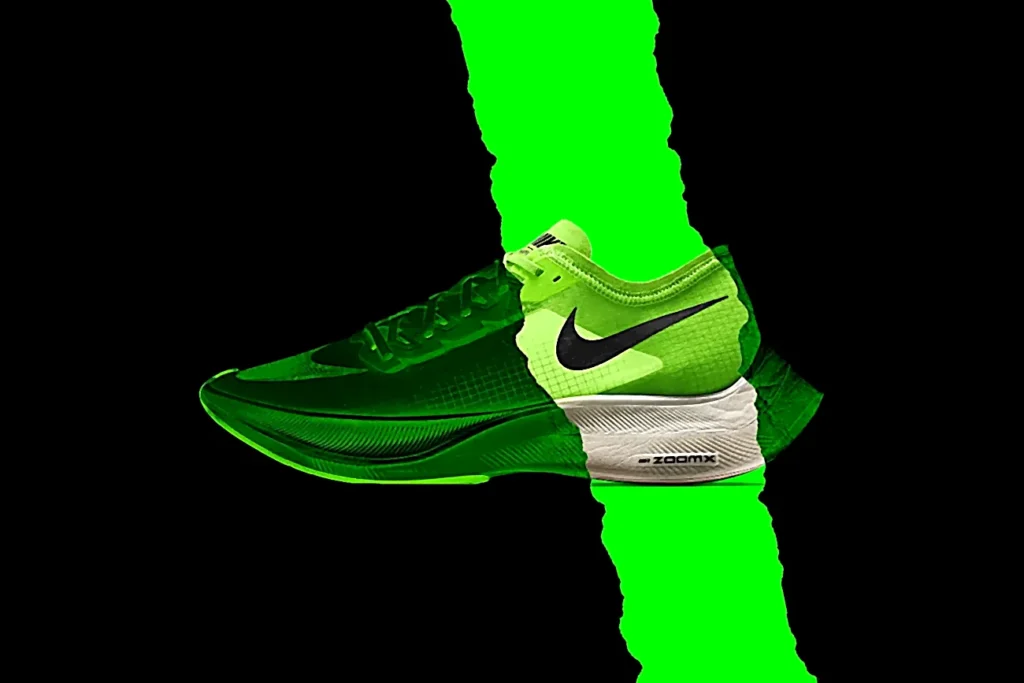
Why can a shoe be considered “technology doping”? In 2017, the Nike Vaporfly 4% (later evolving into Alphafly) introduced a combination that seemed simple in theory but was revolutionary in practice: a curved carbon fiber plate, inserted between two layers of ZoomX foam—a material that returned more energy than any previous compound from the company. Independent studies showed average gains of 4% in energy efficiency, which in elite marathons represented a difference of precious minutes.
World records fell in impressive succession. But the defining moment came in 2019, when Eliud Kipchoge, considered the greatest marathoner in history, broke the two-hour barrier in the 42.195km distance—not in an official competition, but at the INEOS 1:59 event in Vienna. Wearing an Alphafly prototype with three visible Air capsules in the front, Kipchoge completed the race in 1:59:40, proving that the human limit was more mental than physical.
The controversy was immediate and global. Amateur runners questioned whether expensive technology created unequal access. Competitors sponsored by other brands felt at a systemic disadvantage. World Athletics, the governing body of global athletics, intervened in 2020, establishing limits on sole thickness (40mm) and the number of carbon plates allowed. The “super shoes” had forever changed elite running, forcing a redefinition of what constitutes “fair equipment.”
Reflect: when does innovation border on unfair advantage, and who defines the limit? By pushing technical boundaries, Nike forced sports to confront philosophical questions about technology, access, and the essence of athletic competition.
The Revolution of Collaborations: From Partnerships to Hype Culture
If the previous decades established Nike as a technical innovator and narrative builder, the 2010s consolidated it as the supreme curator of collaborative culture. The company discovered something that would transform the sneaker industry: limiting access increases desire, and partnerships with niche creators generate more fervor than traditional advertising campaigns. The collaboration (“collab”) model, once an exception, became a central strategy for marketing, product development, and community building.
Supreme x Nike: The Alchemy of Skate and Hype (2002-2020+)
The partnership between Supreme and Nike didn’t begin in the 2010s, but it was in this decade that it reached absolute maturity, setting standards by which all subsequent collaborations would be judged. Founded in 1994 by James Jebbia as a skate shop in downtown Manhattan, Supreme built its identity around artificial scarcity: products released in limited quantities, sold only in its own physical stores, never restocked. This philosophy of the drop—sudden release followed by permanent scarcity—found in Nike the perfect partner for global amplification.
The first Supreme x Nike collaborations in the 2000s focused on skate models like the Dunk Low and the Blazer. But it was in 2012 that the partnership exploded culturally with the release of the Dunk Low Supreme “Black Cement”—three colorways that incorporated the iconic elephant print pattern of the Air Jordan 3 on premium leather panels. The model sold out in minutes, creating lines that wrapped around blocks in New York and Los Angeles.
What made these collaborations special wasn’t just scarcity but cultural authenticity. Supreme genuinely emerged from New York’s skate culture—its designers were skaters, its stores were temples of the scene, its red box aesthetic with the Futura Heavy Oblique logo was instantly recognizable to insiders. When Supreme collaborated with Nike, it wasn’t a corporate brand renting credibility; it was an authentic community sharing its visual language.
In 2017, Supreme x Nike reached the peak of influence with the release of the Air More Uptempo Supreme—a 90s basketball model with giant “SUPREME” lettering occupying entire sides of the upper. It was a shoe that couldn’t be ignored, a declaration of tribal loyalty visible from blocks away. The same year brought a collaboration on apparel with embroidered logos, pieces that became status uniforms in American schools and universities.
The market dynamics created by these collaborations transformed the sneaker economy. Resale prices on the secondary market often multiplied by 10, 20, 50 times the original value. Automated bots began competing for online releases in milliseconds. Supreme, sold in 2020 to VF Corporation for $2.1 billion, had proven that niche culture, when authentic and scarce, was worth more than mass marketing.
Fragment Design x Nike: The Aesthetic of Japanese Minimalism (2002-2020+)
While Supreme represented the chaotic energy of New York, Fragment Design by Hiroshi Fujiwara embodied the opposite aesthetic: refined minimalism, Japanese heritage, and silent sophistication. Fujiwara, often credited as the “father of modern streetwear,” built his career as a DJ, music producer, style curator, and designer—a versatility that gave him a unique perspective on global culture.
The Fragment x Nike collaboration began in 2002 with the Air Jordan 1 Fragment, but it was in 2014 that it reached mythological status. The Air Jordan 1 Retro High OG Fragment featured premium black leather, a white toe box, and an apparently simple detail: an electric blue rectangle with the “FRAGMENT” logo on the lateral heel. It was a design that didn’t shout but whispered exclusivity. Every element—the quality of the leather, the precision of the blue, the positioning of the logo—was obsessively refined by Fujiwara.
Sugestões para você
 Best Sneaker Stores in the Bronx: Where Real Sneaker Culture Comes to Life→
- Air Jordan 1: The Story of the Sneaker That Defied NBA Rules and Became Legend→
- Nike Air Force One: The Legendary History and Impact of a Global Icon→
- Why Do White Sneakers Turn Yellow? Expert Tips to Prevent and Fix It→
- Is Flight Club Legit? Your Ultimate Guide to Buying Authentic Sneakers Safely→
- The Journey of the Nike Dunk: A Timeless Story of Courts, Streets, and Culture→



The result was one of the most desired shoes of the decade. Released in extremely limited quantities, the Jordan 1 Fragment quickly reached resale prices exceeding $2,000. But more significant than its monetary value was its aesthetic influence: the “Fragment blue” became an instant recognition code, a cultural reference that transcended sneakers to influence product design, fashion graphics, and color palettes in architecture.
Fujiwara expanded the partnership to dozens of models over the years: Air Trainer 1, Sock Dart, Air Zoom Lauderdale, Tennis Classic AC—each receiving a treatment of reduction, elimination of excess, and focus on superior materials and millimetric details. Fragment’s philosophy was almost Zen: remove until only the essence remains, then perfect that essence to exhaustion.
In 2020, the collaboration returned to the Jordan 1 with the Travis Scott x Fragment version—a triple partnership that included the Texas rapper. The model, with its inverted color scheme and multiple logos, sold out instantly and reached resale prices exceeding $3,000, proving that the “Fragment touch” maintained its magical power even after two decades of collaborations.
Off-White x Nike: “Deconstruction” as a Luxury Language (2017-2021)
If any single collaboration defined the era of sneaker hype, it was unquestionably the partnership between Nike and Off-White by Virgil Abloh. Launched in 2017 as “The Ten”—ten iconic Nike models reconstructed through Abloh’s lens—this collaboration didn’t just create desirable products; it redefined the very vocabulary of sneaker design, introducing concepts of “deconstruction” that would influence the entire industry.
Virgil Abloh, an architect by training, DJ, and Louis Vuitton menswear creative director, brought to Nike a methodology he had developed in his Off-White brand: the “3% rule”—changing only 3% of a familiar object to create something completely new. Applied to sneakers, this meant: keeping the recognizable silhouette but exposing seams normally hidden, adding explanatory text in Helvetica quotes (“AIR,” “SHOELACES,” “FOAM”), using materials in apparently “unfinished” states, and always, always including a colored plastic zip-tie—Abloh’s trademark that functioned as a certificate of authenticity and symbol of cultural belonging.
The original ten models included some of the most important in Nike’s history: Air Jordan 1, Nike Air Max 90, Air Presto, Air VaporMax, Blazer Mid, Air Force 1, Zoom Fly SP, React Hyperdunk 2017, Air Max 97, and Converse Chuck Taylor (Nike has owned Converse since 2003). Each was “deconstructed”: external seams, exposed labels, parts of leather left apparently “raw,” soles with printed text.
The Air Jordan 1 Off-White “Chicago” instantly became the most desired sneaker on the planet. With its faded red, seemingly “detached” swoosh, and text identifying parts of the shoe (“C. 1985,” “Air Jordan”), it was both a homage and a simultaneous subversion. The model, which retailed for $190, reached resale prices exceeding $5,000 immediately after launch.
But Abloh’s influence went beyond the commercial. He introduced a luxury fashion language—references to Duchamp, ready-made concepts, postmodern irony—into the world of sneakers, traditionally seen as mass culture or urban niche. Art and museum design articles began analyzing his shoes as objects of cultural study. The boundary between “haute couture” and “streetwear” dissolved, and Nike was at the center of this dissolution.
The collaboration continued after “The Ten” with multiple “drops”—Air Jordan 4, Dunk Low, Air Rubber Dunk, among others—each generating comparable frenzy. The premature death of Virgil Abloh in November 2021, at age 41, transformed his works into objects of cultural memory, further increasing their symbolic and monetary value. The Air Jordan 2 Low Off-White, released posthumously in 2022, became a tangible tribute to one of the most influential minds in contemporary design.
Travis Scott: The Hip-Hop Phenomenon and Organic Marketing (2017-2021+)
Parallel to collaborations with design brands, Nike cultivated partnerships with musical artists that proved equally powerful commercially but distinct in nature. Travis Scott, a rapper and producer from Houston, Texas, emerged as a dominant force in this space, creating models that transcended music fans to become objects of universal desire.
The first significant collaboration came in 2017 with the Air Force 1 Low Travis Scott “Sail”—a model in off-white/cream tones with removable Velcro details and interchangeable metallic swooshes. It was a design that invited personalization, that recognized modern consumers wanted to participate in the creation of their product.
But it was the Air Jordan 1 High Travis Scott “Mocha” of 2019 that established Scott as the king of Nike collaborations. The model featured an unprecedented color scheme—mocha brown, black, and white—with an inverted swoosh, a seemingly simple alteration that challenged decades of the brand’s visual consistency. The tongue hid a zippered pocket, a functional detail for hiding small objects but also symbolic of “secrets” and exclusivity.
The launch was accompanied by a marketing strategy that Scott mastered: “mysteries” on social media, cryptic clues in songs, surprise appearances wearing never-before-seen prototypes. The model, originally $175, reached resale peaks of $1,500-$2,000. In 2021, the Travis Scott x Fragment x Nike collaboration—mentioned earlier—created a perfect triangulation of influences: American hip-hop culture, Fujiwara’s Japanese sophistication, and the Jordan Brand’s basketball heritage.
The Air Jordan 1 Low Travis Scott “Reverse Mocha” of 2022, released after the Astroworld Festival controversy, demonstrated the resilience of demand: even under intense criticism of the artist, the shoe sold out instantly and maintained high resale value, proving that the object had transcended its creator to become an independent cultural entity.
KAWS, Sacai, Fear of God: Expansion of the Collaborative Universe
Beyond these pillars, Nike built a constellation of collaborations that mapped the entire cultural landscape. KAWS, the Brooklyn artist known for his vinyl figures and advertising interventions, collaborated in 2017 to create the Air Jordan 4 in gray suede with glossy rubber details—a wearable sculpture that seemed to have stepped out of a contemporary art gallery. The model, released in extremely limited quantities, instantly became the ultimate grail (object of supreme desire) for collectors.
Sacai, Chitose Abe’s brand, brought an approach of “hybridization”—fusing two shoes into one. The LDWaffle Sacai (2019) combined elements of the LDV and the Waffle Racer, creating double silhouettes, overlapping tongues, and duplicated swooshes. It was a design that challenged perception, that seemed like a digital “glitch” in physical form, that only a Japanese mind trained in form reconstruction could conceive.
Fear of God by Jerry Lorenzo brought California minimalism and spirituality. The Nike Air Fear of God line (2018-2020) included reinterpretations of 90s basketball models with discreet luxury aesthetics—premium materials in earthy tones, constructions reminiscent of liturgical garments. Lorenzo, the son of an evangelical pastor, infused his designs with references to faith, elevation, and transcendence.
StrangeLove, Concepts, Atmos: The Elevation of Niche Stores
Nike also democratized access to collaborations, allowing independent specialty stores to create their own models. StrangeLove Skateboards by Sean Cliver created the Dunk Low Valentine’s Day (2020) in pink and red velvet, with cupid embroidery—a shoe that looked like candy, that challenged traditional masculinities in skateboarding, that became a universally desirable object regardless of gender.
Concepts, a Boston store, created multiple themed Dunks—“Yellow Lobster”, “Purple Lobster”—with elaborate narratives about rarity and exclusivity. Atmos, the legendary Japanese store, produced Air Max with animal patterns—elephant, tiger—creating sneaker bestiaries.
These “tier zero” (maximum exclusivity level) collaborations created a complex economy: app raffles, in-store lotteries, “loyalty” systems that rewarded frequent customers. Nike had transformed sneaker buying into a gamified experience, a digital treasure hunt, a community of initiates.
Activism and Polarization (2018)
In 2018, Nike demonstrated that it understood something essential about contemporary digital culture: polarization, when authentic and aligned with community values, generates deeper loyalty than cautious neutrality. The commercial starring Colin Kaepernick—the quarterback who lost his NFL career after protesting police brutality by kneeling during the national anthem—carried text that would instantly become iconic: “Believe in something. Even if it means sacrificing everything.”
The reaction was immediate and divided. Conservative consumers burned Nike shoes in viral videos, promised eternal boycotts, and accused the company of betraying the American flag. President Donald Trump tweeted direct criticism. Financial analysts predicted catastrophic sales drops.
What happened was the opposite. In the week following the campaign’s launch, Nike’s online sales grew by 31%. Brand value, measured by specialized indices, increased. Nike had bet that its main demographic base—young, urban, diverse, progressive—would value ethical positioning more than the concerns of declining demographic segments.
Strategically, it was a logical continuation of “Just Do It.” If the original 1988 slogan celebrated personal overcoming, the 2018 version celebrated overcoming systemic injustice. Kaepernick, a Black athlete punished for expressing a political opinion, perfectly embodied the narrative of “sacrifice for belief.” Nike wasn’t just selling shoes; it was selling participation in a cultural movement.
14. 2021-2026: Post-Pandemic, Technology, and the Future of Sneaker Culture
What happens when a global pandemic closes physical stores, disrupts supply chains, and simultaneously accelerates the adoption of digital commerce by years that would have taken decades? Nike, already invested in digital transformation since Nike+ in 2006, found itself strangely prepared for the world emerging in 2021—but also faced unprecedented challenges that would test its hegemony.
The SNKRS app, launched years earlier as a platform for “drops” (sudden releases), became central to the company’s strategy. Instead of physical lines that risked public safety, consumers now participated in digital lotteries, watched “live cops” (real-time releases), and engaged with exclusive content that humanized designers and athletes. Online sales exploded, representing over 50% of total corporate sales in 2022.
But the pandemic also exposed vulnerabilities. Supply chain crises (2021-2022) caused widespread delays. Global inflation reduced the purchasing power of key consumers. And competitors that Nike had helped create—Hoka, On Running, New Balance—gained market share in running, especially among serious runners who perceived that rivals’ “super shoes” offered comparable performance.
Recent Innovations: Technology and Sustainability
Nike’s response came in the form of innovations that sought to redefine the boundaries between physical and digital, performance and sustainability, authentication and experience:
- Nike Adapt (2019-2022): Self-adjusting system via electric motor and app, controlled by smartphone. The Adapt BB for basketball and Adapt Auto Max for lifestyle promised a future where laces would be obsolete. Although discontinued in 2022 due to production costs, it paved the way for wearable technology integration.
- ISPA (Improvise, Scavenge, Protect, Adapt): Experimental line launched in 2018 and expanded in the 2020s, which deconstructed existing models into seemingly “improvised” forms—recycled materials combined, hybrid silhouettes, functionality for “urban survival.” ISPA represented Nike allowing itself to be strange, ugly, and anti-commercial.
- Air Max Scorpion (2022): Model that took “visible Air” to the absolute extreme—an air unit that occupied almost the entire sole, creating an alien silhouette worthy of the list of the top 10 Nike sneakers with the most futuristic designs, challenging shoe categories. It was a declaration that, 35 years after the Air Max 1, Nike could still surprise visually.
- Move to Zero: Sustainability initiative that promised zero carbon and zero waste. By 2024, over 50% of Nike products used recycled materials in some proportion. The Space Hippie (2020) demonstrated that sustainability could be desirable: made from “space waste yarn” (production waste), it presented a “post-apocalyptic future” aesthetic that became unexpectedly popular.
In 2024-2026, the corporate focus expanded to holistic wellness through the Nike Well Collective—a platform that included a meditation app, yoga workouts, nutrition, and mental health. “Just Do It” evolved to include not just athletic overcoming but emotional resilience, inclusion of diverse bodies, and community in times of digital isolation.
Artificial intelligence began to permeate design: algorithms that analyzed data from millions of users to create personalized footwear, trend prediction systems that anticipated consumer desires, and augmented reality experiences that allowed “trying on” shoes virtually before purchase.
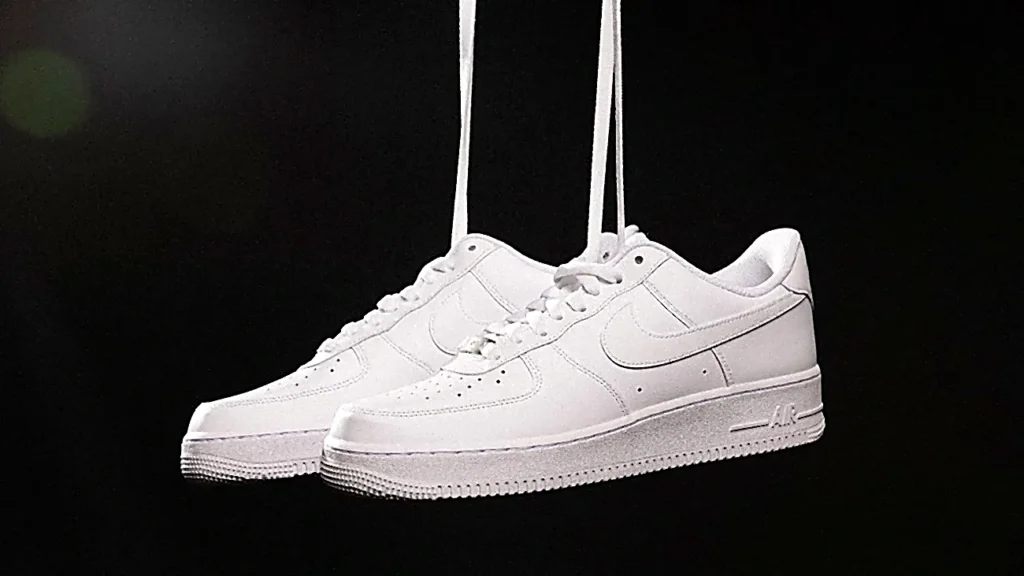
Conclusion: For Sneaker Culture Lovers
From the 70s to the present, Nike has built more than a company—it has built a universal language of objects, stories, and identities. For us, sneaker culture lovers, each pair of Nikes carries not just rubber, mesh, leather, or carbon plates, but layers of meaning accumulated over decades of innovation, rebellion, collaboration, and creative obsession.
The Air Force 1 of 1982, saved from the streets of Baltimore by communities that Nike had never targeted, became an infinite canvas for collaborations—from Supreme to Off-White, from graffiti artists to luxury fashion designers. The Air Jordan 1, banned by the NBA and transformed into a symbol of resistance, continues to be re-released in dozens of annual variations (each selling out instantly) and securing its place among the 20 most iconic Nike sneakers of all time. The Air Max 1, with its plastic window revealing technology, paved the way for transparency as an aesthetic. The Vaporfly, controversial and revolutionary, proved that sneakers could still change entire sports.
What Nike’s Journey Teaches Us:
- Authenticity is worth more than perfection: The Swoosh was born from an “I don’t love it, but I’ll grow to like it”—and became the most recognized symbol on the planet. Collaborations work when partners genuinely represent cultures, not when they’re rented for credibility.
- Culture beats specification: Nike didn’t win by selling technical sneakers; it won by selling stories, attitude, and belonging. The modern consumer buys meaning, not just cushioning—a phenomenon perfectly explained in the psychology behind the love for sneakers and why we collect them.
- Rebellion is fuel: From the “Banned” Jordan to Kaepernick, from Supreme to Off-White, the brand learned that challenging conventions—aesthetic, political, commercial—creates loyal communities that pay a premium for exclusivity.
- Innovation is iterative and collaborative: From the waffle iron to the carbon plate, from Flyknit to “super shoes,” each revolution is born from constant experimentation. But equally important, it’s born from listening to external voices—New York skaters, Japanese designers, Chicago artists.
- The sneaker is an infinite cultural canvas: Air Force 1 in the hoods, Air Max 95 on the streets of London, Jordans on the courts, Off-Whites in art galleries—each model became an expression of who we are, the tribe we choose, the story we want to tell.
Final Reflection for the Sneakerhead Community:
In a world where everyone can have a sneaker, where algorithms predict our desires before we even recognize them, where drops happen every minute and “scarcity” is manufactured on an industrial scale—what makes you choose a specific Nike?
Is it the story of Bill Bowerman destroying his wife’s waffle iron in search of perfect traction? Is it the image of Michael Jordan flying in the Banned, defying the NBA to stop him? Is it the first time you saw an Air Max 90 Infrared and thought “I need this”—not for running, but to be seen? Is it the moment you finally managed to buy an Off-White after dozens of failed attempts on the app?
Or is it something deeper: the feeling that, by wearing a Jordan 1 Travis Scott or a Supreme Dunk, you’re participating in a cultural conversation that spans decades and continents? That you’re connected to Hiroshi Fujiwara in Tokyo, to Virgil Abloh (rest in peace) in Chicago, to millions of strangers who also woke up early to try the same drop?
The truth is that Nike understood something essential about the contemporary human condition: sneakers don’t cover feet, they cover personalities, aspirations, tribal belonging. And that’s why, more than 50 years after the trunk of a Plymouth Valiant in Oregon, we continue to collect, venerate, discuss, resell, and wear Nikes—not because we need footwear, but because they tell us, and allow us to tell others, who we are. Or who we want to be.
Just Do It. But do it with history on your feet, culture in your body, and community in your heart.
Complete Nike Timeline: Innovations and Collaborations (1970-2026)
| Year | Event | Significance |
|---|---|---|
| 1971 | Creation of the name “Nike” and the Swoosh logo ($35) | Establishment of brand identity |
| 1971 | Invention of the waffle sole (destroyed waffle iron) | Technological revolution in traction |
| 1972 | Launch of the Nike Cortez (May 30) | First major commercial success |
| 1972 | Debut at the Munich Olympic Games | Initial international exposure |
| 1974 | Waffle sole patent (US 3.793.750) | Legal protection of innovation |
| 1974 | Launch of the Waffle Trainer | First “blockbuster” of the company (100k+ units) |
| 1977 | “There Is No Finish Line” campaign | Beginning of emotional marketing |
| 1978 | Launch of the Air Tailwind | Introduction of Air technology (invisible) |
| 1979 | Consolidation as a national brand | Basis for global expansion in the 80s |
| 1982 | Launch of the Air Force 1 | First basketball shoe with full-length Air |
| 1985 | Launch of the Air Jordan 1 + “Banned” | Birth of modern sneaker culture ($126M in sales) |
| 1987 | Launch of the Air Max 1 (Tinker Hatfield) | Visible Air for the first time—design revolution |
| 1988 | “Just Do It” campaign (Wieden+Kennedy) | Brand philosophy defined—1,000% growth in 10 years |
| 1990 | Launch of the Air Max 90 | Infrared becomes a cultural signature |
| 1991-1998 | Golden Era of Air Jordan (6 titles) | Sneakers become cultural currency and collectibles |
| 1995 | Launch of the Air Max 95 (Sergio Lozano) | Anatomical design—adoption by hip-hop and skate |
| 1997 | First Skate attempt (Choad, Snak) | Initial rejection and brand learning in underground culture |
| 2002 | Launch of Nike SB and adoption of the Dunk | Bodecker creates the SB line; the Dunk Low becomes the hype canvas of the decade. |
| 2002 | First Supreme x Nike SB collaboration | Start of the “drop” era, camping lines, and global hype culture (Orange Boxes). |
| 2002 | First Fragment Design x Nike collaboration | Japanese minimalism enters sneakers |
| 2005 | The “Pigeon” Dunk riot in New York | Mainstream media discovers resale culture and the chaos of hyper-limited editions. |
| 2006 | Nike+ (partnership with Apple) | Pioneer in wearable tech and tracking |
| 2009 | Launch of the Nike SB Zoom Stefan Janoski | Minimalist model transcends skate scene to dominate casual street style. |
| 2012 | Launch of Flyknit | Sustainable revolution—60% less waste |
| 2014 | Air Jordan 1 Fragment (Hiroshi Fujiwara) | Luxury minimalist collaboration achieves mythical status |
| 2017 | Launch of the Vaporfly 4% | Era of “super shoes”—ethical debate in running |
| 2017 | “The Ten”—Off-White x Nike (Virgil Abloh) | Deconstruction as luxury language; redefines collaborations |
| 2017 | First Travis Scott x Nike collaboration | Hip-hop as a global hype engine |
| 2018 | Colin Kaepernick campaign | Activism as strategy—+31% online sales |
| 2019 | INEOS 1:59—Kipchoge breaks 2 hours | Human limit redefined with Alphafly |
| 2019 | Air Jordan 1 Travis Scott “Mocha” | Reverse Swoosh becomes iconic design |
| 2020 | StrangeLove Dunk / Chunky Dunky | The Dunk SB Renaissance dominates the pandemic and the resale market. |
| 2021 | Death of Virgil Abloh; Olympic Skate | Cultural memory artifacts gain weight / Nike SB establishes itself as a technical power in Tokyo. |
| 2022 | Air Max Scorpion | Visible Air at its absolute extreme |
| 2024-2026 | Digital-First Era, SNKRS, AI, Well Collective | Mass personalization, holistic wellness, and sustainability. |
