The Air Jordan 2 explored a different kind of signature identity: quieter branding, expressive surfaces and a silhouette with its own character.
A sequel that changed the brief
The Air Jordan II debuted in 1986; its original run continued into 1987. Nike credits Peter Moore and Bruce Kilgore. Italian-made originals combined a Swoosh-free side with encapsulated Air.
The central question was how a basketball shoe could feel unmistakably like Michael Jordan’s without repeating the first model. The sequel answered through proportion and surface. It invites a closer look rather than relying on the instant recognition of a large lateral symbol.
What the Italian construction meant
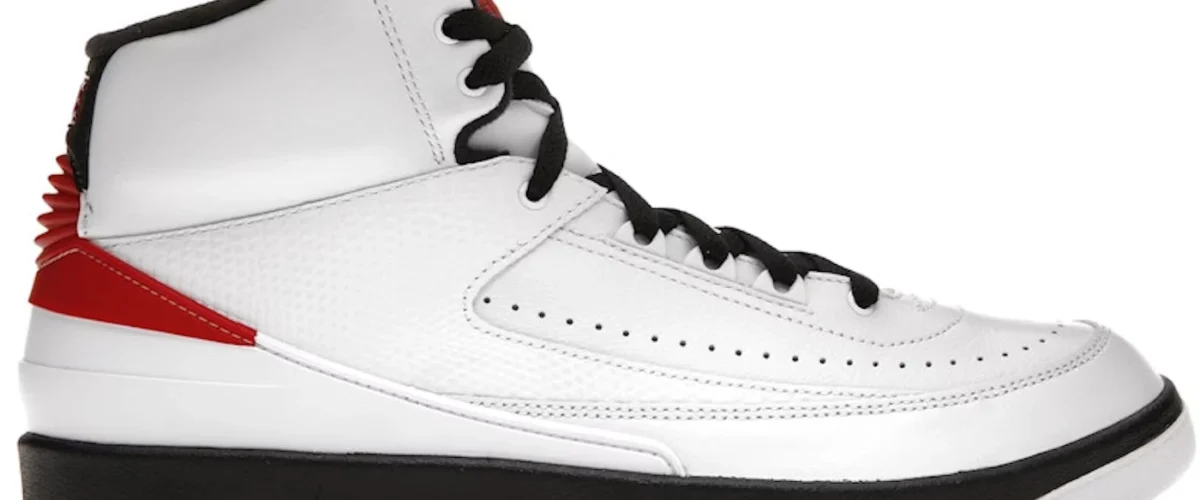
The shoe’s visual character comes from the relationship between smooth and patterned areas. Curves connect its panels, while the lower structure gives the outline a firm base. Read as a composition, it feels considered rather than crowded: a few contrasting surfaces do much of the expressive work.
Read together, those choices reveal the model’s central tension. It was athletic equipment with the visual ambition of a premium leather object. Removing the familiar side logo made the outline, panel arrangement and texture carry more of the identity. That is why an AJ2 can look comparatively quiet in photographs while still representing a major departure in the series.
Boardroom’s oral history describes separate work on rubber, polyurethane and tooling, while Giorgio Franco’s recollections add a manufacturer’s perspective. Looking at those processes helps explain why the finished object depends on more than a sketch. The smooth transitions between its parts are also the result of solving practical production problems.
The two original colorways
The initial lineup used two closely related white-based schemes, commonly cataloged as White/Black and White/Red. Both combined white with Bulls-associated black and red, but distributed those accents differently. Each existed in high and low forms. Counting those cuts produces four original variants; it does not produce four distinct colorways.
White/Black gives the lower structure and trim a darker visual emphasis. White/Red shifts the balance toward the lighter, red-accented arrangement. Modern sellers may use “Chicago” loosely, so a nickname alone is not a reliable way to establish exactly which original blocking a retro references. Compare the midsole, piping, heel and outsole rather than relying only on the color list.
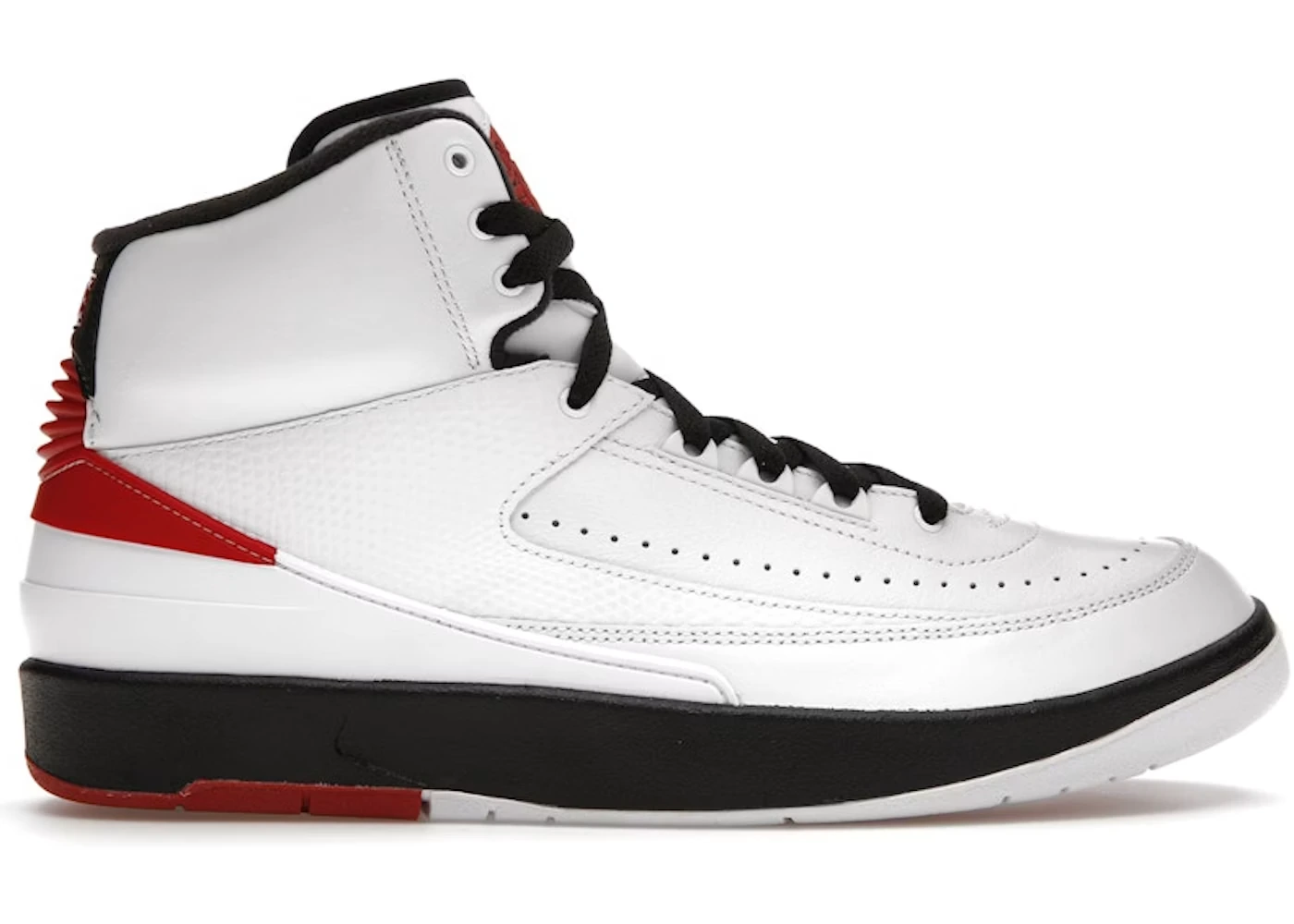
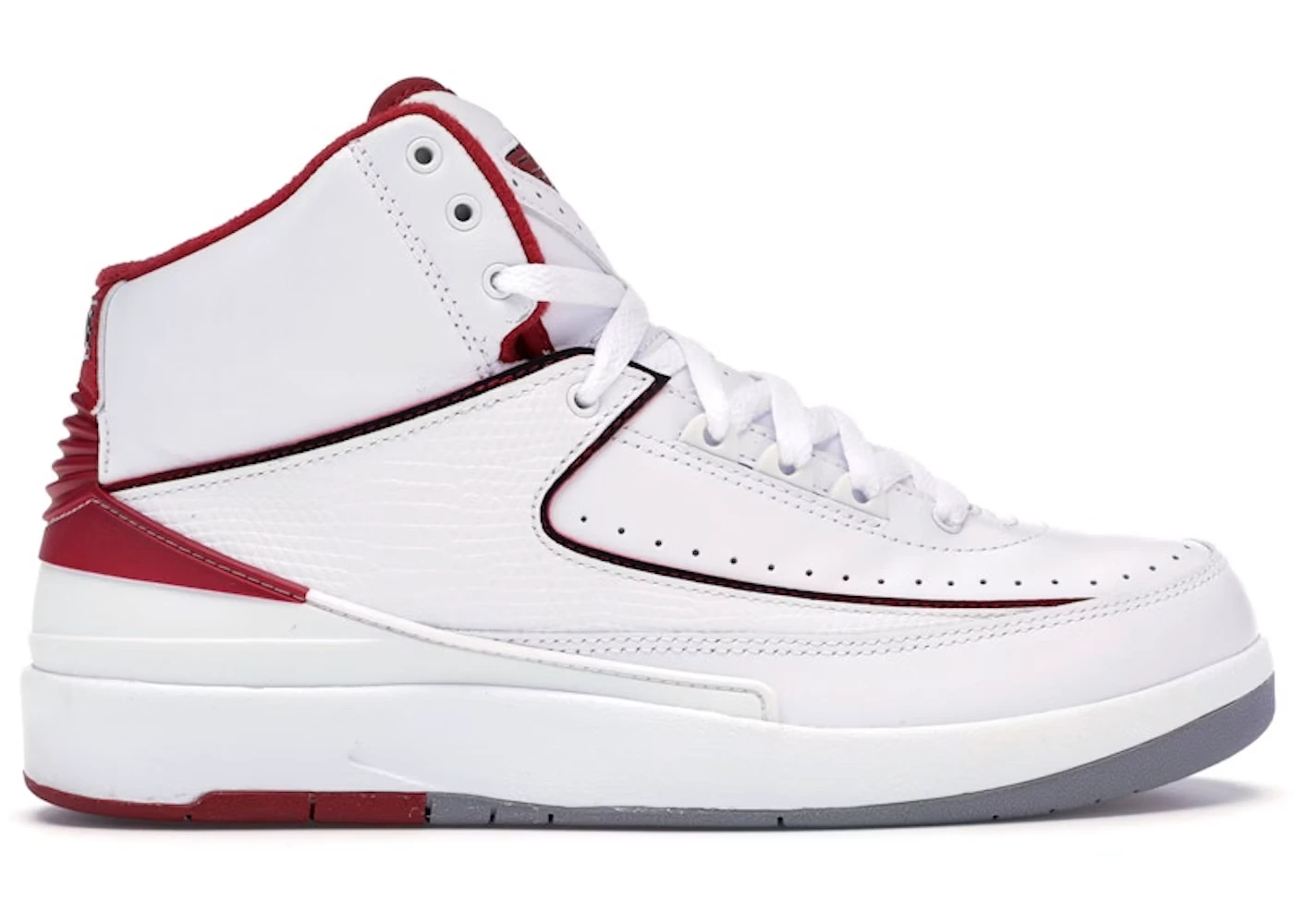
The Low offers another way to experience those original palettes, changing the silhouette through its lower cut. Blue, all-black and collaborative editions would expand the color range in later chapters of the model’s history.
Jordan’s rise before the championship years
The AJ2 belongs to Jordan’s explosive scoring-era image, before Chicago’s first championship. His 1987 Slam Dunk Contest victory gives the model a clear sporting landmark. It is useful to keep that event separate from the better-known 1988 contest associated with the AJ3: adjacent years do not mean interchangeable shoes.
That distinction changes how the model reads. The II is not a championship souvenir. It captures an athlete becoming a larger public figure while his signature line was still deciding what its own design language could be. Its significance lies partly in that uncertainty. A sequel that experiments is historically interesting even when later generations make another model more recognizable.
How to read its retro legacy
The AJ2 returned during the early retro era and later gained new audiences through reissues and collaborations. A retro can reproduce an original palette, alter the materials, change proportions or reinterpret the entire idea. Those are different relationships to the archive, even when all carry the same model number.
For a historically meaningful comparison, start with three questions: is the pair high or low, does its blocking trace to one of the two original schemes, and which details have been reworked? Material choices and an artificially aged finish can change how a contemporary collaboration reads. The exact edition matters as much as the family name.
The lasting argument for the model is visible in that original proposal: Jordan identity could come from shape and texture as well as overt branding. Later attention does not create that importance. It merely offers another opportunity to notice a decision made at the beginning of the line.
The Low: original colors and its first year
The AJ2 Low is documented in 1987 in White/Black and White/Red. Specific Low records support that date; some broader indexes group the whole generation under 1986. Both palettes belong to the initial Low range, without a securely established single first color. (Flight Archives: original AJ2 cuts; SneakerFiles: original AJ2 Low White/Red)
The lower collar changes the proportions while preserving the two color families. It is part of the model’s early story, rather than a cut introduced only when retros became popular.
Frequently asked questions
How do the original high and low versions relate?
They share the original color families, with collar height changing the silhouette. Compare the cut and the distribution of accents separately.
Does “Chicago” identify an exact Air Jordan 2 edition?
Not by itself. The nickname can describe different releases; the midsole, piping, heel and outsole provide a more precise comparison.
What is the difference between an OG colorway and an original pair?
An OG colorway traces to the initial palette. An original pair is an object from that first production period; a later retro can repeat the color without having the same age.
Sources
Historical sources consulted October 15, 2026.