Explore the Air Jordan 1 Low from documented original palettes to modern Low OG, standard editions and the skate and collaboration chapters.
A low top from the beginning
The Air Jordan 1 Low was available in 1985. This history does not assign a separate designer to the Low adaptation. Its story begins decades before the collaborations that brought many newer collectors to the silhouette. Lowering the collar changes the balance of the familiar design: the eye follows the Swoosh and the horizontal sweep of the panels rather than climbing toward the ankle.
That difference is more substantial than a shorter version of a famous shoe might suggest. A high top frames the lower leg; a low top leaves a gap between footwear and clothing. The same family language can therefore communicate a different attitude. The Low belongs inside the original Jordan story while also providing room for a separate everyday identity.
Two documented original-era palettes
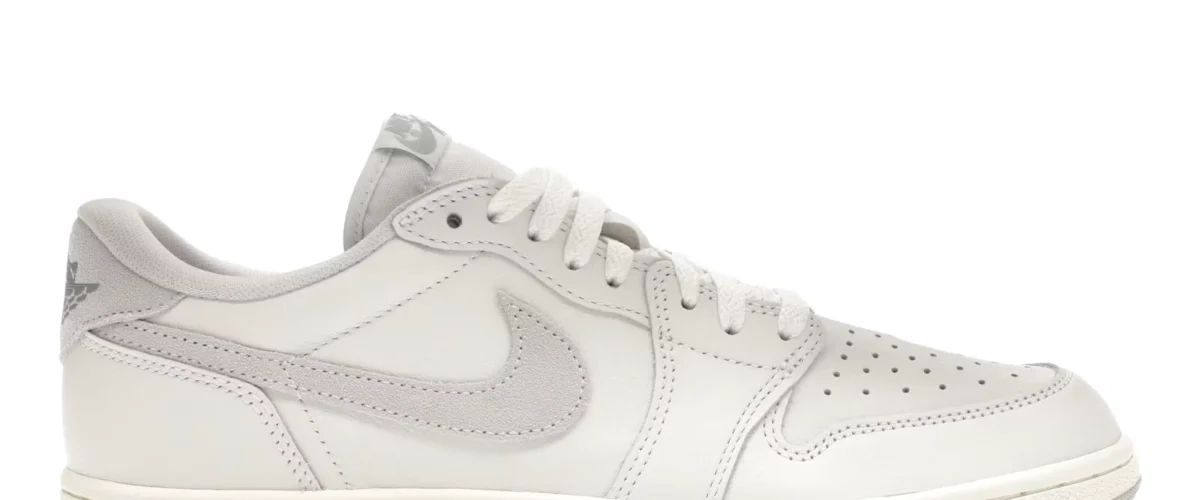
Two documented original-era Low palettes are White/Metallic Blue and White/Neutral Grey, also cataloged as Natural Gray. Original-palette counts differ between archives; these two are documented here without asserting an exhaustive worldwide total or which came first. The familiar black-and-red Bred Low OG belongs to a later release chapter, even though that palette has original high-top roots.
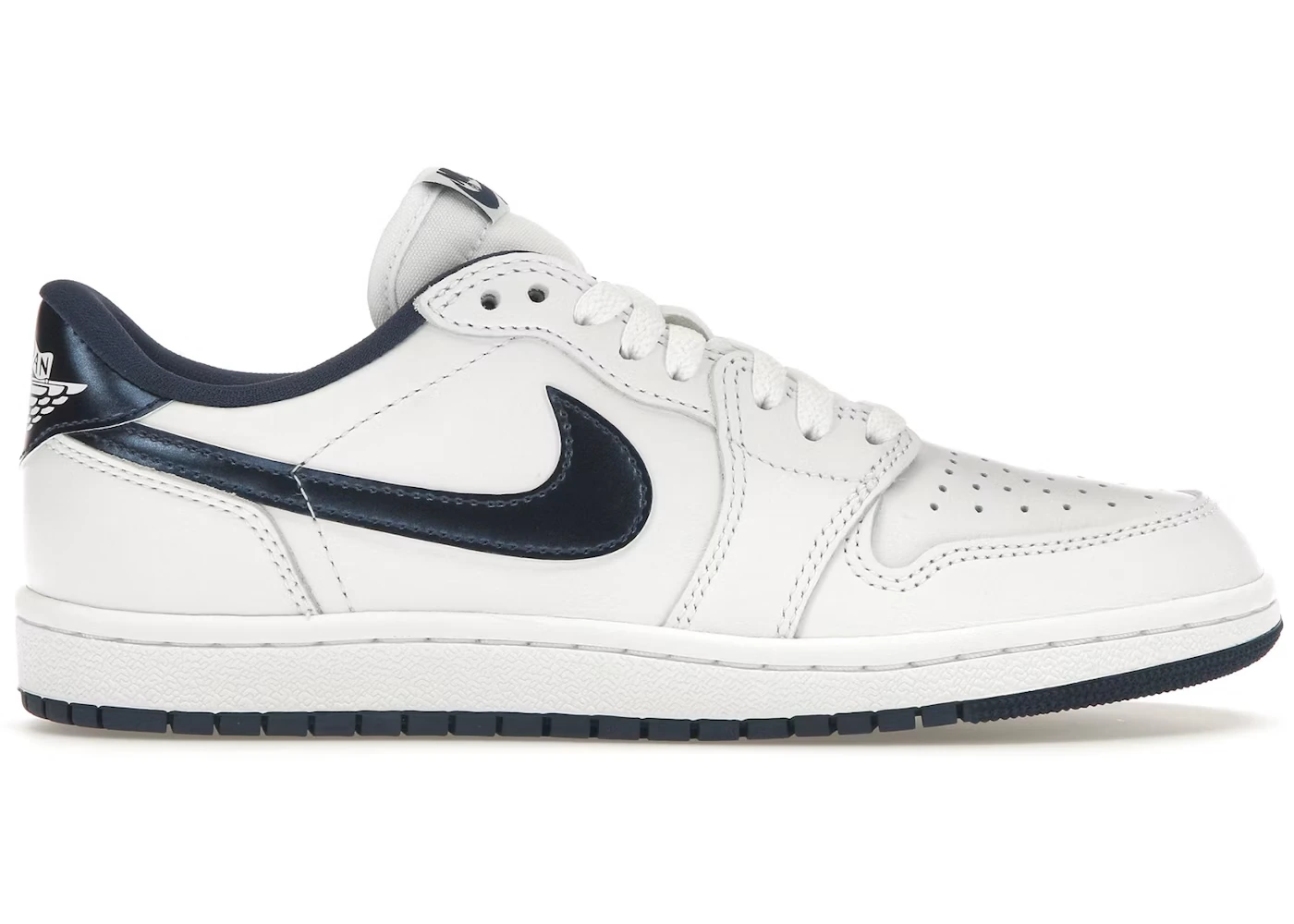
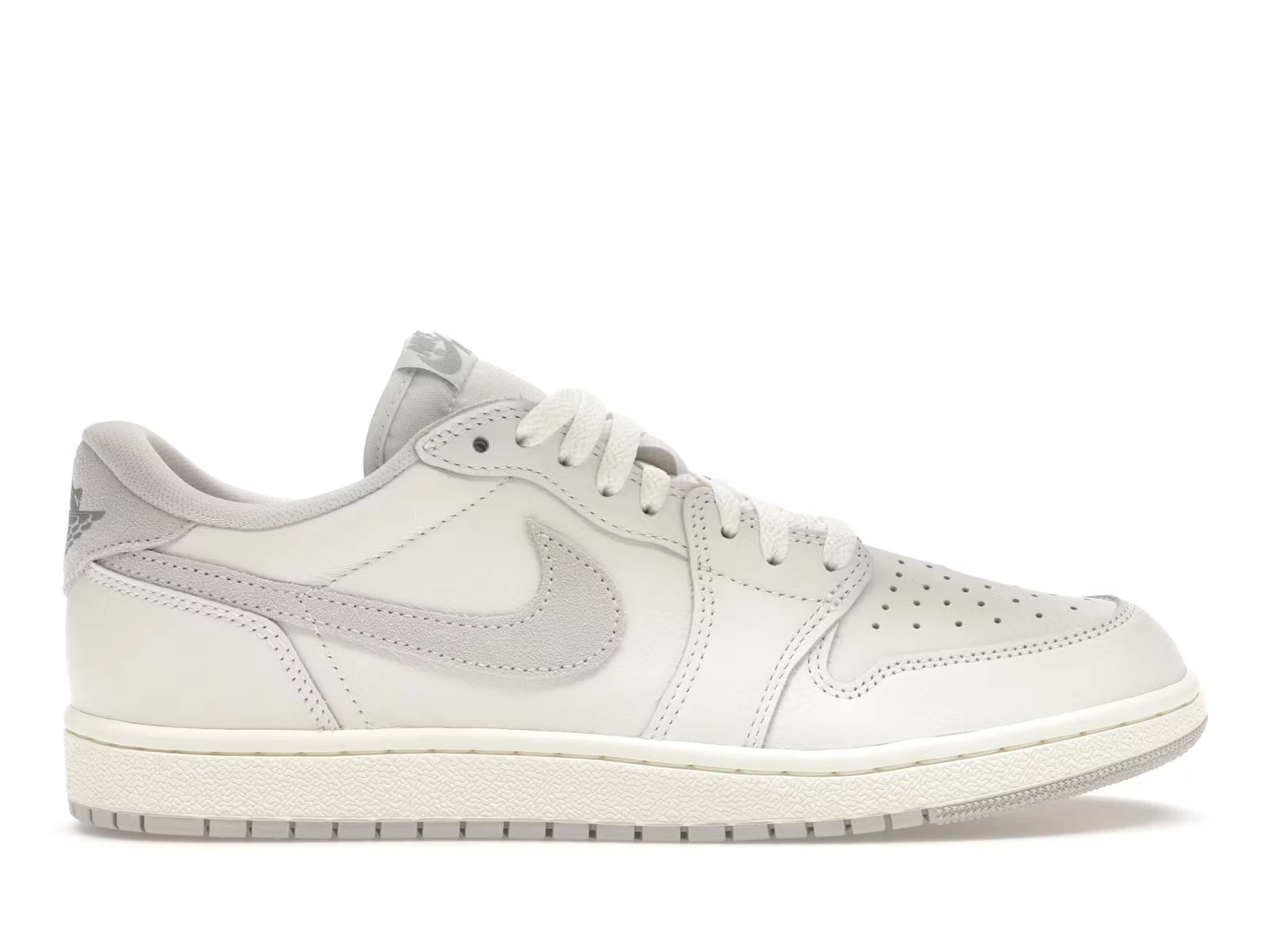
Metallic Blue concentrates attention on the contrast between a light body and darker, reflective accents. Neutral Grey is quieter: its appeal comes from small differences in tone instead of a dramatic color break. Seen side by side, they show that the Low did not need a Bulls-colored outfit to communicate its identity. Their restrained appearance also makes the shape easier to read.
This matters when comparing a modern pair with an old photograph. A historically familiar color does not automatically establish an original low-top configuration. Color, cut and release date are separate parts of the description. A new Low can borrow an old high-top palette without becoming an exact reproduction of a 1985 Low.
The modern Low OG chapter
The 2015 Low OG releases included Bred and Neutral Grey. Nike’s later Neutral Grey launch description explains the heritage-oriented heel-tab branding and Nike Air tongue treatment, contrasting them with more recent Jumpman adaptations. Low OG is consequently a useful product-family label, not a promise that every color existed in 1985.
The distinction also prevents an easy mistake: treating OG as a date printed invisibly on the shoe. A retro is a later object with an archival relationship. Its proportions, materials and finish still belong to a particular release. Two pairs with the same nickname can be interesting for different reasons, one for its color ancestry and another for how it interprets the original shape.
Standard Low, OG and ’85 are not interchangeable
The standard Air Jordan 1 Low commonly carries a Jumpman on the tongue and Wings at the heel. The Low ’85 received its own archival reconstruction in 2023. These branches should be identified by their full product names and style codes rather than collapsed into one supposedly identical shoe.
For a visual comparison, start with the collar opening, tongue height, heel panels and the relationship of the Swoosh to the surrounding leather. Then examine materials. A soft surface, a shiny overlay or a different edge treatment can alter the impression as much as a color change. Branding helps identify a version, but a single logo is not a universal quality grade or an authentication test.
This is also why the family can support several audiences without one invalidating the others. Someone looking for a straightforward daily sneaker may prioritize color and comfort; an archive-focused collector may care more about proportions. Those are different ways of appreciating the same design lineage.
Skateboarding and the collaboration years
Nike SB’s archive records Eric Koston’s navy-and-silver AJ1 Low in June 2019, inspired by an original white-and-blue pair. Travis Scott’s first AJ1 Low followed in July 2019. These are later creative chapters, not original colorways or evidence that the Low began with a celebrity partnership.
The Koston connection is useful because it shifts the discussion from basketball imagery to how another community reads an existing object. A collaboration can make a familiar silhouette feel personal by changing a small detail or attaching a memory to it. Its contribution need not be a completely new shape.
Scott’s interpretation offers a different lens: the low-cut form becomes a platform for an immediately recognizable visual signature. Yet neither partnership explains the entire family. Original palettes, general releases and heritage-oriented retros continue to matter when considering what makes an AJ1 Low recognizable.
Why the Low deserves its own history
The most revealing way to read the Air Jordan 1 Low is across these branches. Its continuity lies in the relationship between a low collar, layered panels and a strong side graphic; its variety lies in the many ways those elements are emphasized. A history focused on one sought-after color would miss that larger design argument.
The Low demonstrates how a signature shoe can retain its identity after the original sporting context becomes only part of its meaning. Its place in the Jordan archive is not borrowed from the current popularity of a collaboration. It begins in the first generation and grows through reinterpretation.
Frequently asked questions
Is every Air Jordan 1 Low OG an original colorway?
No. OG identifies a heritage-oriented version; the color’s history must be checked separately.
Which original Low colors are documented here?
White/Metallic Blue and White/Neutral Grey are documented. Archive counts differ, so this is not presented as an exhaustive global total.
Is a standard Jumpman Low the same as a Low ’85?
No. They are distinct product branches with different design priorities; compare the full name and style code.